Time travel
29th century BC
Southern Mesopotamia fragments into a landscape of walled, independently ruled city-states as the Early Dynastic period begins, while Egypt's obscure Second Dynasty struggles to hold the unified kingdom together.
Mental Worlds: Evidence and Inference
A person living in southern Mesopotamia this century inhabits a political world that has quietly changed shape since the previous era of Uruk's outward reach. Rather than one dominant city projecting influence along distant trade routes, the landscape is now a patchwork of walled, independently governed cities, Ur, Uruk, Kish, Lagash, Umma, each with its own ruling institution, its own temple archive, its own fortifications facing its neighbors. A scribe trained in one city could likely read the accounts of another, since the underlying sign system and numerical conventions remain broadly shared, but political loyalty and the boundaries of a person's practical world had narrowed to the walls of a single city and its immediate hinterland. This is not political chaos so much as a stable, if fragmented, order that Mesopotamian civilization will live inside, with variations, for centuries to come.
In Egypt, by contrast, this century's record is honestly harder to read than the ones on either side of it. The Second Dynasty leaves behind fewer royal monuments and shorter, less legible year-labels than the dynasty that unified the kingdom or the one that will follow with the Step Pyramid, and later Egyptian tradition itself preserves hints of internal conflict, a rival claim to the throne, unresolved by any contemporary Egyptian text from this century that has survived. What a thinking Egyptian official of this era actually knew about the state of the kingdom, whether it felt stable or precarious from the inside, is simply not recoverable; the historian's honest answer is that this dynasty is one of the thinnest stretches in the entire Egyptian record, and that thinness is itself worth stating plainly rather than papered over with invented detail.
Further east, the proto-Elamite writing tradition centered on Susa, whose tablets reached across sites on the Iranian plateau in the previous two centuries, has by now gone silent; the script that once administered a substantial share of the plateau's trade and temple economy stops appearing in the archaeological record around this time, leaving behind an administration that, having written, has since stopped. This body of written material remains substantially opaque to modern scholarship regardless; a literate Elamite scribe of the previous century could produce documents that, four thousand years later, still resist confident translation. It is a useful corrective to any assumption that writing automatically preserves a civilization's voice for later ages: proto-Elamite proves that a script can be extensive and administratively serious across a whole region, and can still both fail to transmit its meaning across the gap of deep time and simply stop, for reasons no later reader has recovered.
Outside these three literate or semi-literate zones, life proceeds as it always has, by memory, craft, and oral transmission, across the Indus valley's farming villages, the Iranian plateau's herding communities, and the rest of the ancient world. What distinguishes this century is not a leap in what any single person could know, but a shift in scale: writing now serves not one dominant city or one unified kingdom but several competing polities at once, each maintaining its own version of the same underlying technology, proof that the invention of writing, once made, could be adopted, adapted, and put to rival political purposes almost as easily as it could be centralized.
The political map
Major Polities and Cultural Regions
- Early Dynastic Mesopotamian city-states Ur, Uruk, Kish, Lagash, Umma, and other independently ruled walled cities of southern Mesopotamia.
- Egypt (Second Dynasty) United Nile kingdom under a dynasty whose record is thinner and more contested than those before or after it.
- Susa (post-proto-Elamite Iran) Lowland Iranian center where the proto-Elamite script tradition, at its height a century or two earlier, has already gone silent.
- Indus valley farming communities Pre-urban cultures of the Indus system, still without cities or writing.
Borders are approximate scholarly reconstructions from historical-basemaps (GPL-3). Nearest available basemap anchor year: 3000 BC.
State of the domains
Texts and Written Culture
Writing continues to serve accounting and royal labeling in both regions, without yet producing a connected narrative or a named individual author. In Mesopotamia, the proto-cuneiform tradition, now roughly four centuries old, is used across multiple independent city-states, Ur, Kish, Uruk, Lagash, and others, each maintaining its own temple and palace archives of the same basic type. Egypt's Second Dynasty is comparatively poorly documented; royal names and short year-labels survive, but the historical record for this dynasty is thinner and more contested than for the century before or after it, an honest gap rather than a suppressed story.
Art
Early Dynastic Mesopotamian cities each maintain their own temple building traditions, votive statuary showing worshippers with large inlaid eyes meant to gaze eternally at a god, and cylinder seals whose banquet and procession scenes grow increasingly standardized across the region. In Egypt, Second Dynasty royal monuments are less numerous and less well preserved than those bracketing this dynasty, though stone vessel production continues at a high level of technical skill. What survives from both regions remains predominantly votive and administrative rather than narrative in purpose, images and objects meant to serve ritual or accounting functions rather than tell a story.
Medicine
The written record stays silent on medicine this century in both Egypt and Mesopotamia. Burial evidence continues to show the physical costs of hard labor, healed fractures, and the wear of repetitive work, evidence that injuries were treated with real, if entirely unrecorded, skill; claims of routine surgical intervention such as trepanation are better supported for the broader Neolithic Near East and Europe than for this specific dynastic-era evidence. The absence of any written medical tradition in either region is not a gap in an otherwise full record; it reflects an honest fact about the century, that healing knowledge, however sophisticated in practice, had not yet become the kind of thing anyone thought worth writing down.
Science
Early Dynastic Mesopotamian city-states each maintain independent but broadly compatible systems of weights, measures, and sexagesimal counting, allowing trade and tribute to be reckoned across political boundaries even without political unity. Lexical lists compiled at temple scribal schools continue to be copied as training texts, an ongoing exercise in classification rather than explanation. In Egypt, the poorly documented Second Dynasty offers little direct evidence of scientific or calendrical development, though the annalistic habit of dating events to regnal years, already established, presumably continues in some form even where the specific records have not survived.
Military
Early Dynastic Mesopotamia is a landscape of walled, independently governed city-states, Ur, Uruk, Kish, Lagash, Umma, and others, whose fortifications and periodic conflicts over land and water rights will define the region's politics for the next several centuries. No surviving text from this specific century narrates a named battle, though the general pattern of city-state rivalry is well attested archaeologically through fortification walls and weapon finds. Egypt's Second Dynasty includes at least one period of internal conflict, reflected in later, indirect tradition about rival claimants to the throne, though contemporary detail from this century itself is sparse.
Technology
Bronze technology, alloying copper with tin rather than the less reliable arsenic used previously, begins to appear across Mesopotamia and the wider Near East around this time, though still rare; most tools and weapons remain copper or arsenical copper for now. Mesopotamian city-states continue to depend on canal-fed irrigation agriculture along the Tigris and Euphrates, engineering that sustains urban populations well beyond what rain-fed farming could support. In Egypt, stoneworking and copper tool production remain advanced, and Nile boat transport continues as the backbone of the kingdom's internal trade and administration, connecting Upper and Lower Egypt despite the political strain visible in this dynasty's fragmentary record.
Material world
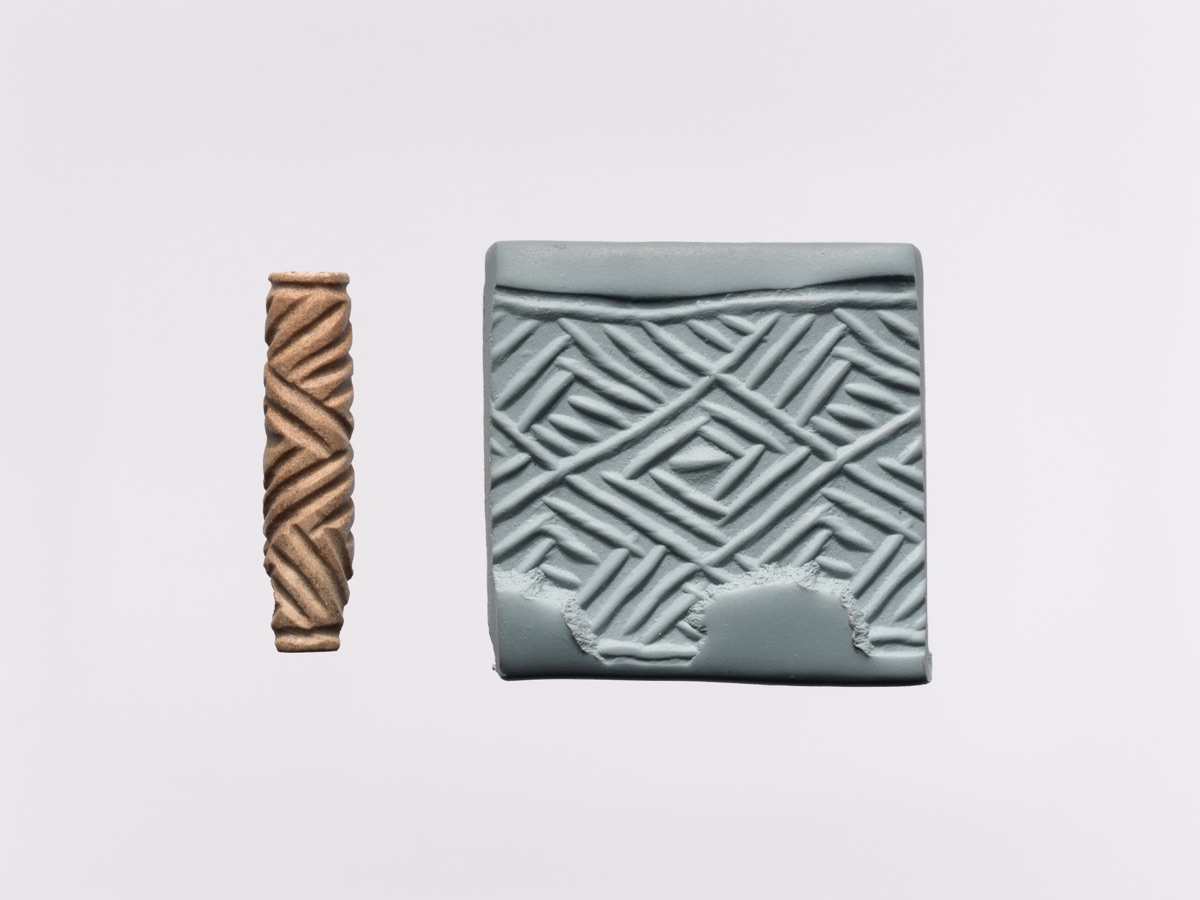
Cylinder Seal with Geometric Design
An Early Dynastic I cylinder seal cut with an abstract geometric pattern, part of the shift away from Jemdet Nasr-style figural seal designs.
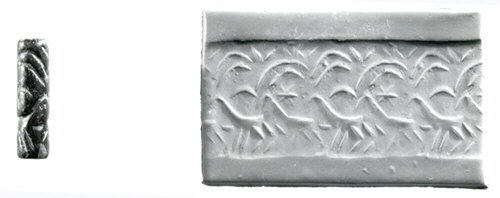
Cylinder Seal with Striding Goats
A seal carved with two striding goats, a favorite animal motif of Early Dynastic Sumerian glyptic art.
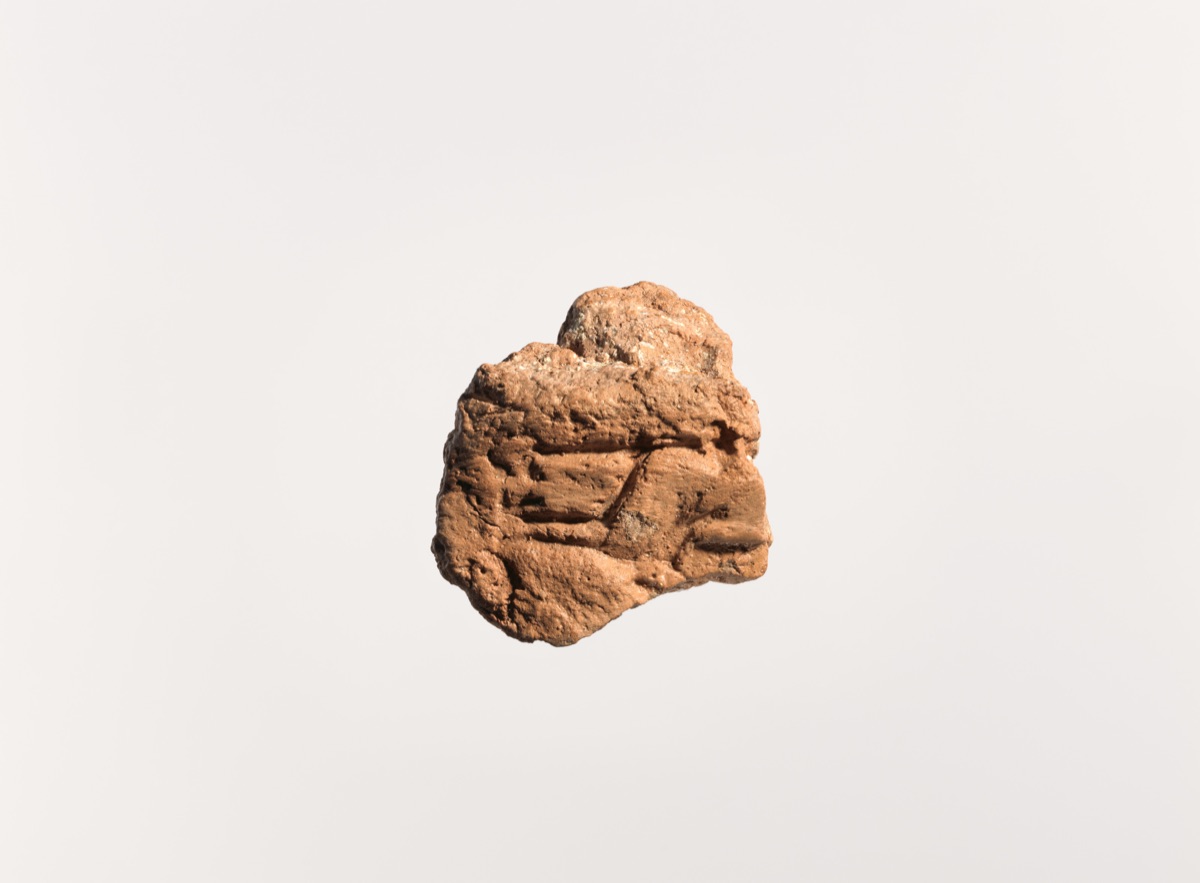
Sealings with Cylinder Seal Impressions
Lumps of clay stamped with cylinder seal impressions, used to secure jars and doors, the administrative bookkeeping that ran alongside early writing.
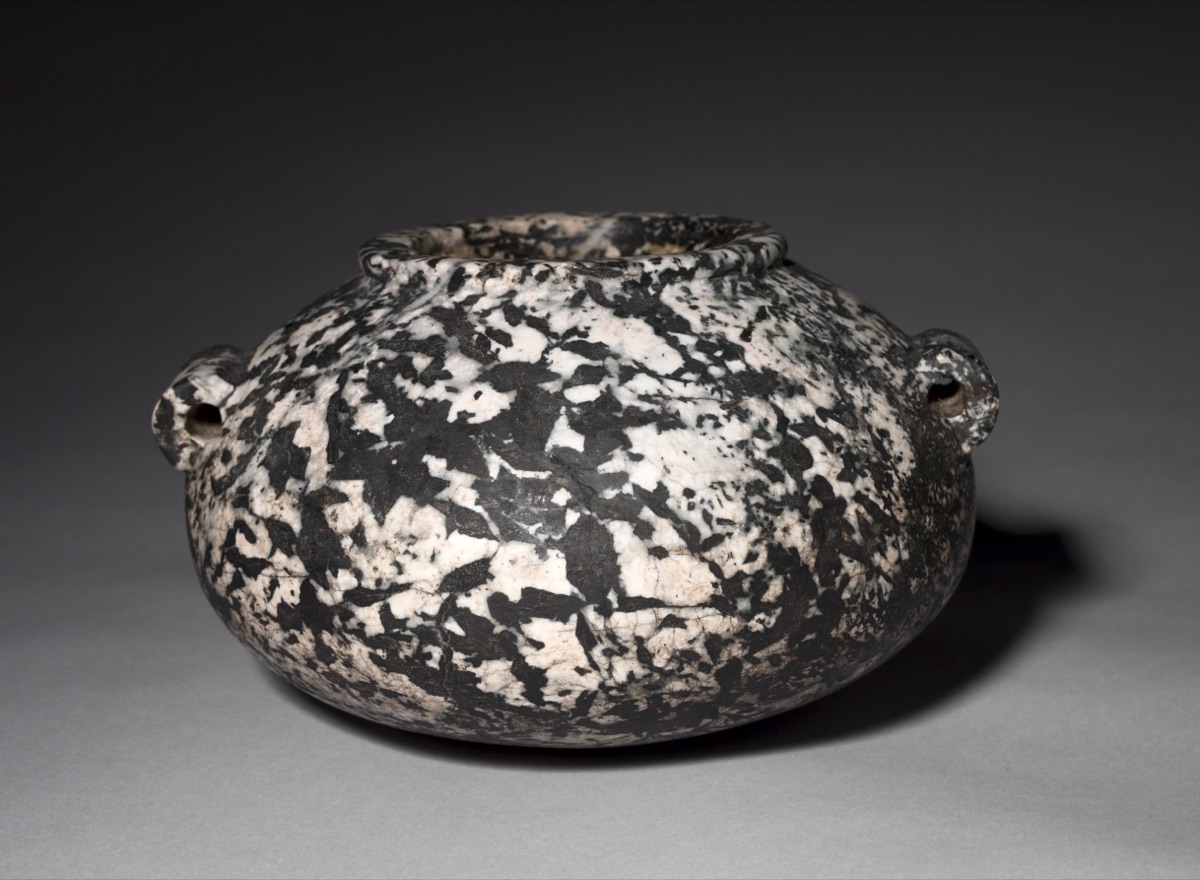
Early Dynastic Squat Jar with Lug Handles
A pegmatitic hornblende diorite jar carved to replicate the shape of an everyday pottery vessel, tomb equipment skilled enough to outlast the clay original it copies.
New this century
No corpus entries yet from this century.
The canon by now
No tier-one work in the corpus predates this century.