Time travel
5th century BC
In one crowded century, Athens, the Ganges plain, and the state of Lu each produce ideas the next two thousand years keep arguing with.
Mental Worlds: Evidence and Inference
By this century's end, a person following Ionian philosophy alone could trace an arc: Thales's water giving way to Heraclitus's argument that only change is constant, contradicted by Parmenides's insistence that change is illusion, refined by Empedocles's four elements moved by love and strife, and arriving, by the century's final decades, at Democritus's claim that everything is made of indivisible atoms moving through empty void. None of these thinkers agree with each other, and none has any experimental method beyond argument and observation, but the sequence itself, each thinker explicitly answering the one before, constitutes something new: a tradition of reasoned dispute that treats disagreement as productive rather than a failure to defer to authority.
The same century's political core is the Persian empire, still the largest state the world has yet organized, and still the power whose administrative reach genuinely connects distant parts of this story, even after failing to conquer mainland Greece. Ephesus, where Heraclitus wrote near the century's start, is Persian territory only until the Ionian revolt and the wars that follow push Persia back out of the Aegean by 479 BC; the argument these thinkers are having then continues west, in Parmenides's Elea and Empedocles's Acragas among the Greek cities of Italy and Sicily, and north in Democritus's Abdera on the Thracian coast, all beyond Persian reach for the rest of the century. The empire's eastern edge, meanwhile, reaches Gandhara on the Indus, close enough to the Gangetic world that Persian administrative practice and Indian polities share the same very large imperial frame, even though Magadha itself, further east, lies outside direct Persian control and develops as an independent, aggressively expanding kingdom under Bimbisara and Ajatashatru.
It is in that Magadhan world that the Buddha teaches for decades, organizing a community of monks and lay followers around teachings on suffering, craving, and release that exist, in this century, almost entirely as oral instruction; he dies, by the traditional long chronology, around 483 BC at Kushinagar, in neighboring Malla territory rather than Magadha itself. Mahavira, the Jain teacher, is likewise understood by tradition to have taught in this general region and period, organizing his own community of ascetics around a demanding ethic of non-violence. Neither man's teaching exists yet as anything resembling a finished text, and neither community yet resembles the organized religious institution later centuries will recognize. Nothing suggests either had any awareness of the Presocratic argument happening in Ionia at the same moment, separated as they are by the entire breadth of the Persian empire and beyond; the near-simultaneity is real, but it is not contact.
Confucius dies in 479 BC in Lu, having spent his final years, after decades of failed political appointment, teaching a circle of disciples an ethic of ritual propriety, filial obligation, and cultivated virtue in service of good government. His sayings, remembered by his students and then by their own students, begin the long compilation that becomes the Analects; its earliest surviving layer falls within a generation of his death, but what exists then is a nucleus still accumulating material for two or three more centuries, not a finished book. Mahavira's Jain community undergoes something similar: the earliest layer of the Acaranga Sutra, recording his teaching, is also dated to around this time, itself only the start of a redaction no council will formalize for another century and a half.
In Athens, meanwhile, a different kind of intellectual explosion takes visible, written form almost immediately: Sophocles and Euripides stage tragedies questioning divine justice, Herodotus writes history ranging across three continents to explain a war, and Thucydides, chronicling the war that follows and eventually destroys Athenian power, strips his own account of divine explanation in favor of ambition, fear, and interest. The Hippocratic physicians, working in these same decades, insist that disease follows bodily and environmental cause rather than a god's anger. What distinguishes Athens within this crowded century is not that its thinkers reason more originally than Heraclitus, the Buddha, or Confucius; it is that Athenian literacy and civic life preserve their arguments in writing almost immediately, while Magadha's and Lu's most consequential thought survives this century only in living memory, waiting generations to become text.
The political map
Major Polities and Cultural Regions
- Achaemenid Persia From the Indus to Thrace and Egypt, the largest empire yet assembled, though pushed out of mainland Greece after 479 BC
- Athens Leads the Delian League into an empire funded by allied tribute, until defeat in the Peloponnesian War by 404 BC
- Sparta Dominant Greek land power, defeats Athens by 404 BC to become the era's leading Greek state
- Magadha Rising Gangetic kingdom under Bimbisara and Ajatashatru, the setting for the Buddha's teaching and death
- Warring Zhou states Late Spring and Autumn order giving way, by the century's end, to the openly competitive Warring States period
- Kingdom of Kush Continues at Napata, increasingly oriented toward Meroe further south
Borders are approximate scholarly reconstructions from historical-basemaps (GPL-3).
State of the domains
Texts and Written Culture
Athenian tragedy matures across the century: Aeschylus dramatizes the Persian Wars he fought in, Sophocles and Euripides stage figures questioning the gods' justice, and Aristophanes satirizes Athenian politics during the war with Sparta. Herodotus writes the first extended prose history of the Persian Wars; Thucydides excludes divine causation for human motive in the war that follows. In China, Lu keeps a terse court chronicle, the Spring and Autumn Annals, closed soon after 481 BC, while Mozi's followers record his ethics. The Buddha teaches for decades in Magadha and dies around 483 BC at Kushinagar, in Malla; Confucius dies in 479 BC in Lu. The Analects and the Acaranga Sutra, recording Mahavira's teaching, both have their earliest surviving layer this century.
Art
Athenian sculpture and architecture reach the high classical style of the Parthenon, built after the Persian sack of the Acropolis, its marbles combining idealized anatomy with unprecedented naturalism of movement and drapery. Severe-style bronze casting, exemplified by the Riace bronzes, replaces the stiffer archaic kouros form with figures caught in convincing, weighted motion. Persian royal art under Xerxes continues the Achaemenid program at Persepolis, reliefs of tribute-bearing peoples projecting an empire's diversity as ordered harmony. Chinese bronze work continues its ritual tradition through the late Spring and Autumn period, while Indian architecture remains largely perishable, leaving little for archaeology to recover. Around this time, Zapotec leaders abandon San Jose Mogote to found Monte Alban atop a defensible mountain ridge in the Oaxaca Valley, a hilltop capital that will go on to carve hundreds of captive monuments recording conquest, entirely unconnected to the classical world's own contemporaneous transformations.
Medicine
The Hippocratic school, active on Cos and Cnidus across the century's second half, produces a body of medical writing that explains disease through bodily imbalance and environmental factors rather than divine punishment, insisting doctors observe and record symptoms methodically. Texts like Airs, Waters, Places connect illness to climate and geography in a genuinely naturalistic framework, and the Epidemics case histories track individual patients day by day, though the theory of humors this school develops will prove wrong in its specifics. No comparable systematic medical literature is attested elsewhere this century, though Indian and Chinese healing traditions, less textually documented at this point, almost certainly continue developing along their own separate lines.
Science
Presocratic cosmology reaches its most varied and ambitious phase: Heraclitus argues that everything is in flux, unified only by an underlying rational order he calls logos; Parmenides argues, by contrast, that change itself is an illusion generated by faulty reasoning about being and non-being; Empedocles proposes four root elements combined and separated by love and strife; and by the century's end, Democritus proposes that all matter consists of indivisible atoms moving through void, a strikingly modern-sounding claim reached through pure reasoning rather than observation. Babylonian astronomers, now under Persian patronage, continue the observational tradition later mathematical astronomy will build on. Sophists like Protagoras and Gorgias treat argument and persuasion themselves as objects of systematic study.
Military
Athens, with Plataea alone beside it, turns back the first Persian invasion at Marathon in 490 BC; a decade later a Greek alliance under Spartan leadership defeats Xerxes's larger expedition at Salamis and Plataea, ending the Persian threat to mainland Greece, though Persia keeps Egypt and its core. From 478 BC the freed Ionian cities join the Athenian-led Delian League, hardening into an empire funded by allied tribute, provoking Sparta into the Peloponnesian War from 431 to 404 BC, which defeats Athens; Ionia returns to Persian control only next century. In China, a treatise attributed to Sun Tzu, the Art of War, distills deception and terrain into principle. In India, Magadha expands against its neighbors under Bimbisara and Ajatashatru.
Technology
Athenian naval technology, particularly the trireme, becomes the decisive instrument of the Persian Wars and the subsequent Athenian empire, requiring a rowing citizenry whose military value reshapes Athenian politics toward broader participation. Persian administrative technology, royal roads, standardized weights and coinage, and an imperial postal relay system, continues linking a territory stretching from the Aegean to the Indus. In the State of Qi, the Kaogongji sets down technical specifications for chariots, bells, and other crafted goods, the era's most systematic surviving craft manual. Iron tools and weapons are now universal and unremarkable across the whole Mediterranean and Near Eastern world this empire spans.
Material world
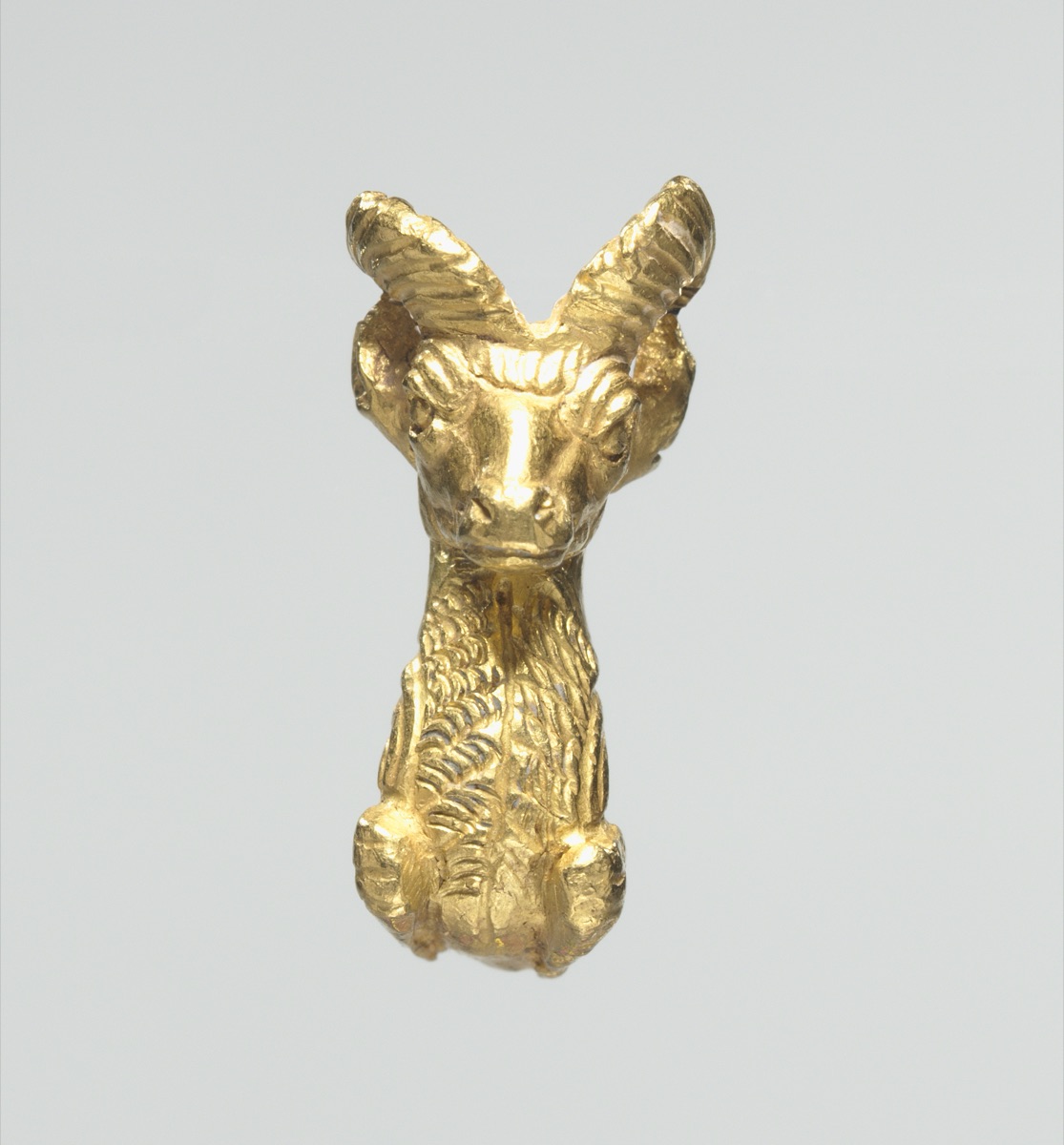
Ibex Bracelet Terminal
A gold bracelet terminal cast as an ibex head, court jewelry from the Achaemenid empire at its territorial height under Darius and Xerxes.
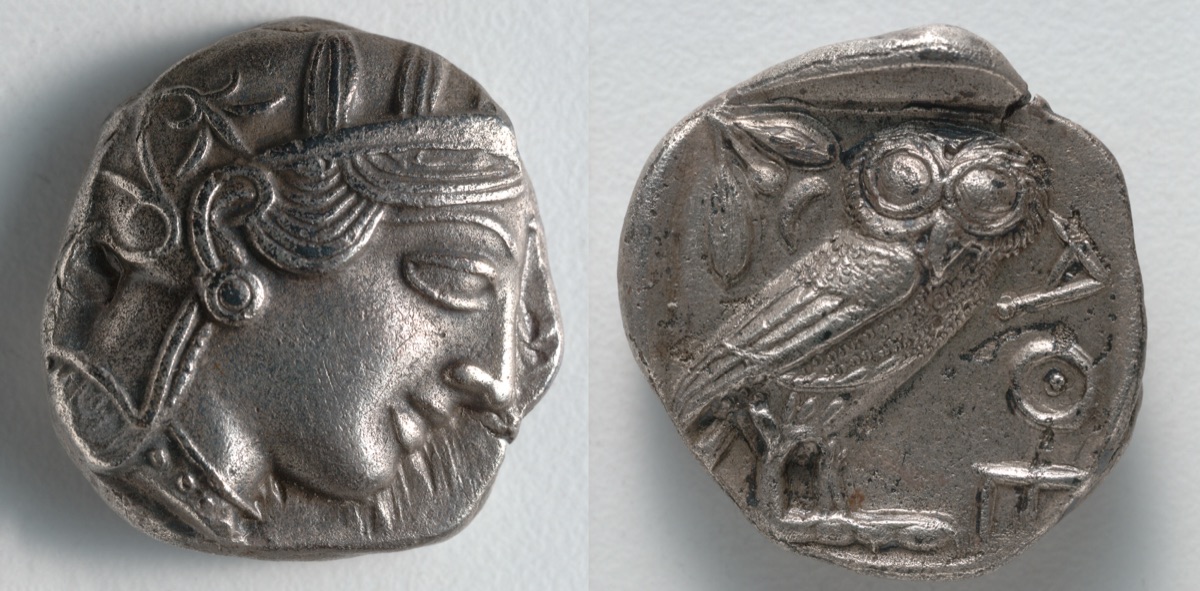
Tetradrachm: Head of Athena / Owl
A silver owl tetradrachm, the standardized Athenian coin that funded the Delian League fleet and circulated across the eastern Mediterranean.
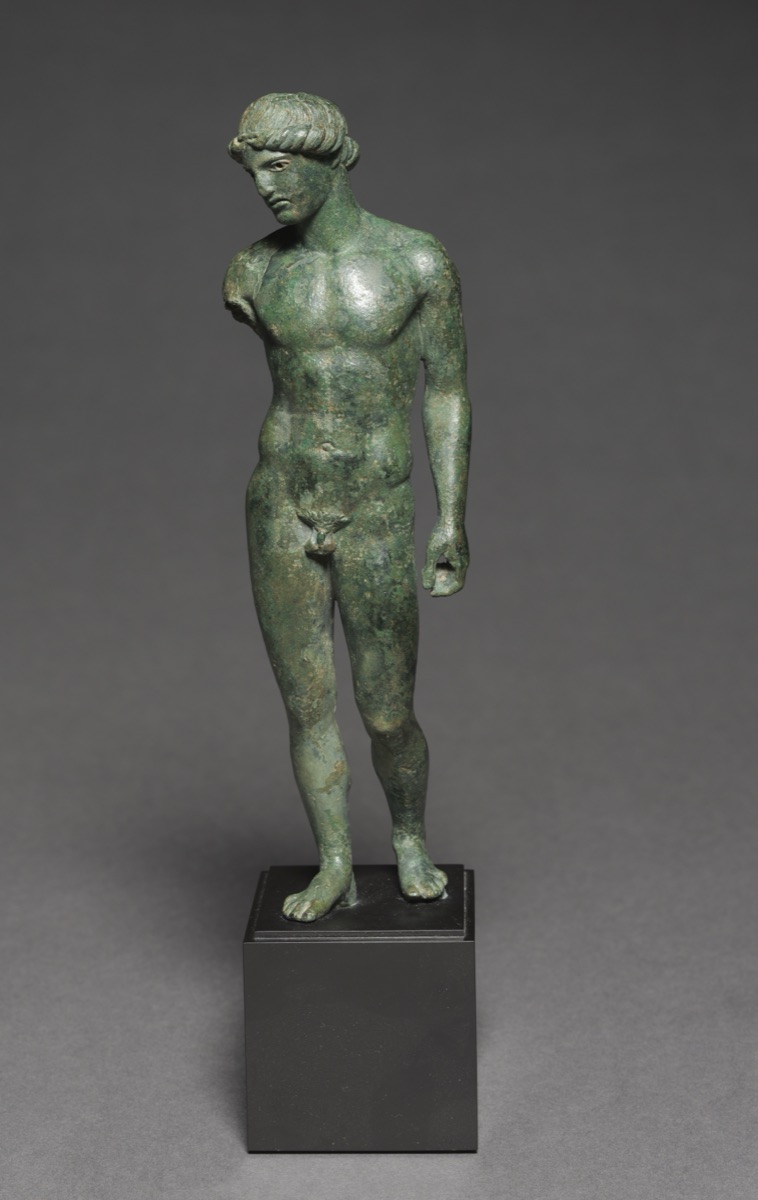
Athlete Making an Offering
A small bronze votive figure of an athlete, the idealized proportions of high Classical sculpture rendered at private scale.
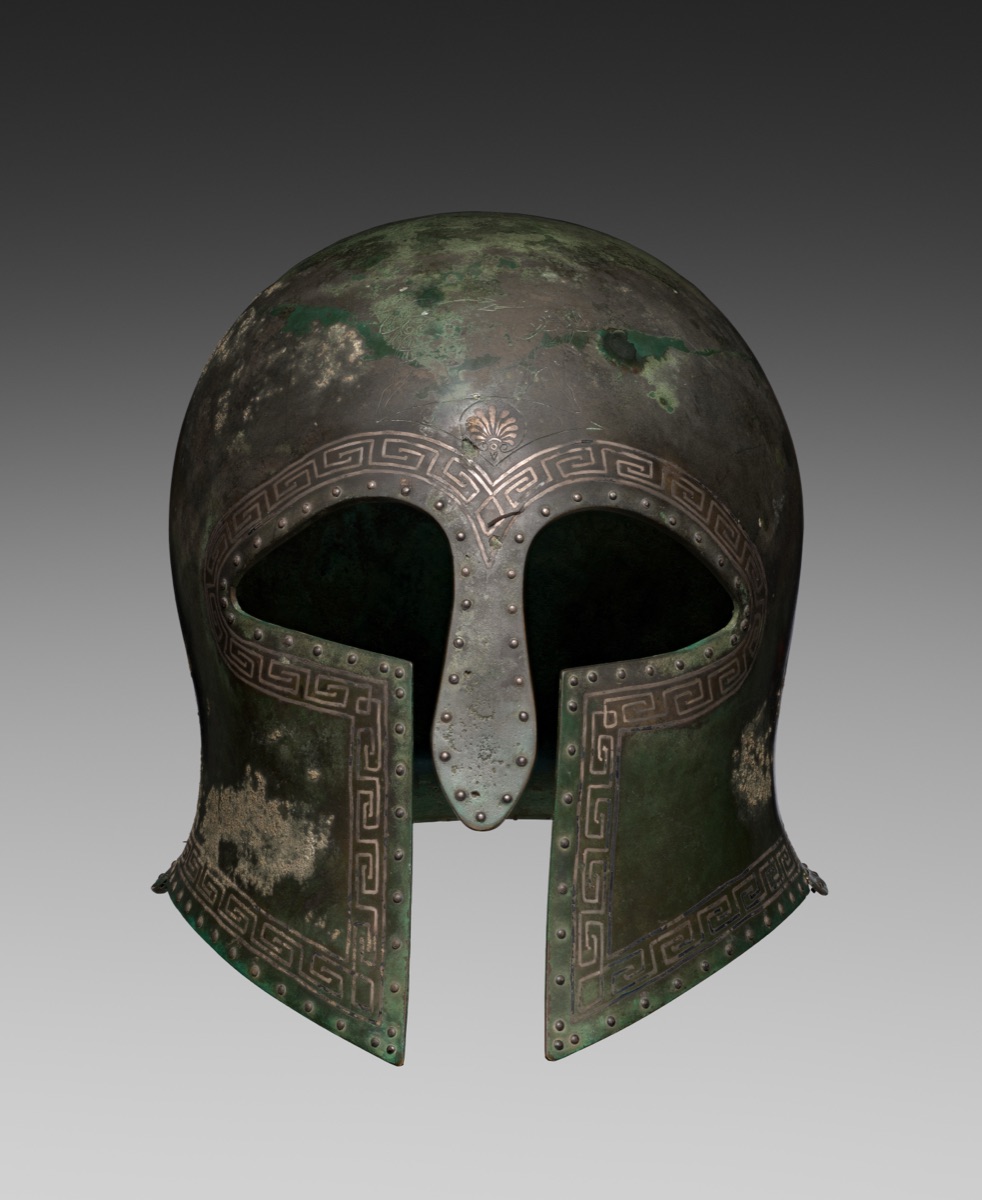
Corinthian Helmet
A bronze helmet of the enclosed Corinthian type worn by Greek hoplite infantry; the museum's own 1928 examination could not settle whether this unusually heavy example is ancient or a later imitation.
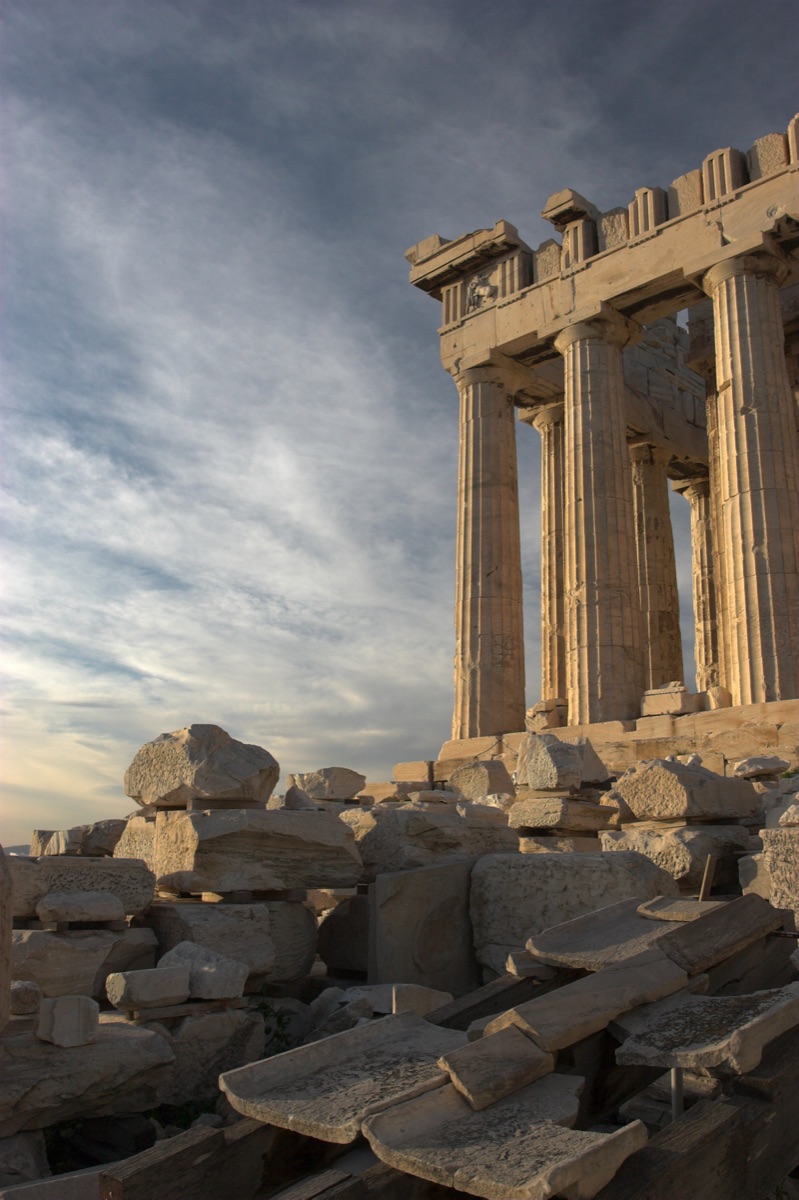
Parthenon
The Doric temple to Athena built on the Acropolis under Pericles, financed in part by the treasury of the Delian League.
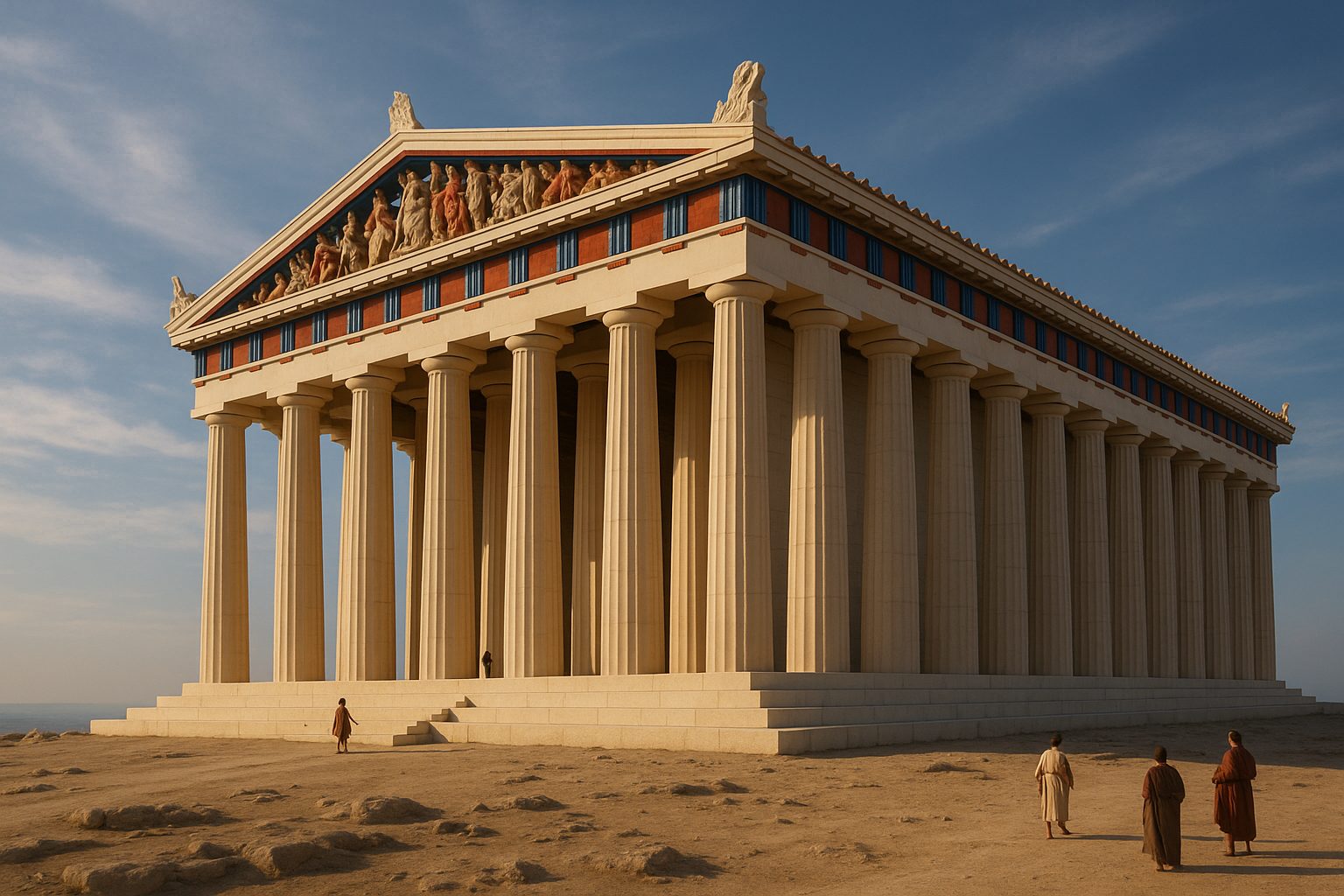
AI reconstruction
Parthenon - reconstruction
The Parthenon as dedicated: the Doric peristyle complete under its tiled roof, new Pentelic marble still pale gold, the pediment filled with painted figures and blue and red picking out triglyphs and sculpture bands - color for which paint traces on the building are the evidence. The temple survived essentially intact until the explosion of 1687; this restores the summit around it to its fifth-century state.
AI reconstruction (2026), based on Parthenon, Athens, photo Thermos via Wikimedia Commons
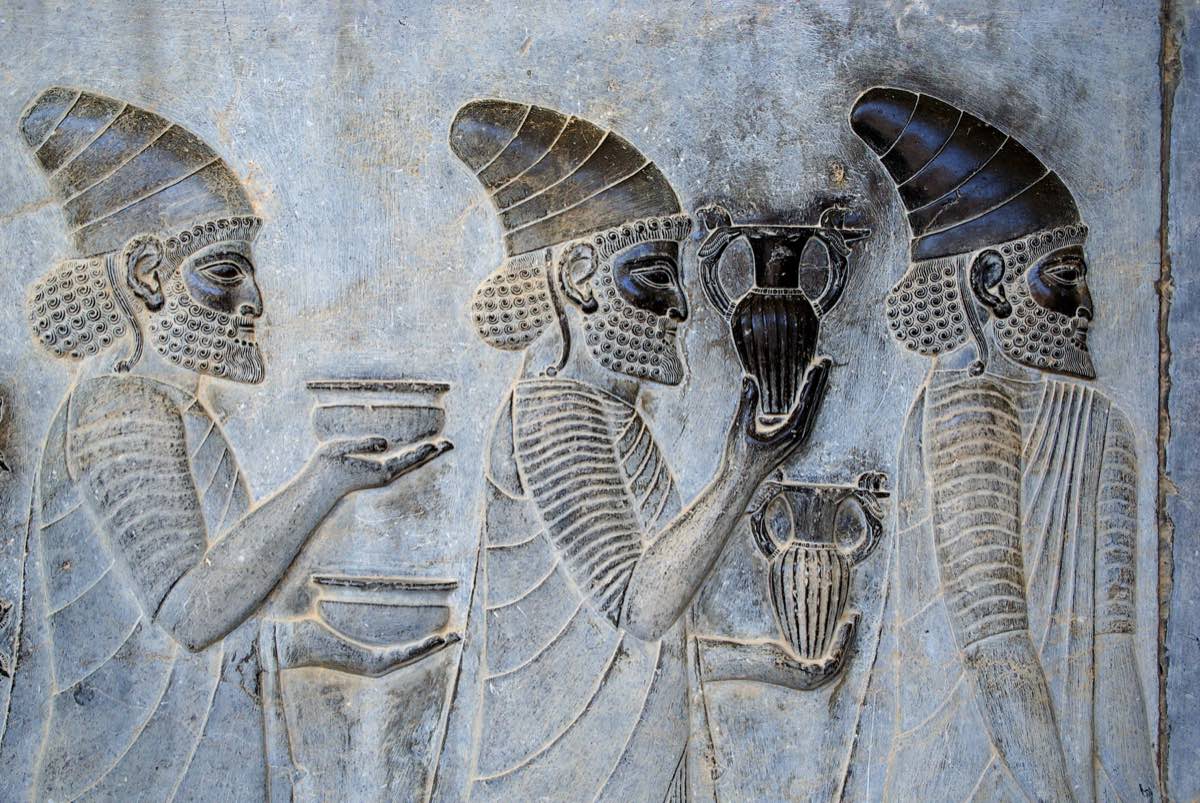
Apadana Staircase Relief
Carved stone reliefs of tribute-bearing delegations lining the Apadana staircase at Persepolis, the Achaemenid empire's ceremonial capital.
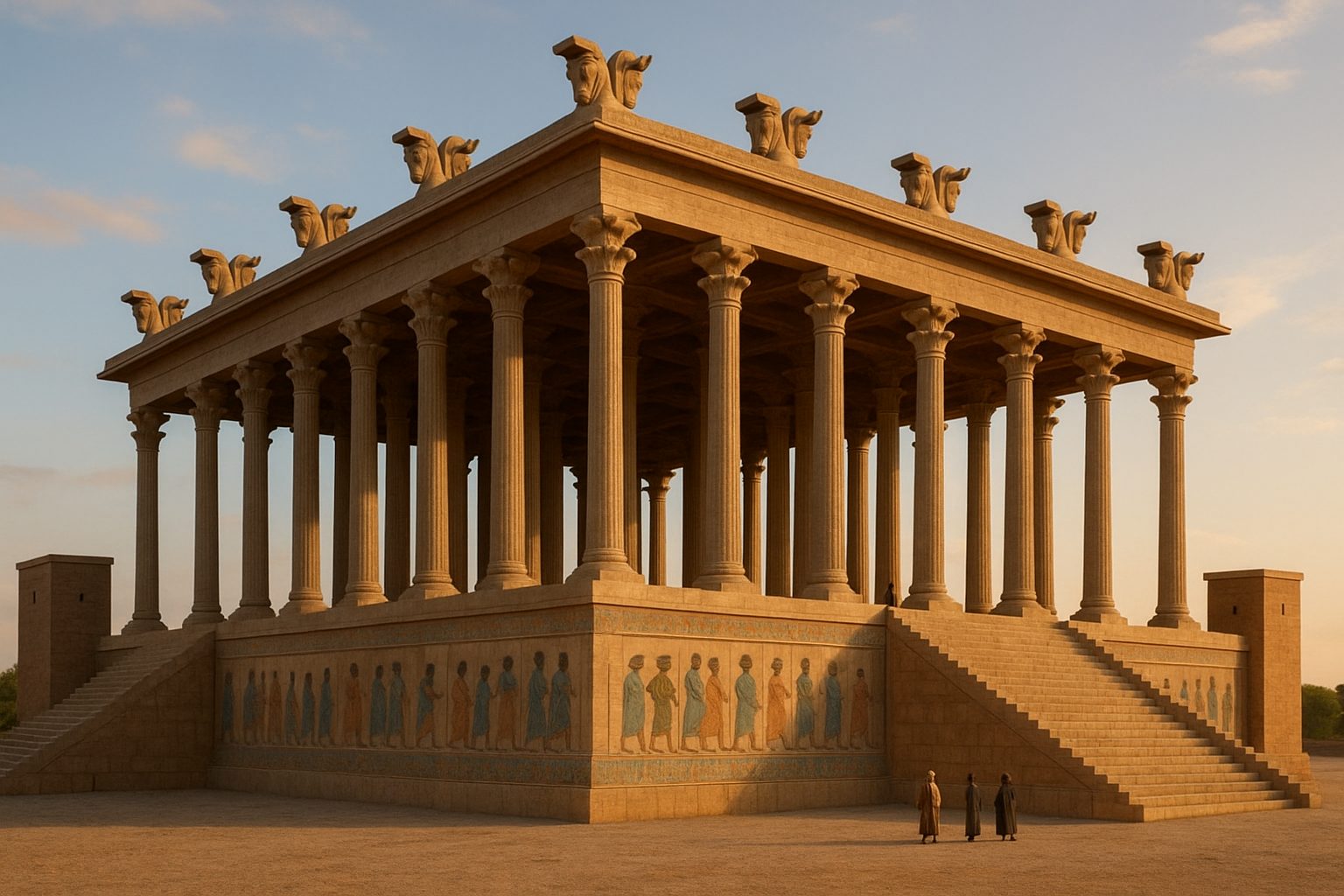
AI reconstruction
Apadana of Persepolis - reconstruction
The great audience hall of the Persian kings as completed under Xerxes: the columned hall on its stone platform, double reversed staircases faced with reliefs of tribute delegations - the museum's carved delegates among them - in the muted paint whose traces survive, and slender fluted columns carrying bull-protome capitals and a cedar roof. Platform, stairs and thirteen columns still stand; the roof and paint scheme are inference.
AI reconstruction (2026), based on Apadana Staircase Relief, Persepolis, photo Phillip Maiwald via Wikimedia Commons
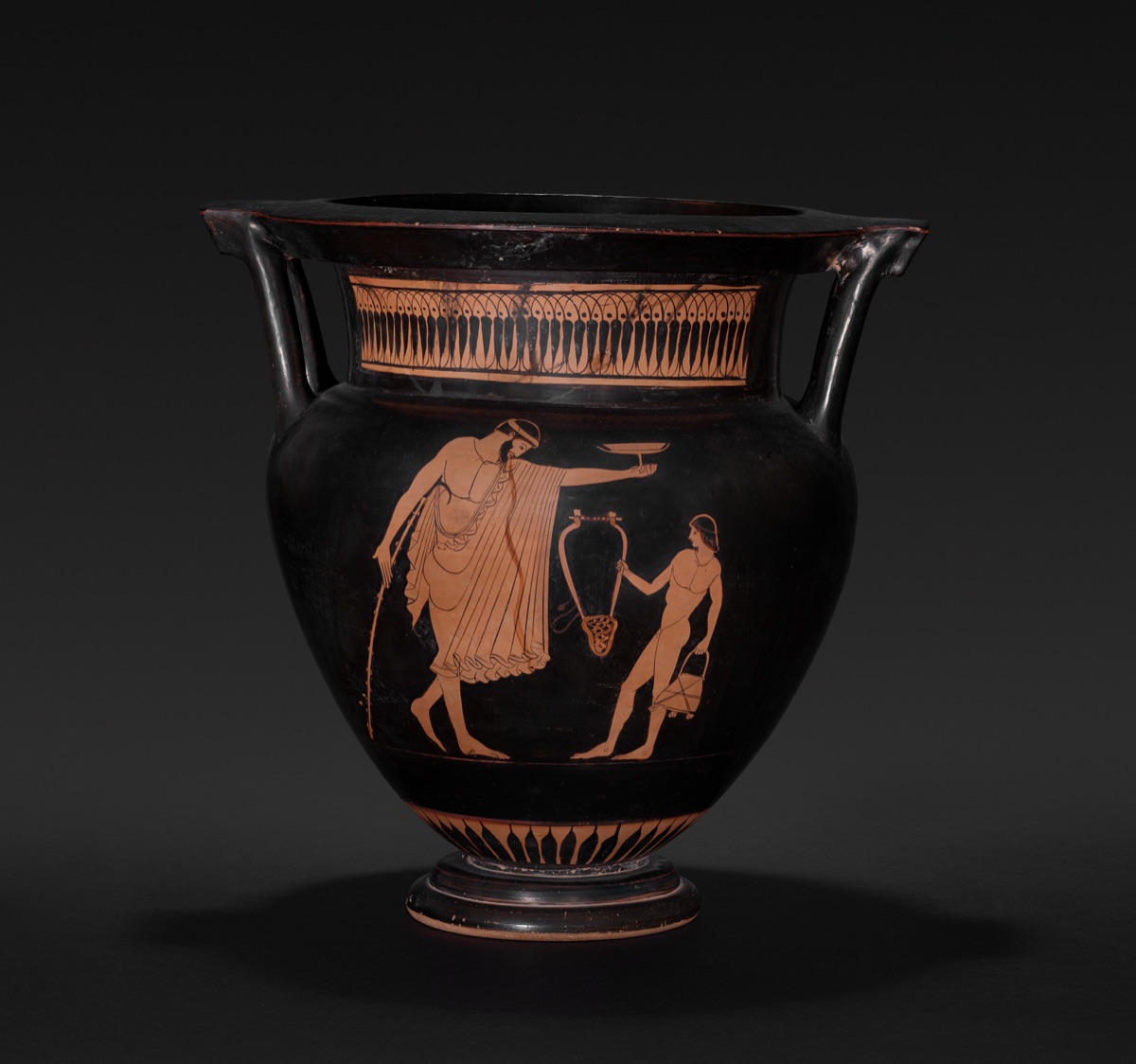
Red-Figure Column Krater: Komos (Revel)
A wine-mixing krater painted in red-figure with a drinking revel, made in Athens in the decades after the Persian Wars.
New this century
- Periplus of Hanno
Hanno's periplus asserts that he led a large Carthaginian colonizing fleet down the Atlantic coast of Africa, founding cities, trading with local peoples, and observing wonders such as volcanic fires and the hairy Gorillai as far as the fleet's provisions allowed.
- Fragments
Everything is in flux, and the only stable thing in the universe is the hidden law of change itself, which most people live inside without ever noticing.
- Katha Upanishad
Through a boy's dialogue with Death itself, the self is shown to survive the body, the good and the pleasant point in opposite directions, and only the wise choose the good over fleeting pleasure to escape rebirth.
- Mundaka Upanishad
Ritual knowledge, the 'lower knowledge' of the Vedas, cannot deliver liberation, and only the 'higher knowledge' of brahman, grasped directly, ferries a person across ignorance the way a raft crosses a river.
- Nirukta
Obscure and archaic words in the Vedic hymns can and must be explained through systematic etymology rather than left as opaque ritual formulas, against skeptics who thought some words could not be derived at all.
- Ramayana
Ideal kingship and ideal personal virtue are the same discipline, embodied in a prince who chooses exile, fidelity, and self-restraint over expedient power even when it costs him his wife's trust and his own peace of mind.
- Art of War
The greatest victory is the war never fought, because an army that wins through deception, positioning, and intelligence has already achieved its aim before a single battle begins.
- Spring and Autumn Annals
The bare, deliberately terse wording chosen to record an event, which words are used for a death, a meeting, or a war, silently passes moral judgment on it, so reading the chronicle correctly means reading what its laconic phrasing withholds as much as what it states.
- Pyrgi Tablets
Thefarie Velianas asserts that his rule over Caere is legitimated by a personal dedication to the goddess Uni, equated in the accompanying Phoenician text with Astarte, recorded permanently in gold so that both an Etruscan and a Phoenician-speaking audience would recognize the grant.
- Zapotec Danzantes and Monte Alban Inscriptions
Carved stone monuments at Monte Alban, above all the so-called Danzantes and the later conquest slabs of Building J, carry some of the earliest secure hieroglyphic and calendrical writing in Mesoamerica, pairing day-name and place-name signs with imagery of bound or slain captives to record Zapotec political and military claims centuries before Classic Maya monumental inscriptions.
- Elephantine Papyri
The Elephantine correspondence documents a Jewish garrison community keeping Passover, maintaining its own temple to Yahu, and successfully petitioning to rebuild that temple after its destruction, evidence that Jewish religious practice and communal identity persisted in a diaspora military colony far from Judea.
- Olympian Odes
Athletic victory is fleeting unless a poet transforms it into enduring praise, woven together with myth and moral reflection that locates the victor's achievement within the larger order of divine favor and human limitation.
- DNa Inscription
In his tomb inscription, Darius I asserts that Ahuramazda alone grants and sustains kingship, and that the long, orderly catalog of peoples paying him tribute is the visible proof of that divine mandate.
- DNb Inscription
Darius asserts that a good king is defined less by conquest than by self-mastery: control of anger, impartial judgment, proportionate reward and punishment, and protection of the weak are the truest proof of Ahuramazda's favor.
- Xerxes Daiva Inscription
Xerxes asserts that he personally, and rightly, tore down the worship of daivas, false or rebellious gods, within his empire, framing forcible religious suppression as an act of restored cosmic order sanctioned by Ahuramazda.
- On Nature
What is, is, and cannot not be; change, plurality, and coming-into-being are therefore illusions of mortal opinion, and only unchanging, undivided Being can be the object of true rational thought.
- Persians
The catastrophic Persian defeat at Salamis is staged from the losing side, at the Persian court itself, to show that hubris and imperial overreach invite divine retribution regardless of which side commits it.
- Seven Against Thebes
A family curse pursuing Oedipus's sons to mutual fratricide shows that inherited guilt can outlast any individual's own choices, closing off every attempt to escape a doom set in motion by a previous generation.
- On Nature
Everything contains a portion of everything else, and it is Mind (Nous), a pure, unmixed, all-powerful substance, that first set the primordial mixture spinning and continues to order the resulting cosmos.
- Oresteia
A cycle of blood vengeance within one family can only be ended by replacing private revenge with a public court of law, even when that means a goddess must overrule the older gods of retribution.
- Prometheus Bound
Defying an unjust tyrant to give humanity the gifts of fire and civilization is worth eternal punishment, and Zeus's absolute power, however overwhelming, does not by itself make his cruelty toward Prometheus just.
- Twelve Tables
Roman law begins with a demand that it be public and fixed on bronze, so that a plebeian could know the same law a patrician did rather than trust magistrates to remember it fairly.
- Song of Songs
Erotic love between two named human lovers can stand in scripture entirely on its own terms, without God ever being mentioned or the poem being forced to argue for anything beyond desire itself.
- Paradoxes
Motion and plurality lead to logical contradictions when analyzed carefully, which defends Parmenides's claim that reality is a single, unchanging whole by showing that the common-sense alternative is actually incoherent.
- On Nature
All change in the world results from the mixture and separation of four eternal, unchanging root elements, earth, water, air, and fire, driven by the cosmic forces of Love, which combines, and Strife, which divides.
- Acaranga Sutra
Nonviolence (ahimsa) must be extended to every living being down to the smallest, invisible organisms, and a monk's entire conduct, down to how he walks, eats, and speaks, must be governed by the discipline of causing the least possible harm.
- Analects
A good society is built not by law or force but by the cultivated character of those who lead it.
- Antigone
An unwritten, higher duty to bury the dead and honor the gods can override a king's civil law, and a ruler who punishes that duty as treason destroys his own household in the process.
- Histories
The Greco-Persian Wars deserve a written record precisely because great deeds by both Greeks and non-Greeks alike would otherwise fade, and understanding why they fought matters as much as recording that they did.
- Fragments
Man is the measure of all things, of what is that it is and of what is not that it is not, so truth and value are relative to each individual perceiver rather than fixed by an independent, knowable reality.
- History of the Peloponnesian War
War is a stern teacher that strips away the rules societies believe in, and understanding this Athenian-Spartan conflict with rigorous, source-tested precision matters more than telling a good story about it.
- Medea
A woman betrayed and cast aside by a husband who owes her everything will exact a vengeance so total, killing her own children to destroy him utterly, that it exposes the limits of a society's justice toward women it treats as disposable.
- Mozi
A society that practiced impartial care for every person equally, rather than graded love beginning with one's own family, would eliminate the theft, war, and cruelty that graded love's favoritism inevitably produces.
- Oedipus Tyrannus
Even a man who solves every riddle but his own cannot escape the truth of who he is, and the harder he pursues it the faster it destroys him.
- Hippolytus
Refusing to honor the goddess of love as fiercely as Hippolytus does invites her destructive retaliation just as surely as indulging desire without restraint does, and no purely virtuous extreme escapes catastrophe among gods who demand their due.
- Clouds
The new intellectual fashions of sophistic rhetoric and natural philosophy, caricatured together in the figure of Socrates, teach clever young men to make the weaker argument defeat the stronger, corrupting traditional piety and family obligation in the process.
- Hippocratic Corpus
Disease has natural causes that can be observed, tracked, and treated through careful clinical method, not divine punishment requiring ritual appeasement, and the physician's first obligation is to do no harm.
- Fragments
Reality consists of nothing but indivisible, indestructible atoms moving through empty void, differing only in shape, arrangement, and position, and everything else, including color and taste, exists only by human convention.
- Encomium of Helen
Speech (logos) is a powerful force capable of overriding reason and will entirely, so Helen of Troy should be excused for eloping with Paris, since she was compelled by persuasion, fate, force, or love rather than acting through free choice.
- Electra
Grief endured too long without action curdles into an obsession that consumes the mourner, but Electra's fierce refusal to move past her father's murder is also what finally drives Orestes to avenge it.
- Electra
Staging Agamemnon's avenging children as an impoverished farmer's household rather than royalty strips the myth of heroic glamor and exposes matricide, even when justified by wrong done, as a squalid, psychologically damaging act rather than a triumphant one.
- Trojan Women
Victory in war does not exempt the victors from moral judgment, and staging the fall of Troy entirely from the perspective of its enslaved, grieving women indicts the Athenian audience for atrocities their own city was committing at the same time.
- Lysistrata
Athenian and Spartan women can force their warring husbands to make peace by the single most effective leverage available to them, a citywide sex strike, exposing how thoroughly a war fought by men depends on the cooperation of the women left behind.
- Bacchae
Denying the god Dionysus his due worship does not make a ruler strong but invites a madness that destroys reason, family, and the city itself, since the irrational forces the god embodies cannot simply be legislated away.
- Oedipus at Colonus
The exiled, blinded Oedipus dies transfigured rather than merely punished, and the place that grants him a peaceful, mysterious death will be blessed and protected because it did so.
- Frogs
Athenian tragedy has declined so badly since the deaths of its great masters that even the god of theater must descend to the underworld to bring one back, and judging whose poetry the city needs more becomes a matter of civic survival.
The canon by now
- Pyramid Texts
- Royal Inscriptions of Sargon of Akkad
- The Exaltation of Inanna
- The Curse of Agade
- Coffin Texts
- Admonitions of Ipuwer
- Eloquent Peasant
- Code of Hammurabi
- Old Babylonian Gilgamesh (Pennsylvania and Yale Tablets)
- Inanna's Descent to the Netherworld
- Edwin Smith Surgical Papyrus
- Book of the Dead
- Rigveda
- Baal Cycle
- Ludlul Bel Nemeqi
- Epic of Gilgamesh
- Instruction of Amenemope
- Gathas
- Book of Songs
- Torah
- I Ching (Book of Changes)
- Mahabharata
- Iliad
- Odyssey