Time travel
3rd century BC
This is the century a ruler's power starts getting justified in writing wherever writing exists to do it, from Ashoka's edicts to Qin's new law code to the Library Alexandria builds to hold everyone else's knowledge too.
Mental Worlds: Evidence and Inference
Three projects define this century's confidence in the written and measured word, and none of them yet knows about the others in more than the vaguest terms. At Alexandria, the Ptolemaic dynasty funds a Library and Museum meant to collect every text in the Greek-speaking world and support scholars who work there as a career rather than a hobby. Euclid, working within this environment, compiles the Elements, deriving all of geometry from a small set of self-evident starting points, a method of proof from first principles that later centuries in totally different fields will imitate as the template for rigorous argument itself. The same city hosts the start of a very different translation project: Jewish scholars, working for a diaspora community that increasingly reads Greek rather than Hebrew, render the Torah into Greek as the Septuagint, among the earliest sustained demonstrations in practice that scripture can survive translation into a new language without ceasing to be scripture.
Two and a half thousand miles east, Ashoka rules a Mauryan empire stretching from the Indus to Bengal, and does something almost no ruler before him has done: he has his own change of mind carved into stone and set up across his territory for anyone literate enough to read. After the brutal conquest of Kalinga, he tells his subjects directly, in edicts inscribed on polished sandstone pillars and rock faces from Afghanistan to south India, that the suffering he caused has made him give up further conquest by war and pursue instead a program of religious tolerance, welfare administration, wells, roads, and medical provision for people and animals alike. It is, among surviving ancient texts, an unusually direct first-person record of a ruler publicly binding himself to a moral program rather than simply claiming divine favor for whatever he had already decided to do.
Farther east again, a third and much harsher answer to the same underlying question, what is a ruler's power for, plays out in the Qin state's final conquest of its Warring States rivals. Han Feizi, a Legalist theorist, argues that a ruler who governs through personal virtue or trusted ministers will be deceived and overthrown, and that lasting order instead requires impersonal law applied without exception, backed by clear rewards and punishments a ruler can enforce without needing to trust anyone. Qin's kings apply exactly this doctrine to devastating military effect, defeating the last independent Warring States one by one and unifying China by 221 BC behind a single script, standardized weights and measures, and a ruthlessly centralized administration, a version of order that could not be more different from Ashoka's simultaneous public renunciation of coercion, or from the collegial, argument-based scholarship Alexandria's Library exists to support.
A fourth register of the same century's thinking plays out in Athens, where Epicurus and Zeno of Citium found rival philosophical schools that have nothing to do with any of these three states directly but answer a related question at the individual scale: not what should a ruler do with power, but how should a person live given how little control any individual actually has over political events. Epicurus counsels retreat into a garden community of friends and modest pleasure; Zeno's Stoics counsel instead a disciplined alignment of one's own will with an indifferent cosmic order. Both philosophies outlast the political arrangements of this century by many centuries, in ways their founders could not have predicted, and none of these four projects, Alexandria's scholarship, Ashoka's edicts, Qin's law, or Athens's competing schools of how to bear an uncertain world, has any concrete knowledge of the others happening at the same time on the same planet.
The political map
Major Polities and Cultural Regions
- Ptolemaic Egypt Alexandria and the Nile to Cyrene and Cyprus, seat of the Library and Museum
- Seleucid Empire Anatolia to the Indus at its widest, the largest of Alexander's successor kingdoms
- Antigonid Macedon and the Greek city-states Macedon and the Aegean rim, contested among Alexander's heirs
- Carthaginian Empire Western Mediterranean and North Africa, Rome's rival from the First Punic War in 264 BC
- Roman Republic Central and southern Italy, expanding into Sicily and Sardinia by century's end
- Qin Wei River valley to all of China after unifying the last Warring States by 221 BC
- Mauryan Empire Indus to Bengal and south past the Deccan under Ashoka
- Kush Upper Nile south of Egypt, capital at Meroe, an independent African kingdom with its own iron-working tradition
Borders are approximate scholarly reconstructions from historical-basemaps (GPL-3).
State of the domains
Texts and Written Culture
Alexandria becomes literature's workshop as much as its subject: Callimachus catalogs the Library's scrolls and writes learned, compressed verse against epic sprawl, while Apollonius of Rhodes attempts epic anyway with the Argonautica and Theocritus invents pastoral poetry. In Athens, Epicurus and Zeno of Citium found rival schools whose letters and fragments teach ways to live rather than only ways to argue. In China, court scholars under the minister Lu Buwei assemble the syncretic Lushi Chunqiu, while Han Feizi writes the Legalist manual that becomes Qin's operating philosophy. Alexandria's translators begin rendering the Torah into Greek as the Septuagint, starting with the Pentateuch.
Art
Hellenistic sculpture trades classical restraint for movement and emotion, favoring twisting poses, strained muscle, and old age or drunkenness rendered without idealizing. Ashoka's edicts, carved onto polished sandstone pillars topped with lion capitals across the Mauryan realm, fuse royal inscription with public monument on a scale India had not attempted before. Ptolemaic Alexandria's court patronizes portraiture and luxury glasswork tied to a new dynasty's self-fashioning as pharaoh and Macedonian king at once. Qin standardizes weights, measures, and script across a newly unified China, an administrative aesthetic of uniformity replacing regional variety almost overnight.
Medicine
Alexandria's Museum gives anatomy an institutional home: Herophilus and Erasistratus perform systematic human dissection there, distinguishing arteries from veins and mapping the nervous system in ways no earlier Greek physician had attempted, work later medicine builds on for centuries even after the practice itself lapses. Egyptian temple medicine and older Babylonian diagnostic tradition continue alongside this new anatomical program. In China, medical theory still develops within the broader correlative cosmology inherited from the Warring States classics rather than as its own discipline, and no dedicated medical treatise from this century survives in the corpus record.
Science
Euclid's Elements, compiled at Alexandria, sets the template for deductive proof that mathematics follows for two millennia. Archimedes, working from Syracuse, calculates the area of a sphere, approximates pi, and works out the principle of buoyancy; Aristarchus proposes that the earth orbits the sun, a hypothesis later astronomy sets aside; Eratosthenes, heading the Library, measures the earth's circumference from shadow angles observed at two cities. Chinese astronomers keep court calendars tied to rival almanac traditions inherited from the Warring States. The Library and Museum of Alexandria, a state-funded research institution, is this century's single most consequential invention.
Military
Alexander's former generals spend the century's opening decades finishing their wars against each other, the Successor kingdoms settling by mid-century into Ptolemaic Egypt, Seleucid Asia, and Antigonid Macedon. Rome and Carthage fight the First Punic War from 264 to 241 BC over Sicily, Rome's first overseas war and first fleet. In China, Qin's armies, organized around Han Feizi's impersonal law and mass conscription, defeat the last Warring States rivals one by one, unifying the land by 221 BC behind standardized weapons and a single command structure. Ashoka's conquest of Kalinga, and his revulsion afterward, closes Mauryan expansion by force for good.
Technology
Qin standardizes axle widths, weights, measures, and script across the newly unified Chinese state, and begins connecting frontier walls into what later ages call the Great Wall. Archimedes designs siege engines for Syracuse and is credited with a water-lifting screw. Alexandria's Museum supports instrument-making alongside research, including early water clocks. Ashoka's edicts describe a state road and well-digging program tied to his welfare administration, plus medical provision for humans and animals, an early instance of public health infrastructure attested in the ruler's own inscriptions rather than through any outside report.
Material world
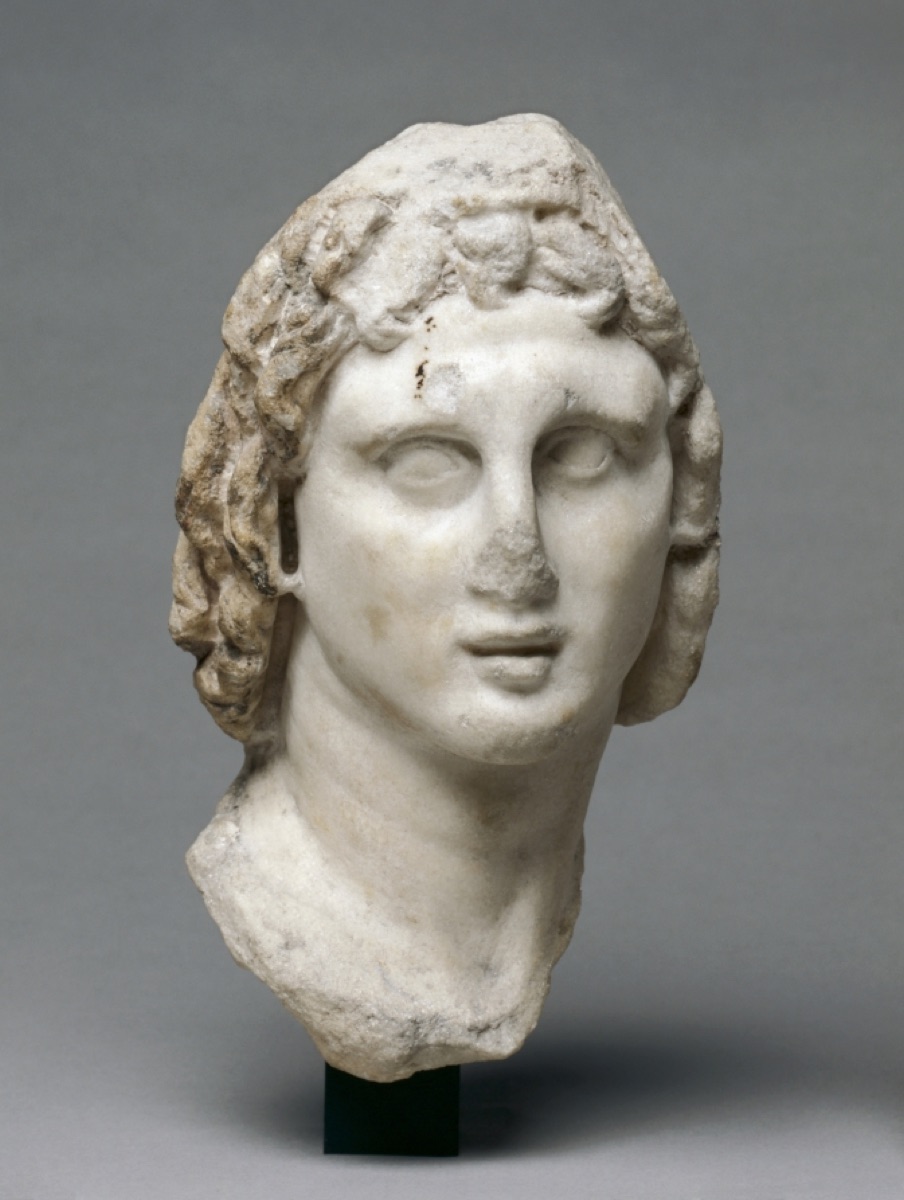
Head of Alexander the Great
A marble likeness of the young conqueror, carved in Alexandria after his death made his features an imperial template across the Hellenistic world.
The Cleveland Museum of Art, Gift of Mrs. Ralph King, 1927.209
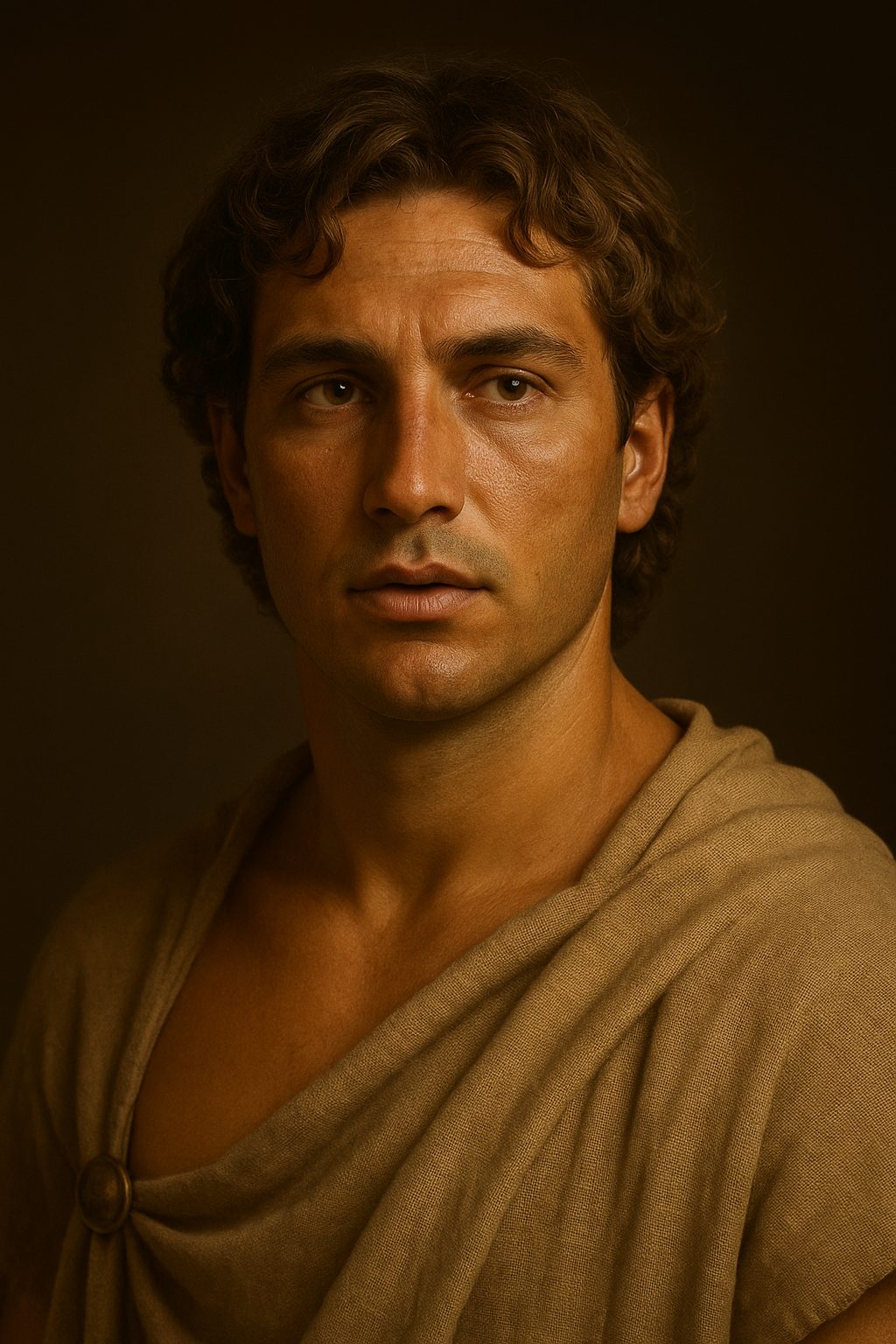
AI reconstruction
Alexander the Great - reconstruction
Alexander of Macedon in his mid twenties, reconstructed from a marble head carved in Alexandria after his death: the tousled hair rising off-center from the forehead, deep-set eyes, strong brow and parted lips of the sculptural tradition his court artists established, with a plain wool chlamys pinned at the shoulder. Every surviving likeness is posthumous and idealized, so this is a portrait of his image, not a verified face.
AI reconstruction (2026), based on Head of Alexander the Great, The Cleveland Museum of Art
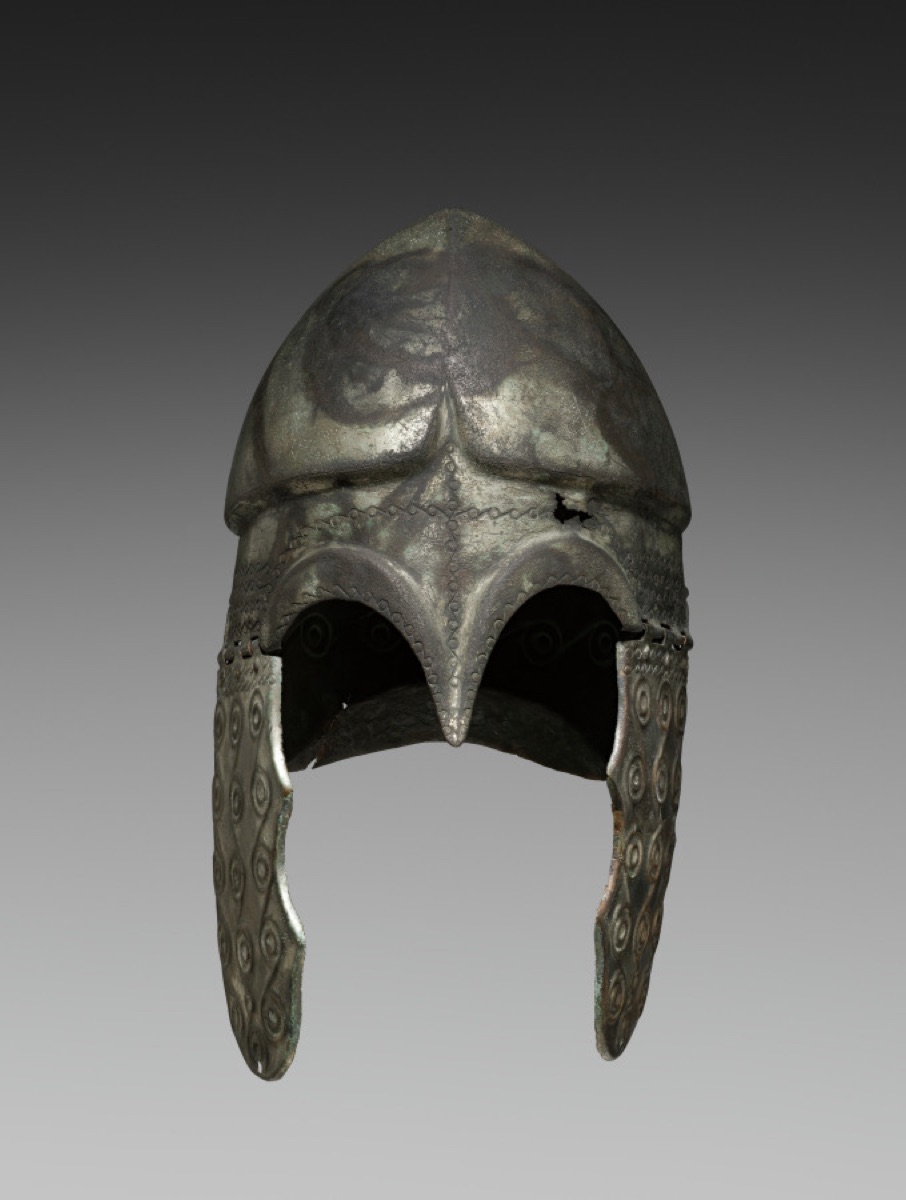
Chalcidian Helmet
A bronze helmet of the Chalcidian type, its hinged cheek-pieces and open face trading protection for the visibility and hearing a fighting man needed.
The Cleveland Museum of Art, Gift of Barbara S. Robinson and Family, 2023.106
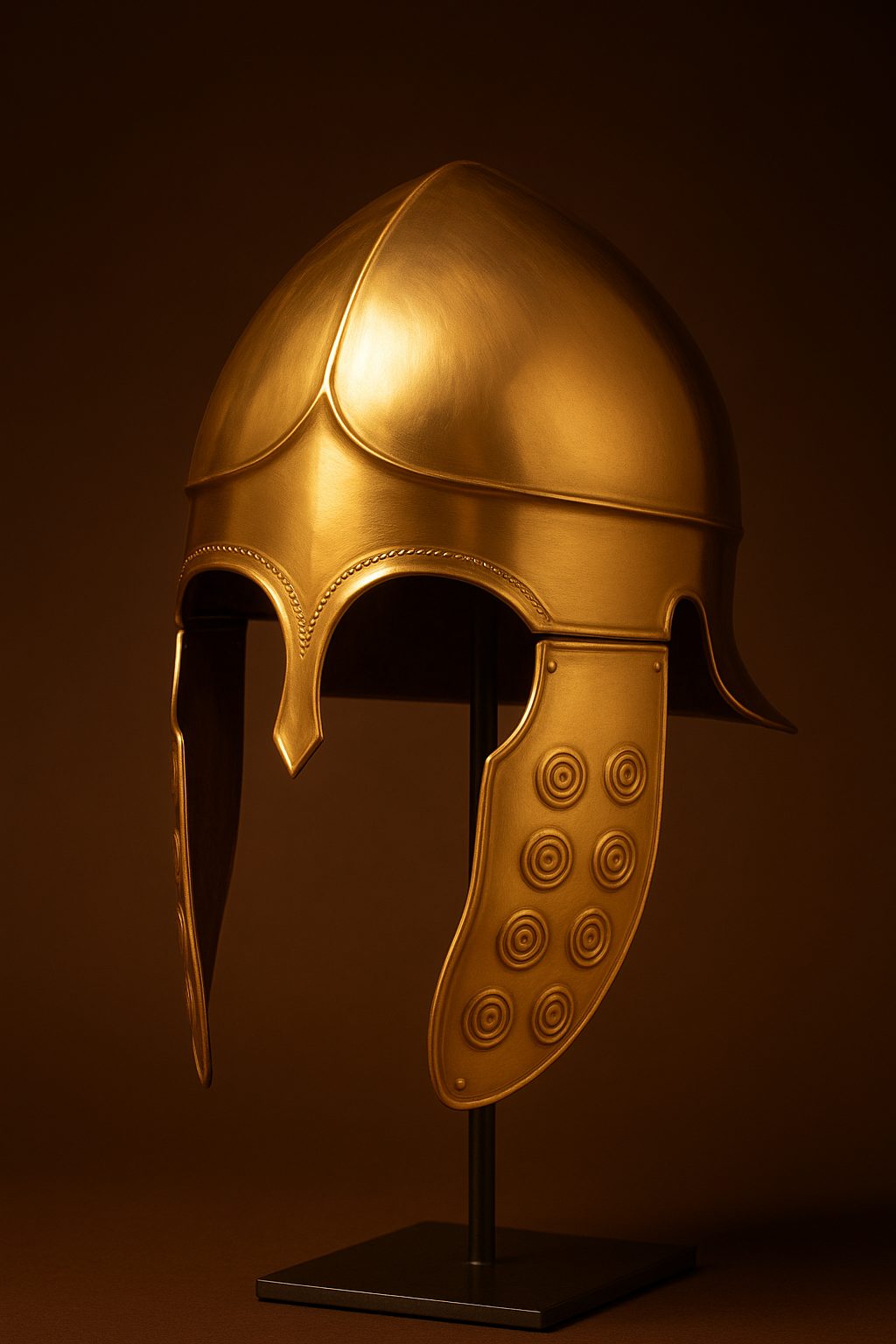
AI reconstruction
Chalcidian helmet - reconstruction
A Greek helmet of the Chalcidian type restored to the armorer's finish: hammered bronze polished to a warm golden sheen, the domed carinated crown, arched eye openings with a small pointed nose-guard, and hinged cheek-pieces embossed with circle ornament, complete and undented on a museum mount. The surviving helmet wears a dark patina; new bronze would have gleamed close to this color.
AI reconstruction (2026), based on Chalcidian Helmet, The Cleveland Museum of Art
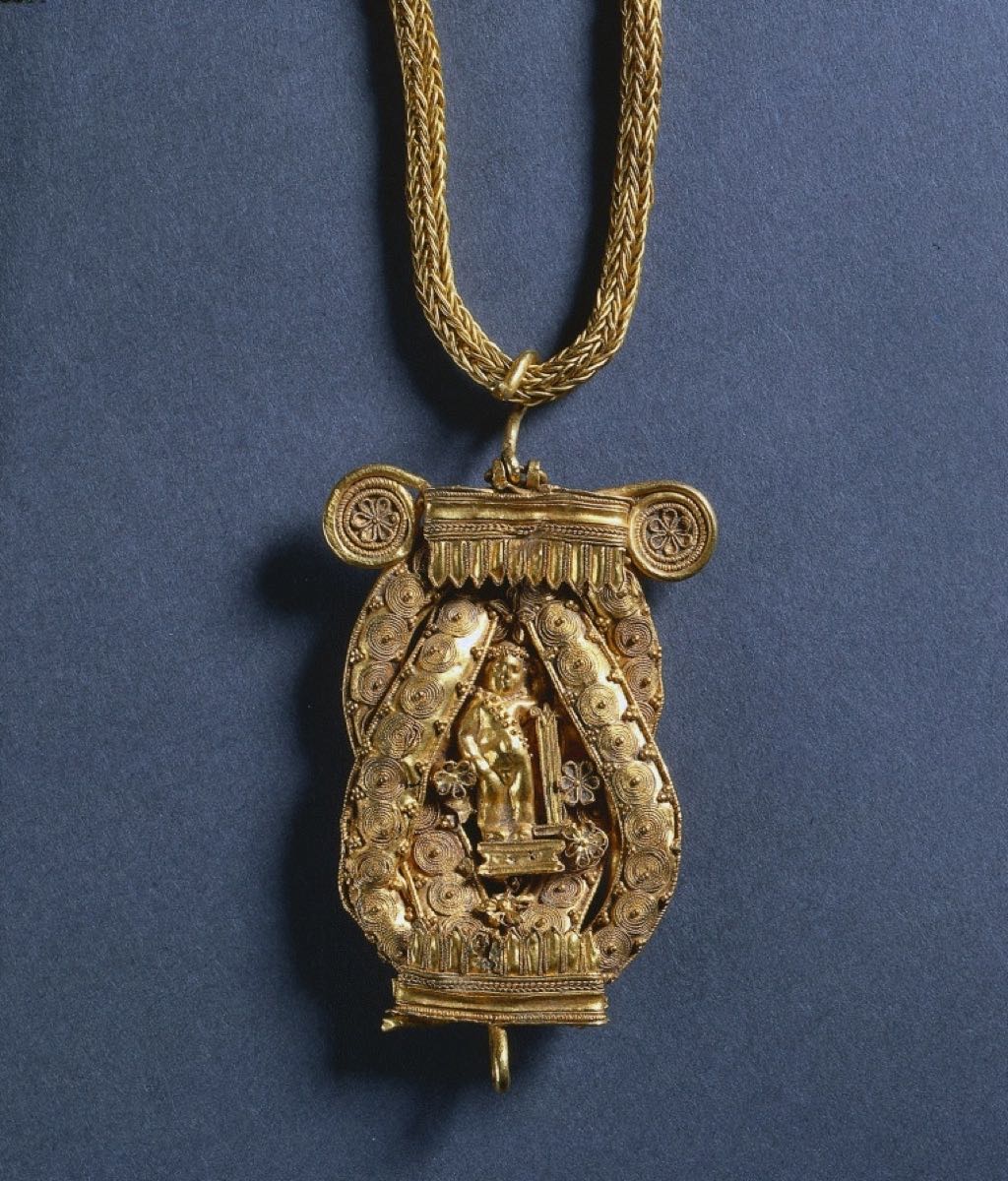
Chain and Pendant
A gold loop-in-loop chain and pendant, the kind of portable, showable wealth Hellenistic goldsmiths perfected for a newly cosmopolitan elite.
The Cleveland Museum of Art, John L. Severance Fund, 1947.505
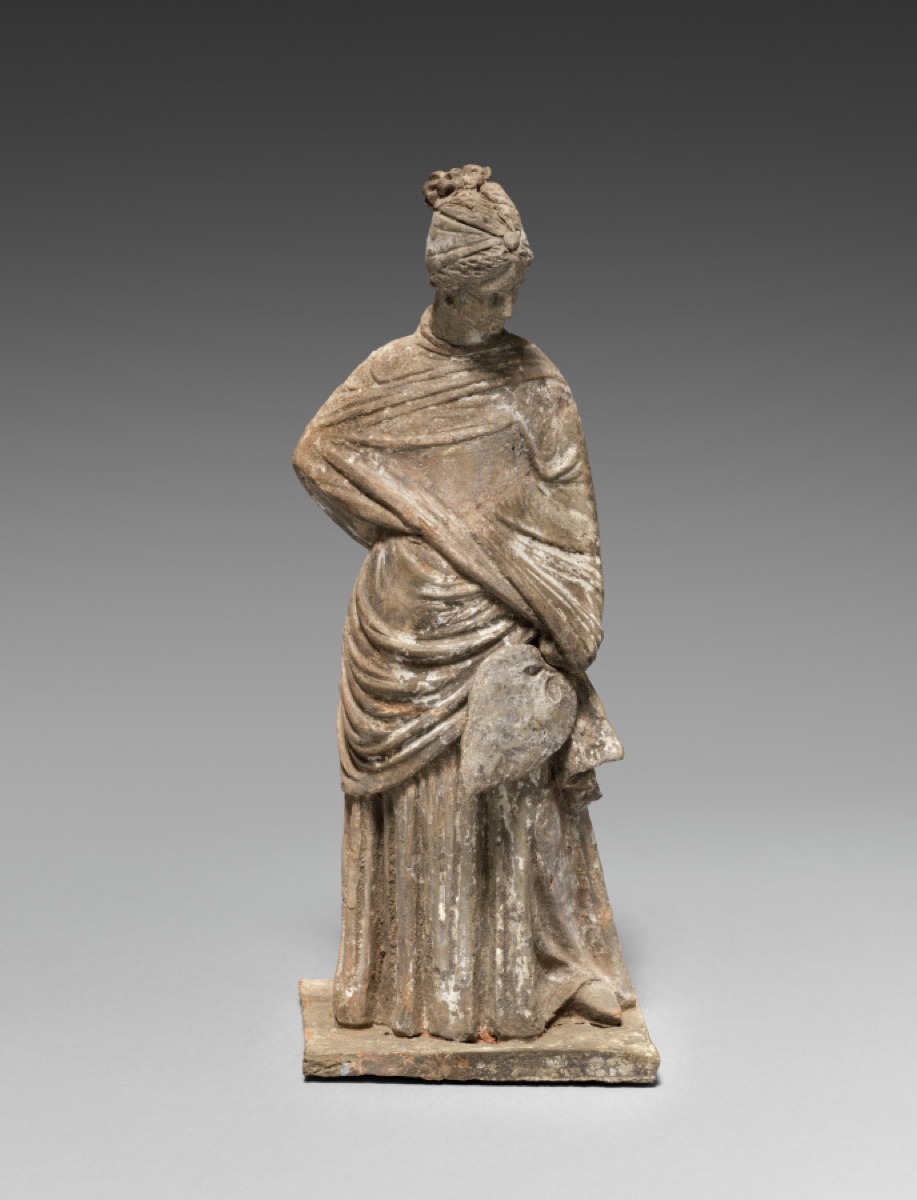
Figurine of a Lady
A terracotta Tanagra figurine, mold-pressed and painted, of the kind mass-produced across the Hellenistic Mediterranean for household shrines and burials.
The Cleveland Museum of Art, Charles W. Harkness Endowment Fund, 1930.240
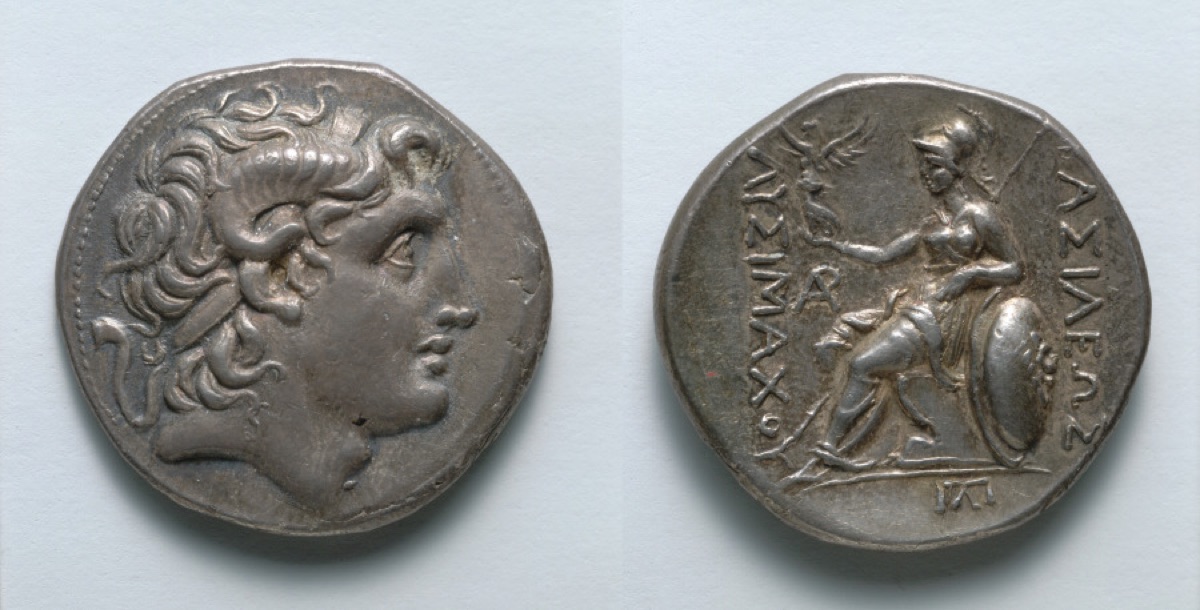
Tetradrachm: Head of Alexander (obverse); Athena (reverse)
A silver coin struck under King Lysimachos, one of Alexander's former generals, who put the dead conqueror's deified portrait on his own currency to claim his legacy.
The Cleveland Museum of Art, Gift of the John Huntington Art and Polytechnic Trust, 1917.984
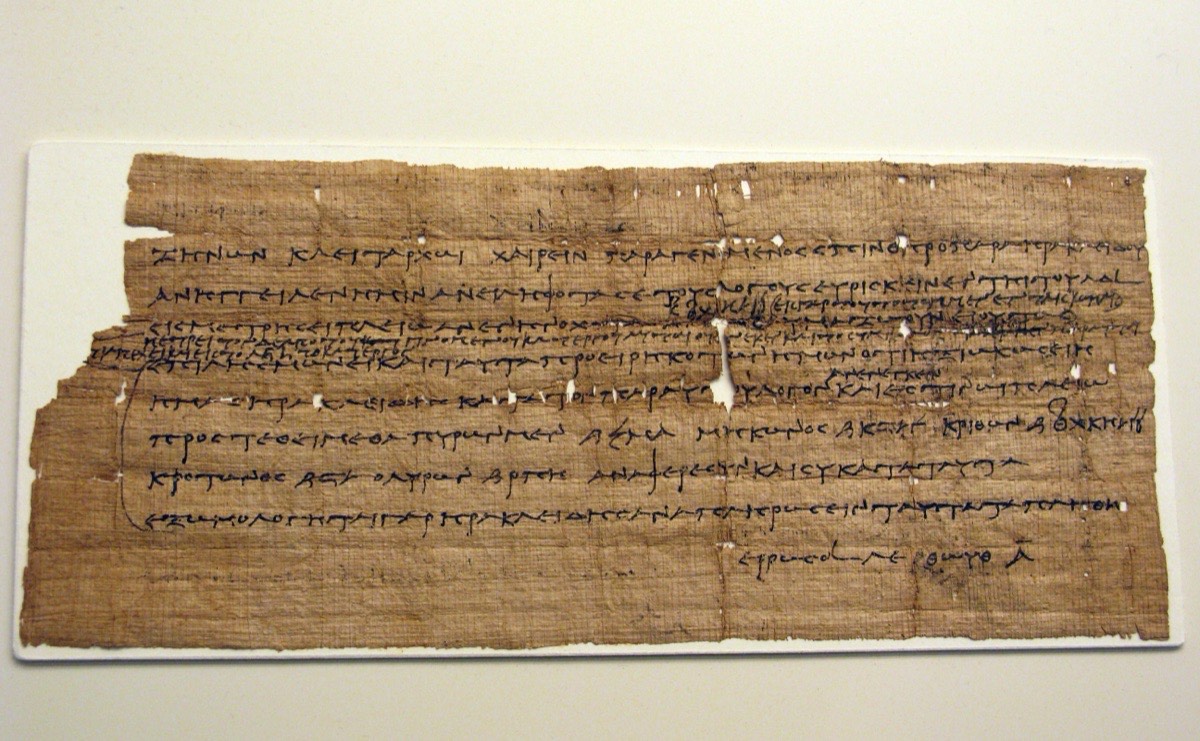
Papyrus Fragment from the Zenon Archive
A Greek business letter on papyrus from the archive of Zenon, an estate manager in the Fayum, part of the everyday paperwork that ran Ptolemaic Egypt.
National Archaeological Museum, Athens. Photo Tilemahos Efthimiadis, CC BY 2.0
New this century
- Instruction of Ankhsheshonq
Practical, often cynical maxims about family, money, and self-preservation, written from a prison cell after a failed conspiracy, offer a harder-edged wisdom than the courtly instructions of earlier centuries.
- Setne Khamwas Cycle
A prince who steals forbidden magical knowledge from the dead, even one as pious as the historical high priest Khaemwaset, will be made to suffer for the theft until he restores what he took.
- Demotic Chronicle
A king's length and success on the throne is a direct verdict on his moral conduct, and the pattern of past reigns, read correctly, points to a future native ruler who will restore Egypt's proper order.
- Ecclesiastes
Nothing gained by human striving, wisdom included, outlasts death or repeats without loss, so the only defensible response to a world without lasting profit is modest, present enjoyment rather than either despair or grand achievement.
- Daniel
History moves through a fixed sequence of empires toward an appointed end under direct divine control, so faithfulness under a persecuting king is not defeat but the last act before certain, imminent deliverance.
- 1 Enoch
The disorder of the world traces back to a primordial rebellion of heavenly beings who bred with human women and taught forbidden arts, and that hidden history, revealed to Enoch alone, explains evil and guarantees final judgment far more than any account confined to human choice alone.
- Elements
Every geometric truth can be derived step by step from a small set of self-evident axioms, establishing proof from first principles as the template for rigorous argument itself.
- Letter to Menoeceus
Pleasure, correctly understood as the absence of bodily pain and mental disturbance rather than indulgence in every available appetite, is the natural and proper goal of life, and an irrational fear of death or the gods is the single greatest obstacle standing in its way.
- Letter to Herodotus
The universe consists of nothing but atoms and void, is infinite and eternal, and understanding its physical workings through this atomic theory is necessary groundwork for achieving the freedom from fear that a good life requires.
- Fragments
Living in accordance with nature and reason, indifferent to external goods like wealth, pleasure, and even health, is the only path to virtue, which alone is sufficient for a good life regardless of circumstance.
- Arthashastra
A king's overriding duty is the material welfare and security of the state, and statecraft is a technical discipline separate from private morality, in which deception, surveillance, and calculated violence are legitimate tools whenever they serve that end.
- Dhammapada
Suffering originates in the untrained mind's craving and delusion, and disciplined attention to one's own thoughts and actions, not ritual or birth, is what ends it.
- Vinaya Pitaka
A monastic community can only remain a functioning path to liberation if its members submit to an exhaustive, case-derived code of discipline, and the text works out that code by narrating the specific offense that provoked each rule.
- Brahmi and Kharosthi Scripts
Two scripts, Brahmi written left to right across most of South Asia and Kharosthi written right to left in the northwest, carried royal, religious, commercial, and personal writing across the subcontinent from the third century BC onward, even though how and when each first developed remains disputed.
- Tamil-Brahmi Inscriptions
Cave-dwelling ascetics' donors, traders, and craftspeople across Tamil Nadu and Sri Lanka adapted the Brahmi script to Tamil sounds it was not designed for, leaving the earliest epigraphic evidence presently known of the Tamil language in writing, though individual inscriptions' dates are often disputed.
- Tolkappiyam
Tamil grammar, poetics, and the social conventions of love and heroism form a single coherent system, so that correct language, correct poetic form, and correct conduct are governed by the same underlying rules.
- Book of Rites
Ritual is not empty formality but the concrete mechanism by which raw human feeling is shaped into a workable social and cosmic order, so getting the details of rites right is inseparable from being a good person.
- Chuci
A loyal minister unjustly exiled by a ruler he cannot stop loving may still find, through shamanic flight, cosmic wandering, and lament, a language for grief and integrity that the plain, communal voice of the Shijing has no room for.
- Zhouli
Good government is achieved by a comprehensive, symmetrically organized bureaucracy, six ministries of roughly 360 offices each, in which every function of the state, from ritual to taxation to public works, has its exactly specified official, so administrative completeness itself is what produces order.
- Xiaojing
Filial piety toward one's parents is not merely a family virtue but the root from which all other virtue and all legitimate political order grow, so a state that wants loyal subjects should above all cultivate and reward filial devotion in the home.
- San Bartolo Murals and Glyphic Texts
Kingship and cosmic order were already being asserted through a developed mythological narrative, the birth and enthronement drama of the maize god, painted with accompanying glyphic captions centuries earlier than most surviving Maya writing, showing that both the pictorial and textual conventions of Classic Maya kingship were already in place in the Late Preclassic.
- Septuagint
Scripture can survive translation into a new language and culture without ceasing to be scripture, and a diaspora community reading Torah in Greek rather than Hebrew is still living inside the covenant.
- Idylls
The idealized, artfully simple lives of herdsmen singing and competing in songs against a rustic landscape are worth as serious and refined poetic treatment as any epic or courtly subject, founding pastoral as its own poetic genre.
- Aetia
Poetry should be short, learned, and finely wrought rather than long and grandly continuous, and a poet who explains the obscure mythical origins of customs, festivals, and place-names in polished, allusive verse achieves more than one who merely repeats epic on a large scale.
- Silloi
Every dogmatic philosopher who claims certain knowledge of how reality really is deserves mockery, since no one has ever actually demonstrated such knowledge, and the only defensible response to their competing certainties is to suspend judgment entirely.
- Xunzi
Human nature is bad, born selfish and prone to conflict, so goodness is not something inside people waiting to be uncovered but something ritual, teachers, and law must painstakingly construct against nature, the way a bent piece of wood is straightened by a press-frame.
- Edicts of Ashoka
A ruler's power should be exercised for the moral and material welfare of all subjects, and after witnessing the suffering caused by his own war of conquest, the king binds himself publicly, in stone, to a program of nonviolence, religious tolerance, and welfare administration.
- On the Sizes and Distances of the Sun and Moon
By measuring the angle between the sun and the moon at the moment of exact half-moon, the relative distances and sizes of the sun and moon compared to the earth can be calculated through pure geometry, and the resulting figures gave Aristarchus grounds to propose that the earth orbits the sun rather than the reverse.
- Argonautica
Jason succeeds in retrieving the Golden Fleece not through Homeric heroic combat but largely through the sorceress Medea's passionate, destructive love for him, making psychological interiority and personal desire, rather than martial glory, the epic's true engine.
- Han Feizi
A ruler who governs through personal virtue or trusted ministers will be deceived and overthrown, so lasting order requires impersonal law applied without exception, clear rewards and punishments, and techniques that let a ruler control his officials without needing to trust any of them.
- Liber Linteus Zagrabiensis
Correct religious practice depends on performing the right rite to the right god on the right calendar date, so the text lays out a ritual calendar of offerings and observances rather than any narrative or historical record.
- Fragments
A rigorously systematic logic and a fully deterministic account of fate can be reconciled with genuine human moral responsibility, since assent to an impression, though caused, is still the agent's own act.
- On the Measurement of the Earth
By comparing the angle of the sun's shadow at noon in two cities a known distance apart, the circumference of the entire earth can be calculated with remarkable accuracy using nothing more than geometry and careful observation.
- Lüshi Chunqiu
No single school has a monopoly on truth, so the wise ruler assembles the best insight from Confucian ethics, Daoist cosmology, Legalist administration, and Mohist economy alike, organizing them around the seasonal structure of the natural year rather than around loyalty to one faction.
- On the Sphere and the Cylinder
A sphere's volume and surface area stand in exact, provable ratio to those of its enclosing cylinder, two-thirds in both cases, and this single elegant proof mattered to Archimedes more than any of his famous mechanical inventions.
- On Floating Bodies
A solid body immersed in a fluid displaces a volume of fluid equal to its own submerged volume and is buoyed up by a force equal to the weight of that displaced fluid, a single principle that determines whether any given shape will float, sink, or rest at any particular depth.
- The Sand-Reckoner
Even a number as vast as the count of grains of sand needed to fill the entire universe can be named and calculated precisely using an extended numerical system, refuting any claim that some quantities are simply too large to express.
- The Method of Mechanical Theorems
Mechanical reasoning, imagining figures balanced against each other on a conceptual lever, can discover geometric truths about areas and volumes even though it cannot rigorously prove them, making mechanical intuition a legitimate tool of discovery that a separate proof must still confirm.
The canon by now
- Pyramid Texts
- Royal Inscriptions of Sargon of Akkad
- The Exaltation of Inanna
- The Curse of Agade
- Coffin Texts
- Admonitions of Ipuwer
- Eloquent Peasant
- Code of Hammurabi
- Old Babylonian Gilgamesh (Pennsylvania and Yale Tablets)
- Inanna's Descent to the Netherworld
- Edwin Smith Surgical Papyrus
- Book of the Dead
- Rigveda
- Baal Cycle
- Ludlul Bel Nemeqi
- Epic of Gilgamesh
- Instruction of Amenemope
- Gathas
- Book of Songs
- Torah
- I Ching (Book of Changes)
- Mahabharata
- Iliad
- Odyssey