Time travel
17th century BC
Old Babylon's dynasty ages toward its end as Hittite kings unify Anatolia and Egypt splits under Hyksos rule, while Atrahasis gives Mesopotamia its fullest account yet of why the gods once tried to destroy humanity.
Mental Worlds: Evidence and Inference
This century's Babylonian scribe inherits Atrahasis, the fullest flood story yet told: the gods, driven to fury by human noise and overpopulation rather than human wickedness, resolve to destroy humanity, are foiled by one god's warning to a chosen man, and settle afterward for less drastic controls on population, such as infant mortality and barren women. It is a strikingly practical theology, closer to divine population management than moral judgment, and it will echo for a thousand years in every later flood story Mesopotamian and, eventually, Israelite scribes tell. He also has Inanna's Descent to the Netherworld, in which a goddess strips herself of power piece by piece to enter the land of the dead and must find a substitute to take her place before she can leave, and the Farmer's Instructions, a father's practical advice on plowing and irrigation timed to the agricultural year.
He watches his own kingdom age past its prime. Hammurabi's descendants hold Babylon but not the confidence or reach their ancestor built the dynasty on, and early in the next century a raiding army arrives from Anatolia, sacks the city, and withdraws without staying to rule, ending the dynasty almost as an afterthought to the raiders' own ambitions elsewhere. That raiding power belongs to the Hittites, a people whose language and state have only recently coalesced around Hattusa; their own scribes are producing, in these same decades, the Hittite Laws in an early form, along with myths like Illuyanka and Telipinu that recast older Hattian religious material for a new royal court. A Hittite scribe of this era would know almost nothing of Atrahasis or Inanna's Descent; his own literary world is younger, thinner, and still absorbing outside influence rather than exporting its own.
In Egypt, a Theban official watching the Delta from the weakened south sees a country divided against itself: Hyksos rulers hold the north from Avaris, bringing with them, according to the archaeological and later textual record, new military technology, the horse-drawn chariot and the composite bow, that will reshape Egyptian warfare within a generation or two. He copies old Middle Kingdom mathematical problems that scribes elsewhere are now compiling into what will survive as the Rhind Papyrus, but no major new literary work marks this Egyptian century the way Atrahasis marks Babylon's.
A traveler reaching Crete would find something unlike any of this: a palace civilization at Knossos just beginning a distinctive wall-painting tradition, still mostly abstract and architectural rather than the vivid bull-leaping, processional, and marine scenes later palace generations will paint, and, as far as anyone can tell, no literature at all that has left a decipherable trace. Whatever administrative records the Minoans keep are in a script, Linear A, that no one, then or since, has fully read.
None of these worlds yet know Rigveda's hymns, still unwritten and unset in India; none know the Ugaritic alphabet, not yet devised; none know Hammurabi's own code as anything but an aging monument rather than living law, since the political order it describes is now crumbling. What a reader could actually know this century is a scatter of regional literatures, Babylonian myth in its most fully developed form yet, nascent Hittite law and religion, quiet Egyptian continuity under foreign rule in the north, and an Aegean art tradition whose script no one can read, none of them yet aware how thoroughly the coming centuries will draw them into contact and conflict with each other.
The political map
Major Polities and Cultural Regions
- Old Babylonian dynasty Hammurabi's successors ruling a weakening kingdom; a Hittite raid will end the dynasty early in the next century
- Hittite Old Kingdom Newly unified central Anatolia under Hattusili I and Mursili I
- Hyksos-ruled Lower Egypt Delta kingdom centered on Avaris, controlling northern Egypt
- Theban Egypt Weakened native dynasty holding southern Egypt during the Second Intermediate Period
- Kerma Independent Nubian kingdom at the height of Kerma Classique, trading with the Hyksos-ruled Delta
- Minoan Crete New Palace civilization at a first artistic and architectural peak
Borders are approximate scholarly reconstructions from historical-basemaps (GPL-3). Nearest available basemap anchor year: 1500 BC.
State of the domains
Texts and Written Culture
Atrahasis gives Babylonian scribes their fullest surviving flood narrative, explaining the deluge as the gods' exasperated response to human overpopulation and noise rather than moral failing, a theological logic strikingly different from later flood stories it will influence. Inanna's Descent to the Netherworld, an Old Babylonian copy of an older Sumerian composition, follows the goddess through death and return. The Farmer's Instructions offer practical agricultural advice in verse form. In Anatolia, the newly literate Hittite court produces its earliest laws and ritual texts, the Illuyanka myth and the Telipinu myth among them, adapting older Hattian religious material into Hittite.
Art
Minoan Crete's New Palace civilization begins a distinctive wall-painting tradition at Knossos, its earliest frescoes favoring abstract and architectural motifs rather than the elaborate figural scenes later palace generations will produce. Hyksos rule in the Egyptian Delta introduces new artistic motifs and technologies from the Levant into Egyptian craft traditions, including composite bow construction and horse trappings. Old Babylonian glyptic art continues its presentation-scene conventions even as the dynasty that popularized them weakens. Hittite art in Anatolia remains modest at this early stage, still absorbing older Hattian and Anatolian visual traditions rather than producing a distinct style of its own.
Medicine
No new medical text distinguishes itself in this century beyond the continuing use of older Egyptian material now aging toward the copies that will survive as later papyri. Mesopotamian healing practice remains bound to omen literature and incantation, treating illness as a sign to be diagnosed rather than a mechanical process to be corrected. What evidence exists is indirect, drawn from later copies and general knowledge of Bronze Age Near Eastern medical practice rather than any text securely dated to this century itself.
Science
The Rhind Mathematical Papyrus, copied this century from an earlier Middle Kingdom original, preserves eighty-odd Egyptian mathematical problems covering fractions, area, and volume, the fullest surviving window into how Egyptian scribes actually calculated. The Venus Tablet of Ammisaduqa, recording the planet's risings and settings under a Babylonian king late in the Old Babylonian dynasty, shows systematic astronomical observation already well underway in Mesopotamia, even if its interpretation remains omen-based rather than predictive. Chariot technology, spreading now across the Near East, itself represents significant applied engineering in wheel and yoke design.
Military
Chariot warfare begins spreading across the Near East this century and the next, introduced or accelerated through Hyksos infiltration of Egypt and adopted rapidly by Hittite and Egyptian forces, with Mitanni's still-forming kingdom soon to follow, changing the pace and reach of Bronze Age campaigning. The Hittite Old Kingdom under Hattusili I and then Mursili I unifies much of central Anatolia and, early in the following century, launches a raid down the Euphrates to sack Babylon itself, ending the Old Babylonian dynasty. In Egypt, Hyksos rulers control the Delta from Avaris while a weakened native dynasty holds on around Thebes.
Technology
The composite bow and horse-drawn chariot, both associated with Hyksos infiltration into Egypt, begin transforming Near Eastern warfare and transport this century, technologies that will remain militarily decisive for the rest of the Bronze Age. In Anatolia, smelted iron appears only as scattered, disputed finds; bronze remains the standard for weapons and tools throughout the newly forming Hittite kingdom. Minoan Crete's New Palace builders refine multi-story construction with light-wells and drainage systems at Knossos. Babylonian scribes continue sexagesimal mathematical and astronomical record-keeping even as the dynasty's political power fades toward collapse.
Material world
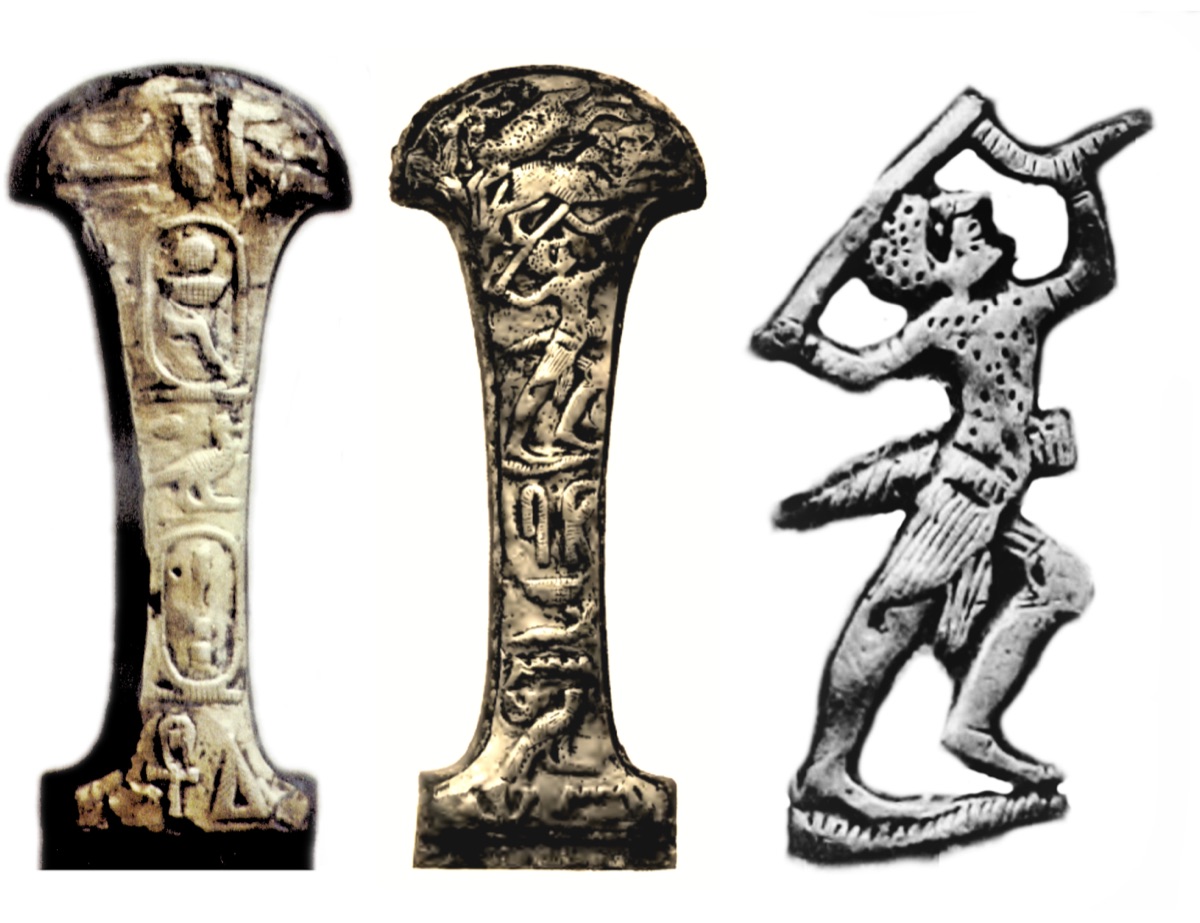
Dagger Handle of Abed, Soldier of the Hyksos Pharaoh Apepi
An inscribed dagger handle naming a soldier of the Hyksos king Apepi, a rare object bearing the name of the foreign dynasty that ruled northern Egypt in this century.
Photo: Udimu (color plate); Georges Daressy (public domain plates) / Wikimedia Commons
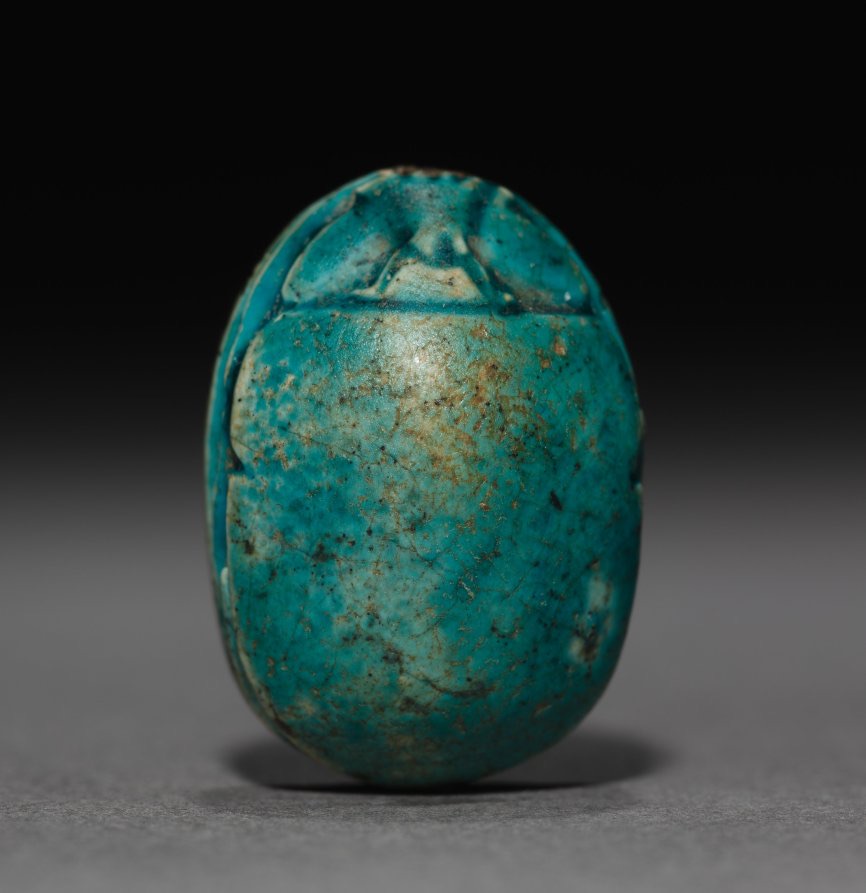
Scarab
A turquoise-glazed steatite scarab seal, the small inscribed amulet Egyptians of the Hyksos era wore and pressed into clay to mark ownership and authority.
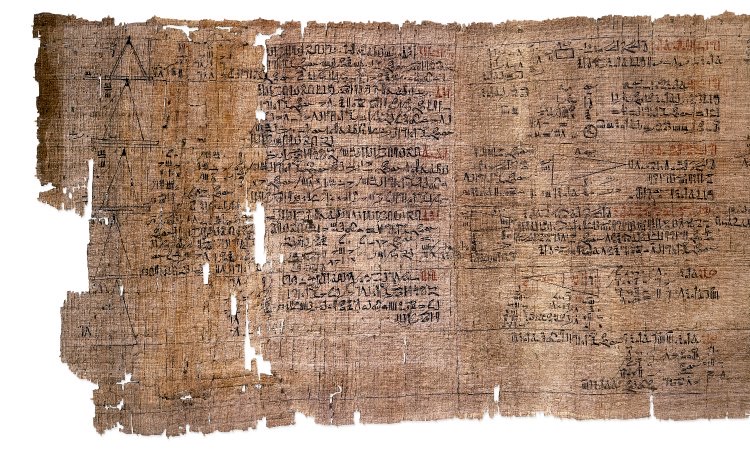
Rhind Mathematical Papyrus
A scribe named Ahmes copied this collection of arithmetic, fraction, and geometry problems from an older Middle Kingdom original, the single richest source on Egyptian mathematics.
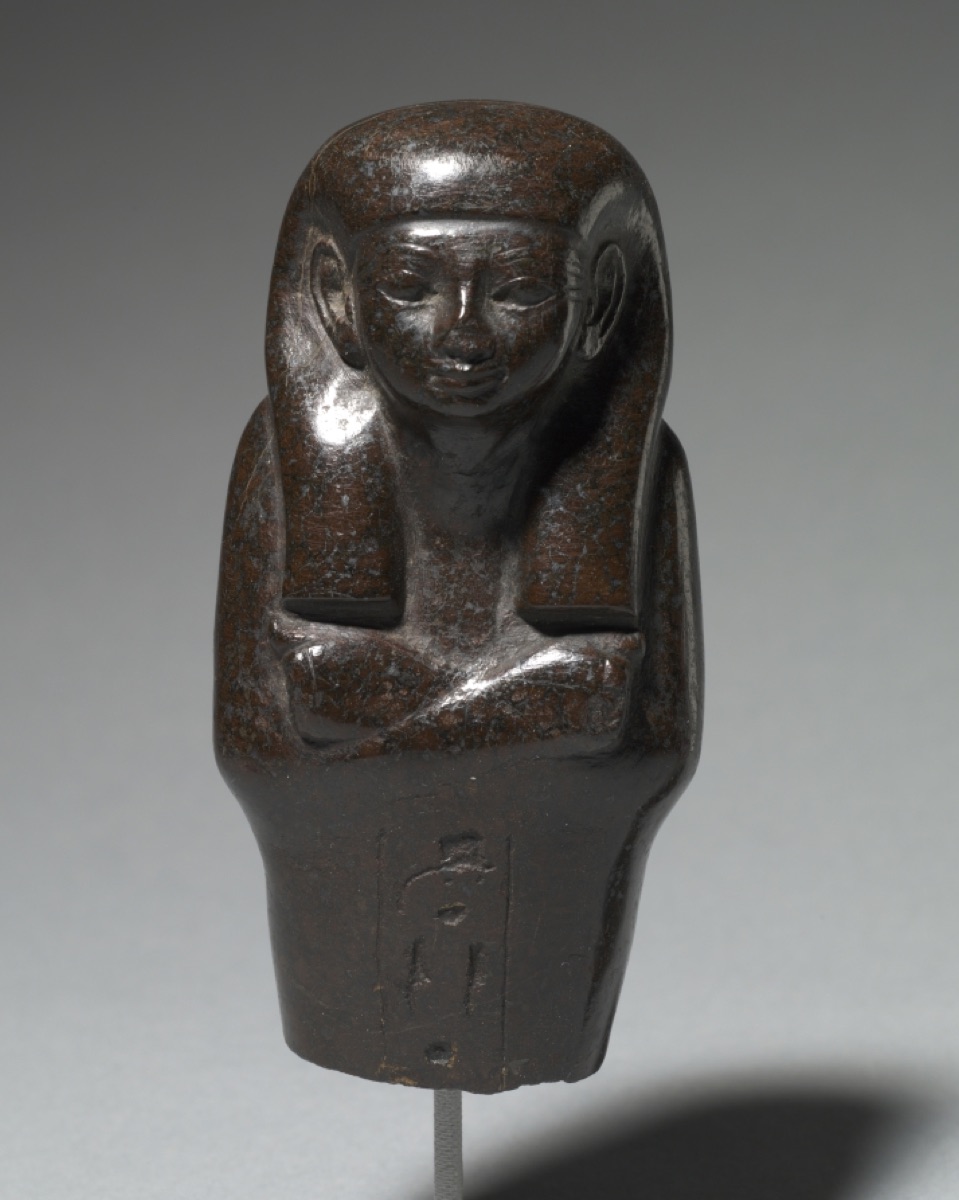
Shawabty
A hematite funerary figurine of the Middle Kingdom, Dynasties 12-13 (c. 1859-1648 BC per Cleveland's dating), made to labor in the afterlife in its owner's place.
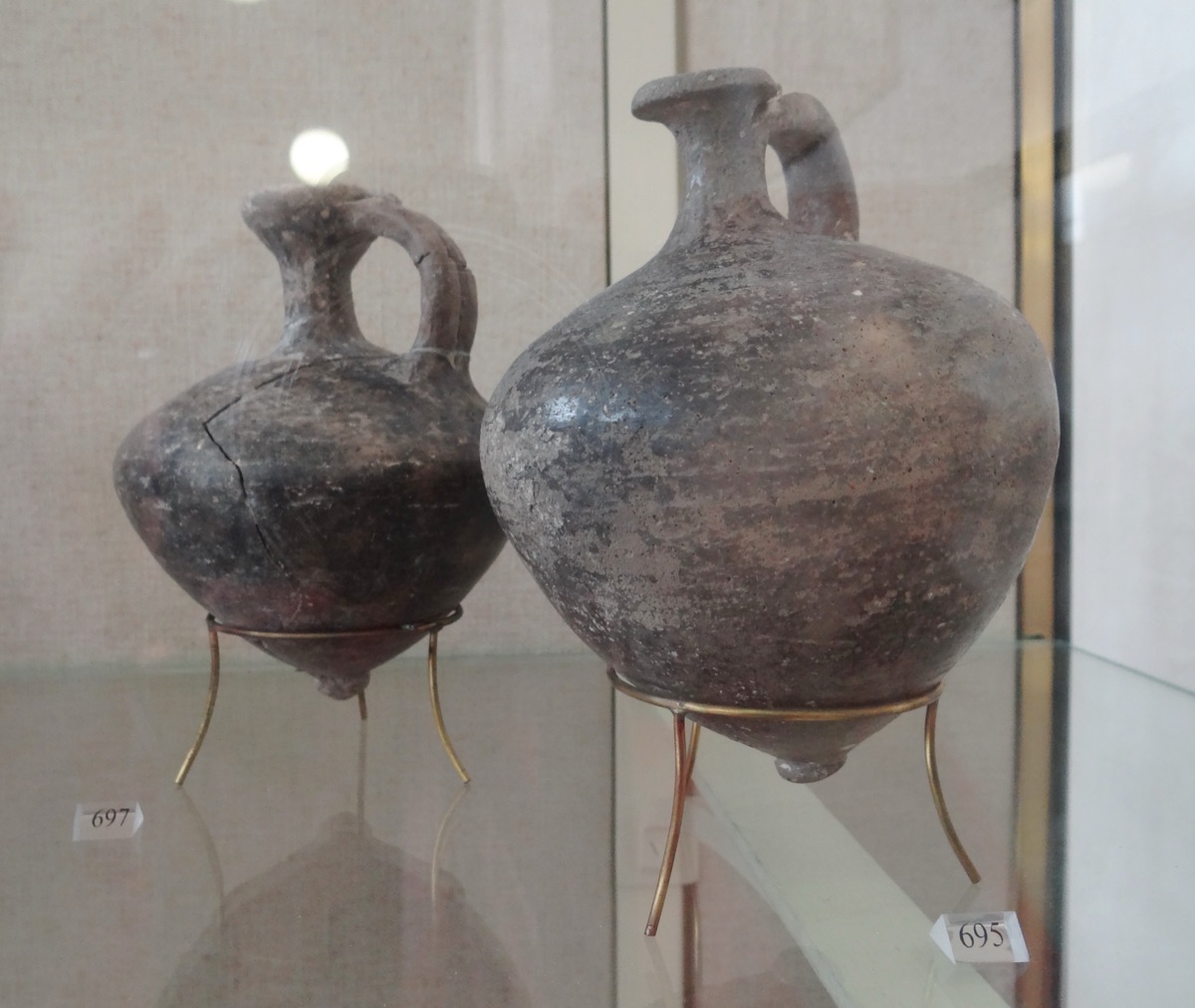
Tell el-Yehudiyeh Ware Juglets
Two small black burnished juglets decorated with punctured dot patterns, a distinctive Middle Bronze Age ware traded across the Hyksos-era eastern Mediterranean.
Photo: Hanay / Wikimedia Commons, The Rockefeller Museum, Jerusalem
New this century
- Inanna's Descent to the Netherworld
No power, divine or otherwise, passes through death without paying for it, and the poem argues that even the queen of heaven must substitute someone she loves to buy her own way back to life.
- The Farmer's Instructions
Good farming is not intuition but a fixed sequence of steps handed down as fatherly instruction, arguing that agricultural success depends on discipline and timing rather than the land's own generosity.
- Atrahasis
The gods flood the world not out of justice but irritation at human noise, and one man survives only because a god breaks his own oath to warn him.
- Westcar Papyrus
Magic performed before a king is also political theater, and its greatest wonder is a prophecy that quietly justifies a coming change of dynasty.
- Rhind Mathematical Papyrus
Practical calculation, not abstract number theory, is the purpose of mathematics: every problem exists to answer a real question about bread, beer, land, or grain.
- Hittite Laws
Punishment should fit restitution rather than retaliation, so nearly every offense in the kingdom is priced in compensation rather than answered with bodily injury.
- Myth of Telipinu
Blight and drought are the visible symptoms of a god's private anger, so the land can only be healed by a ritual that physically locates and appeases the vanishing god rather than by any human remedy.
- Illuyanka Myth
The storm god's rule over the land had to be won by defeating a serpent through trickery and mortal help, not by strength alone, and that victory must be reenacted every year to keep the world in order.
- The Venus Tablet of Ammisaduqa
Twenty-one years of recorded first and last sightings of Venus argue that celestial regularity, not just omen interpretation, was worth tracking for its own sake, laying the observational groundwork later systematized in Enuma Anu Enlil.