Time travel
20th century BC
Ur falls, and Mesopotamia breaks into rival city-states as Amenemhat I refounds Egyptian kingship; the first Cretan palaces rise and an Assyrian merchant network begins knitting the wider world together.
Mental Worlds: Evidence and Inference
A scribe trained in Isin or Larsa this century inherits a library already old. The Sumerian King List, which took shape under Ur's last dynasty a century earlier and continued to be reworked afterward, still frames kingship as something the gods lower from heaven city by city, and the Curse of Agade still explains imperial collapse as divine punishment for royal impiety, a moral he has just watched play out again in Ur's own fall. He can recite Ur-Nammu's law code and the hymns Shulgi commissioned to have himself worshipped as a living god, even though the dynasty that produced them no longer exists. His own king, Ishme-Dagan of Isin, has had new hymns written claiming that vanished prestige for himself, an act of political theater the scribe copies without necessarily believing.
He knows almost nothing of Egypt beyond trade goods and travelers' report, and an Egyptian scribe would know just as little of him. That scribe, serving the new Twelfth Dynasty, has his own recent political literature to master: the Prophecy of Neferti, staged as an ancient sage's vision but written to retroactively bless Amenemhat I's seizure of the throne, and the Instruction of Amenemhat, a posthumous voice-piece in which the murdered king warns his son to trust no one, family included. He also copies the Instruction of Merikare, generations old by now, and drills the formulaic Kemyt as a child learning to write. Egyptian literature at this date is instructional and dynastic rather than narrative; the great story-cycles, Sinuhe among them, belong to the coming decades.
A merchant traveling the roads between Ashur and Kanesh in central Anatolia knows a different world again, one measured in donkey caravans, tin, and textiles rather than royal hymns. The archive he will leave behind, thousands of private letters and contracts, has barely begun to accumulate; the system that generates it, an Assyrian trading colony embedded in a foreign city under local rulers' protection, is itself a recent and fragile arrangement. He would find nothing to read from Crete, where builders have just begun raising the first palace at Knossos, a structure whose purpose, part storehouse, part shrine, part seat of authority, is legible archaeologically but left no contemporary text to explain it in its own words.
None of these figures could read the others' scripts even where correspondence existed, and no one this century has produced anything resembling epic narrative as later ages will define it. What passes for extended literary composition is hymnic, legal, or admonitory: praise of kings and gods, codes claiming to fix just prices and punishments, advice literature staged as a father's or predecessor's voice. The great flood story that will become Atrahasis and, later, part of Gilgamesh, likely already circulates in some oral or fragmentary form, but no text of it from this century survives to prove it. Rigveda's hymns are five centuries from being composed even orally; Hammurabi's stele, the Old Babylonian Gilgamesh, and the Mari archive are all a lifetime and more away. What exists instead is a set of regional literatures, Sumerian, Akkadian, Egyptian, each serving its own scribal bureaucracy, unaware how thoroughly later centuries will braid Mesopotamian and Levantine material together into shared story-cycles. For now, the furthest any single mind's reading plausibly reaches is a few hundred miles and, at best, a few centuries back.
The political map
Major Polities and Cultural Regions
- Middle Kingdom Egypt Nile valley from the Delta to the First Cataract, newly reunified under the Twelfth Dynasty
- Isin and Larsa Rival successor kingdoms contesting the Mesopotamian heartland after Ur's collapse
- Elam Highland power east of Mesopotamia, centered on Susa and Anshan
- Indus Valley civilization Mature Harappan cities along the Indus, past their peak and beginning a slow decline
- Minoan Crete First palace centers rising at Knossos, Phaistos, and Malia
Borders are approximate scholarly reconstructions from historical-basemaps (GPL-3).
State of the domains
Texts and Written Culture
Sumerian royal hymnody survives Ur's fall: Ishme-Dagan of Isin has scribes compose hymns claiming the dead empire's prestige for his rump kingdom, while laments already circulating mourn a lost golden age. In Egypt the new Twelfth Dynasty commissions the Prophecy of Neferti, a fictional sage's vision retrofitted to predict Amenemhat I's own accession, and the Instruction of Amenemhat, purporting to be the murdered king's posthumous warning to his son against trusting anyone. Scribal schools copy the Instruction of Merikare, an older king's political testament, and Kemyt, a formulaic primer that will train Egyptian bureaucrats for centuries to come, still being copied in school exercises seven hundred years later.
Art
Egypt's newly founded Twelfth Dynasty revives Old Kingdom sculptural and relief models at Karnak and Abydos after a century of provincial improvisation, its royal portraiture under Amenemhat I and Senusret I still idealizing rather than the careworn realism later Twelfth Dynasty kings will adopt. On Crete the first palaces rise at Knossos, Phaistos, and Malia, organizing storage, ritual, and craft production around open central courts, the opening move of a distinct Aegean artistic tradition. Mesopotamian cylinder seals from Isin and Larsa keep the repetition-heavy presentation scenes of the Ur III chancery, without its former unity.
Medicine
No medical text survives from this century itself; the Egyptian medical papyri that exist today are later copies, and nothing comparable has yet been found from Isin-Larsa Mesopotamia. What can be said rests on later, retrospective evidence and general knowledge of the period: healing was folded into temple and household ritual, treating illness as a matter of divine anger, demonic attack, or bodily imbalance addressed through incantation alongside practical treatment. Egyptian and Mesopotamian physicians already draw on centuries of accumulated observation, but the earliest texts that let a reader see their methods directly belong to later centuries.
Science
Mesopotamian administration runs on a mature sexagesimal number system, dividing weights, measures, and time-reckoning into sixties and their multiples, a legacy of Ur III bureaucratic record-keeping now inherited piecemeal by Isin and Larsa scribes. Egyptian surveyors and treasury officials use their own fraction system for grain and land accounts, the tradition that later produces the Rhind and Moscow papyri. Systematic astronomy has not yet appeared; the sky is watched for omens and calendar-keeping rather than measured. Mathematics at this date is a practical craft embedded in administration and construction, not yet a subject written about for its own sake.
Military
Chariot warfare has not yet arrived; armies fight on foot with bronze-tipped spears, axes, and simple or, in some depictions, composite bows, organized around city levies rather than professional standing forces. Ur's fall left no single Mesopotamian power able to dominate the others, so Isin and Larsa contest the old imperial heartland in a slow, indecisive rivalry that will run for two more centuries. Egypt's Twelfth Dynasty, by contrast, consolidates: Amenemhat I builds fortresses along the eastern Delta frontier and pushes control southward into Nubia, the start of a state-directed military buildup his successors will extend as far as the Second Cataract.
Technology
Bronze remains the working standard for tools and weapons across the Near East, alloyed from copper and tin routed through long-distance networks whose sources are still not fully mapped by archaeologists. Mesopotamian irrigation canals, silted and neglected during Ur's collapse, are being reclaimed piecemeal by Isin and Larsa. Egypt continues large-scale stone quarrying and canal work tied to Nile flood management. Writing itself is a technology in active use: cuneiform on clay across Mesopotamia, hieroglyphic and hieratic on papyrus and stone in Egypt, each system already centuries old and administratively indispensable.
Material world
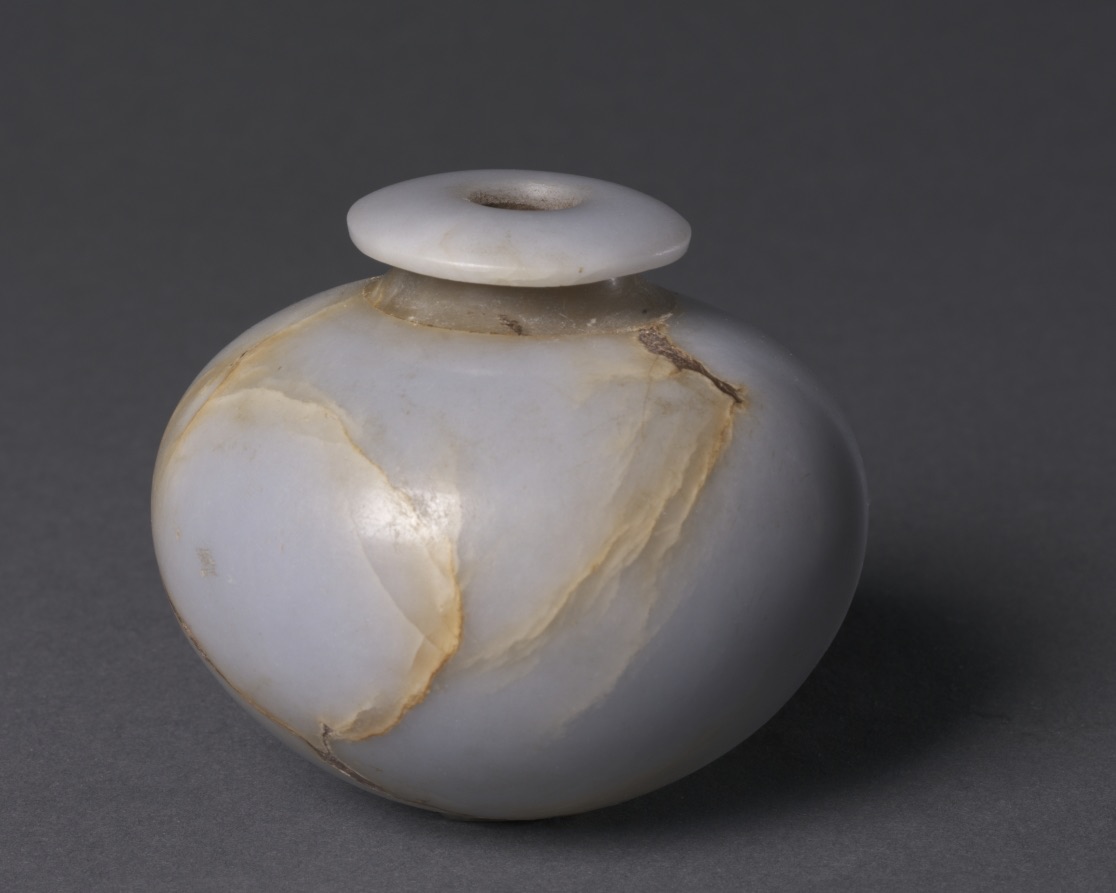
Cosmetic Vessel
A small anhydrite jar for cosmetics or unguents, carved from a hard, translucent stone favored by Middle Kingdom lapidaries for funerary vessels.
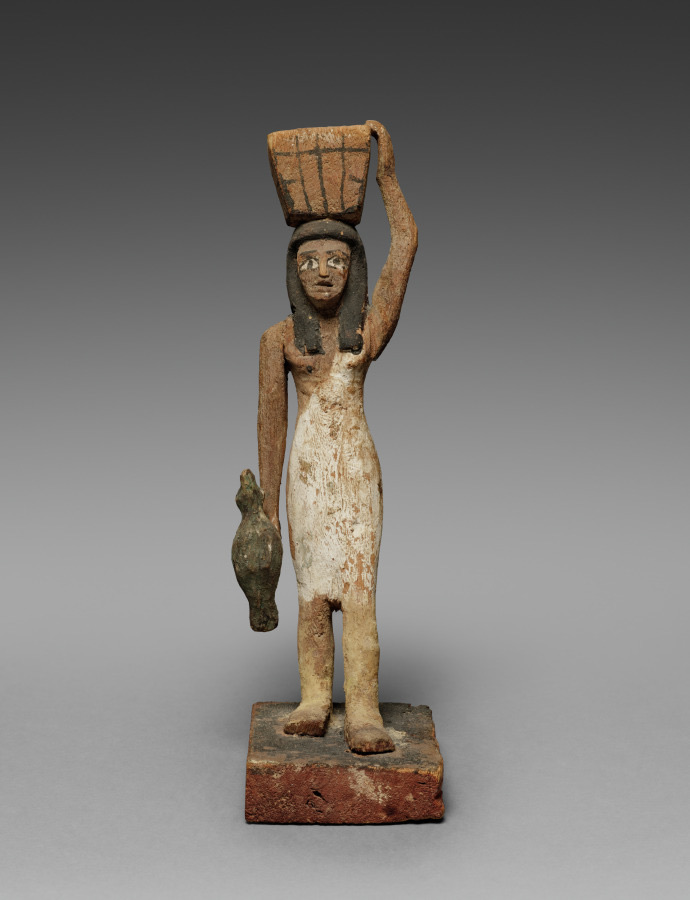
Female Offering Bearer
A painted wooden tomb figure carrying a basket and duck, part of the model servants Middle Kingdom Egyptians buried with the dead to provision them forever.
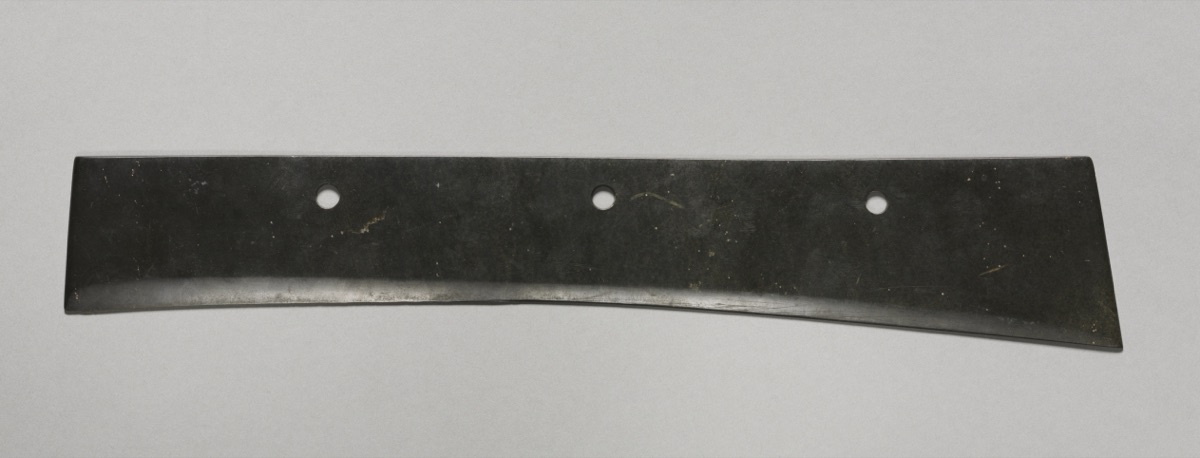
Ceremonial Blade with Three Perforations (Dao)
A jade blade too fine for combat, translating a working knife into the polished nephrite that Bronze Age China's Qijia culture reserved for rank and ritual.

AI reconstruction
Qijia ceremonial jade blade - reconstruction
A ceremonial dao blade of the Qijia culture of northwest China as it left the workshop: a long, thin, slightly curved sheet of dark green nephrite, ground and polished until its edges turn faintly translucent, with three small perforations drilled along the spine for cords or mounting. Never meant to cut, it translated the form of a working knife into the material reserved for rank and ritual.
AI reconstruction (2026), based on Ceremonial Blade with Three Perforations (Dao), The Cleveland Museum of Art
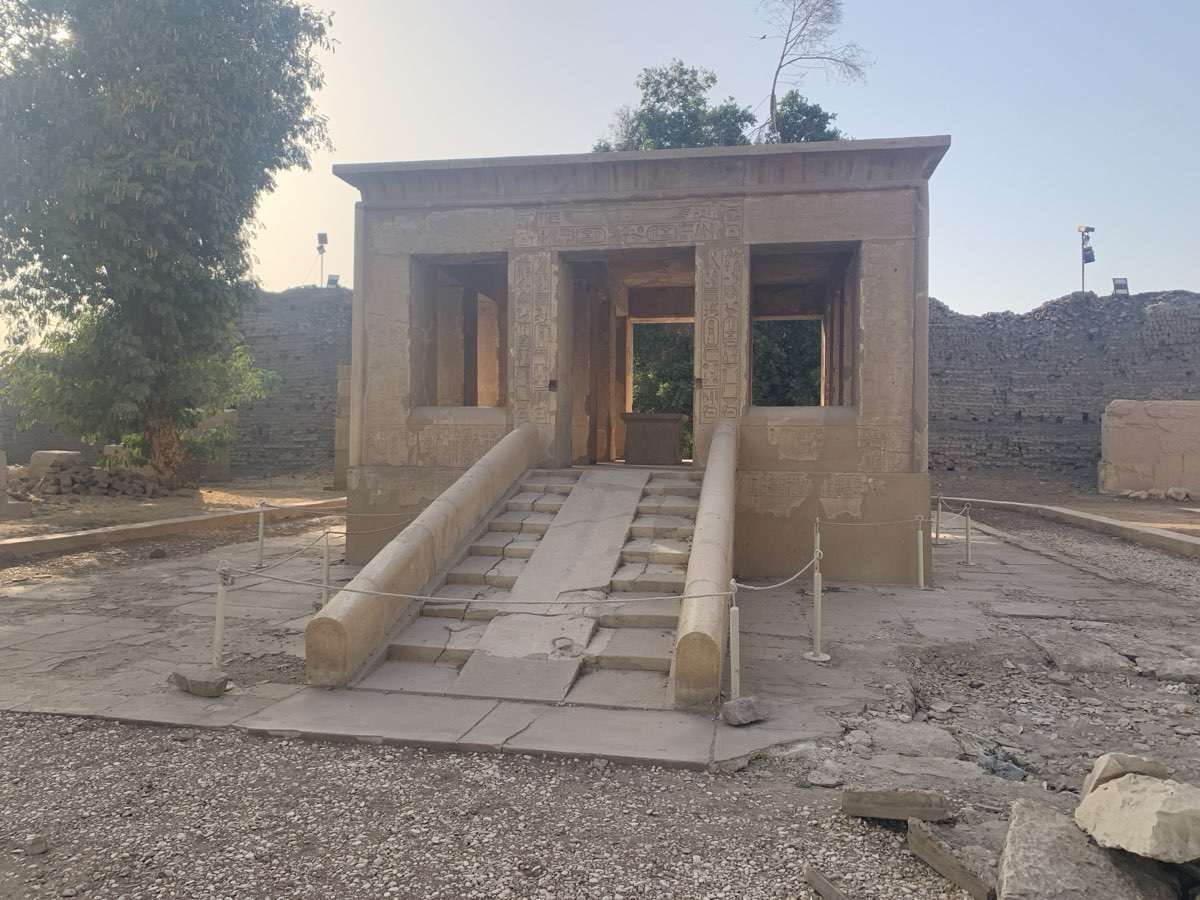
White Chapel of Senusret I, Karnak
A limestone way-station built by Senusret I at Karnak, reconstructed from blocks later reused as fill inside a pylon of Amenhotep III.
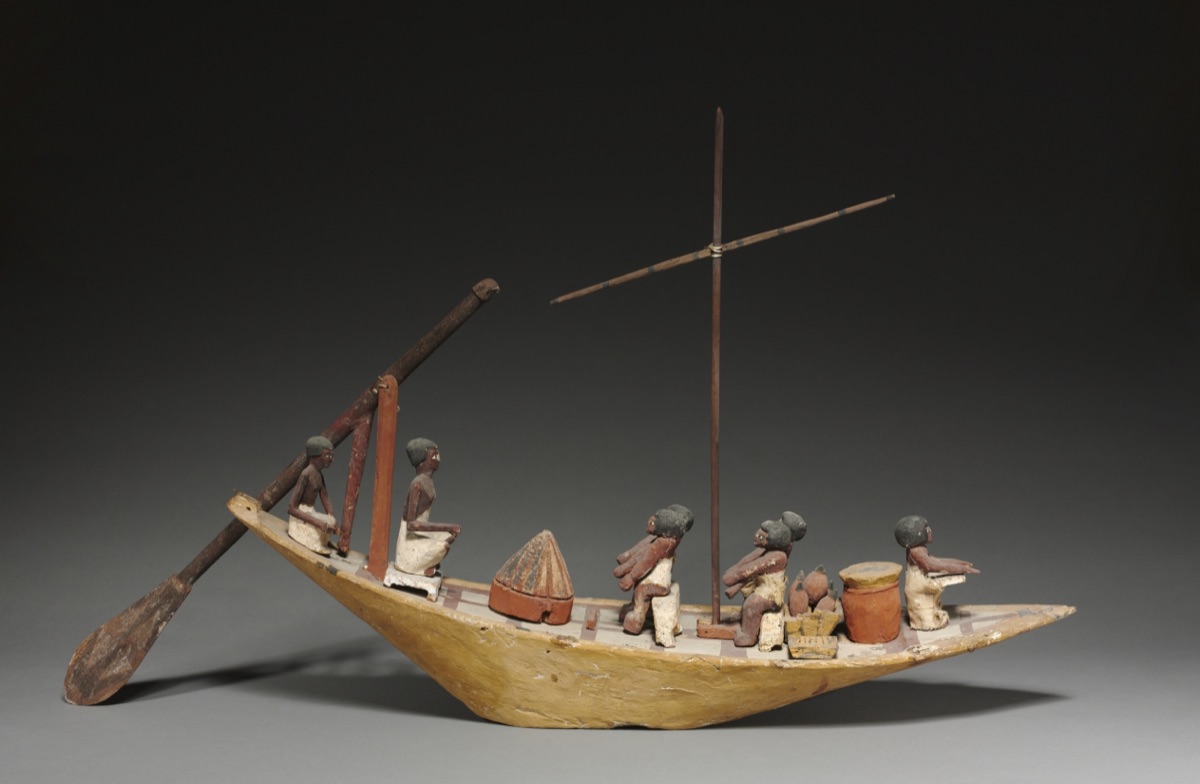
Model Boat
A gessoed and painted model of a Nile riverboat, placed in a tomb so its owner could sail and be towed across the water in the next world as in this one.
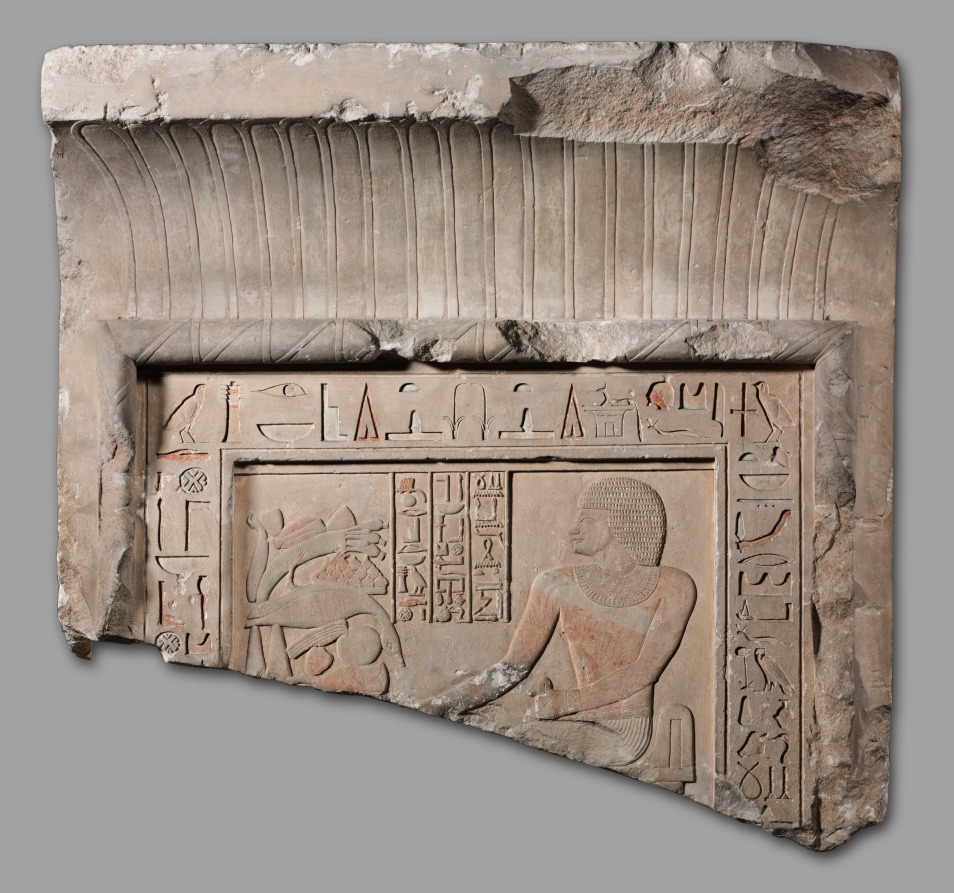
Stele of Shemai
A painted limestone offering stele from a rock-cut tomb at Qubbet el-Hawa, inscribed with the standard funerary formula asking Osiris for bread and beer in the afterlife.
New this century
- Cretan Hieroglyphic and Linear A
Minoan Crete developed two related but distinct scripts, Cretan Hieroglyphic and Linear A, to record palace and sanctuary transactions in numbers, commodities, and personal or divine names whose underlying language, or languages, still cannot be securely identified.
- Prophecy of Neferti
A kingdom in chaos will right itself only through a savior king whose arrival is foreordained, and the current king's rule can be read backward into that same prophecy.
- Instruction of Amenemhat
Trust no one, not even a brother or a friend raised up by your own hand, because betrayal comes from those closest to the throne.
- Code of Lipit-Ishtar
A Sumerian-language code from the Isin dynasty argues that a king renews his legitimacy through divinely commanded justice, echoing the prologue formula of Ur-Nammu's earlier code and presenting law as inherited tradition rather than personal invention.