Time travel
32nd century BC
In Egypt, ivory and bone labels multiply into something like a royal name-and-title system, while at Uruk scribes compile the first known standardized list of professions.
Mental Worlds: Evidence and Inference
By this century a ruler in Upper Egypt has a name that can be written down, enclosed in a rectangular frame beneath a falcon, and attached to the goods buried with him. That single fact marks a real, if narrow, expansion of what writing can do. A person who could read the tags in a royal tomb at Abydos now learns not just how much oil or linen was delivered but whose household received it, which is to say, writing has started to fix identity as well as quantity. It has not yet fixed a claim, a story, or an argument; the serekh names a king the way a label names a jar, but it does so with a permanence that outlasts the king's own memory of himself.
At Uruk, a different but related step is underway. Scribes are compiling and copying a list of official titles in a fixed order, high to low, an exercise that looks, on its surface, like nothing more than administrative housekeeping. But the list is copied by trainee scribes as a memorization text, meaning that for the first time a piece of writing exists specifically to train the next generation of writers rather than to record a single transaction. This is a small but real hinge: writing is starting to reproduce itself as a craft, passed formally from teacher to pupil through a fixed curriculum, rather than only accumulating one tablet at a time as circumstances require.
Neither development would look like literature to a later reader. There is no first-person voice this century anywhere in the world, no complaint, no prayer, no boast beyond the bare assertion of a name inside a frame. What a literate person of this century actually knows how to do is narrow and technical: read a title, recognize a royal name, tally a quantity against a standard measure. The interior life such a person carried, opinions about the harvest, fear of a rival lineage, affection for a child, had no available written form and left this century exactly as it entered it, unrecorded.
Outside the two river valleys, nothing changes. Farming and herding communities from the Indus system to the Iranian plateau to the Aegean continue lives organized by kinship, season, and oral tradition, untouched by and almost certainly unaware of what a handful of scribes at Uruk and Abydos are doing with clay and ivory. There is no reason to think these unlettered societies were intellectually poorer for it; complex social organization, technical skill in metalwork and textile production, and rich oral culture all flourished without writing, and would go on doing so in most of the world for millennia yet. What distinguishes Uruk and Abydos this century is not depth of thought but a new and still narrow tool, one just beginning to learn how to hold a name, rather than only a number, in place.
The political map
Major Polities and Cultural Regions
- Uruk and its trade colonies Southern Mesopotamian temple-city network extending administrative practice into Syria, Anatolia, and Iran.
- Susa (proto-Elamite sphere) Lowland Iranian center in continued trade contact with Uruk, still without its own script.
- Naqada Egypt (late predynastic) Upper Egyptian rulers based at Abydos, using the serekh and organized iconography of kingship, on the edge of unification.
- Indus valley farming communities Kot Diji and related pre-urban cultures of the Indus system; still no cities or script.
Borders are approximate scholarly reconstructions from historical-basemaps (GPL-3). Nearest available basemap anchor year: 3000 BC.
State of the domains
Texts and Written Culture
Two developments push writing slightly past pure tallying without yet producing a sentence. At Uruk, scribes compile what modern scholars call the Standard Professions List, an ordered catalogue of official titles from the highest to the lowest, copied and recopied by trainee scribes as a memorization exercise; it is the oldest known lexical list and will still be copied a thousand years later. In Egypt, the ivory and bone tags from royal tombs at Abydos increasingly pair a ruler's name, written inside a rectangular serekh frame topped by a falcon, with a place name or commodity, an early, formulaic use of writing to fix a specific person's identity rather than only a quantity.
Art
Egyptian royal iconography consolidates around the serekh, a rectangular frame representing a palace facade topped by the falcon god Horus and enclosing a ruler's name, the earliest durable emblem of Egyptian kingship. Decorated ceremonial objects, carved ivory combs, cosmetic palettes, and knife handles, increasingly show organized registers of animals, boats, and human figures rather than scattered imagery. At Uruk, cylinder seal design grows more standardized around recurring scenes of temple economy and procession, and monumental cone-mosaic facades continue to mark the city's ceremonial buildings as the largest built structures anywhere in the world this century.
Medicine
Nowhere this century does a text explain illness, injury, or the body; only bones speak, and only in general terms. Egyptian and Mesopotamian skeletal remains continue to show healed fractures and the wear of manual labor, the ordinary signature of hard agricultural and construction work rather than any documented complaint. Claimed cases of trepanned Egyptian skulls this early are often disputed on closer study, post-mortem damage or later intrusive burials rather than genuine surgery, so the operation is better treated as a Neolithic-era phenomenon attested more securely elsewhere than as routine dynastic practice here. None of this is explained or theorized in writing, a gap that will remain total in both regions for well over a thousand years.
Science
The Standard Professions List at Uruk is, among other things, an act of classification, imposing a fixed hierarchical order on the offices of a temple economy, and lexical lists of this kind will become the seedbed of later Mesopotamian scholarship. Numerical and metrological notation continues to be refined as trade and taxation grow more complex. In Egypt, the increasingly formulaic ivory tags suggest a stabilizing calendar and administrative year, since some tags appear to record events tied to a ruler's reign rather than only goods. Neither tradition yet asks why the natural world behaves as it does; both are occupied with ordering what is already known.
Military
Egyptian ceremonial objects from this period, cosmetic palettes and macehead fragments among them, depict bound captives, smiting rulers, and processions of standard-bearers, iconography that will crystallize within a few generations into the Narmer Palette's canonical scene. Whether these images record specific campaigns or assert a general royal ideology of conquest is debated, but the visual language of Egyptian kingship as martial dominance is already fully formed. In Mesopotamia, fortification at Uruk's colony sites in the north continues, and the geographic reach of Uruk's trade network implies organized protection of caravans and river transport, though no text describes a battle or names an enemy.
Technology
Copper metallurgy continues to spread across both regions, and Egyptian craftsmen achieve increasingly fine ivory and stone carving, visible in the elaborate ceremonial palettes and combs of the period. Faience, a glazed quartz-based material, is manufactured in Egypt for beads and small amulets. In Mesopotamia, standardized bevel-rim bowls remain the basic tool of institutional rationing, evidence of a labor system organized around fixed daily allotments of food. Wheeled vehicles, attested through model wagons and seal imagery, are now an established feature of transport in the Uruk sphere, complementing river transport on the Euphrates and Tigris and boat-based transport on the Nile.
Material world
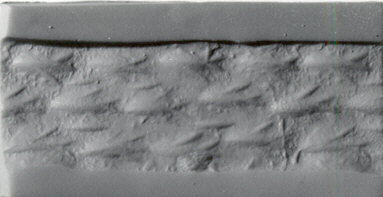
Cylinder Seal (Late Uruk-Jemdet Nasr)
A calcite cylinder seal from the transitional Late Uruk-Jemdet Nasr period, rolled across wet clay to authenticate goods and seal storerooms.
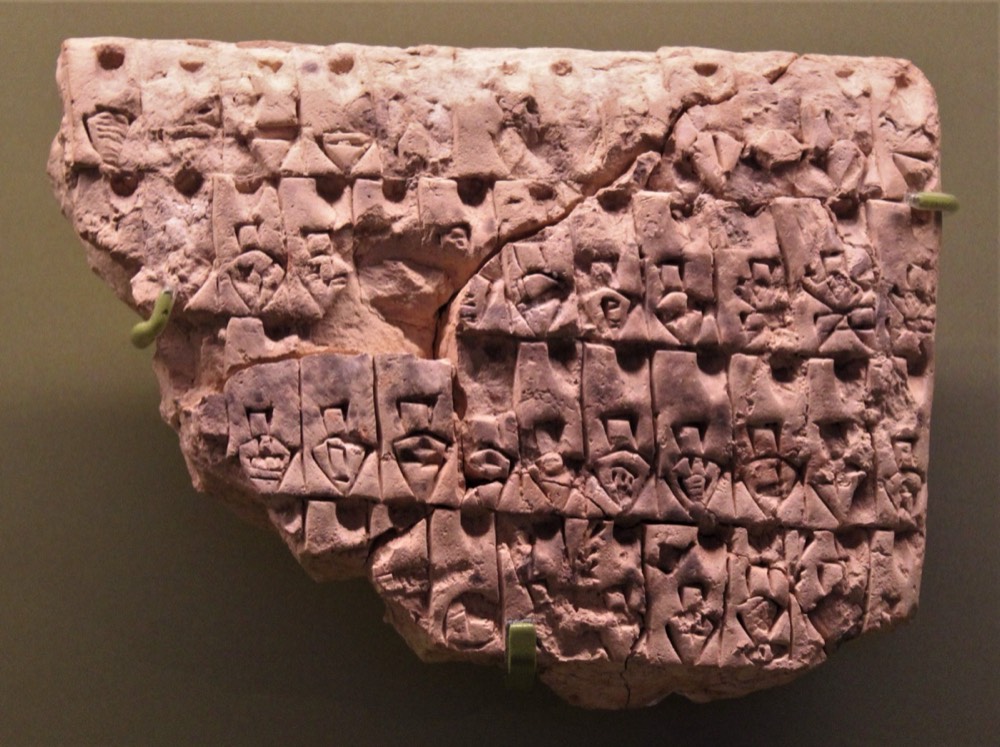
Lexical List of Vessels
A fragmentary training tablet listing vessel types by pictogram, part of the standardized word-lists Sumerian scribes memorized as writing was still taking shape.
Ashmolean Museum, 1928.445b. Photo: Zunkir, via Wikimedia Commons
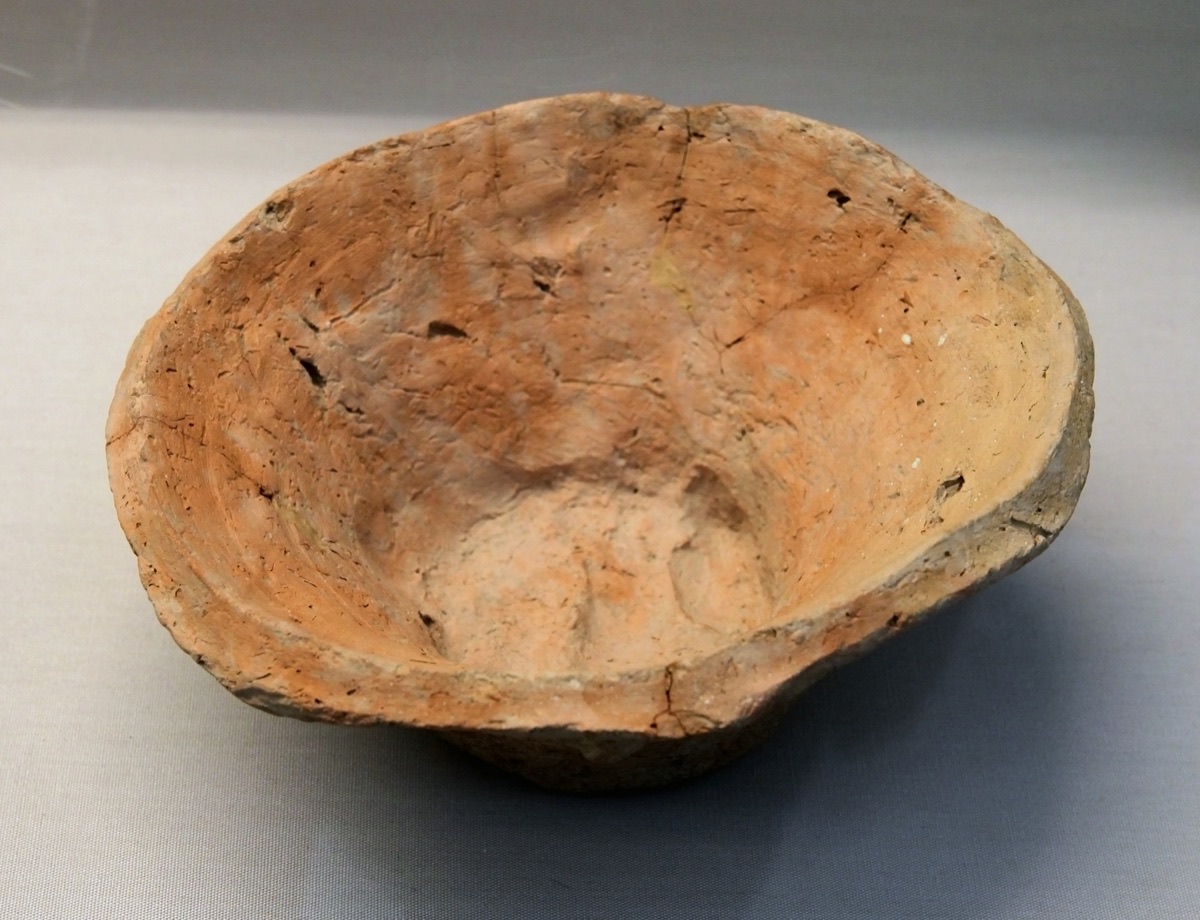
Beveled Rim Bowl (Nineveh)
A second beveled rim bowl, this one from Nineveh in the north, showing how far the standardized Uruk ration-bowl form spread beyond southern Mesopotamia.
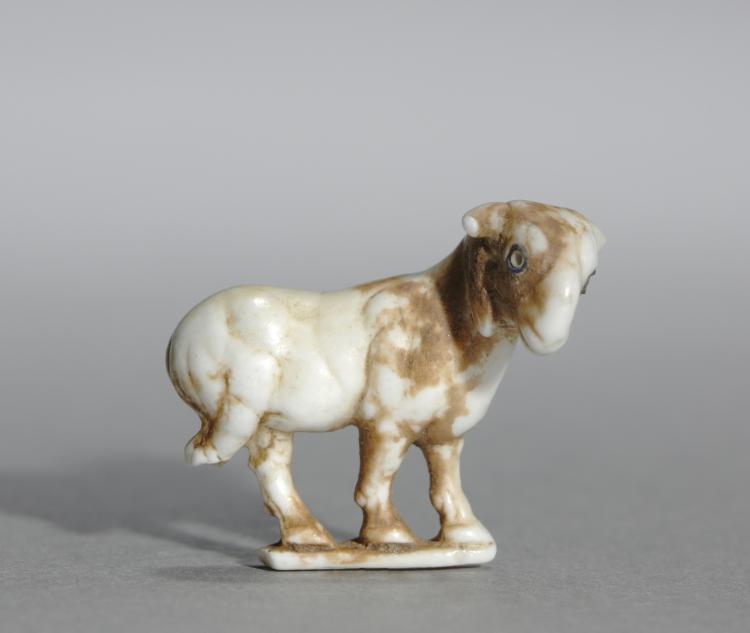
Striding Goat
A small figure of a striding goat with Egyptian blue inlay, part of the animal-form votive and amuletic tradition that runs through early Sumerian art.
New this century
No corpus entries yet from this century.
The canon by now
No tier-one work in the corpus predates this century.