Time travel
2nd century AD
By 180 AD the Roman peace that opened this century, Ptolemy's heavens fixed, Galen's body mapped, has visibly started to strain under plague and a war its philosopher-emperor never wanted to fight.
Mental Worlds: Evidence and Inference
This is the century two of antiquity's most totalizing intellectual systems reach their mature form, both within Rome's orbit and both destined to outlive the empire that gave them room to work. Ptolemy, at Alexandria, compiles the Almagest, a mathematical account of planetary motion so thorough and internally consistent that astronomers keep using its earth-centered model, epicycles and all, for the next fourteen hundred years, alongside a Geography assigning coordinates to thousands of places across the known world. Galen, physician to the imperial court at Rome, builds an equally comprehensive system out of anatomy, physiology, and Hippocratic humoral theory in treatises like On the Natural Faculties, restricted to animal dissection by custom and taboo rather than any attested law, but rigorous enough within that constraint to dominate medical thinking in both the Christian and Islamic worlds for a millennium afterward.
Marcus Aurelius, ruling through most of this same period, spends much of his reign not in Rome but on campaign along the Danube fighting the Marcomannic Wars, and writes the Meditations as a private notebook of Stoic self-instruction between engagements, never intending it for publication. The same years bring the Antonine Plague, often hypothesized to have been smallpox, with measles and other diagnoses also proposed though no identification is secure, carried home by troops returning from a Parthian campaign and killing a substantial share of the empire's population, a catastrophe that strains the legions, the treasury, and the emperor's own equanimity all at once. Rome at this century's opening looks like it has reached a stable, prosperous peak under Trajan and Hadrian; by the century's end, under Marcus Aurelius's son Commodus, the strain is unmistakable.
In China, a comparable figure works the same general problem, an unpredictable natural world, from an entirely different institutional position. Zhang Heng, serving the Han court as astronomer and engineer, invents a seismoscope that registers the direction of distant earthquakes using a pendulum mechanism and a set of dropped bronze balls, and improves the armillary sphere used for astronomical observation, achievements attested by later Chinese official histories rather than by any surviving treatise in his own hand. The Han court he serves is itself under mounting strain from factional struggle between eunuchs and consort clans, strain that erupts into the Yellow Turban Rebellion by the century's final years, a domestic collapse running roughly parallel in timing, if not in cause, to Rome's own troubles under Marcus Aurelius and Commodus, and overlapping with epidemic outbreaks of its own the Han court records independently of anything happening in the Roman world.
At Gandhara, on Kushan territory straddling the old trade corridor between these two exhausted centers of gravity, and at Mathura farther south, sculptors produce the first anthropomorphic images of the Buddha in these same decades, which workshop got there first still argued over among art historians. Gandhara's workshops combine a local South Asian Buddhist subject matter with visual conventions shaped by Hellenistic, Iranian, Central Asian, and Roman-period artistic worlds alike, the relative contribution and route of each influence still argued over by art historians. It is a rare instance this century of actual technique, not just goods or rumor, crossing a real cultural boundary; Rome and Han China themselves remain, as in the century before, aware of each other mostly as names attached to a trade good, apart from one party recorded in 166 as claiming to come from the court of a ruler called Andun and reaching Rinan, almost certainly merchants trading on the name rather than any actual embassy.
The political map
Major Polities and Cultural Regions
- Roman Empire Peak territorial extent under Trajan, then tested by plague and war under Marcus Aurelius
- Parthian Empire Iran and Mesopotamia, repeatedly invaded by Rome, visibly weakening
- Han Empire China, prosperous at century's opening, eroded by court factionalism by its close
- Kushan Empire Bactria to northern India, at its height under Kanishka
- Kush Nile valley south of Egypt, Meroe still trading iron and ivory down the Nile toward Roman Egypt
Borders are approximate scholarly reconstructions from historical-basemaps (GPL-3). Nearest available basemap anchor year: AD 100.
State of the domains
Texts and Written Culture
Marcus Aurelius writes the Meditations in Greek as a private notebook of Stoic self-address, never intended for publication. Lucian writes satirical dialogues and the fantastical True History; Apuleius writes the only complete Latin novel to survive from antiquity, the Metamorphoses; Aulus Gellius compiles the miscellany Noctes Atticae. Arrian writes the Anabasis of Alexander, the best surviving ancient account of Alexander's campaigns, drawing on now-lost eyewitness sources. Justin Martyr defends Christian belief to a Roman audience in the First Apology. In India, Nagarjuna's Mulamadhyamakakarika reworks Buddhist emptiness into a rigorous philosophical system, and Buddhist scripture, freshly arrived from Central Asia, begins circulating in small circles at Luoyang.
Art
Trajan's Column, completed early in the century, wraps a continuous narrative relief of the Dacian Wars around a hundred-foot shaft, without real precedent at that scale. Hadrian's Pantheon rebuilds Rome's temple to all the gods with the largest unreinforced concrete dome built before the modern era. Portrait sculpture under Hadrian and the Antonines favors a Hellenizing, bearded, philosophical ideal over the previous century's severe verism. Gandhara and Mathura both begin producing anthropomorphic images of the Buddha in these decades, priority between the two workshops still argued over; Gandharan workshops combine South Asian Buddhist subject matter with visual conventions from Hellenistic, Iranian, Central Asian, and Roman-period artistic worlds, the relative contribution of each still debated. In the Valley of Mexico, equally unconnected, Teotihuacan raises its Pyramids of the Sun and Moon as the city takes shape around what will become the Avenue of the Dead.
Medicine
Galen, physician to the imperial court, writes On the Natural Faculties and On the Usefulness of the Parts of the Body, synthesizing and extending Hippocratic humoral theory into a comprehensive anatomical and physiological system that dominates Western and Islamic medicine for over a thousand years afterward. In China, Zhang Zhongjing writes the Shanghan Lun, the Treatise on Cold Damage, systematizing diagnosis and herbal treatment for epidemic fever in direct response to devastating outbreaks among his own extended family, in years that overlap with epidemic disease recorded independently at the Han court, though whether the two outbreaks share a common origin is not established.
Science
Ptolemy compiles the Almagest at Alexandria, a mathematical model of planetary motion using an earth-centered system with epicycles that remains astronomy's working standard for fourteen centuries, and pairs it with a Geography cataloging coordinates for thousands of places across the known world. Galen's anatomical program, though restricted to animal dissection by custom and taboo rather than any attested law, remains the era's most systematic empirical medical science. In China, mechanical and seismological invention proceeds alongside the era's historiography, though no single scientific treatise from this specific field dominates the corpus record for the century.
Military
Trajan pushes Roman territory to its greatest extent, annexing Dacia and briefly Mesopotamia before his successor Hadrian withdraws to more defensible frontiers and builds his namesake wall in Britain. The Marcomannic Wars, fought along the Danube from 166 to 180, force Marcus Aurelius to spend much of his reign on campaign, writing the Meditations from military camps between engagements. The Antonine Plague, brought back by troops from the Parthian campaign, devastates the legions as much as any enemy does. In China, corruption and factional struggle at the Han court erode central authority through the century's second half, culminating in the Yellow Turban Rebellion of 184.
Technology
Roman engineering peaks with Trajan's bridge over the Danube and continued aqueduct and road building across the provinces. Ptolemy's astronomical tables require and reflect increasingly sophisticated trigonometric calculation. In China, the polymath Zhang Heng, working at the Han court, invents a seismoscope that registers the direction of distant earthquakes using a pendulum and dropped balls, and improves the armillary sphere for astronomical observation, inventions attested by later Chinese histories rather than by a surviving treatise of his own in this corpus. Galen's surgical technique for the era's gladiatorial and battlefield wounds refines earlier Hellenistic practice considerably.
Material world
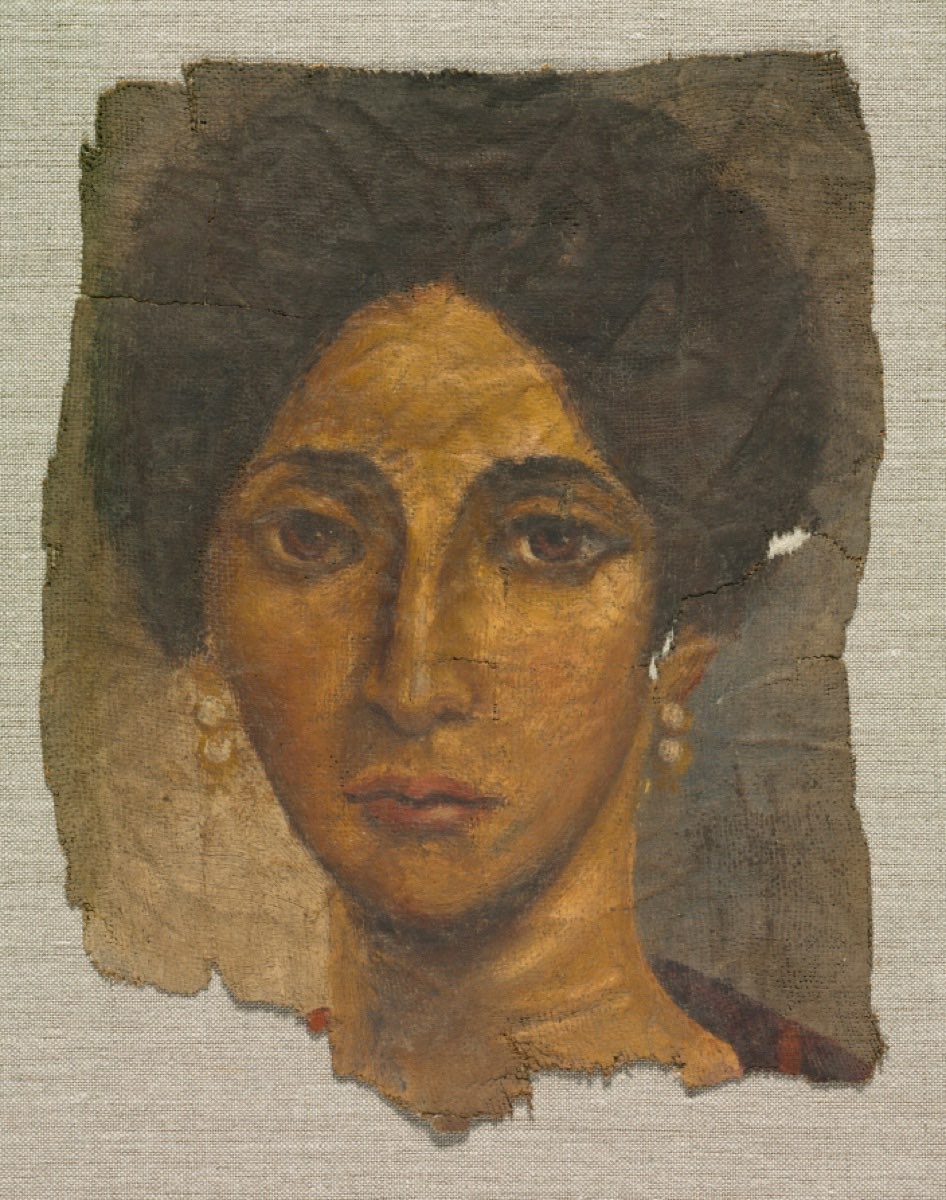
Funerary Portrait of a Woman
An encaustic portrait on linen, trimmed from its frame and bound to a mummy at burial, part of the Fayum tradition that let Roman Egyptians face the afterlife with an unmistakably individual likeness.
The Cleveland Museum of Art, John L. Severance Fund, 1971.136
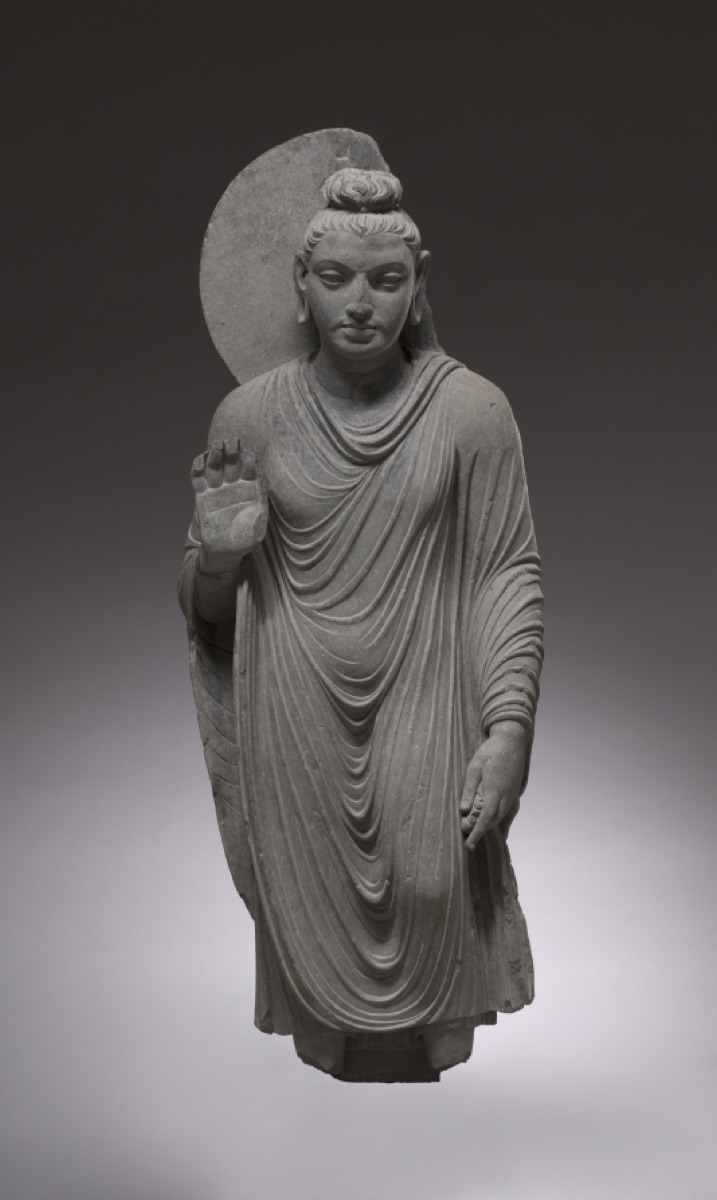
Standing Buddha
A grey schist Buddha carved under the Kushans, its South Asian Buddhist subject rendered in visual conventions shaped by Hellenistic, Iranian, Central Asian, and Roman-period artistic traditions, the relative contribution of each still debated.
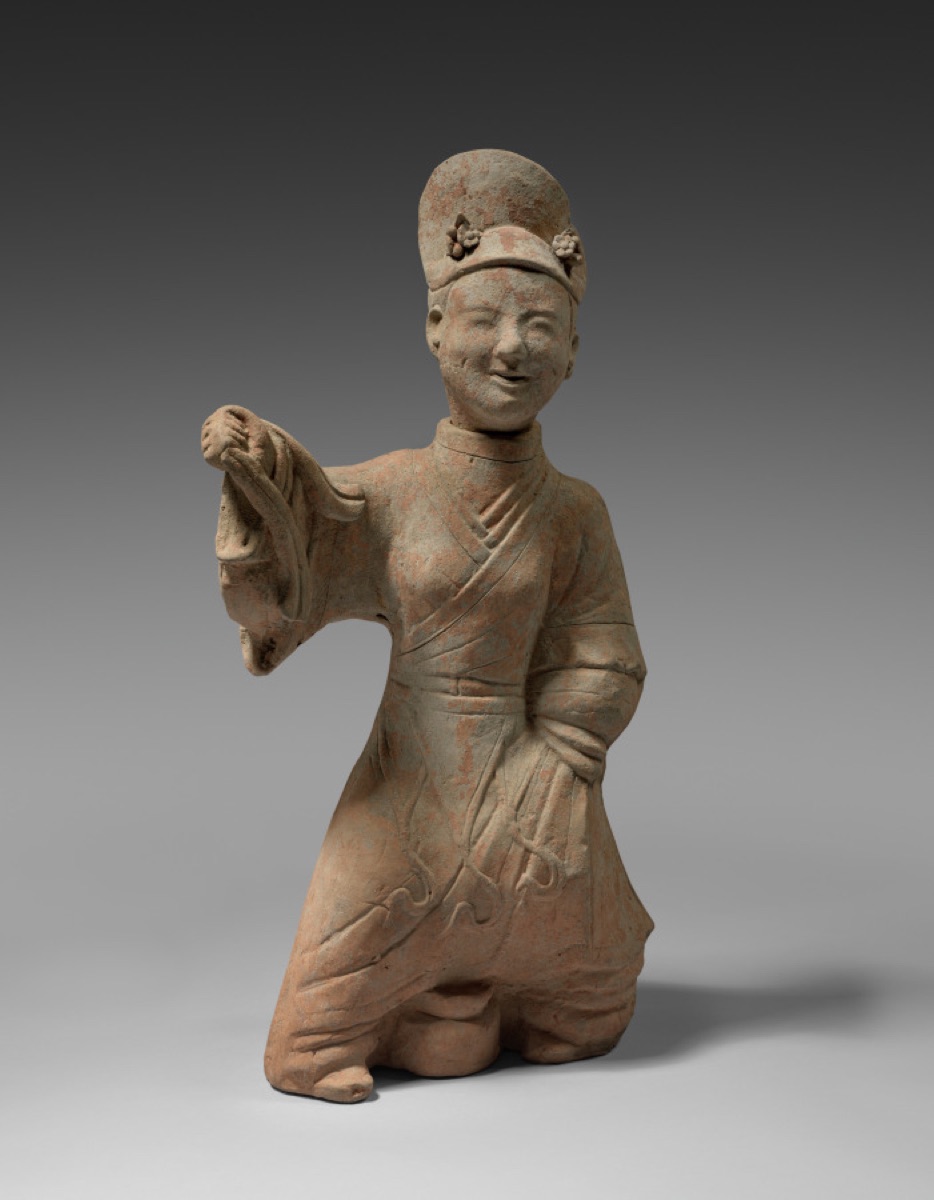
Female Figure of a Court Entertainer Dancing
An earthenware tomb figure of a dancer caught mid-motion, made to entertain a Han official in the afterlife the way she had at his table in life.
The Cleveland Museum of Art, Gift of Barbara S. Robinson and Family, 2023.98
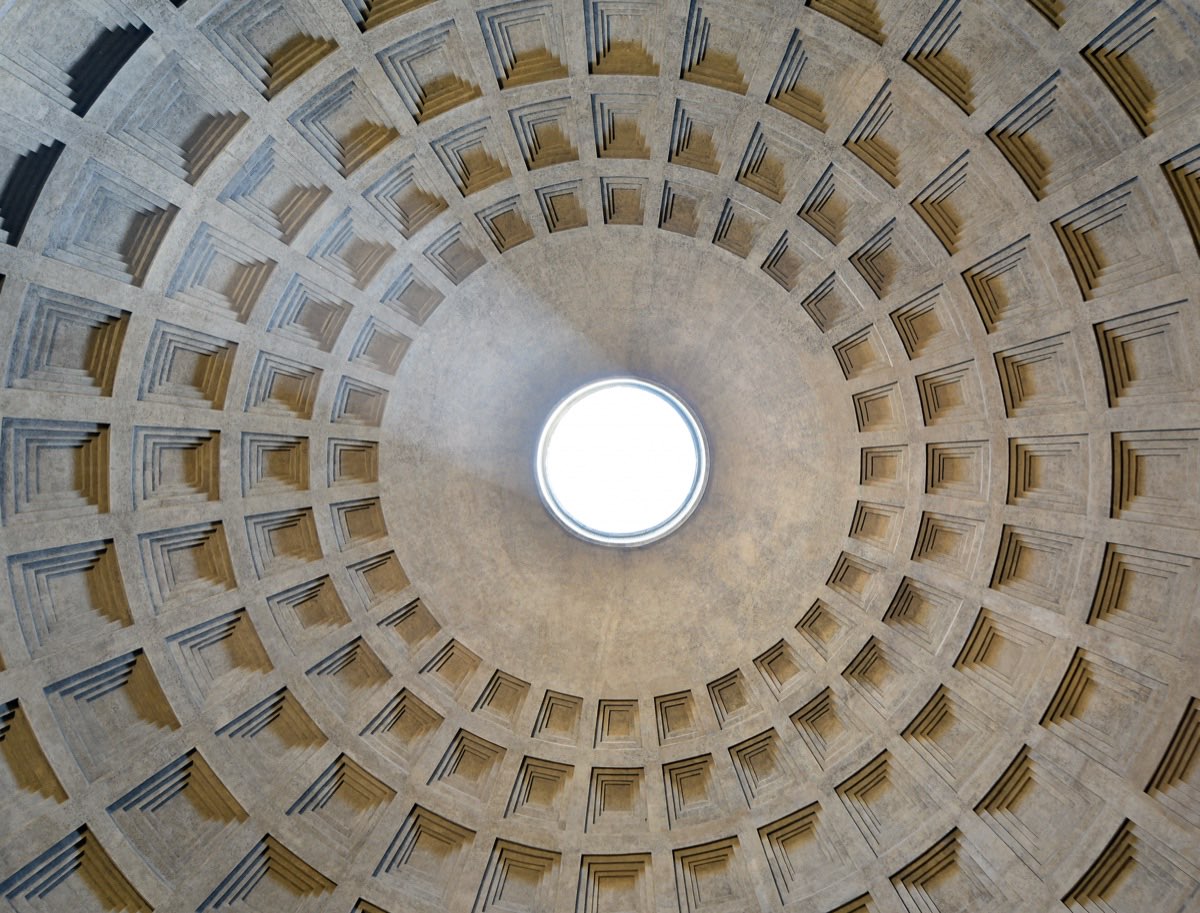
Pantheon
Rebuilt by Hadrian over Agrippa's ruined original, its unreinforced concrete dome and open oculus have stood as the widest of their kind for nineteen centuries.
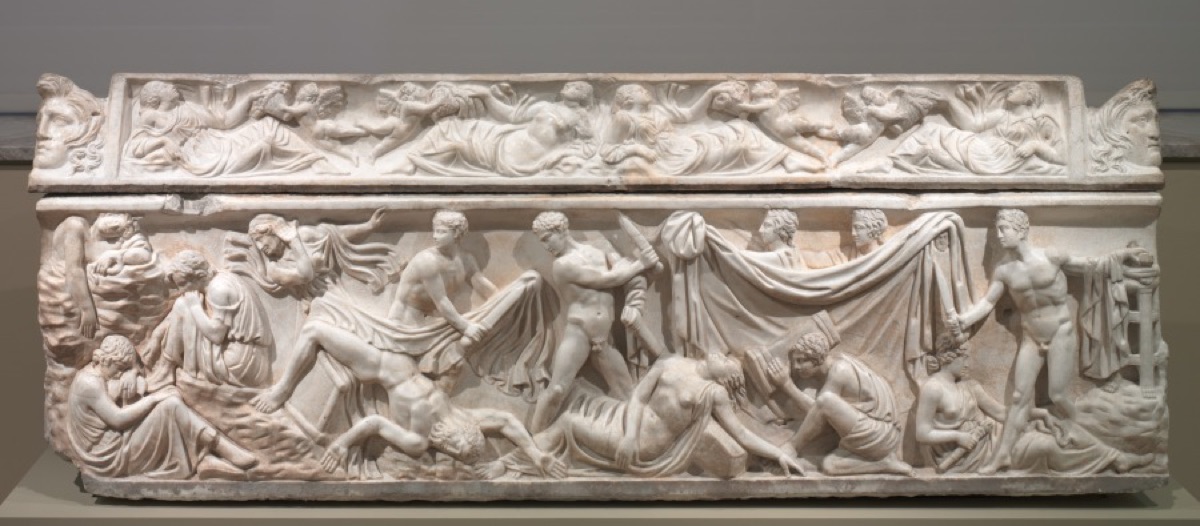
Sarcophagus
A carved marble coffin from the period when Romans began favoring burial over cremation, its relief work aimed at mourners who would walk past it along a tomb-lined road.
The Cleveland Museum of Art, Gift of the John Huntington Art and Polytechnic Trust, 1928.856
New this century
- Enchiridion
Freedom and peace of mind come entirely from correctly distinguishing what is within our power, our own judgments and choices, from what is not, everything else including our body, reputation, and circumstances, and directing all effort only toward the former.
- Annales (Annals)
The reigns of Rome's early emperors from Tiberius through Nero reveal that autocracy corrupts nearly everyone it touches, turning the machinery of law and honor into instruments of suspicion, flattery, and murder, while leaving historians the grim task of recording it 'without anger and without partiality,' even when that neutral pose barely conceals Tacitus's own contempt.
- De Vita Caesarum (The Lives of the Twelve Caesars)
An emperor's character is best revealed not through the chronological narrative of his political and military acts but through an organized inventory of his personal habits, appetites, cruelties, and eccentricities, since private conduct exposes the man underneath the office more honestly than public record does.
- Almagest
A single geometric model with the earth at its center can predict the observed positions of the sun, moon, planets, and stars with enough mathematical precision to be practically indispensable, whether or not it describes the true physical arrangement of the cosmos.
- Geography
The entire known world can be mapped onto a single mathematical grid of latitude and longitude, projected systematically from a sphere onto a flat surface, turning geography from a descriptive art into a coordinate-based mathematical science.
- Noctes Atticae (Attic Nights)
Miscellaneous notes taken for personal use while studying abroad, on grammar, philosophy, law, history, and antiquarian curiosities, deserve to be organized and published without disguising their unsystematic, notebook origins, because the variety itself is the point.
- Tattvartha Sutra
Liberation follows a precise, three-part discipline of right faith, right knowledge, and right conduct, and the whole Jain worldview, from the categories of reality to the mechanics of karma, can be systematized into a single logically ordered treatise.
- Mulamadhyamakakarika
Nothing, including causation, motion, the self, or even the Buddha's own teaching, possesses independent inherent existence, and everything arises only in dependence on other things, a middle way between the extremes of eternalism and nihilism.
- Coligny Calendar
Time can be reconciled between the moon's visible cycle and the solar year through a fixed, precisely tracked lunisolar calendar with named months marked good or bad for undertakings, requiring calculation, not just observation, to keep the two cycles in step.
- Rabatak Inscription
A single inscribed stone found near Rabatak lets Kanishka I state his own genealogy, territorial claims, and religious patronage in the Bactrian language, in his own words, across a multilingual Central Asian empire.
- Metamorphoses (The Golden Ass)
A man transformed by his own reckless curiosity into a donkey and forced to observe human cruelty and desire from the humiliating position of a beast of burden eventually finds, through the goddess Isis's intervention, that only religious devotion, not clever wit, can restore what curiosity destroyed.
- Description of Greece
Systematically walking the roads of mainland Greece and recording every temple, statue, tomb, and local legend along the way preserves, at a moment when much of it was already decaying under Roman rule, a physical and cultural record of Greek religious and civic life that would otherwise vanish entirely.
- Institutiones (Institutes)
Roman private law can be taught systematically to beginners by organizing it into a clear framework of persons, things, and actions, rather than left as scattered case-by-case precedent accessible only to specialists.
- Tuxtla Statuette
A small jadeite figurine of a man in a bird costume, its mask resembling a boat-billed heron's bill, found by a farmhand plowing a field near Tres Zapotes in 1902 and in Smithsonian custody since 1904, carries about 75 incised epi-Olmec (Isthmian) glyphs by decipherers John Justeson and Terrence Kaufman's count, including a Long Count date corresponding to AD 162, making it one of only about a dozen known epi-Olmec texts and the object whose extensive, well-preserved inscription first opened the script to modern decipherment work.
- On the Natural Faculties
Living organs perform their functions through inherent natural faculties, attraction, retention, alteration, and expulsion, that arise from a purposeful, teleological design of the body, refuting mechanistic accounts, especially the atomists', that reduce physiology to blind matter in motion.
- True History
A narrator who announces at the outset that everything he is about to say is a lie can still expose real truths about human credulity, by pushing the conventions of travelers' tall tales and historical exaggeration to such openly absurd extremes that no honest reader could mistake the account for fact.
- Meditations
The only thing fully within a person's control is their own judgment, so a good life consists of governing that judgment with reason and accepting everything else, including death, without complaint.
- On the Usefulness of the Parts of the Body
Every part of the human body, down to the smallest structure, is arranged with a purpose so precise and beneficial that the arrangement itself is evidence of a wise, providential craftsman, so that careful anatomical study becomes a form of natural theology.
- Mouzi Lihuolun
Buddhism does not contradict Confucian filial piety or Daoist naturalness properly understood; each apparent conflict, a monk's shaved head, celibacy, or foreign origin, dissolves once judged by its actual effect on virtue rather than by superficial custom, so a cultivated Chinese person can adopt Buddhism without betraying native tradition.
- Apologeticus
The legal persecution of Christians for the mere fact of the name, without proven crime, is unjust by Rome's own standards of law, and the blood of persecuted Christians only multiplies converts rather than eliminating the movement.
- Tosefta
The Mishnah's own compact rulings do not exhaust the tannaitic legal tradition, and a fuller, more discursive parallel collection is needed to preserve the material its editor left out or abbreviated.
- Outlines of Pyrrhonism
For every argument establishing a dogmatic claim about how reality really is, an opposing argument of equal weight can be found, and recognizing this equal force should lead a careful thinker to suspend judgment entirely, which in practice brings the tranquility that dogmatic certainty only promises.
- Kamasutra
Pleasure (kama) is a legitimate goal of a well-lived life on equal footing with duty and wealth, and erotic and social skill can and should be studied systematically rather than left to instinct.
- Collected Poems of Cao Zhi
The formal virtuosity of five-syllable verse can carry acute personal grievance, in Cao Zhi's case the grief of a gifted prince stripped of power and watched as a suspected rival by his own brother the emperor, without collapsing into either court flattery or bare complaint.
The canon by now
- Pyramid Texts
- Royal Inscriptions of Sargon of Akkad
- The Exaltation of Inanna
- The Curse of Agade
- Coffin Texts
- Admonitions of Ipuwer
- Eloquent Peasant
- Code of Hammurabi
- Old Babylonian Gilgamesh (Pennsylvania and Yale Tablets)
- Inanna's Descent to the Netherworld
- Edwin Smith Surgical Papyrus
- Book of the Dead
- Rigveda
- Baal Cycle
- Ludlul Bel Nemeqi
- Epic of Gilgamesh
- Instruction of Amenemope
- Gathas
- Book of Songs
- Torah
- I Ching (Book of Changes)
- Mahabharata
- Iliad
- Odyssey