Time travel
7th century BC
Assyria reaches its greatest extent and then collapses within decades, Ashurbanipal's library preserves more of Mesopotamian literature than any earlier effort, and Greek lyric poets begin writing in the first person as Athens gets its first written law.
Mental Worlds: Evidence and Inference
No Near Eastern empire before this century had ruled as much territory as Assyria does at its height, and none had fallen as fast. Esarhaddon's conquest of Egypt in 671 BC briefly puts the entire arc from the Persian Gulf to the Nile valley under a single administration, an achievement his son Ashurbanipal reinforces by sacking Thebes in 663 BC when Kushite-backed rebels test Assyrian resolve there, an act of destruction far enough south and against so venerable a religious center that it becomes, for later Hebrew prophets remembering it generations afterward, the proof text for the argument that no city's sanctity guarantees its safety. And yet within two generations of that peak, internal succession crises and a Babylonian-Median military alliance bring the whole structure down; Nineveh itself, the capital that had housed the greatest library the Near East had yet assembled, falls in 612 BC and is never significantly rebuilt.
That library is this century's quieter achievement, and arguably its more durable one. Ashurbanipal's agents scour Babylonia for old and rare tablets, copying and collecting scholarly, literary, and divinatory texts on a scale no earlier ruler had attempted, an act that preserves centuries of Mesopotamian intellectual work, including the Epic of Gilgamesh's standard version and the omen astronomy of Enuma Anu Enlil, specifically because a conquering king wanted the accumulated knowledge of the civilizations he ruled concentrated where he could consult it. When Nineveh burns a few decades later, the library burns with the city, and it is precisely that fire, baking the clay tablets hard rather than destroying them, that preserves so much of it for modern archaeology to recover twenty-five centuries later.
In Judah, Assyria's collapse creates room for King Josiah to centralize worship at Jerusalem and, in the process, to sponsor the first written edition of what becomes the Deuteronomistic History, a sweeping narrative reinterpretation of the kingdom's past organized around covenant faithfulness and its violation. Jeremiah begins prophesying in these same years, watching first Assyrian collapse and then the rise of a new Babylonian threat, and his early oracles reflect the genuine uncertainty of a small kingdom that has just watched one empire fall without yet knowing what the next one will demand.
In Greece, this is the century individual literary voices become visible for the first time. Homer's Odyssey and Hesiod's Theogony and Works and Days extend the hexameter epic tradition the previous century had fixed, but it is Archilochus, writing scandalous, specific, first-person lyric about his own soldiering, his broken engagement, and his contempt for a shield he abandoned in battle, who represents something genuinely new: a poet speaking as himself rather than through a heroic persona borrowed from the distant past. Athens, meanwhile, gets its first written law under Draco in 621 BC, a code so severe that its name becomes, permanently, a byword for excessive punishment, but which nonetheless represents a small polis's first attempt to make justice depend on a fixed text rather than an aristocrat's memory and discretion.
Nobody in Jerusalem, Nineveh, or Athens this century could have known which of these developments, an empire's library, a reforming king's history, or a soldier-poet's complaints, would matter more to the following two and a half millennia. All three did.
The political map
Major Polities and Cultural Regions
- Neo-Assyrian Empire Reaches its greatest extent under Esarhaddon and Ashurbanipal, briefly ruling Egypt, then collapses; Nineveh falls in 612 BC
- Kingdom of Kush Loses Egypt to Assyrian conquest in the 670s-660s BC, retreating to its Nubian heartland at Napata
- Egypt Reunified under the native Saite dynasty after Assyrian withdrawal, a brief cultural and political renaissance
- Kingdom of Judah Assyrian vassal, then briefly independent under Josiah's reforms as Assyrian power fails
- Neo-Babylonian Empire Founded by Nabopolassar in 626 BC, allying with the Medes to destroy Assyria by the century's end
- Athens A minor Attic polis whose harsh law code under Draco (621 BC) matters chiefly to later constitutional history, not to this century's balance of power
- Median kingdom Rising Iranian power on the Zagros plateau, allying with Babylon to help bring Assyria down by the century's end
- Lydia Anatolian kingdom under the Mermnad dynasty, from Gyges through Alyattes, a persistent regional power through the century
Borders are approximate scholarly reconstructions from historical-basemaps (GPL-3).
State of the domains
Texts and Written Culture
Homer's Odyssey follows the Iliad within a generation, while Hesiod's Theogony and Works and Days bring didactic and genealogical poetry into the same hexameter tradition, the first Greek poet whose name attaches to a clear individual perspective. Archilochus, writing personal, often scandalous lyric poetry in his own first-person voice, breaks from epic's third-person distance entirely. In Judah, Jeremiah begins prophesying around 627 BC as Assyrian power visibly weakens, and an editorial school under king Josiah produces the first edition of what becomes the Deuteronomistic History. In Assyria, Ashurbanipal assembles at Nineveh the largest library the ancient Near East has yet built. In India, the Brihadaranyaka and Chandogya Upanishads develop philosophical reflection on the self within the older Vedic tradition.
Art
Assyrian palace relief reaches its technical peak under Ashurbanipal, notably the famous lion-hunt scenes at Nineveh, combining narrative sophistication with an unusually sympathetic rendering of animal suffering rarely matched in the empire's earlier, more purely triumphalist art. Greek pottery painting transitions from Geometric abstraction toward Orientalizing styles absorbing Near Eastern and Egyptian motifs, evidence of intensifying Mediterranean trade contact. Egyptian art under the new Saite dynasty deliberately revives Old Kingdom forms, an archaizing program meant to assert continuity after Kushite rule and Assyrian invasion both. Nothing comparable to Assyrian narrative relief exists yet in Greece, India, or China, where art remains more closely tied to ritual object than extended pictorial storytelling.
Medicine
No major new medical compilation is attested this century, though the diagnostic handbook systematized generations earlier in Babylon remains in active scribal circulation, copied into Ashurbanipal's library among the thousands of tablets his agents collected. Egyptian medicine likely continues under the Saite dynasty's broader revival of older cultural forms, though no distinctly new medical papyrus from this exact window survives. Greek medical thought, still centuries from the Hippocratic corpus, shows no sign yet of separating illness from divine or magical cause; Near Eastern medicine, similarly, remains embedded in an exorcistic framework unchanged for many centuries and unlikely to have shifted much within this one.
Science
Ashurbanipal's library preserves and copies Enuma Anu Enlil and the wider Babylonian omen literature on a scale no earlier collection attempted, an act of systematic scholarly compilation that, whatever its original divinatory purpose, functions as a genuine research library. Babylonian astronomical observation continues accumulating the data later centuries will need for mathematical astronomy, though that mathematical stage has not yet arrived. No Greek natural philosophy exists yet; the earliest Presocratic thinkers are still a generation or two away. Egyptian and Indian calendrical and ritual-astronomical knowledge continues along established, largely unrecorded lines throughout this century as well.
Military
Assyria under Esarhaddon conquers Egypt outright in 671 BC, briefly ruling the entire Fertile Crescent plus the Nile valley, the largest territorial extent any Near Eastern empire has yet achieved; his son Ashurbanipal sacks Thebes in 663 BC to suppress a Kushite-backed revolt, an act later Hebrew prophets remember as proof no city, however sacred, is safe from Assyrian reach. That reach proves temporary: internal succession crisis and external pressure from a Babylonian-Median coalition bring the empire down with startling speed, and Nineveh itself falls in 612 BC, a collapse as sudden as Assyria's rise over the previous century and a half had been gradual. Athens meanwhile writes its first law code under Draco in 621 BC.
Technology
Assyrian engineering under Sennacherib includes an aqueduct system supplying Nineveh, alongside continued advances in siege technology that make the empire's armies difficult for any single city to resist directly. Ironworking is now fully mature and universal across the Near East and Mediterranean world, no longer a marker of any particular culture's advancement. Greek alphabetic literacy, adopted the previous century, spreads widely enough this century to support named individual poets and Athens's first written law, a legal and literary infrastructure the syllabic and logographic scripts of the wider Near East never made available to a comparably wide population.
Material world
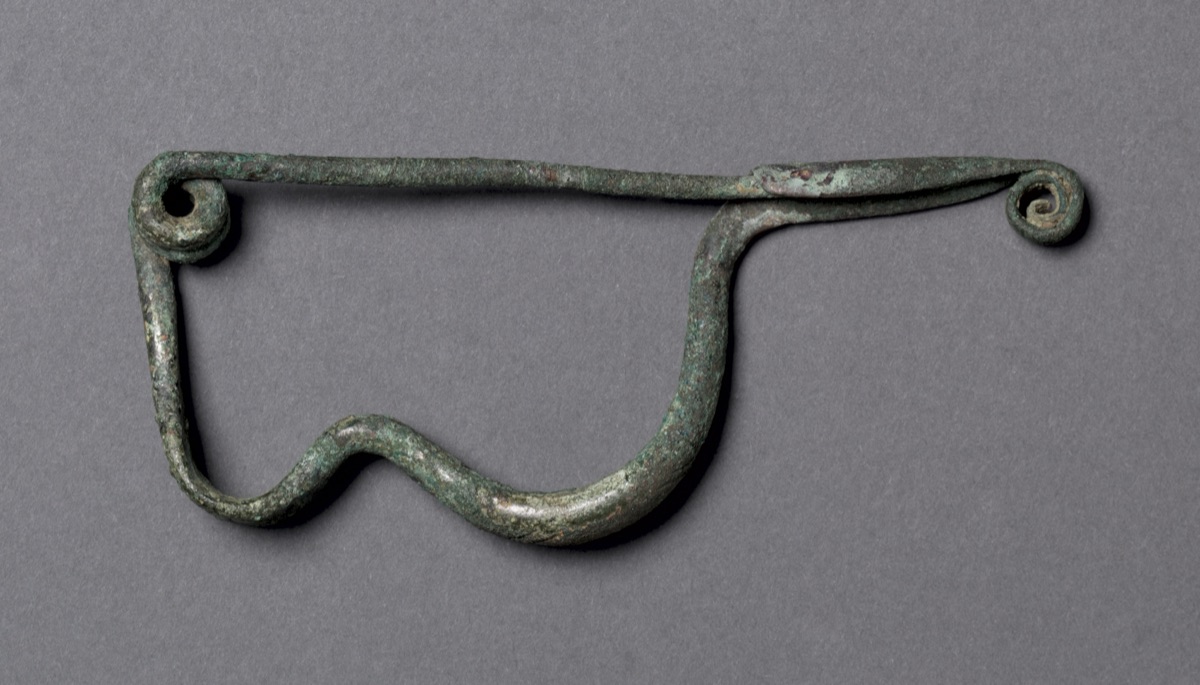
Fibula
A bronze fibula, the safety-pin clasp that closed cloaks and tunics across early Iron Age Italy.
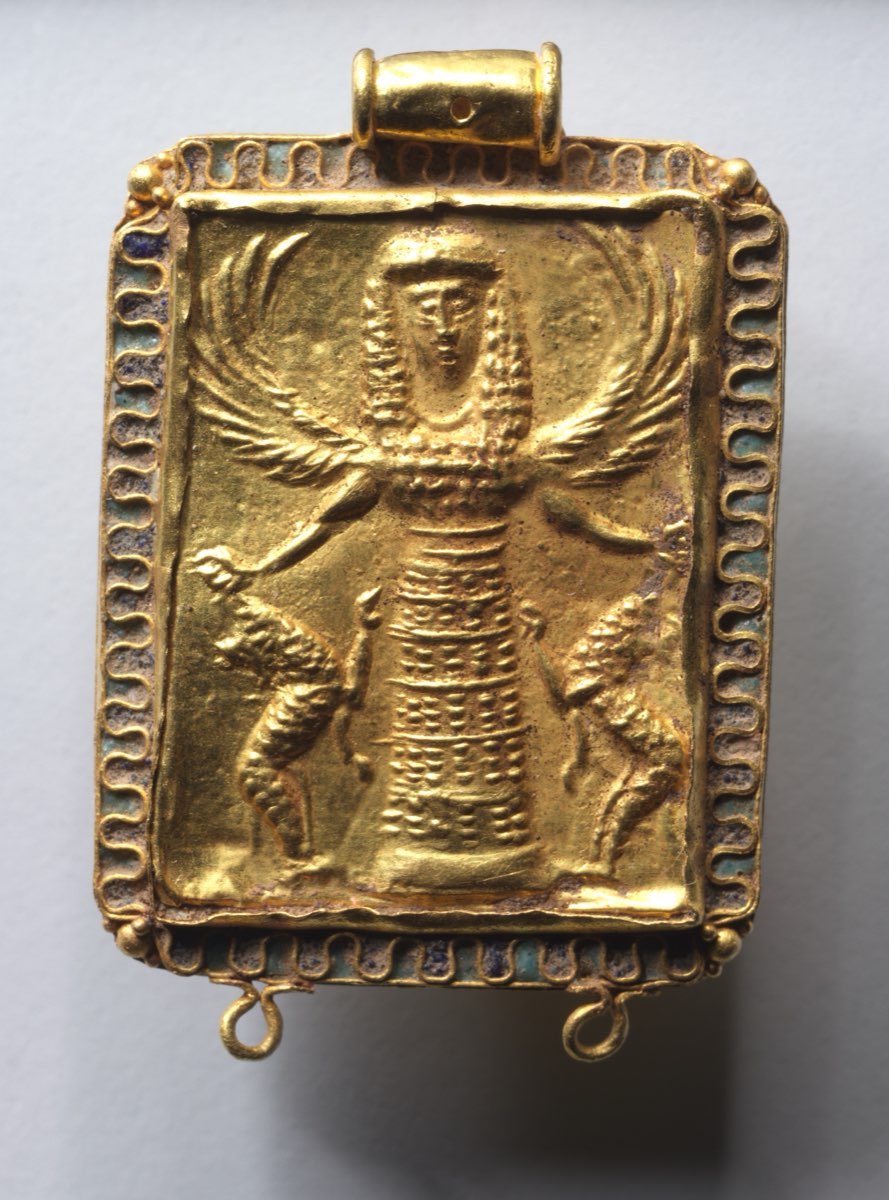
Daedalic Pendant with Potnia Theron (Mistress of Animals)
A gold and glass pendant of Potnia Theron, the winged 'mistress of animals' who grips the leashes of a pair of rearing felines, likely once strung on a necklace.
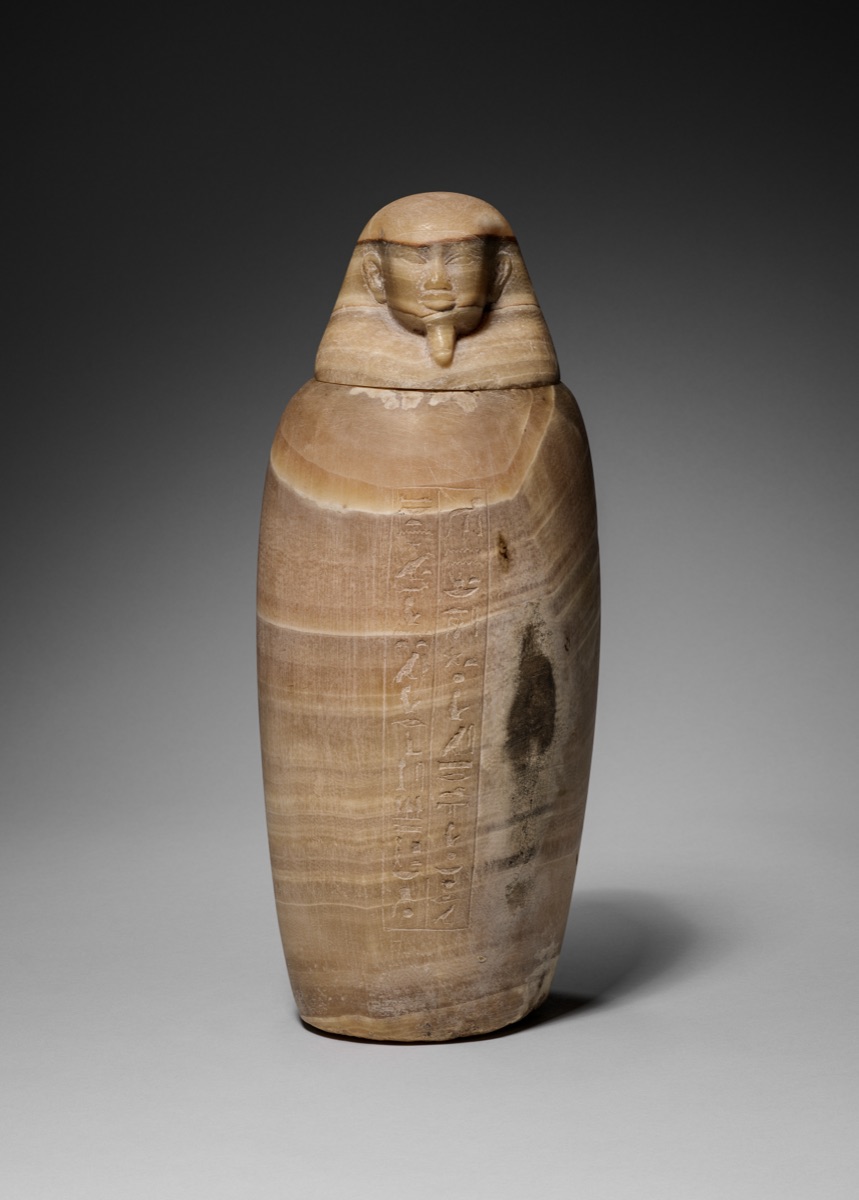
Canopic Jar with Man's Head
A travertine canopic jar carved with the human head of Imsety, made to hold a mummified liver under Egyptian embalming practice.
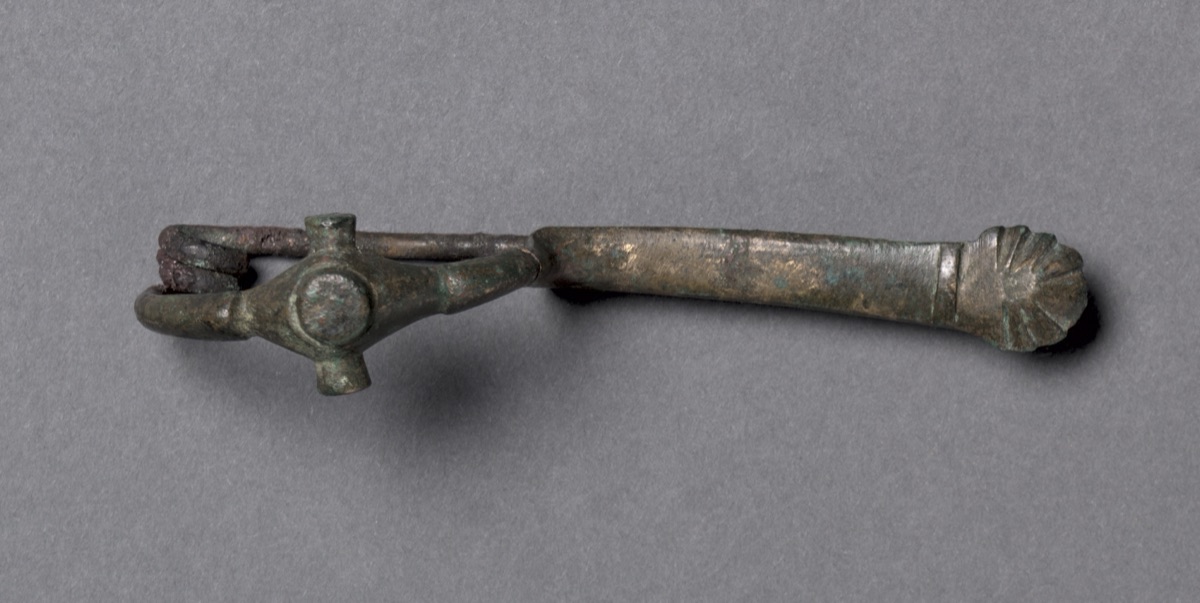
Fibula
A bronze dress-fastener from Etruria, the same fibula technology used across the Mediterranean before Etruscan cities built their first stone temples.
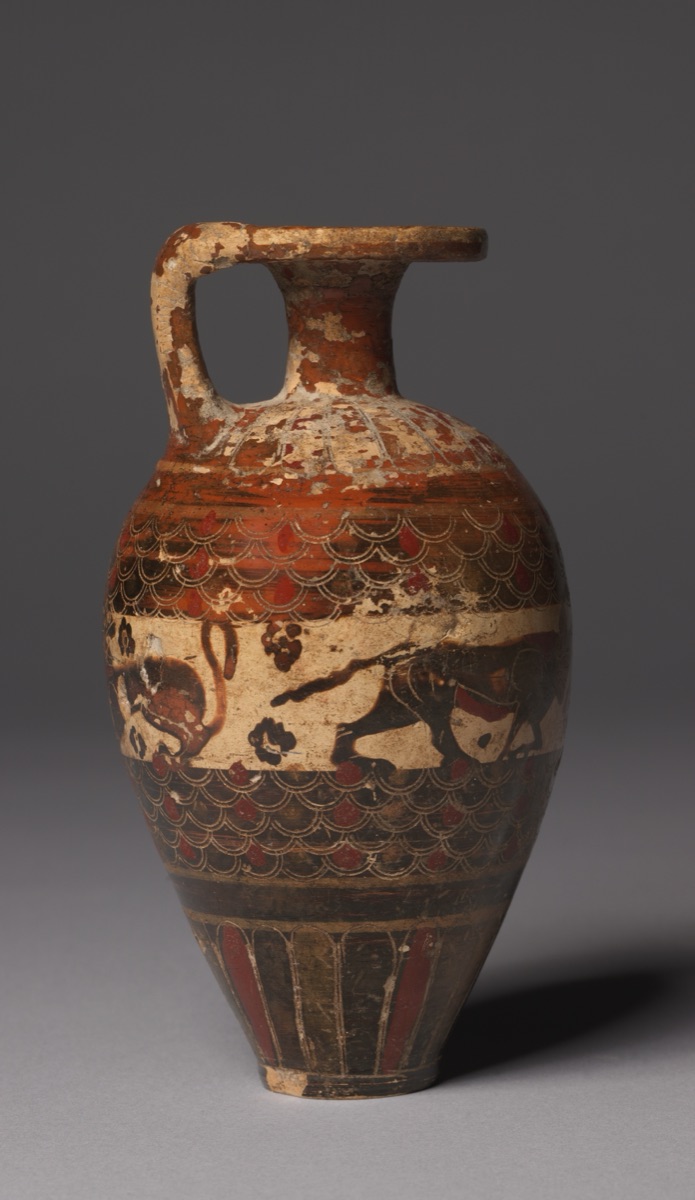
Protocorinthian Aryballos: Animals
A small oil flask painted with animal friezes in the earliest black-figure technique, a Corinthian export style copied across the Greek world.
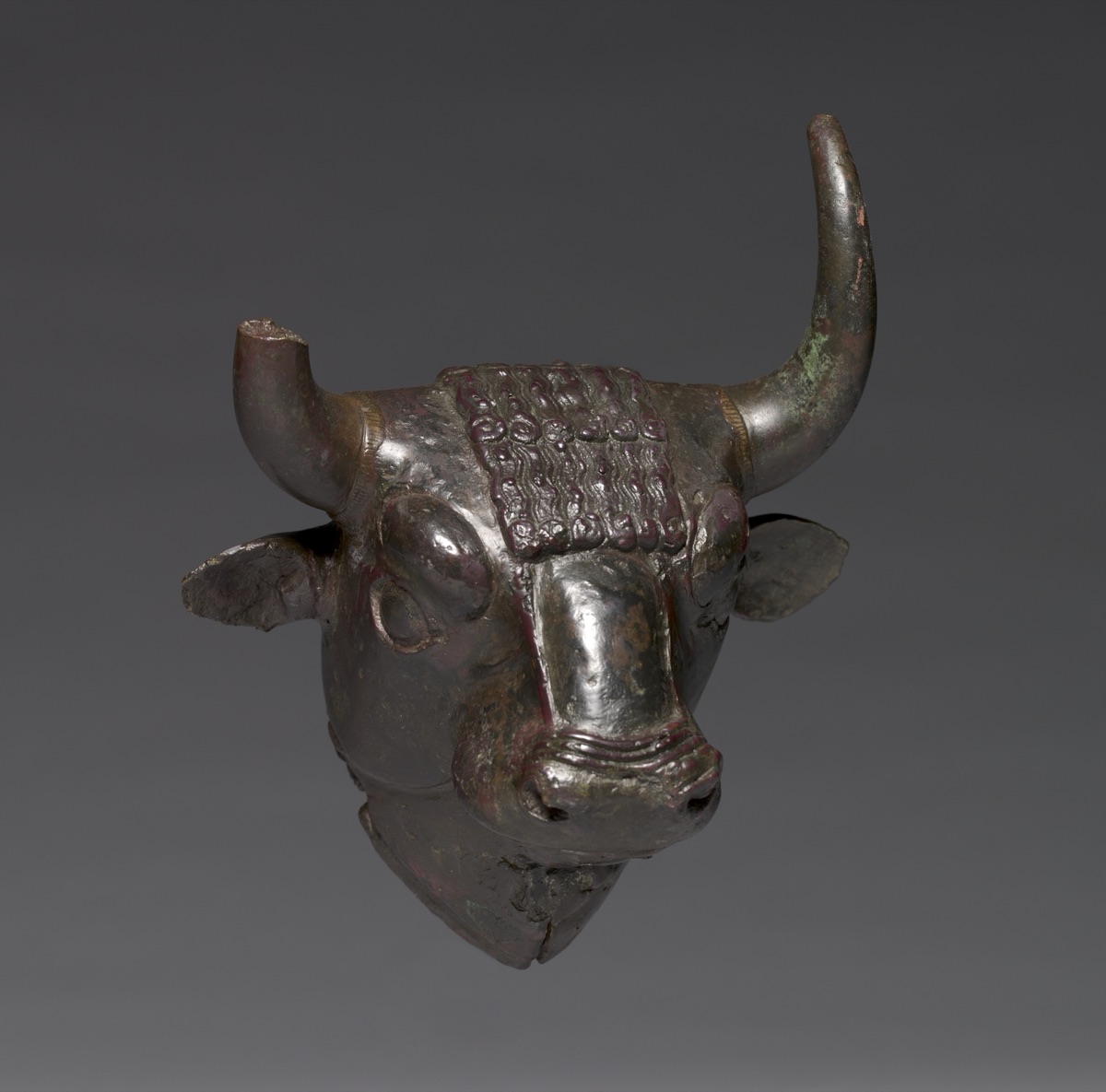
Bull Head Attachment
A cast bronze bull's head that once decorated a cauldron rim, from Urartu, the mountain kingdom that rivaled Assyria for a century.
New this century
- Odyssey
Coming home is its own ordeal, harder in its way than the war, because a returning hero must out-think monsters, gods, and finally his own household to reclaim a life that has moved on without him.
- Works and Days
Justice and hard work, not divine favor alone, are what separate a household that survives the year from one that starves, and the poem is written to prove it to Hesiod's own idle brother.
- Theogony
The order of the cosmos and the reign of Zeus were not always secure but had to be won through successive generations of divine violence, and recounting that violent genealogy explains why the world is arranged as it now is.
- Brihadaranyaka Upanishad
The innermost self and the ultimate reality behind the universe are one and the same, and knowing that identity, not ritual sacrifice, is what ends suffering.
- Chandogya Upanishad
Through the teaching 'tat tvam asi' (that thou art), the individual self is shown to be not merely similar to but identical with brahman, the single reality underlying all things, and grasping that identity is what liberates.
- Annals of Sennacherib
Sennacherib's annals argue that a king's authority is proven by the completeness of his control, over foreign kings he shuts up 'like a caged bird,' over rebellious cities he levels, and over nature itself, which he claims to have redirected to build the empire's new capital.
- The Vassal Treaties (Succession Treaty) of Esarhaddon
To secure a contested succession before his death, Esarhaddon argues that loyalty to his chosen heir must be sworn as an unbreakable, minutely detailed oath binding not just vassal kings but their households, their thoughts, and their descendants forever.
- Deuteronomistic History (Joshua-Kings)
National catastrophe was not divine defeat but divine judgment, because a single law given at Sinai supplies the yardstick by which every king before the fall can be shown to have failed.
- Fragments
Personal experience, including cowardice, appetite, and grievance openly confessed, is as legitimate a subject for poetry as heroic myth, and a soldier who throws away his shield to survive can say so without shame.
- Homeric Hymn to Demeter
The abduction of Persephone into the underworld and Demeter's grief-stricken search for her explain both the origin of the seasons and the founding of the Eleusinian Mysteries, the most important secret religious rite in the Greek world.
- Annals of Ashurbanipal
The last great Assyrian annalist argues, through an account of his brother's betrayal and Elam's near-total destruction, that even a scholar-king who could read cuneiform himself was still expected to answer treachery with a campaign of deliberate, exhaustive annihilation.
- Partheneion
Choral song performed by a chorus of unmarried girls could itself become the poem's subject, turning ritual performance into a meditation on beauty, rivalry, and divine favor among the singers themselves.
- Jeremiah
A nation can be argued with like a defendant in a lawsuit, and its refusal to answer the charge, not the might of Babylon, is what destroys it.
The canon by now
- Pyramid Texts
- Royal Inscriptions of Sargon of Akkad
- The Exaltation of Inanna
- The Curse of Agade
- Coffin Texts
- Admonitions of Ipuwer
- Eloquent Peasant
- Code of Hammurabi
- Old Babylonian Gilgamesh (Pennsylvania and Yale Tablets)
- Inanna's Descent to the Netherworld
- Edwin Smith Surgical Papyrus
- Book of the Dead
- Rigveda
- Baal Cycle
- Ludlul Bel Nemeqi
- Epic of Gilgamesh
- Instruction of Amenemope
- Gathas
- Book of Songs
- Torah
- I Ching (Book of Changes)
- Mahabharata
- Iliad