Time travel
5th century AD
The western Roman Empire ends this century, formally in 476 but really across decades of accumulating loss, even as the world's intellectual map grows wider than it has ever been.
Mental Worlds: Evidence and Inference
Alaric's Visigoths take Rome in 410, the first time in eight hundred years an outside army has entered the city, and the psychological shock is, if anything, larger than the immediate territorial damage. Pagan critics blame the disaster on Rome's abandonment of its traditional gods for Christianity; Augustine spends more than a decade of this century answering them with the City of God, arguing that earthly cities, however great, are always temporary and secondary to an eternal City of God that Christians build through love of God rather than love of self and worldly power, and that Rome's fall proves nothing about which gods, if any, deserve credit or blame for a city's fortunes.
In China, Buddhism completes a transition this century from an imported curiosity to a fully institutionalized presence with its own direct lines of contact to India. Faxian, a Chinese monk, walks and sails to India and back over roughly fifteen years, writing up the journey not as adventure but as careful testimony about which scriptures and relics he found, noting some sites associated with the Buddha's life already standing empty even as Magadha's monasteries flourish and the faith takes deeper root in China. At Chang'an, the scholar-monk Kumarajiva leads a state-sponsored translation bureau that produces, among a large body of work, a Chinese Diamond Sutra in 402, rendering some of Buddhism's most demanding material, the claim that even the categories a mind uses to grasp reality must themselves be released as empty of fixed essence, into Chinese with a fluency earlier, more improvised translation efforts had not achieved.
Hypatia, who taught mathematics and Neoplatonist philosophy at Alexandria, is murdered by a Christian mob in 415, an event that becomes an enduring symbol of the city's religious and political violence. It does not end Alexandria's intellectual life: the city remains a major center of mathematical, philosophical, medical, and theological scholarship for centuries afterward, and its pagan, Jewish, and Christian communities, which had long competed, overlapped, and shared educational traditions even as this century's conflict intensified, keep doing so after her death rather than ceasing to. At Athens, Proclus keeps a separate Neoplatonist tradition alive in relative isolation, systematizing it in the Elements of Theology into one of pagan philosophy's last great systematic statements before Christian and, later, Islamic thought absorb its method more than its content, though Damascius and Simplicius keep the Athenian school running a while longer still. It is India, this century, that produces the era's most forward-looking scientific work: Aryabhata, writing at the very end of the century in 499, compiles the Aryabhatiya, a compact treatise on arithmetic, algebra, trigonometry, and planetary motion that states, with unusual clarity, that the earth itself rotates on its axis while the heavens only appear to move, a position most of his own successors do not adopt but one now on the record.
Rome's western half does not survive the century as an independent state. Attila leads the Hunnic confederacy to a brief, devastating peak in the 440s and 450s before dying in 453 and the confederacy collapsing almost as fast as it rose; Vandals sack Rome again in 455 and hold North Africa as an independent kingdom; and in 476 the Germanic general Odoacer deposes the last western emperor, a boy named, with unfortunate irony, Romulus Augustulus, an event later historians treat as the western empire's formal end even though contemporaries had little reason to experience it as more decisive than the previous decades' losses. In China, the Northern Wei unifies the fragmented north by 439. And in Armenia, on a scale far smaller than any of this but no less deliberate, Mesrop Mashtots invents an alphabet around 405 built for one purpose, letting scripture and liturgy exist in the Armenian language itself rather than only in Greek or Syriac, a genuinely new technology created explicitly for religious use and documented directly by his student Koriun, a reminder that this century's story is not only large empires falling but also small nations writing themselves into permanent existence for the first time.
The political map
Major Polities and Cultural Regions
- Western Roman Empire Italy and the shrinking west, ends with Odoacer's deposition of Romulus Augustulus in 476
- Eastern Roman Empire Balkans to Egypt and Syria, intact and increasingly the empire's real center
- Sasanian Persia Iran and Mesopotamia, Rome's stable eastern counterpart through the west's collapse
- Gupta Empire Ganges plain, prosperous through most of the century, pressured by Huna incursions late on
- Germanic successor kingdoms Visigoths in Iberia and Gaul, Ostrogoths in Italy, Vandals in North Africa, Franks in Gaul
- Northern Wei Unifies fragmented north China by 439
Borders are approximate scholarly reconstructions from historical-basemaps (GPL-3). Nearest available basemap anchor year: AD 400.
State of the domains
Texts and Written Culture
Augustine writes the City of God across more than a decade, answering pagan critics who blame Rome's fall in 410 on abandoning the old gods, with a theology of two overlapping cities, earthly and divine. Rutilius Namatianus, a pagan Gallo-Roman aristocrat, writes De Reditu Suo, sailing home to a Gaul already slipping from Roman control. Nonnus writes the Dionysiaca, the longest surviving poem in Greek. Faxian writes up his own fifteen-year pilgrimage to Buddhist India and back. Kumarajiva's circle at Chang'an translates the Diamond Sutra, Tao Yuanming writes Peach Blossom Spring, and Koriun writes a biography of Mesrop Mashtots, inventor of the Armenian alphabet.
Art
Ravenna, capital of the shrinking western empire from 402, begins the mosaic tradition that makes it Late Antiquity's best-preserved showcase of Christian art, figures rendered in gold-ground abstraction rather than classical naturalism. Gupta India's sculpture reaches its most celebrated phase, the serene, technically masterful Buddha images at Sarnath and elsewhere that later become the template for Buddhist art across much of Asia. Proclus and the last generation of pagan Neoplatonists teach at Athens, their school's eventual closure still a century away but its intellectual isolation from an increasingly Christian public culture already visible. Chinese tomb art in the fragmented north reflects a landscape of competing, short-lived non-Chinese dynasties.
Medicine
No landmark new medical treatise from this century dominates the corpus record; Galen's system continues as the working standard across both the fracturing western empire and the still-intact eastern one, while Gupta India's Ayurvedic tradition continues developing along lines set by the Charaka Samhita two centuries earlier. Monastic and increasingly urban Christian institutions in both Roman halves begin formalizing charitable care for the sick and poor as a specifically religious duty, an institutional development attested by the period's ecclesiastical and administrative sources more than by any single medical text. Faxian's travel account describes charitable dispensaries at Pataliputra endowed by lay householders, an early attestation of institutionalized medical charity in India.
Science
Aryabhata, writing at the very end of the century in 499, compiles the Aryabhatiya, a compact treatise on arithmetic, algebra, trigonometry, and planetary motion that treats the earth as rotating on its own axis, a position most of his successors do not adopt but one stated with unusual clarity and confidence. Hypatia teaches mathematics and Neoplatonist philosophy at Alexandria until a Christian mob murders her in 415, a well-documented act of religious and political violence, though the city's mathematical, philosophical, and medical scholarship continues for centuries afterward. Proclus systematizes Neoplatonic metaphysics at Athens in the Elements of Theology, the last great systematic statement of pagan Greek philosophy before Christian and Islamic thought absorb its method.
Military
Alaric's Visigoths sack Rome in 410, the first time in eight hundred years an outside force has taken the city, a shock reverberating through the empire's intellectual life more than through its actual territorial losses, which continue for decades after. Attila leads the Hunnic confederacy to its peak in the 440s and 450s before dying in 453 and the confederacy collapsing almost immediately without him. Vandals sack Rome again in 455 and hold North Africa as an independent kingdom. The last western emperor, Romulus Augustulus, is deposed by the general Odoacer in 476, an event later historians treat as the western empire's formal end. In China, the Northern Wei unifies the fragmented north by 439.
Technology
Western Roman infrastructure, roads, aqueducts, and fortifications, increasingly falls into disrepair or piecemeal local maintenance as central funding and administration collapse across the century, while the eastern empire's comparable infrastructure around Constantinople remains intact and functioning. Gupta India's irrigation and urban building continue at a high standard through most of the century, declining only toward its end under Hunnic pressure on the northwest frontier. Mesrop Mashtots's invention of the Armenian alphabet around 405, designed specifically to let scripture and liturgy exist in Armenian rather than only Greek or Syriac, is a genuinely novel writing technology created for an explicitly religious purpose, attested directly by his student Koriun's biography.
Material world
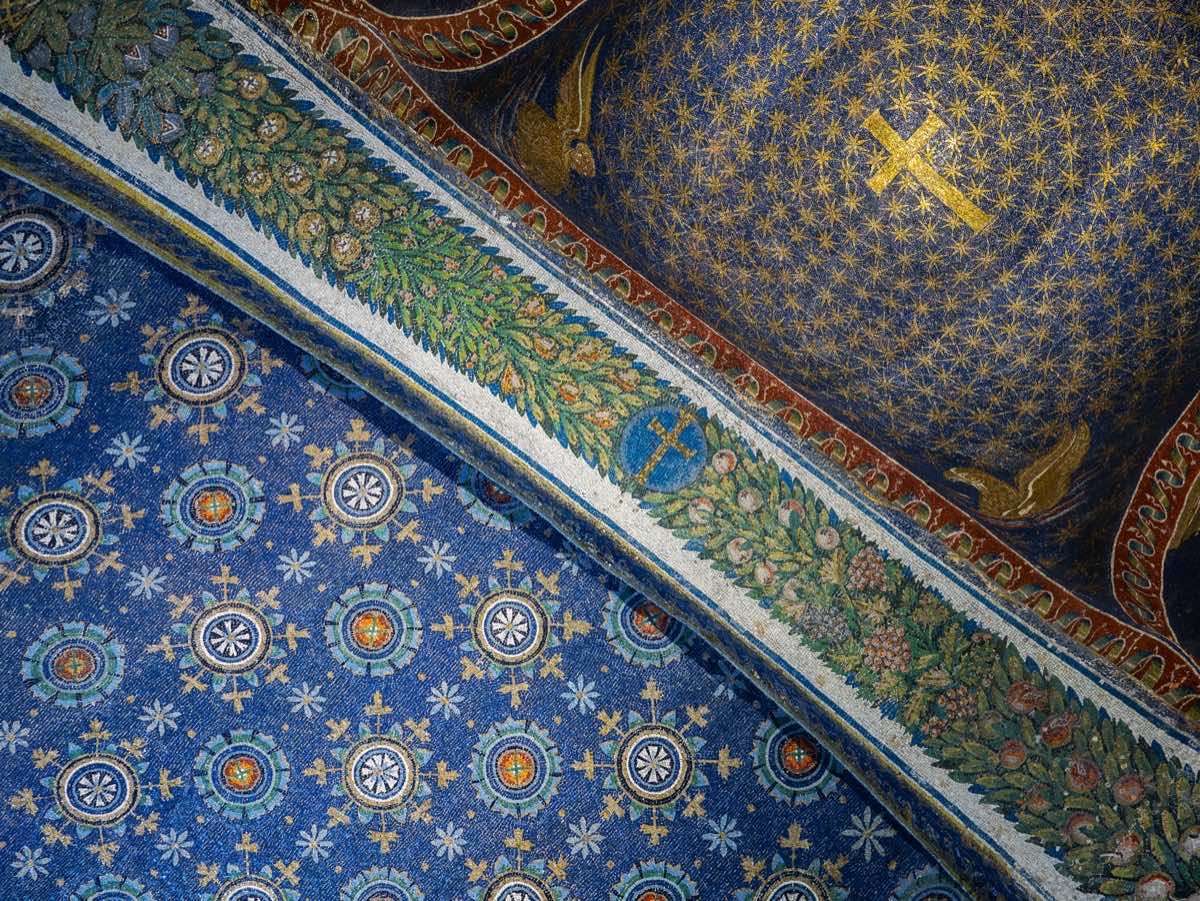
Mausoleum of Galla Placidia
A small brick chapel in the western capital of Ravenna, its interior wrapped floor to ceiling in deep-blue mosaic, built in the decades the western empire was losing its provinces one by one.
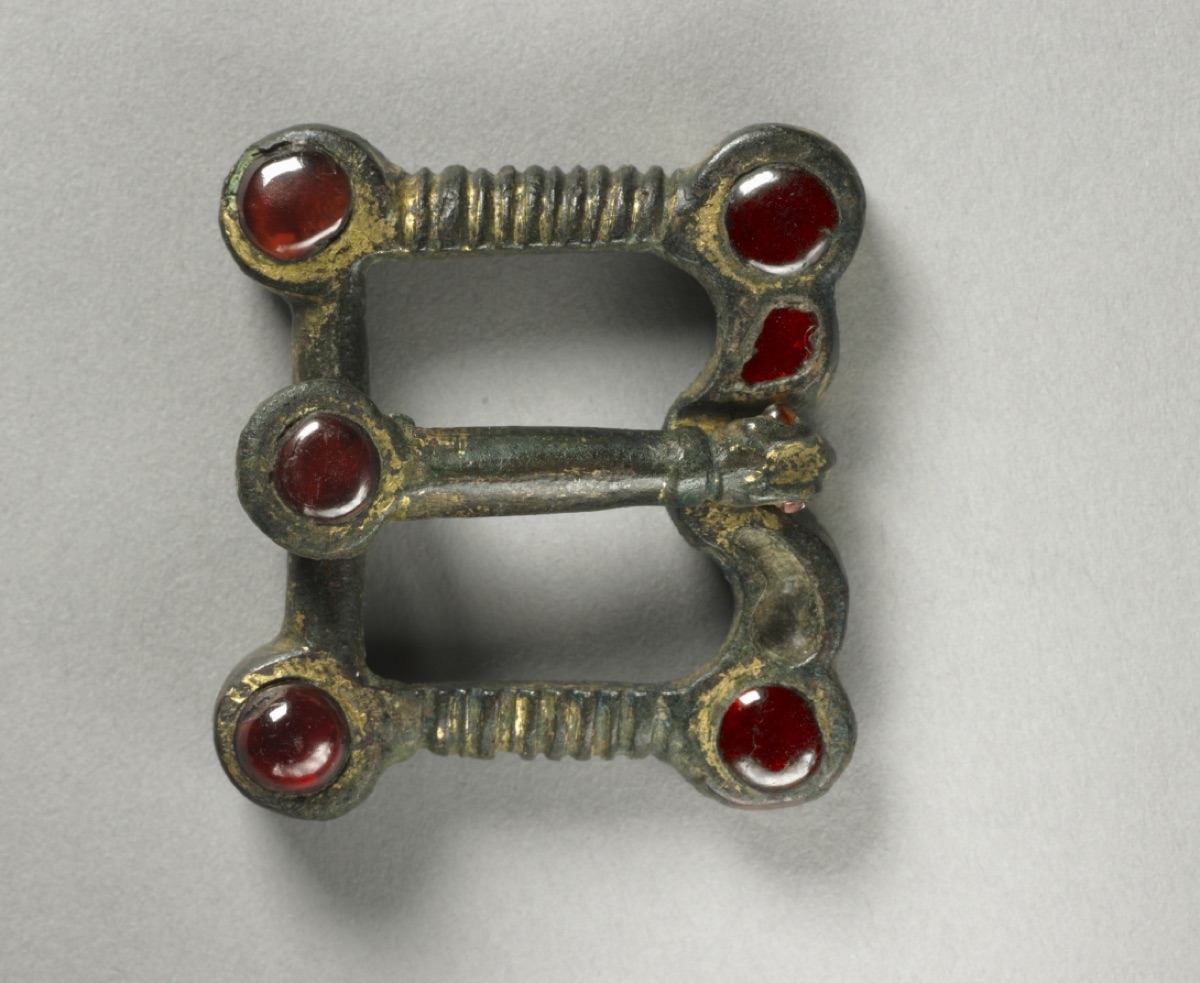
Buckle with Animal-Shaped Thorn and Belt Plate
A gilded belt buckle in the animal style that moved west with the peoples pressing on Rome's collapsing frontiers, worn by a warrior aristocrat of the post-imperial west.
The Cleveland Museum of Art, In memory of William M. Milliken, 1981.9
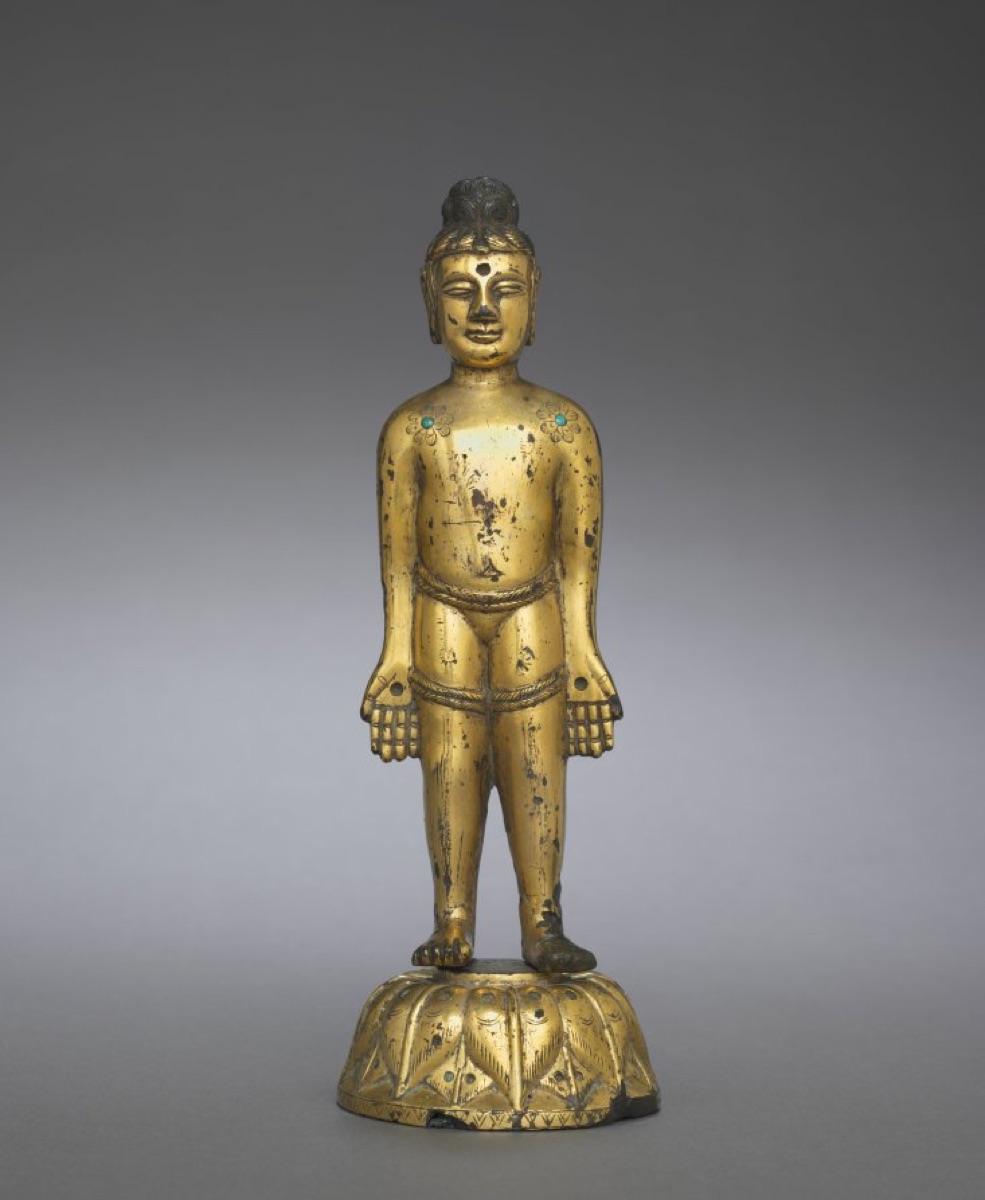
The New-born Buddha
A gilt bronze figure of the newborn Buddha with both hands at his sides, bathed by the nine Nagas - a rare iconography - cast as the Northern Wei court adopted Buddhism as a pillar of a non-Chinese dynasty's legitimacy.
The Cleveland Museum of Art, Purchase from the J. H. Wade Fund, 1955.46
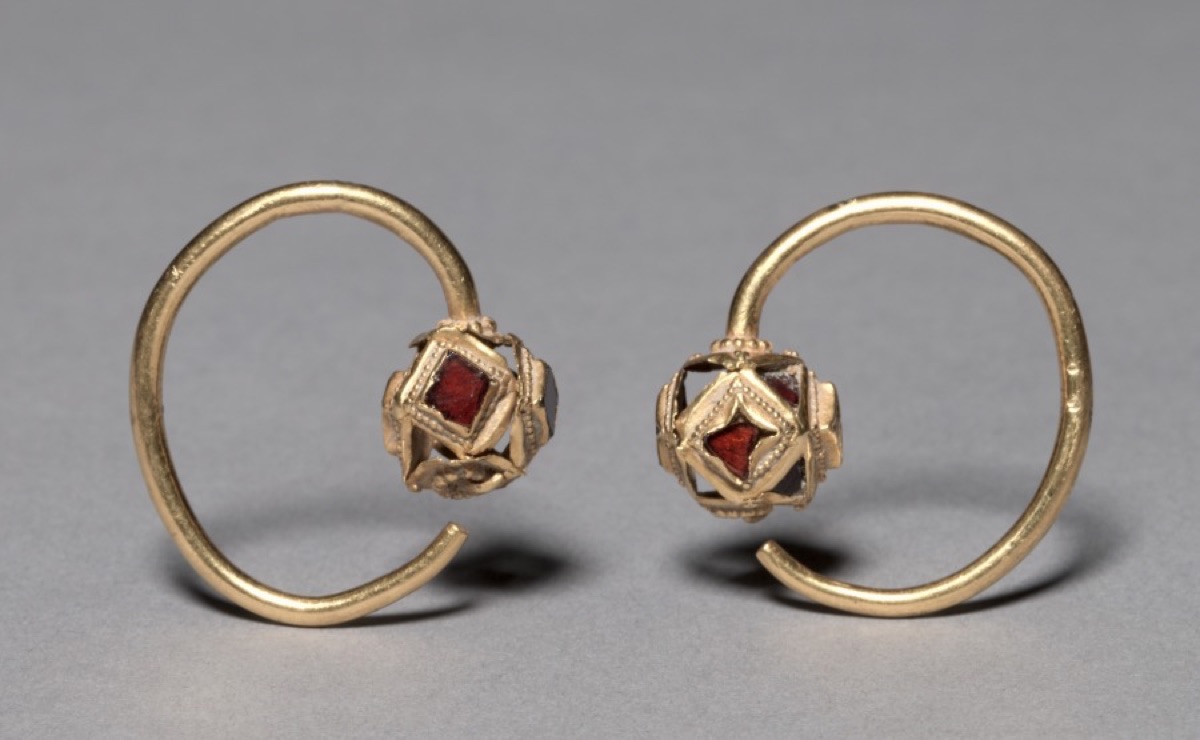
Earrings
Gold earrings set with garnets in the cloisonné technique Gothic goldsmiths carried into Italy, made for an Ostrogothic woman living among the ruins of the western empire.
The Cleveland Museum of Art, Gift of Dr. and Mrs. John R. McKay, 1975.48
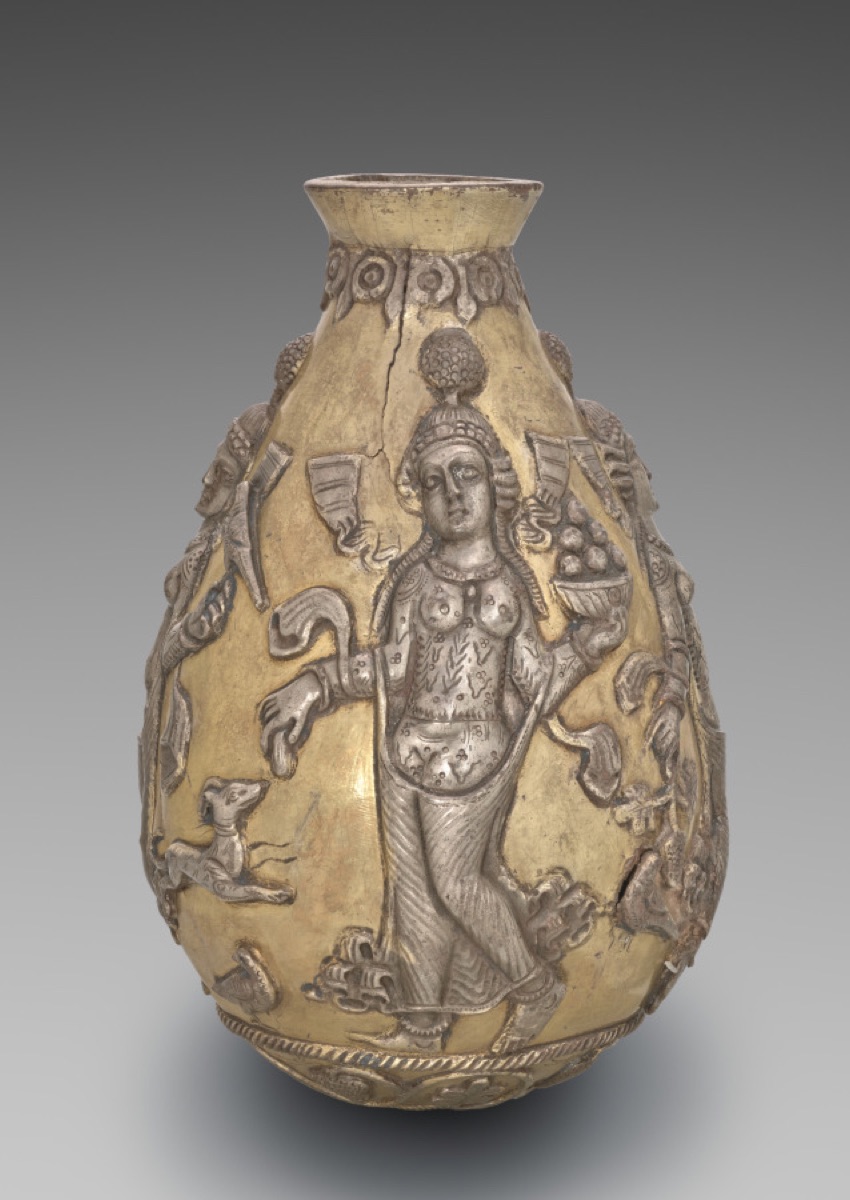
Anahita Vessel
A silver-gilt vessel raised and chased with the water goddess Anahita, the kind of ceremonial vessel Sasanian nobles commissioned and scholars still cannot date more closely than two centuries.
The Cleveland Museum of Art, Gift of Katharine Holden Thayer, 1962.294
New this century
- De Civitate Dei (The City of God)
Rome's fall to the Goths in 410 was not caused by its abandonment of the pagan gods, as critics claimed, and in any case earthly cities, however great, are always temporary and secondary to the eternal City of God, which Christians build through love of God rather than love of self and worldly power.
- Gwanggaeto Stele
A seven-meter stele erected in AD 414 by King Jangsu for his father Gwanggaeto the Great records, in roughly 1,800 Classical Chinese characters, the Goguryeo kingdom's founding legend, Gwanggaeto's military campaigns, and the households assigned to tend his tomb, making it Korea's major early historical inscription; its account of Goguryeo campaigns against Baekje, Silla, and forces described as Wae is read very differently by Korean, Japanese, and Chinese historians, and the passage bearing on Wae involvement has additionally been damaged in ways that further complicate any reading, so the stele's political interpretation is treated here as genuinely disputed even though the object and its date are not.
- Shishuo Xinyu
Character is best revealed not through formal biography or moral pronouncement but through a single sharp anecdote, a witty retort, an act of composure under threat, a breach of etiquette, so a collection of such fragments can capture a person's essential nature more precisely than a conventional life story could.
- Aryabhatiya
A compact set of versified rules for arithmetic, algebra, trigonometry, and planetary motion, including treating the earth as rotating on its axis while the heavens appear to move, is sufficient to compute planetary positions, eclipses, and time accurately.
The canon by now
- Pyramid Texts
- Royal Inscriptions of Sargon of Akkad
- The Exaltation of Inanna
- The Curse of Agade
- Coffin Texts
- Admonitions of Ipuwer
- Eloquent Peasant
- Code of Hammurabi
- Old Babylonian Gilgamesh (Pennsylvania and Yale Tablets)
- Inanna's Descent to the Netherworld
- Edwin Smith Surgical Papyrus
- Book of the Dead
- Rigveda
- Baal Cycle
- Ludlul Bel Nemeqi
- Epic of Gilgamesh
- Instruction of Amenemope
- Gathas
- Book of Songs
- Torah
- I Ching (Book of Changes)
- Mahabharata
- Iliad
- Odyssey