Time travel
13th century BC
Ramesses II and the Hittite king sign history's earliest surviving peace treaty after Kadesh, Assyria conquers Babylon under Tukulti-Ninurta I, and Shang diviners at Anyang produce East Asia's first surviving writing on oracle bones.
Mental Worlds: Evidence and Inference
Ramesses II leaves no doubt how he wants the Battle of Kadesh remembered, and a scribe in his service this century knows the official version by heart. The Poem of Pentaur, carved onto multiple temple walls from Abydos to Abu Simbel, casts a battle that modern historians read as a near-disaster, Ramesses's own division isolated and nearly overrun, as a personal triumph in which the king alone, abandoned by his troops, turns the tide through raw courage and divine favor. He would not necessarily know, or would not say aloud, how differently the Hittite court remembers the same battle. What he could know, because both versions survive and were formally exchanged, is the peace that eventually follows: the Treaty of Kadesh, agreed some fifteen years after the battle, a genuinely reciprocal document promising mutual defense, extradition of fugitives, and invoking a long list of gods from both pantheons as witnesses, the earliest peace treaty between two great powers to survive in full from either side.
A Hittite scribe at Hattusa reading that same treaty inhabits a court now more concerned with internal legitimacy than external conquest; Hattusili III, who negotiated the treaty, had seized the throne from his own nephew, and much of the era's Hittite documentary energy, treaties like the one with Sausgamuwa of Amurru, or Tudhaliya IV's bronze tablet settling a dispute with his cousin Kurunta, goes toward managing exactly this kind of dynastic anxiety through careful, legally precise diplomacy. He would also know, with real alarm, that Assyria to the east has grown dangerous. Tukulti-Ninurta I's armies defeat and briefly occupy Babylon itself around the middle of this century, the first time an Assyrian king has managed such a thing, commemorated in the Tukulti-Ninurta Epic in language that treats the conquest as a moral vindication, Babylon's own god Marduk supposedly abandoning the city for its sins before Assyria's arrival.
A Babylonian scribe living through that occupation has less triumphant literature to offer: Ludlul Bel Nemeqi, composed around this period, gives voice to a once-prosperous man stripped of health, status, and divine favor for reasons he cannot discern, wondering aloud whether the gods' justice is even legible to human minds at all, a text later readers, without any claim of direct influence, will keep comparing to the biblical Book of Job. He would have felt that uncertainty rather literally, watching an Assyrian army occupy his city and remove its patron god's statue.
None of these Near Eastern scribes have any way of knowing that on the far side of the continent, in the Yellow River valley, diviners serving Shang kings at Anyang have begun doing something no one in China has done before: writing. Questions posed to royal ancestors, about harvests, about illness, about the wisdom of a coming campaign, are scratched onto prepared turtle plastrons and ox shoulder blades, heat applied until the material cracks, the cracks read as answers, and the whole exchange, question, sometimes answer, sometimes later verification of outcome, inscribed directly onto the bone. It is East Asia's first attested writing system, arriving fully independently of any Mesopotamian or Egyptian influence, a separate invention of literacy roughly two thousand years after cuneiform's, in a script already sophisticated enough to record complex bureaucratic and religious information rather than simple tallies.
Nothing connects a Ugaritic scribe still copying the Baal Cycle in his young alphabet, a Hittite treaty-clerk drafting extradition clauses, an Assyrian court poet celebrating Babylon's fall, and a Shang diviner reading cracks in a turtle shell, except that all four are, in this same century, independently discovering how much a durable written record can do: bind kings to promises, justify conquest, question divine justice, and ask ancestors for guidance. A fifth tradition, back in the Punjab, is solving the same problem, how to make memory outlast a single lifetime, without writing anything down at all, its reciters trusting sound and discipline where these four trust clay, stone, and bone.
The political map
Major Polities and Cultural Regions
- New Kingdom Egypt Under Ramesses II, near its territorial and monumental peak
- Hittite Empire Under Muwatalli II, Hattusili III, and Tudhaliya IV, Egypt's treaty partner and rival for the Levant
- Middle Assyrian kingdom Under Shalmaneser I and Tukulti-Ninurta I, expanding sharply and briefly conquering Babylon
- Kassite Babylon Weakening, sacked by Assyria around 1225 BC
- Elam Highland power east of Babylonia, bordering Kassite Babylon and a rival that will help end its dynasty
- Mycenaean Greece Palatial Aegean kingdoms trading and corresponding with Hittite Anatolia as Ahhiyawa
- Late Shang China Anyang-centered kingdom producing East Asia's first attested writing on oracle bones
- Ugarit Coastal vassal kingdom continuing as a literary and commercial crossroads
Borders are approximate scholarly reconstructions from historical-basemaps (GPL-3). Nearest available basemap anchor year: 1500 BC.
State of the domains
Texts and Written Culture
The Poem of Pentaur commemorates Ramesses II's version of the Battle of Kadesh in heroic verse, inscribed on temple walls as state propaganda even though the battle itself was closer to a costly draw. The Hittite version of the resulting Treaty of Kadesh survives as history's earliest fully preserved peace treaty between two great powers. Merneptah's victory stele names the earliest known reference to a people called Israel among the defeated of a Canaanite campaign. Ludlul Bel Nemeqi, a Babylonian meditation on undeserved suffering, anticipates themes later ages recognize in Job. Oracle bone inscriptions, Shang China's divination records, begin appearing this century, the first attested Chinese writing.
Art
Ramesses II's building program dwarfs his predecessors': Abu Simbel's colossal facade statues, the Ramesseum, and extensive additions to Karnak all commemorate his reign at a scale meant to overshadow it in stone. Hittite rock reliefs at sites like Yazilikaya near Hattusa depict processions of gods in a distinctive Anatolian style. Assyrian royal art under Tukulti-Ninurta I begins developing the triumphal relief tradition that will define later Neo-Assyrian palace decoration. Shang bronze vessels, cast using a distinctive piece-mold technique unlike Near Eastern lost-wax methods, represent East Asia's most technically accomplished metalwork of the era, an independently developed casting tradition even as other technologies, chariotry among them, likely reached China from the west.
Medicine
No major new Egyptian or Mesopotamian medical compendium marks this century itself, though the established genre mixing herbal remedy with incantation continues and will produce the Berlin Medical Papyrus within a generation or two. Hittite medical practice, known mainly through ritual and magical texts rather than a dedicated medical treatise, treats illness as impurity requiring ritual cleansing as much as physical treatment. Shang divination records occasionally ask the royal ancestors about a king's illness, evidence that medical concern and ancestor-worship were closely intertwined in early Chinese royal practice, though no separate medical text survives from this era.
Science
Shang diviners at Anyang develop a sophisticated bureaucratic divination practice, applying heat to prepared turtle plastrons and ox scapulae, reading the resulting cracks, and recording the question and answer directly on the bone, a record-keeping habit that constitutes the earliest surviving Chinese science of any kind presently known, astronomical and calendrical notices included. In Mesopotamia, omen-based astronomy under Kassite Babylon and rising Assyria continues without a major theoretical leap this century. Egyptian mathematics and astronomy remain administratively focused, supporting temple and state accounting rather than independent inquiry.
Military
The Battle of Kadesh, fought between Ramesses II and the Hittite king Muwatalli II, ends inconclusively but produces, decades later, the Treaty of Kadesh, the earliest fully surviving peace treaty between two great Bronze Age powers, complete with mutual extradition clauses and divine witnesses. Assyria's rise accelerates sharply under Tukulti-Ninurta I, who defeats and briefly occupies Babylon around 1225 BC, a first for an Assyrian king and a shock to the existing Mesopotamian balance of power. Shang China wages regular campaigns against neighboring peoples, recorded in oracle bone inscriptions asking the ancestors for victory. Chariot warfare remains the standard decisive arm from Egypt to China.
Technology
Shang China's bronze casting, using piece-mold techniques capable of extraordinarily large and intricate ritual vessels, represents a casting tradition developed independently of Near Eastern lost-wax methods, even as the chariot technology Shang armies now field almost certainly reached China by an eastward route across the steppe. Near Eastern iron use remains limited and largely prestige-driven, still generations from displacing bronze. Egyptian monumental construction under Ramesses II, especially the rock-cut temples at Abu Simbel, demonstrates engineering and quarrying at an ambitious new scale. The alphabetic writing in use at Ugarit continues regionally alongside standard cuneiform and Egyptian scripts.
Material world
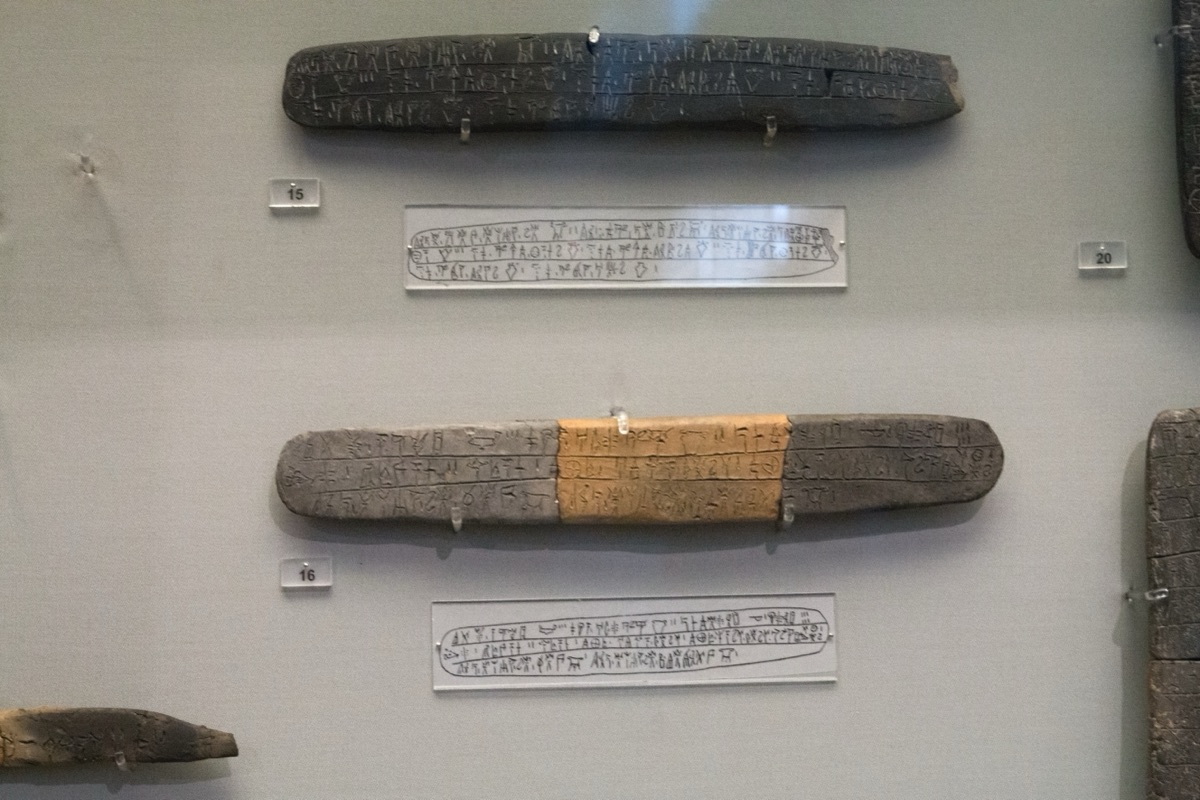
Linear B Tablet, Pylos
A clay administrative tablet from the palace archive at Pylos, inscribed in Linear B, the earliest deciphered form of written Greek.
Photo: Zde / Wikimedia Commons, National Archaeological Museum, Athens
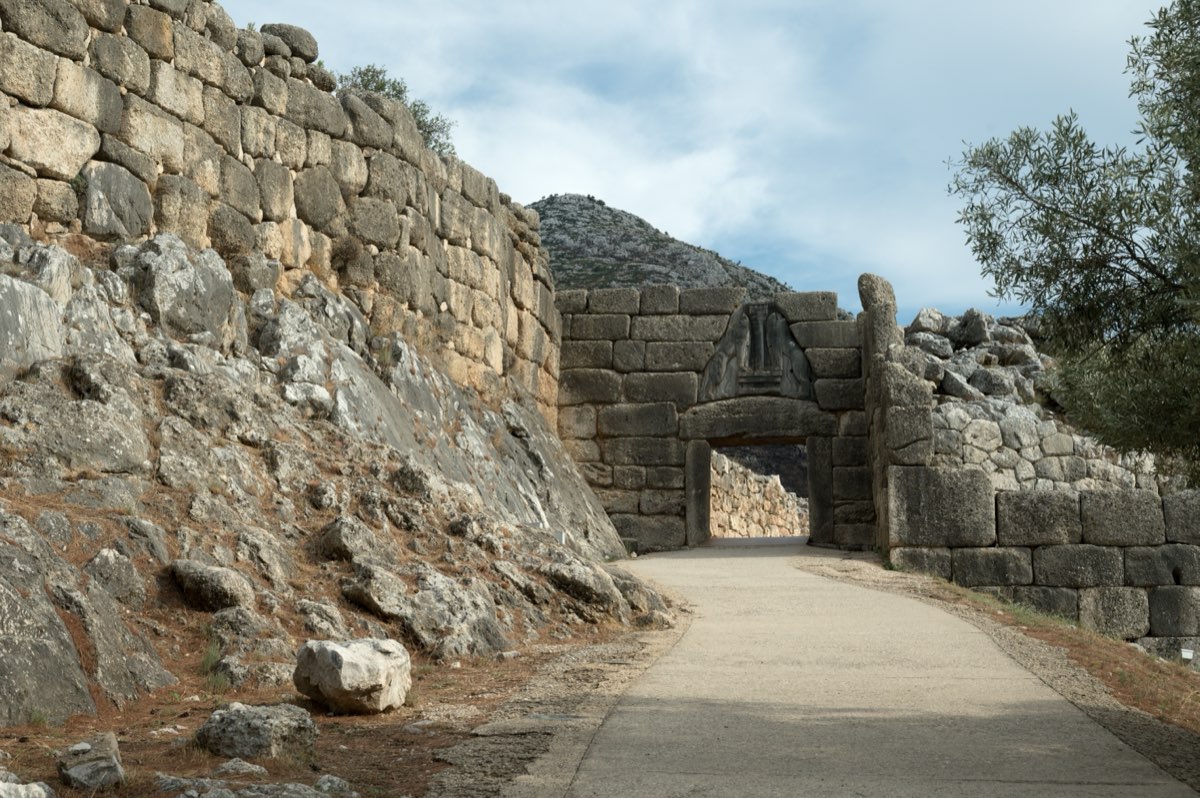
Lion Gate, Mycenae
The main entrance to the citadel of Mycenae, capped by a relief of two lionesses flanking a column, the oldest known monumental sculpture in mainland Europe.
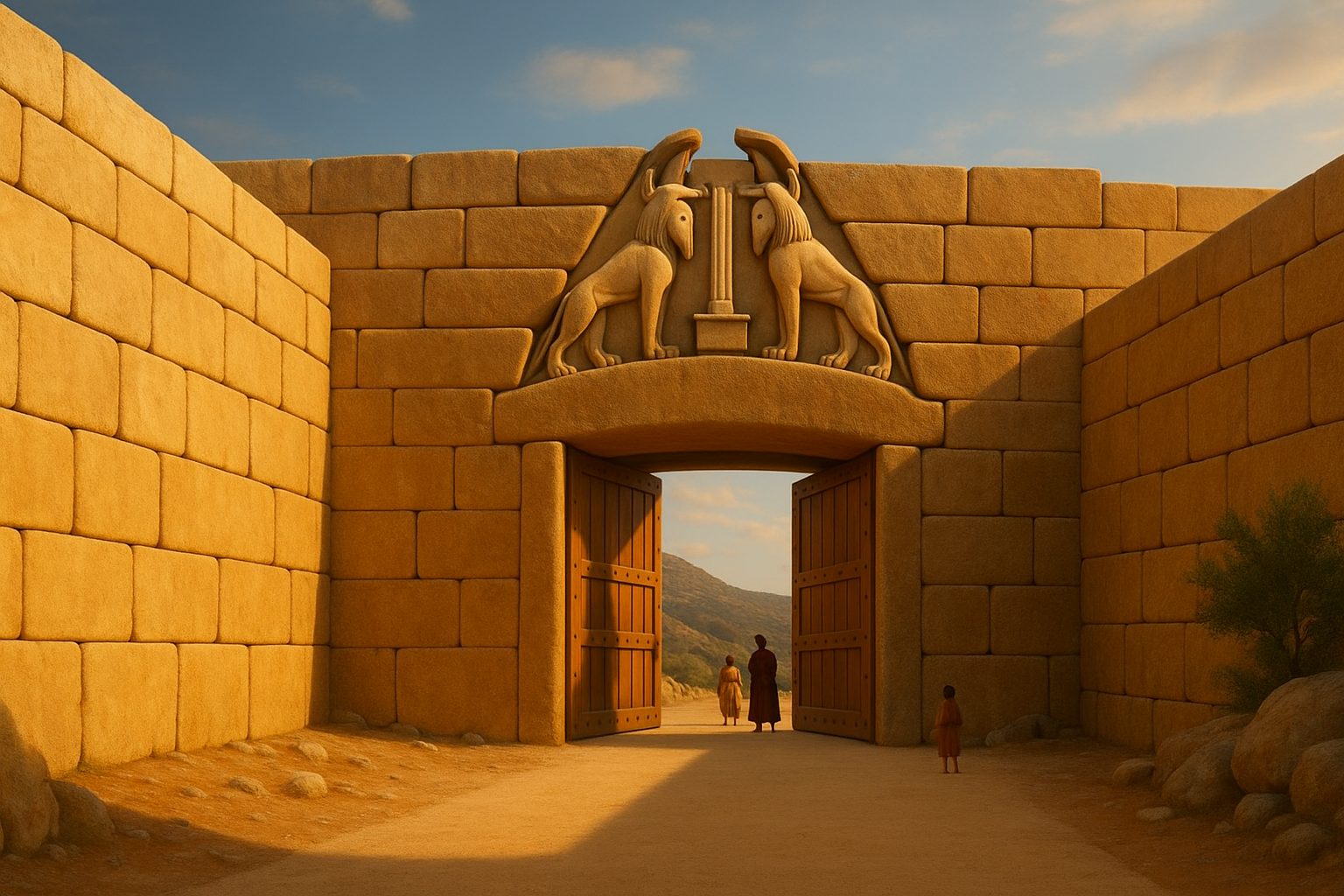
AI reconstruction
Lion Gate at Mycenae - reconstruction
The citadel gate of Mycenae as built: cyclopean walls at full height, the massive lintel carrying the relief of two lionesses flanking a column, and heavy wooden double doors open in the passage. The lionesses' heads, which were made separately and are lost, are restored here by inference - their exact form and material remain debated - and the fresh pale stone would have weathered darker within a generation.
AI reconstruction (2026), based on Lion Gate, Mycenae, photo Zde via Wikimedia Commons
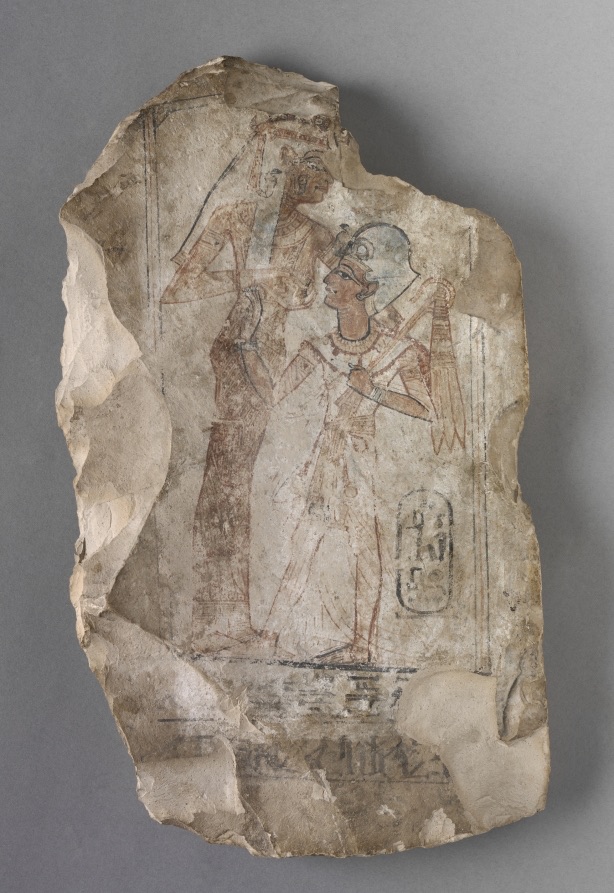
Ostracon: Ramesses II Suckled by a Goddess
A limestone sketch, likely a trial piece by a Theban tomb artist, showing the king nursed by a goddess as proof of his divine right to rule.
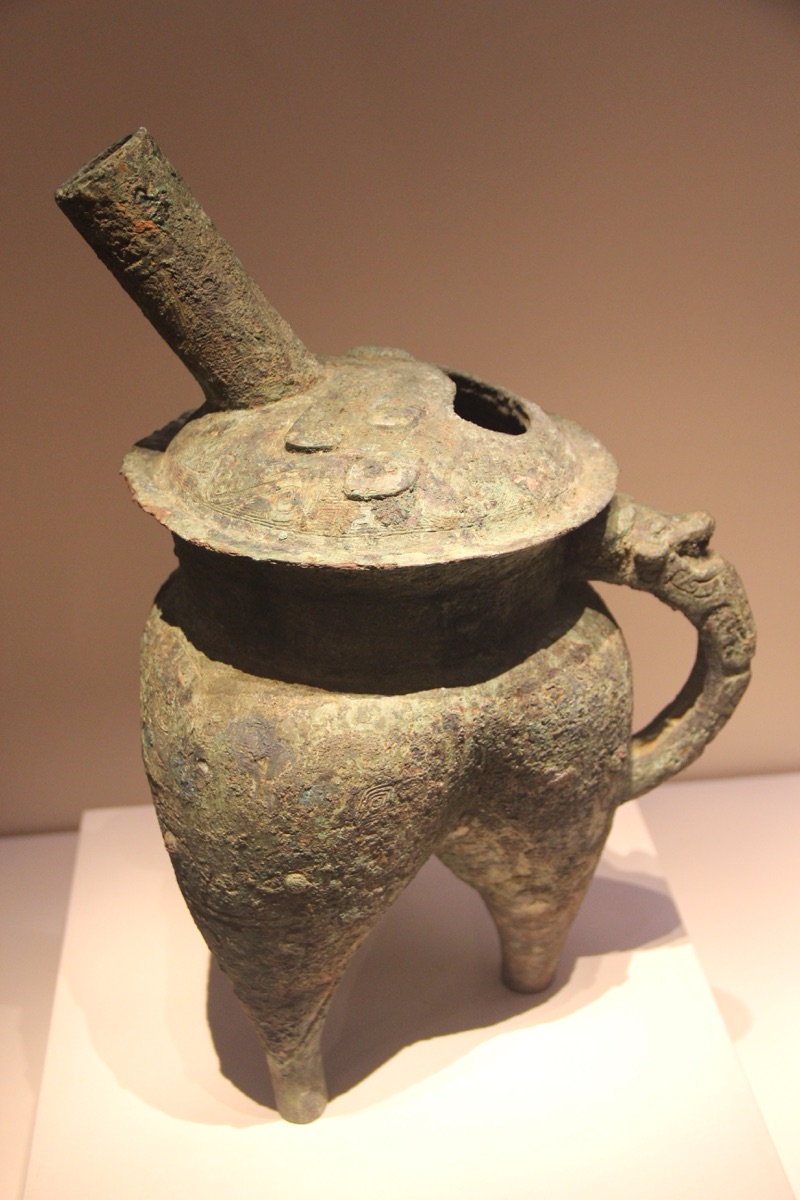
Bronze He (Pouring Vessel), Tomb of Fu Hao
A bronze wine vessel from the intact tomb of Fu Hao, consort and general of the Shang king Wu Ding, whose reign anchors the tomb's date more precisely than almost any other Shang burial.
Photo: Gary Todd / Wikimedia Commons, National Museum of China, Beijing
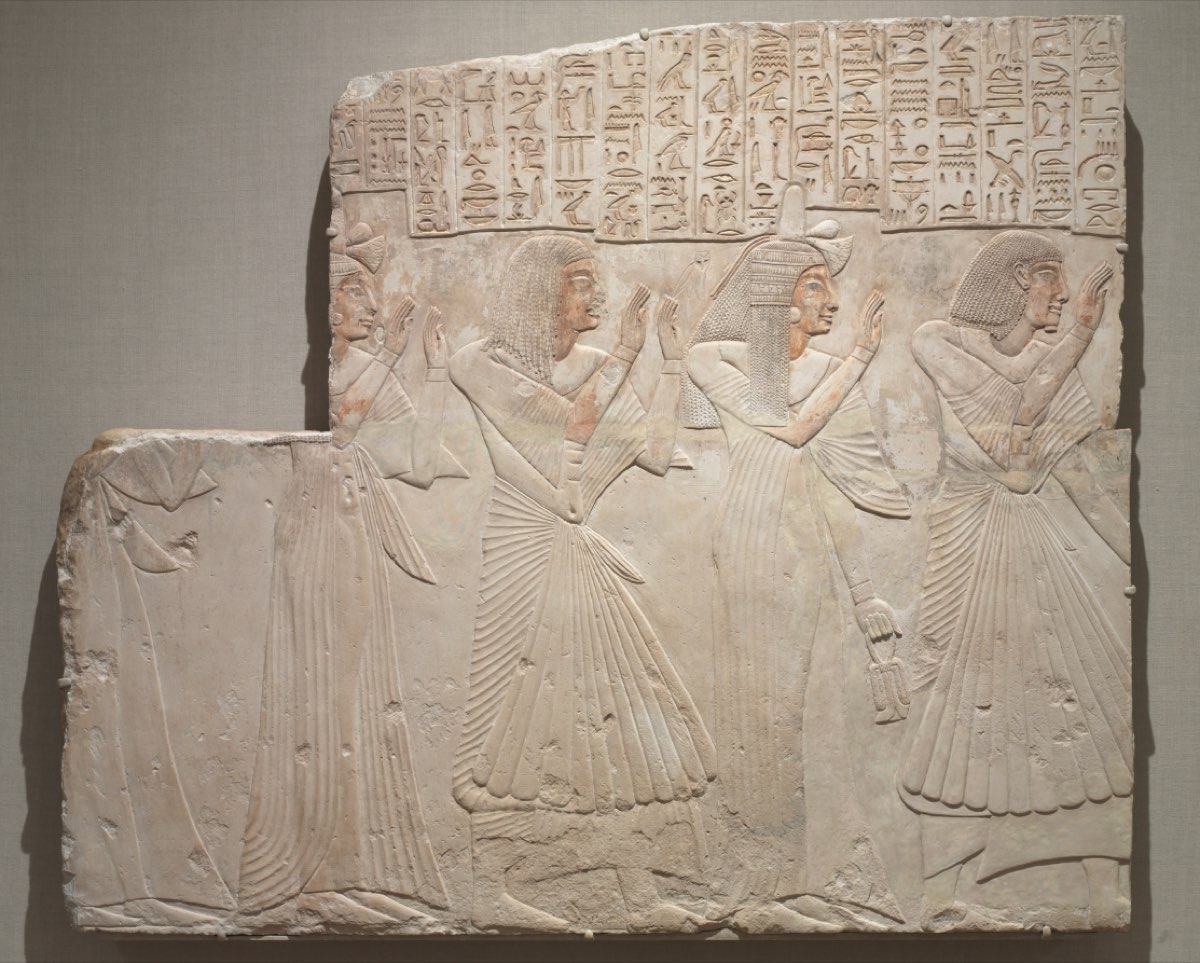
Tomb Relief of the Chief Physician Amenhotep and Family
A limestone tomb relief naming its owner chief physician, evidence that medicine was a formal, titled profession under Ramesses II.
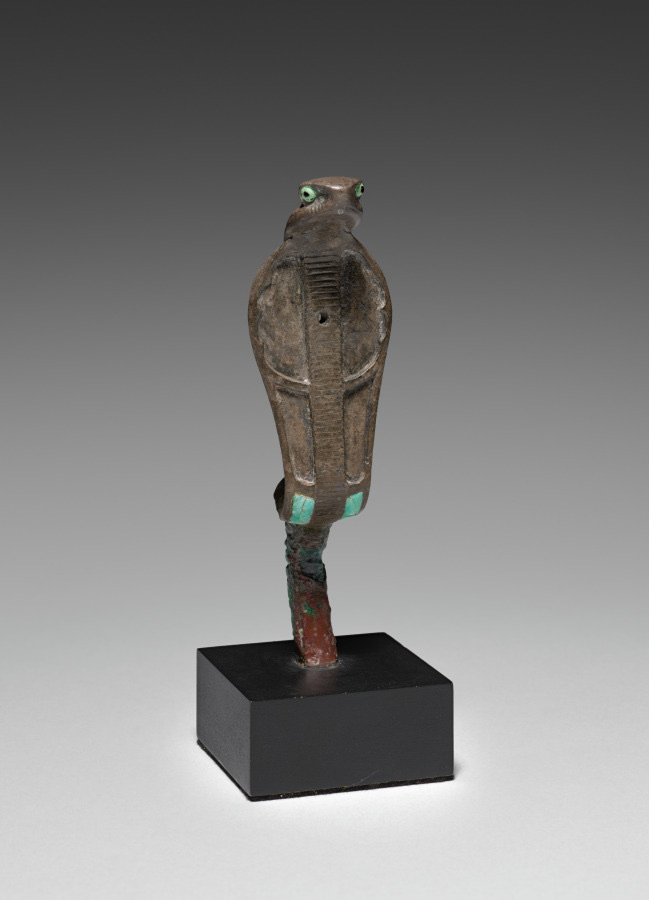
Uraeus (Rearing Cobra)
A gilded silver-copper cobra inlaid with feldspar, turquoise, and possibly obsidian, made as the protective crown ornament of a Ramesside pharaoh or god's statue.
New this century
- Ludlul Bel Nemeqi
A once-favored official, stripped of health, status, and friends for no offense he can name, argues that the gods' justice is real but structurally invisible to the sufferer, knowable only in hindsight, after an arbitrary and unexplained restoration.
- Book of the Heavenly Cow
The sun god's withdrawal from a rebellious humanity, after nearly annihilating it, explains why the divine and human realms are now permanently separated, and why kingship exists to manage what the gods no longer directly rule.
- Poem of Pentaur
A king's personal courage, holding a battlefield abandoned by his own army through the favor of a god who fights physically at his side, can turn a strategic near-disaster into a monument to unmatched valor.
- Treaty of Kadesh (Hittite version)
Two empires that fought each other to a standstill can bind themselves and their heirs to permanent peace, mutual extradition, and mutual military aid, sworn on both sides' gods as guarantors.
- Turin King List
Egyptian kingship forms an unbroken chain running from the reigns of the gods themselves down to the living king, and that chain can be counted, dynasty by dynasty, year by year.
- Apology of Hattusili III
A usurper's seizure of the throne from his own nephew was not treason but the working-out of a goddess's lifelong favor, so every step of the coup is retold as evidence of divine election rather than ambition.
- Oracle Bone Inscriptions
Every consequential decision of state, from harvest timing to war to childbirth, must be tested through cracked bone and shell against the will of royal ancestors and nature spirits before a Shang king can safely act on it.
- The Tukulti-Ninurta Epic
Assyria's earliest royal epic argues that Tukulti-Ninurta I's conquest of Babylon was not aggression but forced justice, since the Babylonian king Kashtiliash IV had already broken a sworn treaty and thereby forfeited his gods' protection before the war began.
- Merneptah Stele
Egypt's enemies abroad, named one by one, have already been permanently subdued, and among them, almost as an aside, stands the earliest known reference to Israel outside its own scriptures.
The canon by now
- Pyramid Texts
- Royal Inscriptions of Sargon of Akkad
- The Exaltation of Inanna
- The Curse of Agade
- Coffin Texts
- Admonitions of Ipuwer
- Eloquent Peasant
- Code of Hammurabi
- Old Babylonian Gilgamesh (Pennsylvania and Yale Tablets)
- Inanna's Descent to the Netherworld
- Edwin Smith Surgical Papyrus
- Book of the Dead
- Rigveda
- Baal Cycle