Time travel
9th century BC
Assyria turns from surviving to conquering, campaigning as far as a coalition of Levantine kings at Qarqar, while Phoenician sailors reach Sardinia and the divided Hebrew kingdoms settle into an uneasy order between Assyria and Aram.
Mental Worlds: Evidence and Inference
Assyria spends this century relearning how to conquer, and it does so with a self-consciousness that earlier Near Eastern empires had not bothered to display. Ashurnasirpal II's annals do not merely record victories; they describe, in specific and repeated detail, the flaying and impaling of rebellious officials and the piling of skulls outside conquered cities, described as a matter of course rather than an aberration. This is policy stated openly: terror as a substitute for the manpower a still-recovering Assyria cannot yet spare for permanent garrisons everywhere it wants influence. His son Shalmaneser III extends the method across decades of campaigning and eventually meets its limit, when a coalition of Levantine states, including the northern Hebrew kingdom of Israel under Ahab and the Aramean kingdom of Damascus under Hadadezer, fights Assyria to a draw at Qarqar in 853 BC. The battle is known only from Shalmaneser's own inscription, which claims victory in the way conquerors' inscriptions generally do; the coalition's survival afterward suggests the claim was, at minimum, exaggerated.
For the two Hebrew kingdoms, Israel and Judah, this is the century in which Assyrian power becomes the defining fact of regional politics, a pressure that will eventually destroy the northern kingdom outright within the following century and reduce the southern one to a vassal. Nothing written by either kingdom from this century survives directly; critical scholarship places the earliest narrative and legal material that will eventually be woven into the Torah in this general period, but what exists now is fragments and oral material, not a text a contemporary reader could have held. A literate person in Samaria or Jerusalem this century would have known Assyria mainly as the empire whose armies periodically probed the Levant, not yet as the annihilating threat it will become for Israel by 722 BC.
Set against Assyria's overland terror is a much quieter form of expansion happening at sea. Phoenician sailors from Tyre and its sister cities have, by roughly this period, reached Sardinia, a fact known only because they left an inscription at Nora recording it, almost incidentally, in the alphabet their cities use for ordinary commerce; the inscription's own date is debated on palaeographic grounds and could sit a little earlier or later than this century. There is no conquest narrative attached to this, no annal boasting of subjugated peoples; it is trade and settlement, moving an alphabet toward the central Mediterranean a full century or more before that alphabet reaches Greek hands and becomes, eventually, the ancestor of most of the world's writing systems. Whoever carved that Nora inscription had no reason to know its significance; from where they stood, it was simply a record left far from home.
In China, an entirely unconnected crisis produces an unexpected historiographical gift. The Gonghe Regency, beginning in 841 BC after the Zhou king is driven from his capital, marks the point from which Chinese chronology can be reconstructed year by year with confidence, an accident of political breakdown that later historians will treat as their discipline's true beginning. Three widely separated literate worlds, an expanding Near Eastern empire, a quietly expanding trading network, and a court in temporary crisis, each produce, this century, the raw material later ages will use to write their own histories, none of them aware the others exist.
The political map
Major Polities and Cultural Regions
- Assyria Neo-Assyrian resurgence under Ashurnasirpal II and Shalmaneser III, campaigning from the Zagros to the Mediterranean coast
- Babylonia Weak and largely overshadowed by Assyria, its scholarly institutions intact but its military reach limited
- Kingdom of Israel Northern Hebrew kingdom, part of the coalition that fought Assyria to a draw at Qarqar in 853 BC
- Kingdom of Judah Southern Hebrew kingdom, smaller and less prominent than Israel in this century's Assyrian records
- Arameans Damascus and its neighbors, Assyria's most persistent Levantine rivals this century
- Phoenician city-states Byblos, Tyre, and Sidon, now reaching Sardinia and the central Mediterranean by sea
- Western Zhou Yellow River valley, weakening toward the crisis that produces the Gonghe Regency of 841 BC
Borders are approximate scholarly reconstructions from historical-basemaps (GPL-3). Nearest available basemap anchor year: 1000 BC.
State of the domains
Texts and Written Culture
In Israel, critical scholarship places the earliest written strands later woven into the Torah in this century, composed centuries before the text reaches anything like its final form; nothing like a finished Torah exists yet, only early narrative and legal material later editors will use. Proverbs begins gathering sayings that accumulate for centuries before final editorial shaping. In China, the core hexagram and line texts of the Zhouyi, later expanded into the I Ching, take shape within the Zhou court. In Babylon, the Poem of Erra dramatizes plague and civil breakdown as the god Erra's rampage restrained only by his own herald, a rare meditation on violence as something even a war-god must be talked down from.
Art
Assyrian palace relief matures into a distinctive imperial form under Ashurnasirpal II, whose reliefs at his new capital Kalhu record victories and, deliberately, atrocities, designed to frighten rather than only commemorate. Phoenician craftsmen continue producing carved ivory and metal bowls, traded as far as Assyria itself even while it campaigns against Phoenician cities' neighbors. Zhou ritual bronze work continues its high sumptuary tradition. Israelite and Judean material culture, known mostly through archaeology, shows modest fortified administrative centers rather than anything comparable to Assyrian palace building. Far beyond the reach of any of these networks, Olmec La Venta in the Gulf Coast lowlands of Mexico raises colossal basalt heads and buries elaborate jade offerings beneath its plazas, the dominant center of a Mesoamerican tradition with no contact of any kind with the Near East, Mediterranean, or East Asian worlds sharing this century.
Medicine
No new medical compilation is attested this century specifically, though the diagnostic and exorcistic tradition Esagil-kin-apli had systematized roughly two centuries earlier in Babylon continues in active use, copied and consulted by working practitioners rather than revised. Egyptian temple medicine likely continues along established lines through a still-divided, militarily weak state. Assyria's rapidly expanding court, now wealthy from conquest, can be assumed to support physicians and healers, though no distinctly Assyrian medical text from this century survives to describe their methods, leaving this domain's picture thinner than the century's military and artistic record.
Science
Assyrian scribes maintain the eponym list, a year-naming system that lets later scholars reconstruct Assyrian chronology with unusual precision; the practice itself is older, but the classical form of the list solidifies around this period. In China, the Gonghe Regency beginning in 841 BC marks the first year in Chinese history for which a continuous, verifiable count of subsequent years survives, an accident of political crisis that becomes historiography's benefit. Babylonian celestial omen compilation continues without evident change. No tradition anywhere yet separates prediction from divination, or natural cause from divine intention; precise chronology and predictive magic develop side by side in the same scribal institutions.
Military
Ashurnasirpal II rebuilds Assyrian military power through campaigns whose brutality his own annals advertise rather than conceal, flaying and impaling rebels as calculated deterrence. His son Shalmaneser III extends the pattern, campaigning for decades and fighting a coalition of Levantine kings, including Israel's Ahab and Damascus's Hadadezer, to a draw at Qarqar in 853 BC, a battle known only from the Assyrian side. Phoenician cities meanwhile expand by sea rather than land: an inscription left at Nora, on Sardinia, whose exact date is debated but usually placed in this general period, is among the earliest evidence Phoenician sailors have reached the central Mediterranean, a different kind of expansion from Assyria's overland terror.
Technology
Iron has become the dominant metal for tools and most weapons across the Near East and the Aegean by this century, bronze now reserved mainly for fine and ceremonial work; the long transition begun after the Bronze Age collapse is essentially complete. Assyrian armies field increasingly sophisticated siege equipment, including battering rams and siege towers depicted in Ashurnasirpal II's palace reliefs. Phoenician shipbuilding has advanced enough to sustain open-water voyages to Sardinia and likely beyond, a navigational and hull-construction achievement that leaves little textual trace but is attested by the goods and inscriptions these ships carried west.
Material world
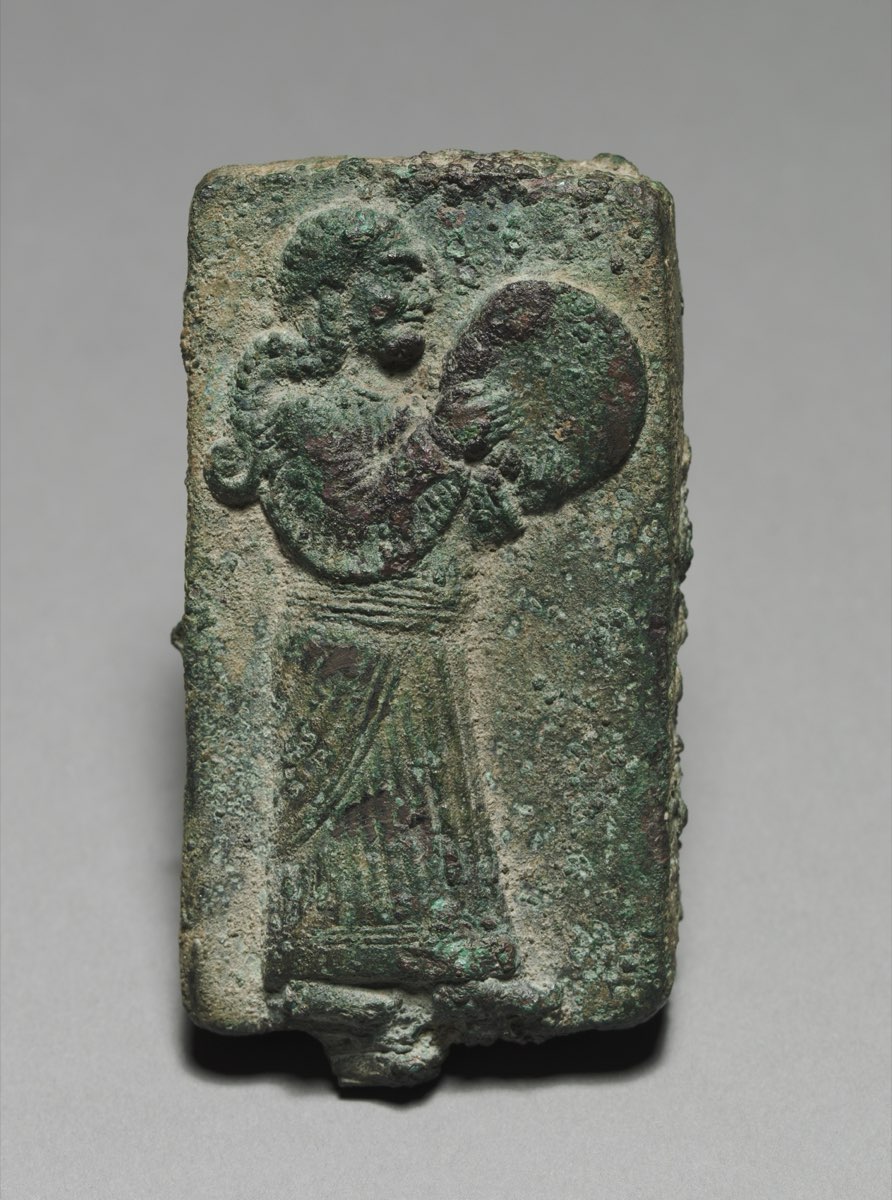
Hand Drummer
A cast bronze plaque of a musician playing a hand drum, probably one of a set that decorated the side of a throne.
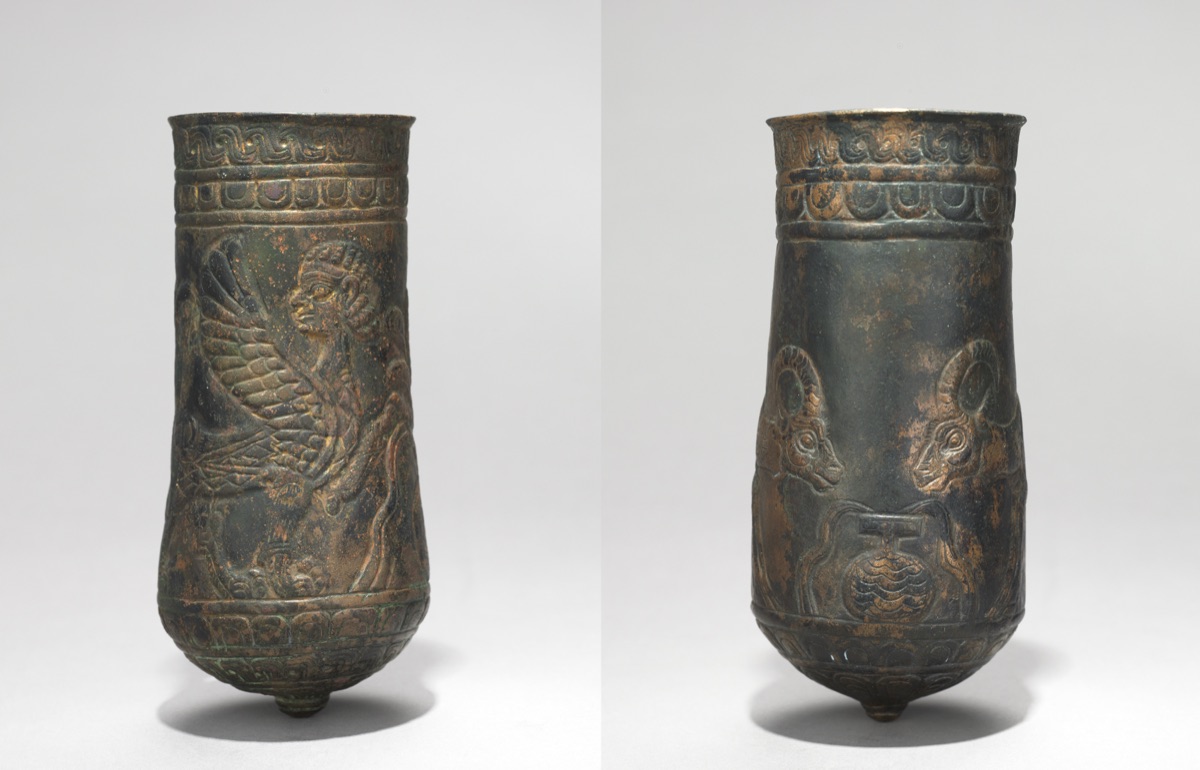
Button-Based Situlas
A pair of bronze situlas from the Luristan highlands of western Iran, one decorated with ibexes at a water jar, the other with sphinxes.
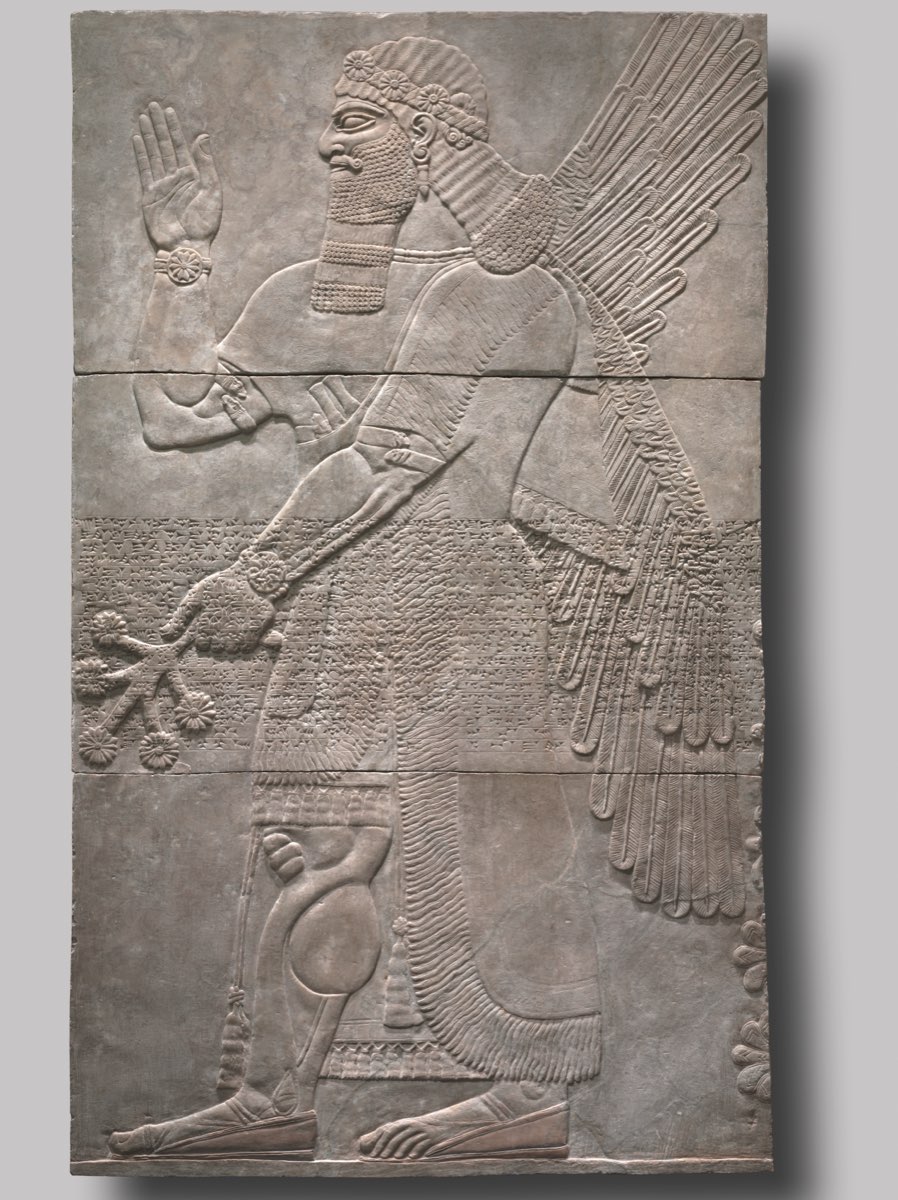
Saluting Protective Spirit
A gypsum wall relief from Ashurnasirpal II's palace at Nimrud, the winged guardian figures that lined the corridors of Assyrian royal power.
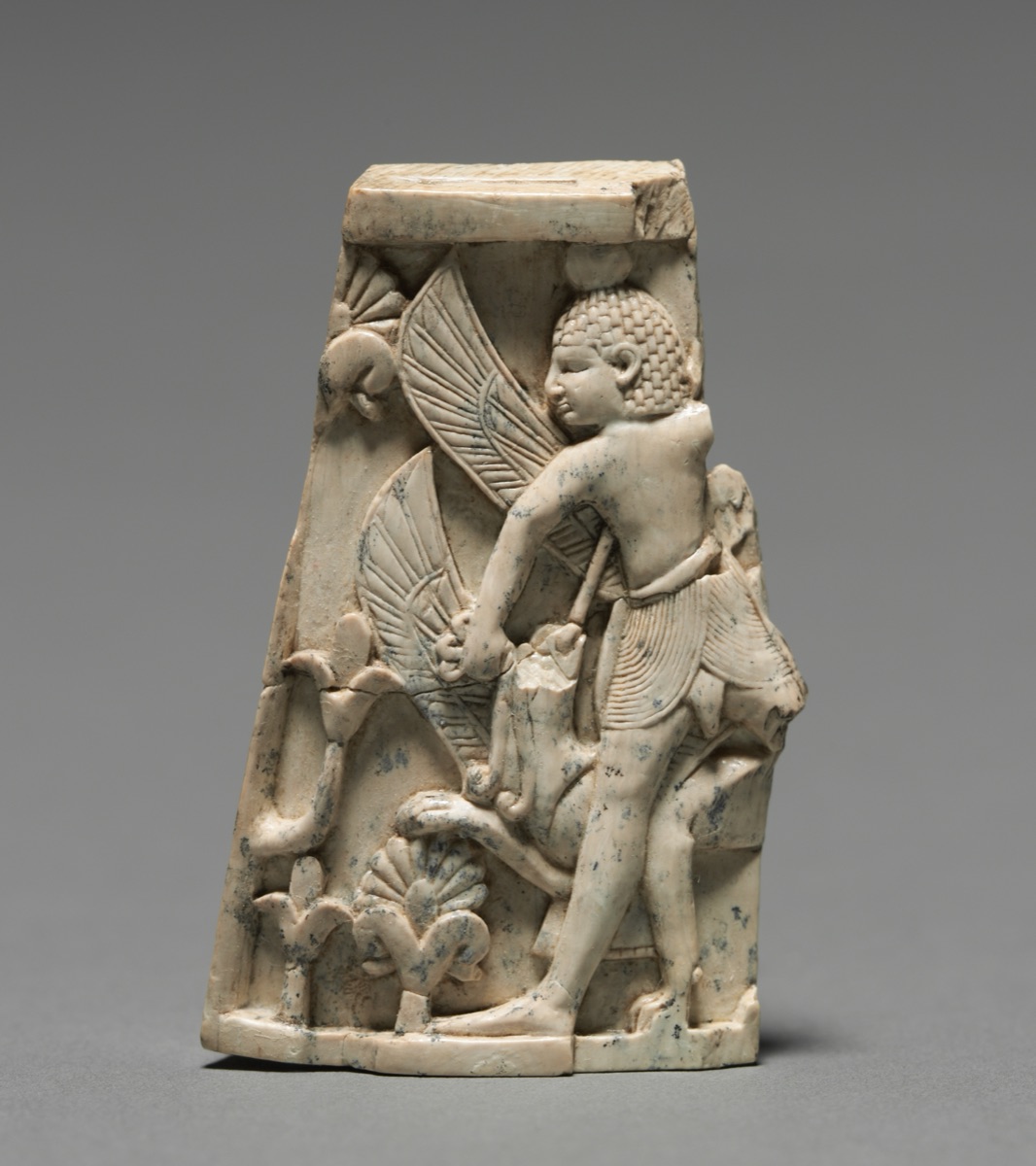
Decorative Plaque: Man and Griffin in Combat
A carved ivory plaque showing a man battling a griffin, part of the Phoenician-carved furniture hoard recovered from Nimrud's palaces.
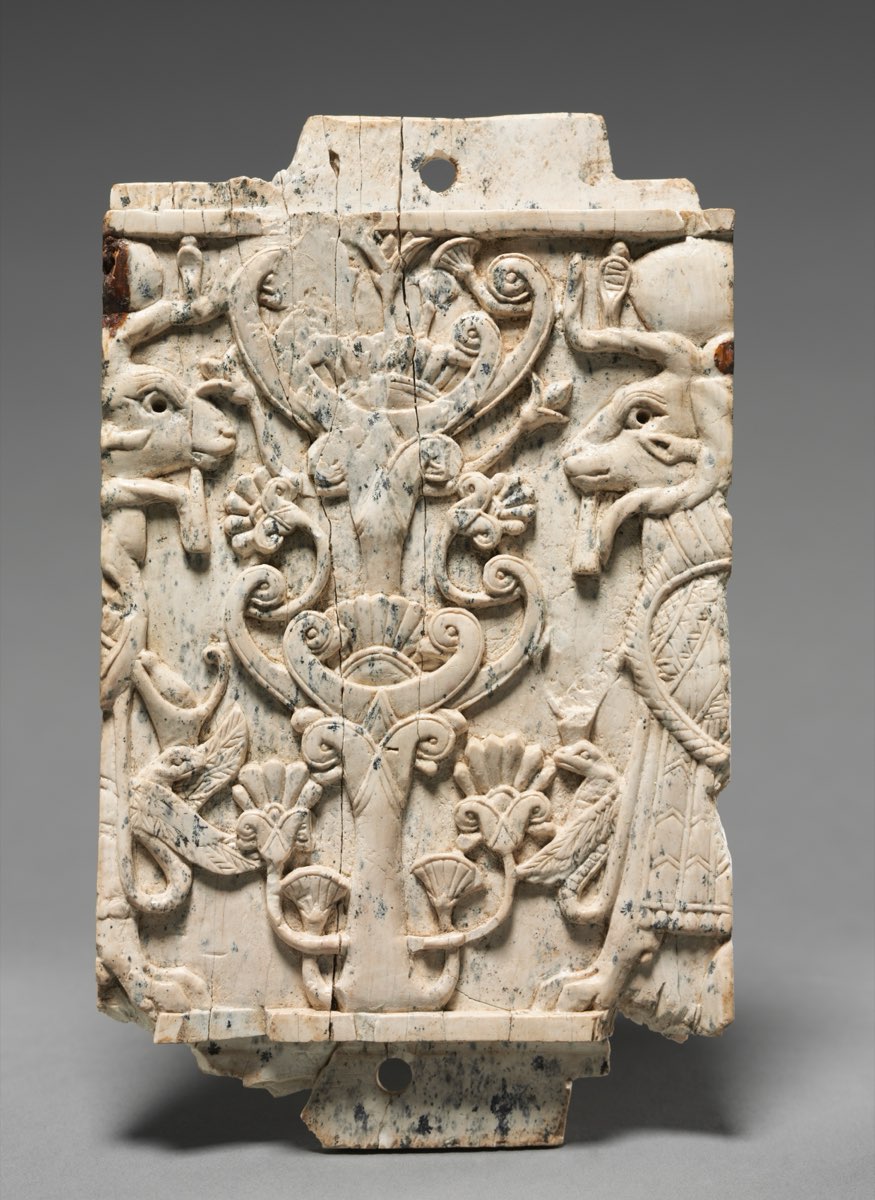
Decorative Plaque: Ram-Headed Sphinxes Flanking a Sacred Tree
An ivory plaque carved with ram-headed sphinxes flanking a sacred tree, Phoenician workmanship that furnished Assyrian palace interiors.
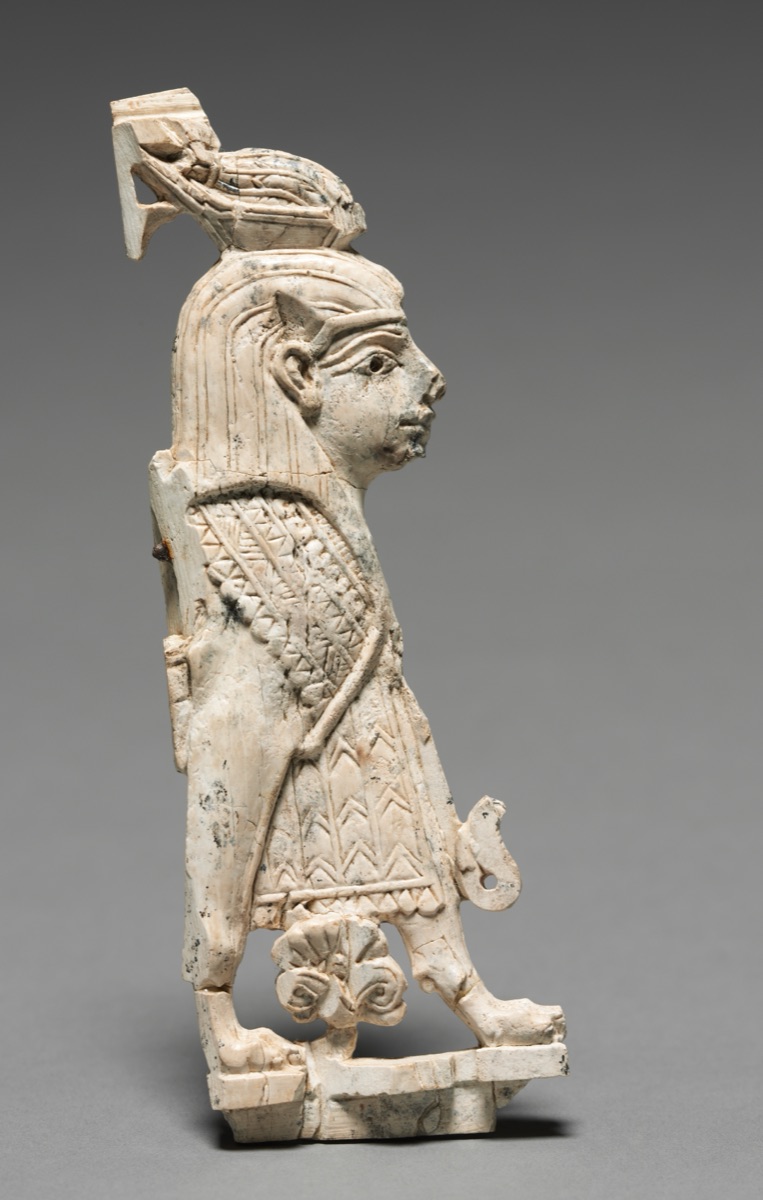
Decorative Plaque: Winged Sphinx
A carved ivory furniture inlay in Phoenician style, tribute or trade goods that ended up decorating Assyrian palace furniture at Nimrud.
New this century
- The Poem of Erra
War and plague are explained not as random catastrophe but as the result of a bored, restless god goading a reluctant king of pestilence into unleashing violence the god's own advisor then has to talk him out of.
- Torah
One God, bound to a people by covenant and law, acts through history rather than nature.
- I Ching (Book of Changes)
Change itself has a structure, sixty-four patterned situations built from broken and unbroken lines, and a person who correctly reads which pattern is unfolding can act in accord with it rather than against it.
- Annals of Ashurnasirpal II
Founding the mature form of the Neo-Assyrian royal annal, Ashurnasirpal II argues for kingship through an unbroken first-person narration of campaign after campaign, deportation after deportation, cataloguing conquered territory as evidence of divinely sanctioned, permanent Assyrian dominance.
- Proverbs
Practical wisdom for ordinary life is itself a form of piety, because "fear of the Lord" and shrewd, observant living are treated as the same discipline rather than as rival goods.
- Kilamuwa Stela
Kilamuwa of Sam'al asserts that he alone among his dynasty's rulers, by shrewdly balancing Assyria against the Danunians and by improving the lot of a subject population, delivered a stability his four royal predecessors failed to provide.
The canon by now
- Pyramid Texts
- Royal Inscriptions of Sargon of Akkad
- The Exaltation of Inanna
- The Curse of Agade
- Coffin Texts
- Admonitions of Ipuwer
- Eloquent Peasant
- Code of Hammurabi
- Old Babylonian Gilgamesh (Pennsylvania and Yale Tablets)
- Inanna's Descent to the Netherworld
- Edwin Smith Surgical Papyrus
- Book of the Dead
- Rigveda
- Baal Cycle
- Ludlul Bel Nemeqi
- Epic of Gilgamesh
- Instruction of Amenemope
- Gathas
- Book of Songs