Time travel
1st century BC
Rome's Republic dies in exhaustive, self-documented detail this century, in Cicero's letters and Caesar's own campaign reports, while Han China, at the other end of Eurasia and on a separate clock, spends it quietly building a road west instead.
Mental Worlds: Evidence and Inference
Rome's Republic dies this century in slow motion, and nearly everyone involved keeps a remarkably detailed written record of it happening. Cicero's speeches, letters, and philosophical dialogues, the largest surviving body of work by any figure of the Roman Republic, document a statesman trying and ultimately failing to hold a functioning constitutional order together against generals who have learned that loyal armies matter more than the Senate's approval. Caesar's own commentaries on his Gallic and civil wars are simultaneously military reports and calculated political self-justification, published for a Roman public whose opinion still mattered enough to be worth managing. Catullus writes personal lyric poetry of an intimacy nothing earlier in Latin approaches, and Lucretius versifies Epicurean physics in De Rerum Natura, arguing that a universe made of atoms and void, indifferent to human affairs, should free people from exactly the political and religious anxieties consuming Rome around him.
By the century's end Octavian has defeated every rival, taken the name Augustus, and begun quietly assembling one-man rule while preserving the Republic's forms closely enough that Virgil, Horace, and Livy can write as if Rome's old civic virtues have been restored rather than replaced. Actium, in 31 BC, breaks Antony's rebellion, and Cleopatra's death and Egypt's annexation the following year end the Ptolemaic dynasty, folding Egypt, Alexandria's Library included, into a single man's personal territory rather than the Senate's. Virgil begins the Aeneid, an epic that retroactively justifies the entire process as fate's plan since Troy's fall, while Horace's Odes and Livy's history both, in their different registers, help write the ideological vocabulary the new order needs to describe itself as continuity rather than as the coup it substantially is.
Far to the east, Han China extends its own reach into Central Asia on a wholly separate timeline and for its own reasons, formalizing control over the Tarim Basin's oasis states by establishing the Protectorate of the Western Regions in 60 BC. This corridor, threading between Parthia's territory and the Kushan region taking shape in its wake, is what eventually carries Chinese silk toward Roman markets and, much more faintly, some awareness of a wealthy state drifting back toward Han court records. It carries goods and rumors of wealth in both directions, never texts, embassies, or any accurate sense of who actually rules at the other end; Rome's elite know silk comes from somewhere impossibly far east, and Han geographers record only the vaguest secondhand account of a wealthy state somewhere impossibly far west, each empire's most intimate self-understanding a total blank to the other.
What this century actually produces, on both ends of that silent corridor, is an unusual density of people writing down what they think while their political world visibly changes shape under them, Cicero and the historians compiling Han's own archives alike treating the act of written record as a kind of anchor against events neither fully controls.
The political map
Major Polities and Cultural Regions
- Roman Republic, becoming the Roman Empire Mediterranean basin entire by century's end, Republic giving way to Augustus's rule
- Parthian Empire Iran to Mesopotamia, Rome's standing check in the east
- Han Empire Core China plus a new protectorate over the Western Regions from 60 BC
- Ptolemaic Egypt Nile valley, ending with Cleopatra's death and Roman annexation in 30 BC
- Judea Small client kingdom under Hasmonean then Herodian rule, increasingly under direct Roman oversight
- Kush Nile valley south of Egypt, Meroe's rulers trading with both Rome's new Egyptian province and the Red Sea
Borders are approximate scholarly reconstructions from historical-basemaps (GPL-3).
State of the domains
Texts and Written Culture
Rome's first century of genuinely first-rank literature: Cicero's speeches, letters, and philosophical dialogues set Latin prose's standard for the rest of antiquity; Lucretius versifies Epicurean physics in De Rerum Natura; Catullus writes personal lyric poetry of an intimacy nothing earlier in Latin approaches; Caesar's own campaign commentaries double as political self-justification. By the century's final decades Virgil completes the Eclogues and Georgics and begins the Aeneid, Horace writes the Odes and Satires, and Livy begins Ab Urbe Condita. In China, Yang Xiong writes the Taixuanjing, a divinatory and cosmological text modeled on, and rivaling, the ancient Yijing.
Art
Roman portrait sculpture develops a severe, deeply lined verism distinct from Hellenistic idealism, favoring the weathered face of hard-won authority over youthful beauty, suiting a political culture nominally still ruled by elder statesmen even as one man begins concentrating power. Wall painting in Roman houses, later preserved at Pompeii, develops the illusionistic architectural styles art historians will classify by period. Alexandria's court art continues under the Ptolemies' final, weakening generation. Han China's tomb art and jade burial suits for the elite reflect a settled bureaucratic empire's confidence in its own permanence.
Medicine
Asclepiades of Bithynia brings a mechanistic, atomist-influenced medical theory to Rome, treating disease as disordered particle movement rather than humoral imbalance, and helps make Greek medicine socially acceptable among a Roman elite that had distrusted it a century earlier. No major theoretical medical treatise from Han China survives from this specific century in the corpus, though the correlative framework organizing the following century's great medical compilations is already forming. Roman military medicine develops informally through the logistics of Caesar's and Pompey's campaigns, treating wounds at a scale civilian practice had rarely required before.
Science
Chinese mathematicians compile the core of the Nine Chapters on the Mathematical Art, a practical manual of algorithms for surveying, taxation, and engineering that remains China's foundational mathematics text for a millennium. Posidonius, a Stoic polymath at Rhodes, studies tides, geography, and astronomy, teaching Cicero at his school and receiving Pompey there as a visiting dignitary. Sosigenes of Alexandria advises Julius Caesar on the calendar reform of 46 BC, finally fixing a leap-year system close to the one the Decree of Canopus had proposed two centuries earlier for Egypt alone. Roman engineering and Chinese astronomy each advance without either civilization's science reaching the other.
Military
Rome's late Republic is a century of civil war as much as conquest: Marius and Sulla, then Caesar and Pompey, then Antony and Octavian, fight each other for control of a state whose armies now answer to generals more than to the Senate. Caesar conquers Gaul between 58 and 50 BC, then crosses the Rubicon; Octavian defeats Antony and Cleopatra at Actium in 31 BC, and Cleopatra's death and Egypt's annexation the following year end the Ptolemaic dynasty as the Republic gives way to Augustus's rule. Han China formalizes its reach into Central Asia by establishing the Protectorate of the Western Regions in 60 BC, extending the corridor Zhang Qian's embassy had first reported possible two generations earlier.
Technology
Roman engineering matures with concrete construction, extending aqueducts and roads across an empire in all but name. Vitruvius, writing at century's end, compiles De Architectura, systematizing Roman building practice, materials, and machinery into the first surviving comprehensive architectural treatise. Han China's ironworking and silk production support the goods that now move west along tentative routes through Central Asian intermediaries, later called the Silk Road, though the term itself is a nineteenth-century coinage and no Roman or Han source of this century names it that way. Neither empire yet imports the other's inventions directly.
Material world
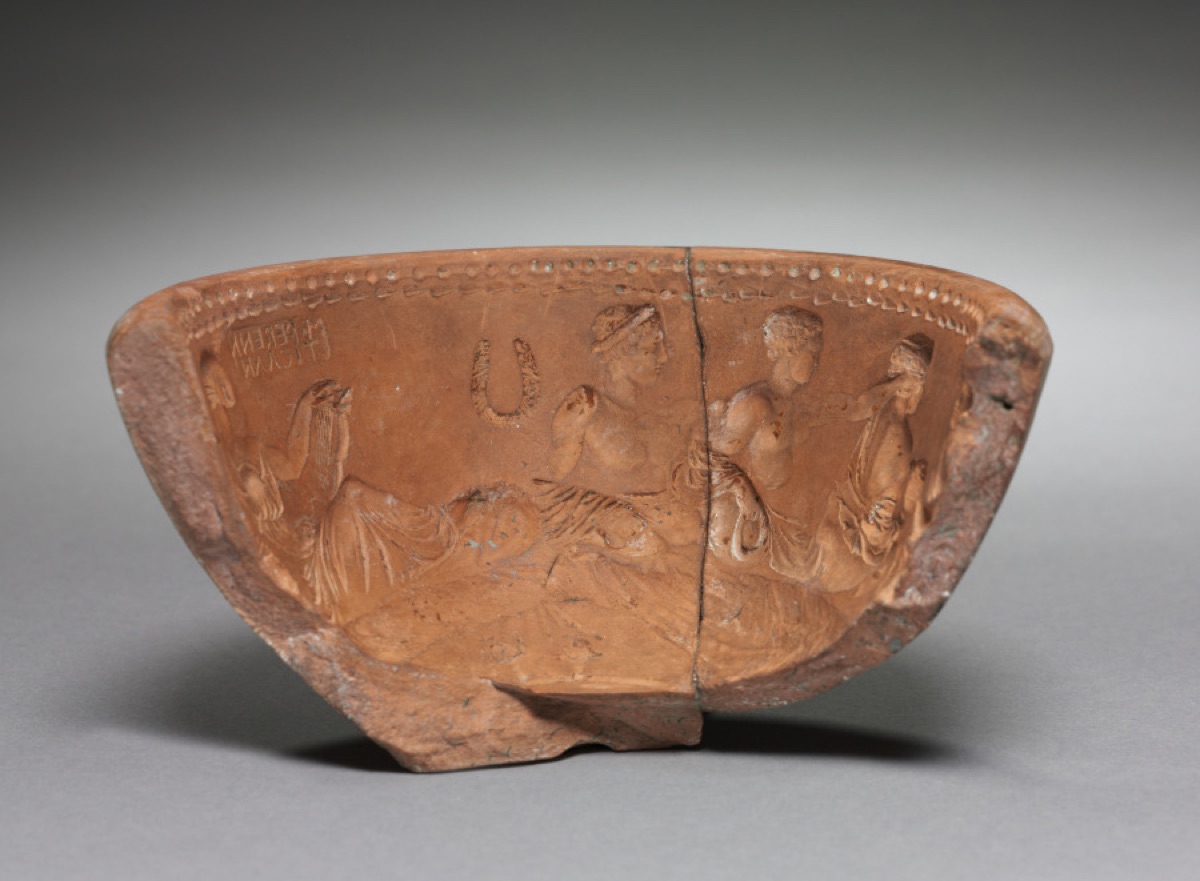
Fragment of a Mold for Arretine Bowl
A ceramic mold from Arezzo used to mass-produce the glossy red terra sigillata tableware that Roman workshops shipped across the empire by the crate-load.
The Cleveland Museum of Art, Gift of the John Huntington Art and Polytechnic Trust, 1916.2009
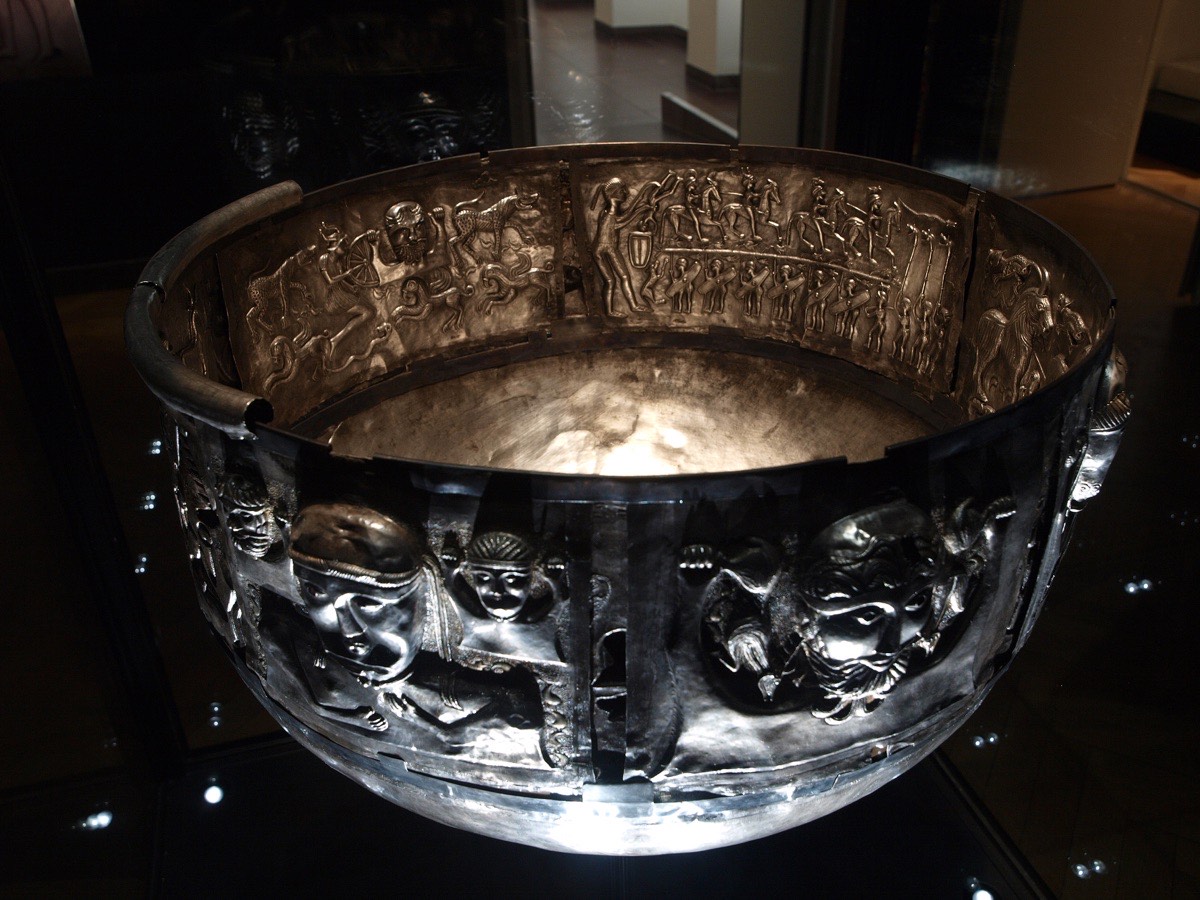
Gundestrup Cauldron
A large silver vessel worked with gods, warriors, and a bull sacrifice in a style pointing to Thracian silversmiths, found dismantled in a Danish peat bog far from where it was made.
National Museum of Denmark, Copenhagen. Photo mararie, CC BY-SA 2.0
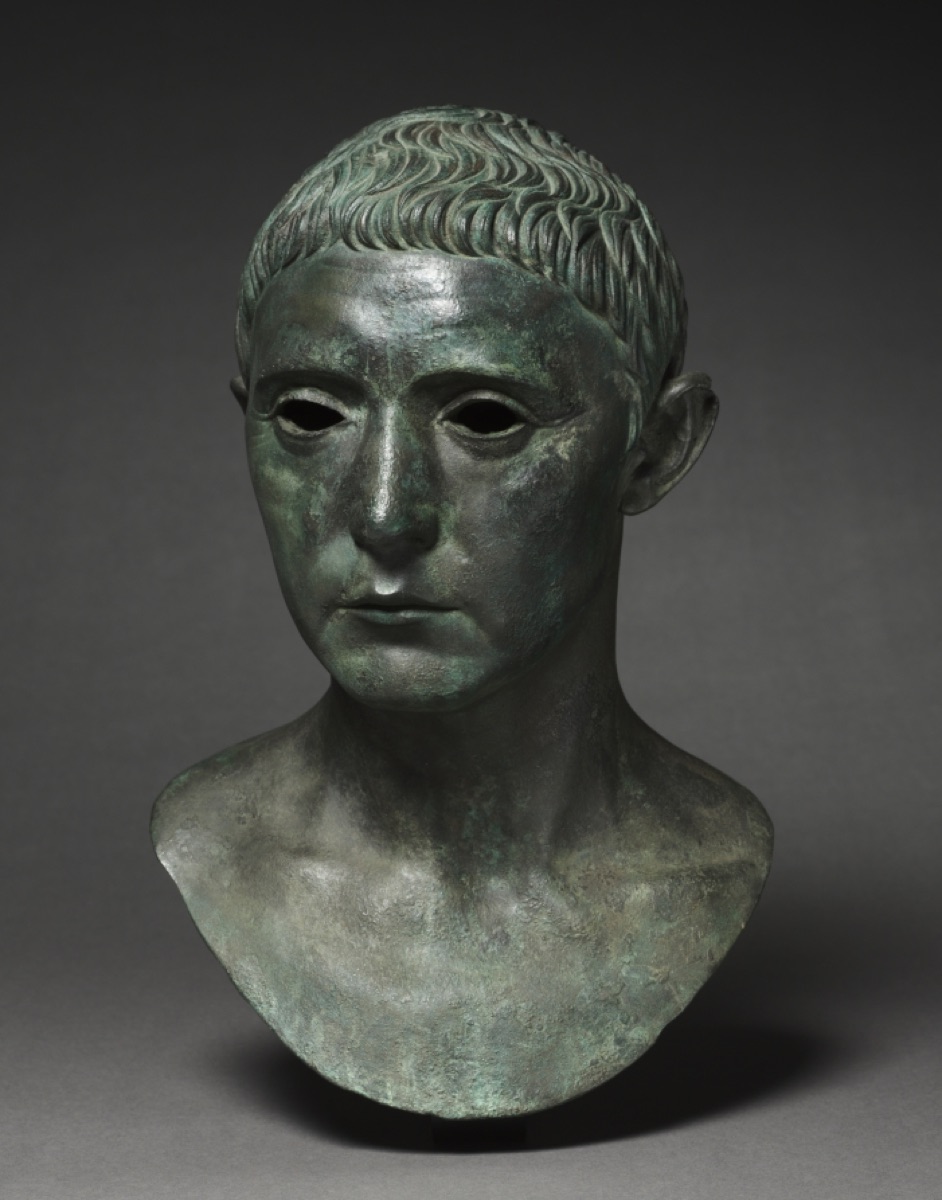
Portrait Bust of a Man
A cast bronze portrait bust, its wrinkled forehead, naturalistic ears, and neatly stylized hair pointing to an Augustan date; the sitter, likely once honored on a herm, is unknown.
The Cleveland Museum of Art, Gift of the John Huntington Art and Polytechnic Trust, 1928.860
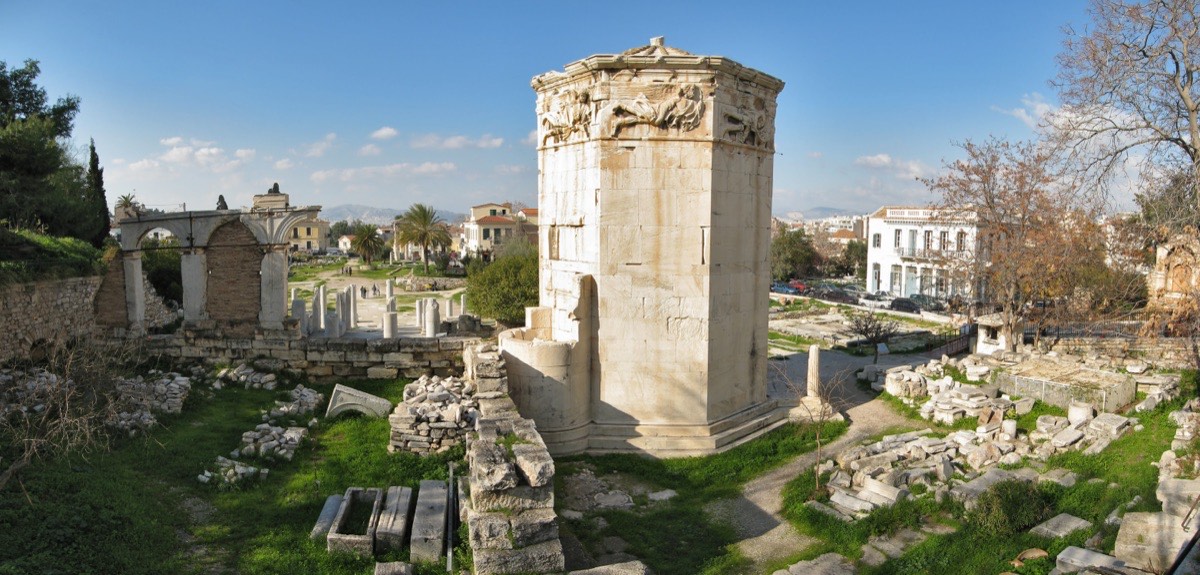
Tower of the Winds
An octagonal marble horologion built by Andronicus of Cyrrhus, each face carved with the personified wind it faced above a sundial, and a water clock running inside.
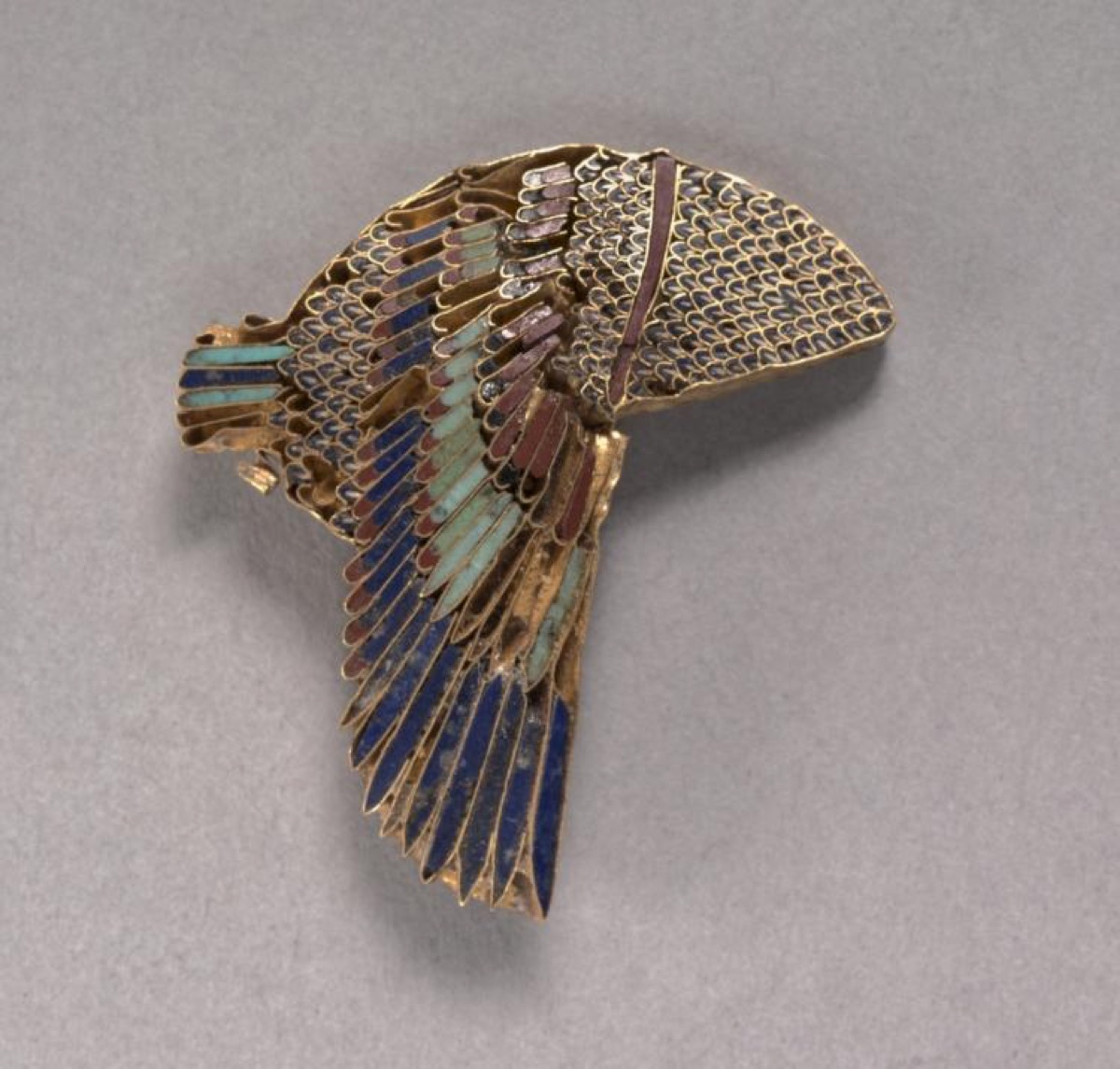
Vulture Headdress Inlay
A gold inlay set with lapis lazuli, turquoise, and petrified wood, shaped as the vulture headdress worn by goddesses and queens in Ptolemaic Egypt, its more than one hundred stones separated by thin plates of gold.
The Cleveland Museum of Art, Gift of the John Huntington Art and Polytechnic Trust, 1920.1991
New this century
- Wisdom of Solomon
Wisdom is a divine, quasi-personal emanation who both created the world and guarantees the immortal soul's reward, so a Jew living among Greek philosophy need not choose between Mosaic faith and philosophical reason.
- War Scroll
History will end in a precisely choreographed forty-year battle between the sons of light and the sons of darkness, laid out in the detail of an actual military manual, because the community believed the final war was near enough to plan for.
- Charaka Samhita
Disease results from imbalance among three bodily forces, vata, pitta, and kapha, and treatment must restore their balance through diet, regimen, and medicine tailored to the individual patient rather than applied as a fixed formula.
- Milindapanha
Buddhist teachings on non-self and rebirth can survive rigorous logical scrutiny without appeal to revelation, shown through a sustained cross-examination by a skeptical Greek king and answered with analogy, most famously the chariot that has no single part identifiable as 'the chariot.'
- Gandharan Buddhist Manuscripts
Birch-bark scrolls written in Gandhari using the Kharosthi script preserve some of the earliest physical Buddhist manuscripts known, opening a direct textual window onto Buddhist literature centuries before most other Buddhist canons survive in manuscript form.
- Ettuthokai (the Eight Anthologies)
Love and war are the two great subjects of a fully lived life, and this corpus of hundreds of poems by many poets codifies each into precise, conventionalized landscapes and moods rather than leaving them to open improvisation.
- Nine Chapters on the Mathematical Art
Mathematics should be organized around the practical problems a Han administrator actually faces, land area, tax proportion, engineering, and surveying, and solved by generalizable step-by-step procedures rather than by abstract proof for its own sake.
- Yantie Lun
State monopolies on salt and iron, defended by Legalist-minded ministers as necessary revenue for frontier defense, in fact impoverish ordinary farmers and merchants and corrupt government by rewarding profit-seeking officials, so a Confucian court should restore private production and govern instead through frugality and moral example.
- In Catilinam (The Catilinarian Orations)
A conspiracy to overthrow the republic by force justifies extraordinary action by a consul, even action that skirts due process, because the survival of the state outweighs the rights of a man plotting to destroy it.
- De Rerum Natura
The universe is made of nothing but atoms and void, and grasping that fact honestly is what frees a person from the fear of death and the gods.
- Carmina
Personal obsession, not epic grandeur, is worthy subject for serious poetry, and the raw record of one man's love and hatred for a woman he calls Lesbia can carry as much weight as any inherited genre.
- Commentarii de Bello Gallico
Caesar's own account of subduing Gaul argues, through the plain, third-person record of a commander who never doubts his own decisions, that eight years of conquest were necessary, justified, and militarily masterful.
- De Re Publica
The best form of government is not any single pure type, monarchy, aristocracy, or democracy, but a mixed constitution combining all three, because a mixed constitution alone resists the decay that eventually corrupts each pure form.
- Lotus Sutra
The Buddha's earlier teachings of multiple paths to liberation were provisional accommodations to different capacities, and in truth there is only one vehicle leading all beings, without exception, to buddhahood.
- Commentarii de Bello Civili
Caesar's account of the civil war against Pompey argues that the war was forced on him by an intransigent Senate faction that refused a negotiated peace, casting himself throughout as the reluctant defender of his own dignity rather than an aggressor against the republic.
- Tusculan Disputations
Philosophy alone can cure the mind's worst afflictions, death, pain, and grief, so a person who wants to live well needs philosophical training the way a sick body needs medicine.
- Philippics
Mark Antony's grab for Caesar's unclaimed power makes him a public enemy, and the republic's remaining defenders are obligated to resist him even at ruinous personal cost.
- De Senectute (Cato Maior on Old Age)
Old age is not the burden people fear if a life has been lived with virtue and cultivated interests, because the mind's powers, unlike the body's, need not decline and can find new pleasures suited to each stage of life.
- De Amicitia (Laelius on Friendship)
True friendship is possible only between good people and exists for its own sake rather than for advantage, so a friendship pursued for what it can get is not really friendship at all.
- De Officiis
Moral goodness and practical advantage never truly conflict, so a person who believes they must choose between doing right and doing well has misjudged the situation, not discovered an exception to virtue.
- Bellum Catilinae (The War with Catiline)
Catiline's conspiracy was a symptom, not an aberration, a sign that decades of moral decline brought on by wealth and empire had already corrupted the republic before any single conspirator tried to overthrow it.
- Eclogues
Pastoral fiction, shepherds singing about love and loss in an idealized countryside, can carry serious contemporary content, including the trauma of land confiscated for war veterans, without abandoning its artificial, idyllic form.
- Bellum Iugurthinum (The War with Jugurtha)
The long, disgraceful war against the Numidian king Jugurtha exposes how thoroughly senatorial corruption and incompetence had already hollowed out Roman government before the civil wars finished the job.
- De Viris Illustribus (Lives of Eminent Commanders)
Non-Roman military and political greatness, mostly Greek generals, deserves biography written for a Roman audience because virtue and achievement, not Roman citizenship, are what make a life worth recording.
- De Re Rustica (Res Rusticae)
Successful farming rests on codifiable, transmissible knowledge, not just inherited habit, and the Roman gentleman farmer benefits from having that knowledge organized as a systematic technical manual.
- Georgics
Hard agricultural labor, properly understood through poetry, mirrors and models the discipline Rome itself needs to recover after a generation of civil war, since both farm and state require patient toil against a natural tendency toward decay.
- Satires
Moral instruction lands better delivered as conversational, self-mocking verse about everyday Roman life than as formal preaching, because a reader laughs along before noticing the lesson has already landed.
- De Architectura
Good architecture rests on three inseparable qualities, structural durability, functional convenience, and visual beauty, and a properly trained architect needs broad education across many fields, not just building craft, to achieve all three together.
- Aeneid
Empire is founded on duty and loss; the cost of Rome's destiny is written in the suffering of the man who carries it.
- Elegies
Devotion to a demanding, unfaithful mistress is a rival calling to public ambition and military glory, worth a man's whole life and poetic talent even though, or because, it brings him more suffering than reward.
- Ab Urbe Condita (From the Founding of the City)
Rome's history from its legendary founding through the author's own lifetime is best told as a continuous moral drama, in which the virtues that built Roman greatness and the vices that later corrupted it can be read directly off the actions of individual Romans in individual episodes.
- Elegies
A simple rural life shared with a loved one is worth more than the wealth and status that military campaigning could bring, even to a poet who has himself served on campaign and knows what that wealth looks like up close.
- Odes
A poet can adapt the demanding Greek lyric meters of Sappho and Alcaeus to Latin and use them to argue that pleasure taken carefully in the present moment is wiser than anxious ambition, because death makes all larger schemes irrelevant in the end.
- Ars Poetica (Epistle to the Pisos)
Good poetry requires the same disciplined craft as any other skilled trade, unity, appropriateness, and years of revision, so raw inspiration without technical labor produces only a beautiful woman's head grafted onto a fish's tail.
- Fayan
Confucius remains the only reliable standard against which every later teaching, Daoist mysticism, Legalist expediency, or literary fashion, should be measured, and a scholar's proper task is not to invent a new doctrine but to defend and clarify that standard in plain, quotable language.
- Ars Amatoria (The Art of Love)
Seduction is a learnable technical skill, not a matter of fate or divine favor, and a didactic poem can teach it with the same systematic confidence Virgil brought to teaching farming.
The canon by now
- Pyramid Texts
- Royal Inscriptions of Sargon of Akkad
- The Exaltation of Inanna
- The Curse of Agade
- Coffin Texts
- Admonitions of Ipuwer
- Eloquent Peasant
- Code of Hammurabi
- Old Babylonian Gilgamesh (Pennsylvania and Yale Tablets)
- Inanna's Descent to the Netherworld
- Edwin Smith Surgical Papyrus
- Book of the Dead
- Rigveda
- Baal Cycle
- Ludlul Bel Nemeqi
- Epic of Gilgamesh
- Instruction of Amenemope
- Gathas
- Book of Songs
- Torah
- I Ching (Book of Changes)
- Mahabharata
- Iliad
- Odyssey