Time travel
3rd century AD
Between 235 and 284 Rome runs through so many emperors that provinces barely learn one name before the next claimant kills him for it, including one, Valerian, taken alive by the Sasanians and never released.
Mental Worlds: Evidence and Inference
Every settled arrangement the previous two centuries built comes apart within a few decades of each other across Eurasia, and almost none of the people living through it could have known how widely shared the experience was. Rome's Crisis of the Third Century, roughly 235 to 284, cycles through dozens of emperors and rival claimants, most killed by their own troops or a rival's, the empire briefly splitting into a breakaway Gallic empire in the northwest and a Palmyrene empire in the east before Aurelian forces reunification by 274. The Plague of Cyprian, an unidentified pandemic recurring from 249 to 262, kills at a rate contemporaries describe as emptying whole cities, striking an empire already fighting Germanic incursions on the Rhine and Danube and a newly aggressive Persia on its eastern frontier at the same time. Aurelian's response, a new defensive wall around Rome itself completed by 275, is a physical admission that the city's old security, unquestioned for eight hundred years, no longer holds.
That eastern pressure has a specific new source. Ardashir I overthrows the last Parthian king in 224 and founds the Sasanian dynasty, which proves immediately more centralized and more aggressive toward Rome than the looser Parthian confederation it replaces, fighting repeated wars along the Mesopotamian frontier and, in 260, capturing a Roman emperor, Valerian, alive in battle, a humiliation without precedent in Rome's previous three centuries of dealing with its eastern neighbors.
China's crisis runs on its own clock but lands in the same decades. The Han Empire formally ends in 220, fracturing into the rival kingdoms of Wei, Shu, and Wu, whose wars, including the Battle of Red Cliffs in 208, supply the material for centuries of later Chinese storytelling. Chen Shou, who lived through the period as an official under first Shu and then the reunifying Jin, compiles the Sanguo Zhi, an official history of the very collapse and reunification he had personally witnessed, completed only after the Jin dynasty restores a single Chinese state by 280, itself a reunification no more secure than Rome's own recent stabilization under Diocletian's four-way Tetrarchy of 293.
What is strangest about this century, in retrospect, is how much serious intellectual work continues regardless of any of this. Plotinus teaches at Rome itself through the worst of the crisis, developing in lecture the mystical, intensely systematic metaphysics his student Porphyry later edits into the Enneads, a philosophy almost entirely uninterested in the political chaos surrounding its composition. Diophantus, at Alexandria, develops an abbreviated or syncopated algebraic notation for unknowns and powers in the Arithmetica; Liu Hui, in a fractured China, refines mathematical approximations of pi and writes on surveying technique. Neither the Roman soldier-emperors cycling through power nor the warlords carving up Han China's territory much interrupt the actual working mathematics and philosophy of the age, a continuity between intellectual and political history that the crisis, for all its violence, does not manage to break. Farther still, Teotihuacan in the Valley of Mexico continues its own rise into one of the largest cities in the Americas of its time, its grid of walled apartment compounds rising without any awareness that Rome or China exist.
The political map
Major Polities and Cultural Regions
- Roman Empire Fractures into rival Gallic and Palmyrene empires mid-century, reunified by Aurelian and Diocletian
- Sasanian Persia Replaces Parthia from 224, immediately more aggressive on Rome's eastern frontier
- Chinese Three Kingdoms, reunified as Jin from 280 Wei, Shu, and Wu divide Han's former territory until Jin reunification
- Kushan Empire Bactria and northwest India, fragmenting under Sasanian pressure
- Kush Nile valley south of Egypt, still independent, Meroe's power beginning a slow decline
Borders are approximate scholarly reconstructions from historical-basemaps (GPL-3). Nearest available basemap anchor year: AD 200.
State of the domains
Texts and Written Culture
Plotinus, teaching at Rome, develops Neoplatonism in lectures his student Porphyry later edits into the Enneads, a systematic mystical metaphysics built on Plato read through half a millennium of commentary. Origen, at Alexandria and Caesarea, writes Against Celsus, defending Christian belief against a sophisticated pagan critic point by point. Diogenes Laertius compiles Lives of Eminent Philosophers, a gossipy but invaluable doxography of the entire Greek tradition. Cassius Dio writes a Roman History spanning from Rome's mythical founding to his own turbulent times. Tertullian becomes Christianity's first major Latin theologian. In China, Chen Shou compiles the Sanguo Zhi, the official history of the Three Kingdoms he had just lived through.
Art
Third-century Roman portrait sculpture abandons the calm idealism of the Antonine era for anxious, deeply furrowed faces that seem to register the century's chaos directly, soldier-emperors carved as men bearing an impossible job rather than serene philosopher-kings. Sarcophagus relief grows more crowded and emotionally charged, reflecting shifting attitudes toward death among an increasingly diverse Roman religious landscape that now includes Mithraism, Christianity, and traditional cult side by side. Palmyra, a wealthy caravan city on the Silk Road's western end, produces distinctive funerary busts fusing Roman, Parthian, and local styles before Rome destroys the city's brief independent empire in 273. In the Valley of Mexico, entirely unconnected to any of this, Teotihuacan continues its rapid growth into one of the largest cities in the Americas of its time, its walled apartment compounds decorated with standardized mural programs of ritual and cosmological imagery.
Medicine
No single medical treatise from this century dominates the corpus record the way Galen and Zhang Zhongjing's works did the century before; instead this is the century their systems get applied, copied, and excerpted under conditions of repeated epidemic. The Plague of Cyprian, a still-unidentified pandemic, recurs across the Roman world from 249 to 262, killing at its worst several thousand a day in Rome by one later and unreliable Roman source, and further destabilizing an empire already fighting on multiple frontiers. Chinese medicine continues to develop within the Cold Damage tradition Zhang Zhongjing established, treating epidemic fever as the era's central clinical problem on both ends of Eurasia independently.
Science
Diophantus writes the Arithmetica at Alexandria, introducing symbolic notation for unknowns and solving equations in ways later mathematicians call Diophantine analysis, a genuine advance in algebraic method within the older Greek geometric tradition. In China, Liu Hui writes commentary and independent work on surveying and mensuration, refining approximations of pi well beyond earlier Chinese estimates, work later collected as the Haidao Suanjing. Alexandria's long observational astronomical tradition continues without producing a treatise to rival Ptolemy's from the previous century. Mathematics at both ends of Eurasia advances this century largely independent of the political catastrophe around it, in Alexandria's case despite it.
Military
Rome's Crisis of the Third Century, roughly 235 to 284, sees dozens of emperors and claimants killed in rapid succession, the empire briefly splitting into a Gallic empire in the west and a Palmyrene empire in the east before Aurelian reunites it by 274 and Diocletian stabilizes it into a Tetrarchy by 293. Decius's edict of 250 orders empire-wide sacrifice, the first imperial measure to fall on Christians everywhere at once. Ardashir I overthrows the last Parthian king in 224, founding the more aggressive Sasanian dynasty. In China, the Han Empire formally ends in 220, fracturing into Wei, Shu, and Wu, reunified only at century's end under the Jin in 280.
Technology
Rome responds to the era's instability with fortification: Aurelian builds a new twelve-mile defensive wall around the city itself between 271 and 275, something no emperor had thought necessary since the Republic's earliest centuries, a physical admission that Italy's old security is gone. Currency debasement across the crisis, silver coinage diluted repeatedly to fund military pay, amounts to a slow-motion failure of the state's own monetary instrument. In China, Liu Hui's mathematical surveying techniques support practical engineering and cartography even as central authority fragments. Sasanian Persia inherits and continues Parthian road and irrigation infrastructure across Mesopotamia and Iran.
Material world
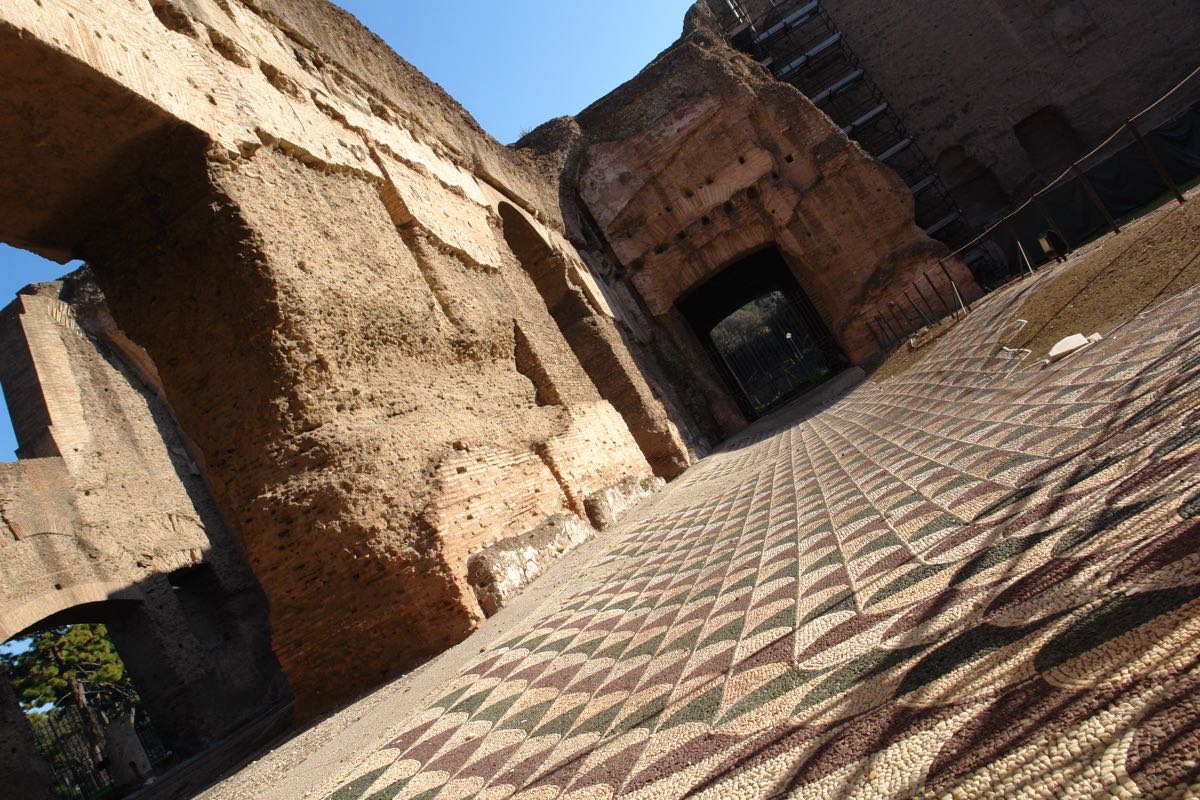
Baths of Caracalla
A vast public bathing complex with room for over a thousand bathers at once, its brick-faced concrete vaults engineered on a scale that later inspired Renaissance architects.
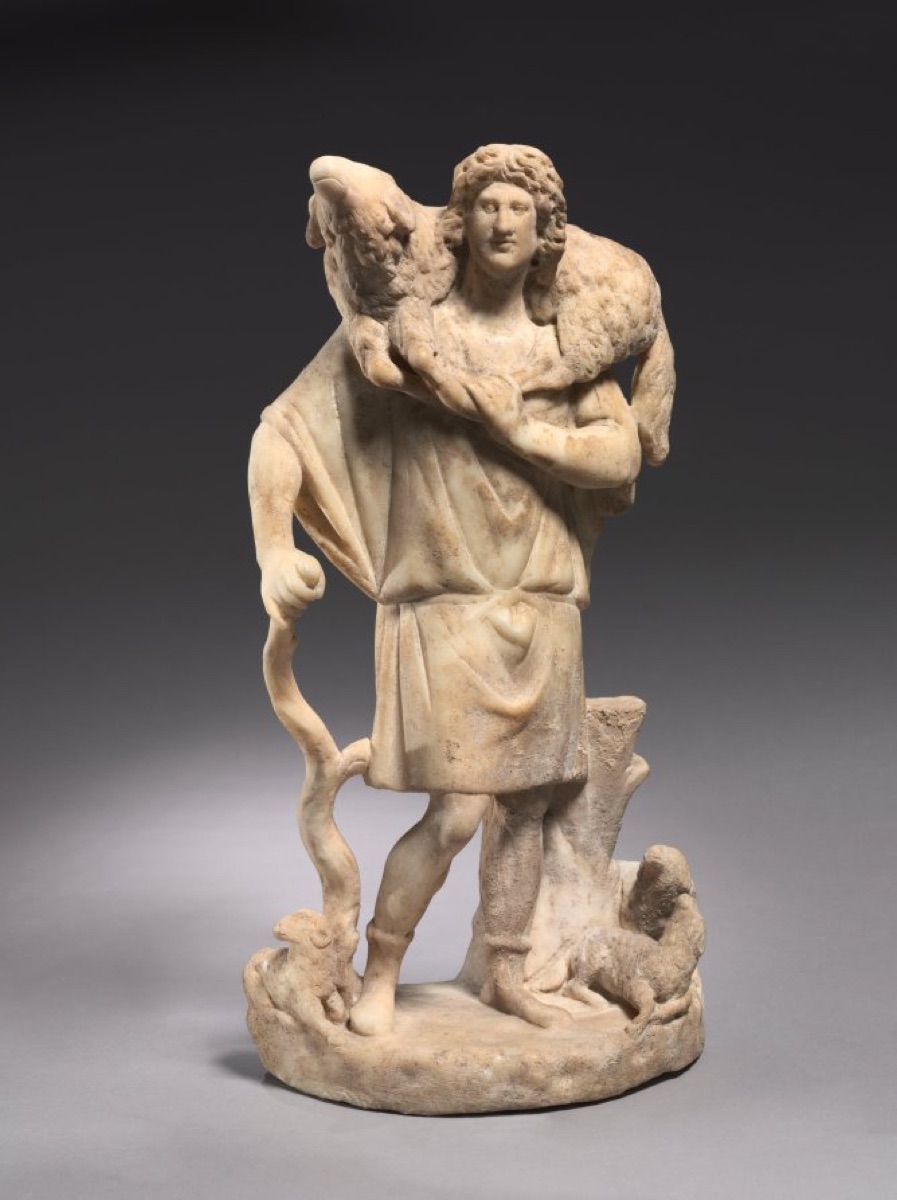
The Good Shepherd
A small marble shepherd carrying a lamb, a pastoral image pagan and Christian viewers could both read, carved as Christianity was spreading through the empire's cities before its legalization.
The Cleveland Museum of Art, John L. Severance Fund, 1965.241
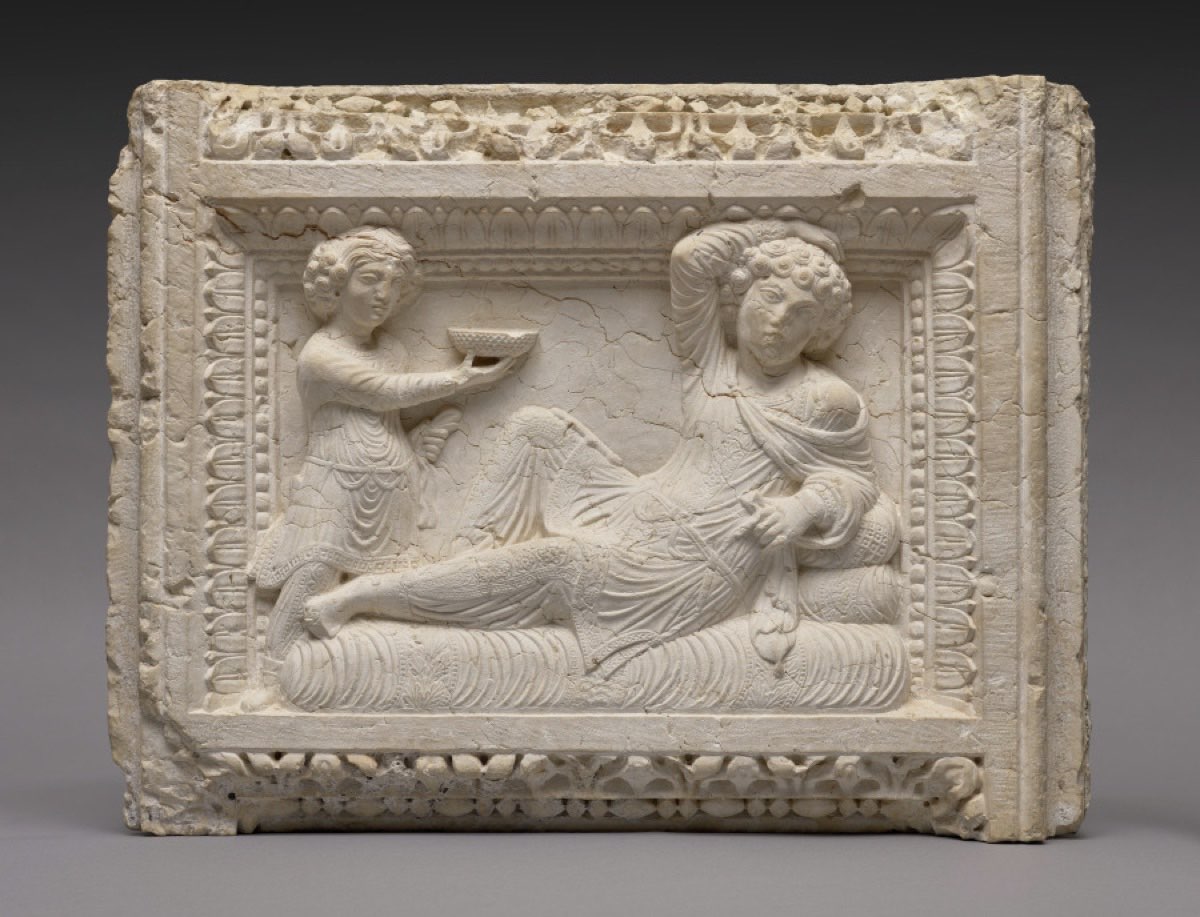
Tomb Relief
A limestone funerary banquet relief from a Palmyrene family tomb - a reclining man with a standing attendant offering a wine bowl - carved in the caravan city's own hybrid style four decades before Rome razed it for Zenobia's revolt.
The Cleveland Museum of Art, Leonard C. Hanna Jr. Fund, 1964.359
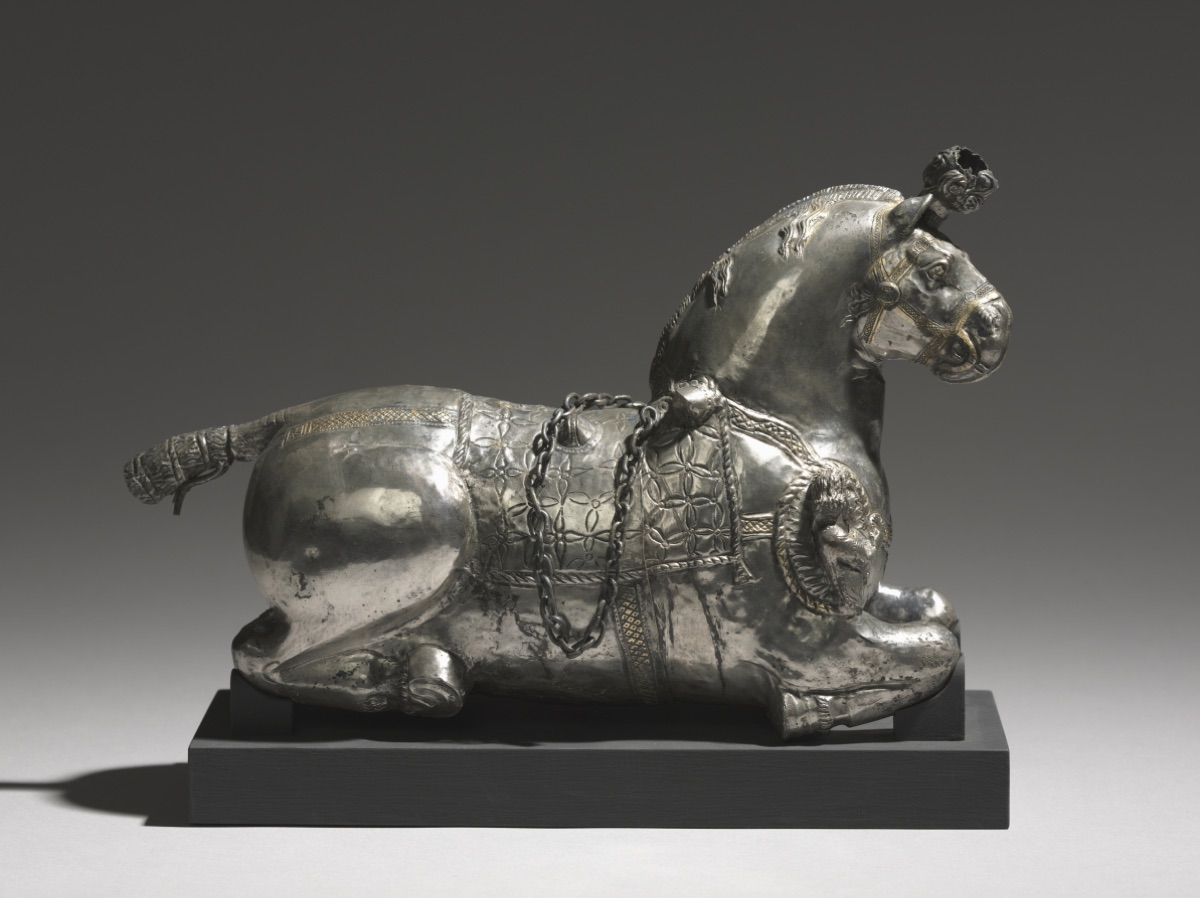
Horse-Shaped Drinking Vessel
A partly gilt silver drinking vessel in the form of a complete recumbent horse, legs folded as if waiting for its rider, made for the Sasanian court that succeeded the Parthians and revived Persian imperial silverwork as a mark of royal status.
The Cleveland Museum of Art, John L. Severance Fund, 1964.41
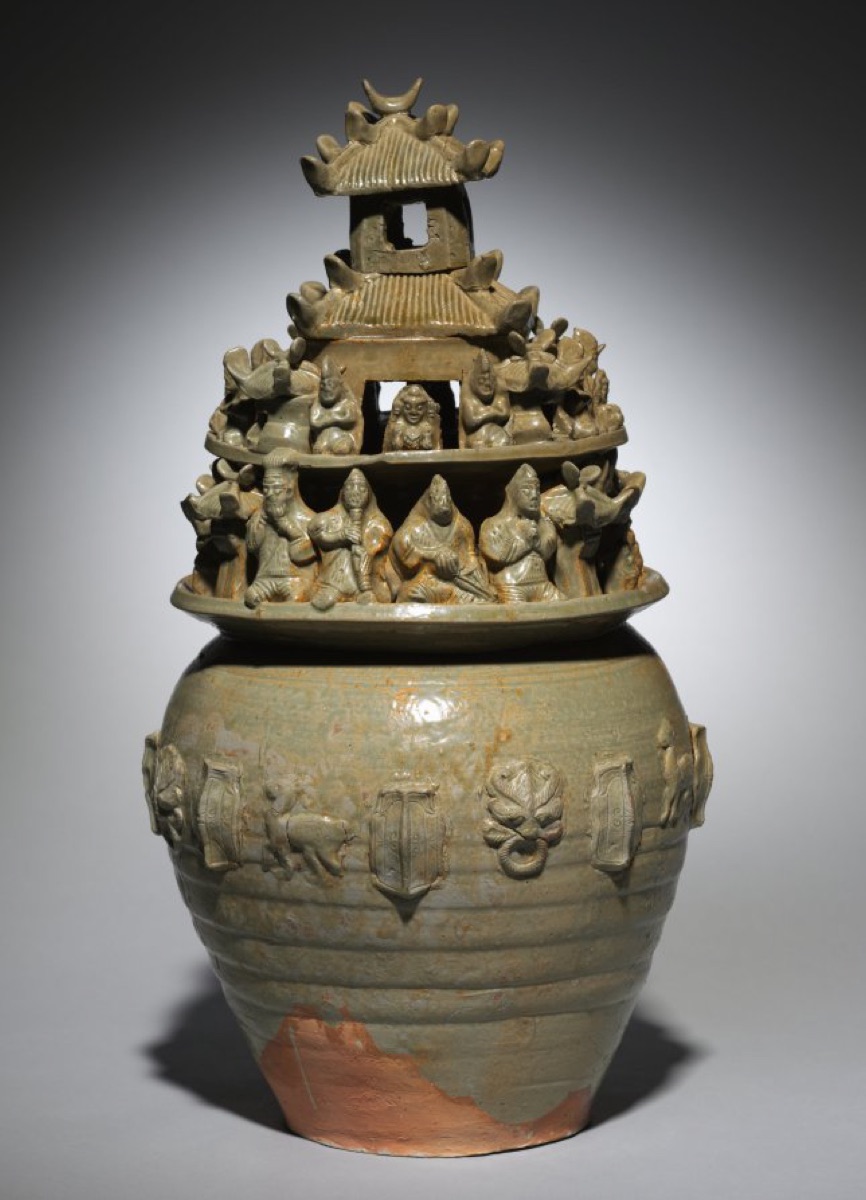
Funerary Urn (Hunping)
A glazed stoneware urn crowded with miniature buildings and figures, a soul jar meant to give the dead a walled compound to inhabit after the Han empire's collapse.
The Cleveland Museum of Art, Severance and Greta Millikin Purchase Fund, 1988.21
New this century
- Lives of Eminent Philosophers
Understanding a philosopher's teaching is inseparable from knowing the life, sayings, and even gossip surrounding him, and compiling the biographies, doctrines, and quips of every major Greek philosophical school into one work preserves a record that would otherwise have been lost entirely.
- Liezi
The boundary between waking and dreaming, self and other, life and death is far less stable than ordinary experience suggests, and stories rather than argument best convey how thoroughly unstable it is.
- Enneads
All reality emanates in descending stages from a single, ineffable source beyond being itself, and the soul's task is to reverse that descent through contemplation until it is reunited with the One.
- Sanguo Zhi
The chaotic collapse of Han authority into three warring successor states, Wei, Shu, and Wu, is best understood as three parallel, internally coherent political histories rather than as one continuous narrative, since each state's claim to legitimacy has to be assessed largely on its own terms.
- Tirukkural
Virtue, wealth, and love form a single integrated path to a well-lived life, condensed into couplets terse enough to be memorized by anyone regardless of caste or creed.
The canon by now
- Pyramid Texts
- Royal Inscriptions of Sargon of Akkad
- The Exaltation of Inanna
- The Curse of Agade
- Coffin Texts
- Admonitions of Ipuwer
- Eloquent Peasant
- Code of Hammurabi
- Old Babylonian Gilgamesh (Pennsylvania and Yale Tablets)
- Inanna's Descent to the Netherworld
- Edwin Smith Surgical Papyrus
- Book of the Dead
- Rigveda
- Baal Cycle
- Ludlul Bel Nemeqi
- Epic of Gilgamesh
- Instruction of Amenemope
- Gathas
- Book of Songs
- Torah
- I Ching (Book of Changes)
- Mahabharata
- Iliad
- Odyssey