Time travel
2nd century BC
Rome razes Carthage and Corinth in the same year, 146 BC, and finishes, in one stroke, becoming the Mediterranean's only remaining great power.
Mental Worlds: Evidence and Inference
Rome spends this century finishing what the previous one started, and finishing it with a thoroughness that shocks contemporaries. Carthage, defeated but left standing after the Second Punic War, is besieged, taken, and razed in 146 BC, its population enslaved and its territory turned into a Roman province; Corinth is destroyed the same year, ending organized Greek resistance to Roman domination of the Aegean. Polybius, a Greek statesman held hostage in Rome for seventeen years after Rome's earlier defeat of Macedon, watches this consolidation from close enough to write Histories explaining to a Greek audience exactly why Rome, and not any of the old Hellenistic kingdoms, has become the power that now decides the eastern Mediterranean's fate. It is history written from inside an occupation, by someone trying to understand the machine that has just absorbed his own country.
In Han China, Emperor Wu spends much of the century's second half turning a defensively organized state into an expansionist one, campaigning against the Xiongnu confederacy to the north and pushing Han influence west toward the Tarim Basin for the first time. He also establishes Confucian learning as the empire's official orthodoxy, recruiting officials through recommendation and study of the classics at a new Imperial Academy rather than through birth alone, a decision whose administrative logic outlasts the Han dynasty itself by well over a thousand years. Sima Qian's father begins compiling the archival and historical material his son will finish as the Shiji, a project already underway, though not yet complete, by this century's end.
Between Rome's Mediterranean and Han's East Asia, the Hellenistic world's easternmost fragment is disappearing without either great power much noticing. Bactria, a Greek kingdom descended from Alexander's conquests and stranded far from the Mediterranean for over a century, survives until the 140s and 130s BC, when Yuezhi and Saka pressure from the steppe ends it, one of the last visible traces of Alexander's empire outside Egypt and the Seleucid heartland. Parthia itself, under Mithridates I, expands rapidly into the vacuum, taking Mesopotamia from a Seleucid state too weakened by its losses to Rome in the west to hold its eastern territory as well, and becomes by century's end the power controlling the middle of the trade routes that will, without either side quite intending it, eventually connect Rome and Han China.
None of this stops astronomical and mathematical work from continuing at a level that owes little to any single patron's political fortunes. Hipparchus, working mostly from Rhodes, discovers the precession of the equinoxes by comparing his own star observations against centuries of preserved Babylonian records, and compiles a star catalog more systematic than anything before it. Apollonius of Perga writes the definitive ancient treatment of conic sections. Alexandria's Library persists under a Ptolemaic dynasty that is, by any political measure, in visible decline, squeezed between Roman power to the west and its own increasingly bitter dynastic succession disputes; the science the city supports does not need the dynasty to be strong, only to keep paying for it a little longer.
The political map
Major Polities and Cultural Regions
- Roman Republic Italy to Iberia, Greece, and the ruins of Carthage, destroyed in 146 BC
- Ptolemaic Egypt Nile valley, still independent but shrinking under Roman pressure
- Seleucid Empire Syria and Mesopotamia, stripped of Asia Minor after 190 BC
- Parthian Empire Iran and, by century's end, Mesopotamia, rising under Mithridates I
- Han Empire Yellow and Yangzi valleys, pushing west under Emperor Wu from 141 BC
- Bactria Greek successor kingdom in Central Asia, absorbed by Yuezhi and Saka pressure in the 140s-130s BC
- Mauryan successor states Ganges plain, fragmenting into regional kingdoms after Ashoka's line ends
- Kush Nile valley south of Egypt, centered on Meroe's iron-working capital
Borders are approximate scholarly reconstructions from historical-basemaps (GPL-3).
State of the domains
Texts and Written Culture
Rome's literature comes of age this century in direct imitation of Greek models: Plautus adapts Greek comedy for a Roman stage in the Pseudolus, Terence refines the form in the Andria and Adelphoe, and Ennius writes the Annales, the first Roman national epic in Greek-derived hexameter, following Naevius's earlier Bellum Punicum in native Saturnian verse. Polybius, a Greek hostage in Rome, writes Histories explaining Rome's rise to a Greek audience that badly needs the explanation. In Han China, court scholars compile administrative and ritual texts building on Warring States foundations, and Sima Qian's father begins the archival work his son later finishes as the Shiji.
Art
Pergamon's sculptors carve the Great Altar's frieze of gods battling giants, Hellenistic pathos at its most theatrical, while Rhodes's bronze-casting workshops keep their reputation even with the great Colossus itself long fallen in earthquake ruins, and Alexandria refines miniature and luxury arts for a Ptolemaic court under increasing financial strain. Egyptian temple relief, now under Ptolemaic patronage, continues pharaonic convention nearly unchanged, visible on the temple walls the Rosetta Stone decree describes honoring. Han China settles on clerical script for administration, alongside funerary art for a bureaucratic elite. Roman art remains largely derivative of Greek originals, looted wholesale as generals bring statuary home as war spoils.
Medicine
China produces this century's major medical synthesis: the Huangdi Neijing, a composite text mainstream scholarship dates roughly 200 BC to AD 100, organizing diagnosis and treatment around correlative theory, yin and yang, the five phases, channels of qi, attributed to the legendary Yellow Emperor but compiled and layered by generations of unnamed physicians. Alexandria's anatomical program from the previous century is not sustained at the same pace, and Hippocratic and Herophilean theory continue circulating as the working framework across the Hellenistic world. Roman medicine remains largely folk and household practice administered by the paterfamilias, with Greek physicians only beginning to practice in Rome toward the century's end, viewed with suspicion by conservative figures like Cato the Elder.
Science
Apollonius of Perga writes the Conics, the definitive ancient treatment of ellipses, parabolas, and hyperbolas, building on Euclid's method. Hipparchus, working mainly from Rhodes, discovers the precession of the equinoxes and compiles one of antiquity's earliest systematic star catalogs, comparing his own observations against centuries of preserved Babylonian records. Alexandria's astronomers keep refining the calendar reform first proposed in the Decree of Canopus, an idea Rome does not adopt for another century yet. Chinese court astronomers maintain the Han dynasty's own calendrical and astrological observation, continuous with earlier practice but not yet organized into the mathematical treatises the following century produces.
Military
Rome fights and wins the Second Punic War against Hannibal by 201 BC, then the Third against a Carthage it finally destroys in 146 BC, razing the city and enslaving survivors. In the same decades Rome defeats Macedon three times, in 197, 168, and 148 BC, and dissolves the Achaean League, absorbing Greece outright. The Seleucid Empire loses Asia Minor after the Battle of Magnesia in 190 BC, the territory parceled out to Rome's allies Pergamon and Rhodes rather than to Rome itself, and cedes ground east to a rising Parthia under Mithridates I. Han China, having weathered the Xiongnu confederacy defensively for decades, turns to sustained offensive campaigns under Emperor Wu from 141 BC on.
Technology
Rome's road network and aqueduct engineering extend with its conquests, adapting techniques learned from the Greek and Etruscan world it now dominates outright. Hipparchus's astronomical instruments improve on earlier Alexandrian models for measuring stellar position. A geared bronze device for calculating astronomical cycles, of the kind later recovered near Antikythera, belongs to this general era of Hellenistic instrument-making, though its precise origin and date remain debated among historians. Han China's ironworking and canal engineering expand to support the new offensive campaigns against the Xiongnu, moving grain and troops across greater distances than the earlier defensive Han state required.
Material world
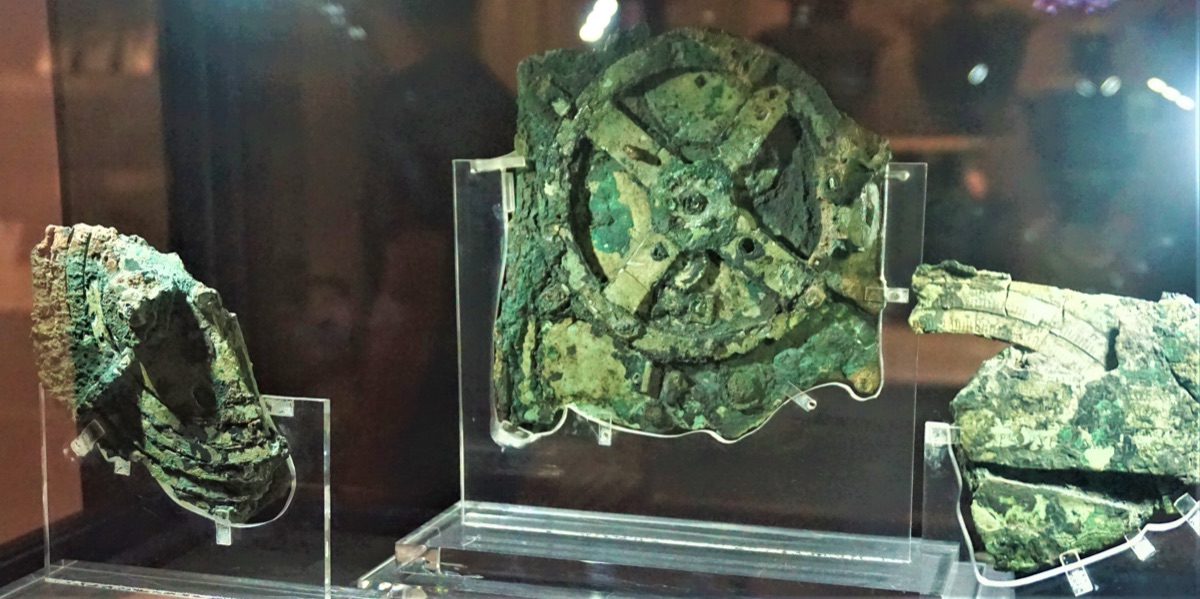
Antikythera Mechanism
A bronze geared instrument recovered from a shipwreck off Antikythera, its dozens of interlocking gears tracking the calendar, eclipses, and planets - a complexity in mechanical computation not matched again for over a thousand years.
National Archaeological Museum, Athens. Photo Joyofmuseums, CC BY-SA 4.0
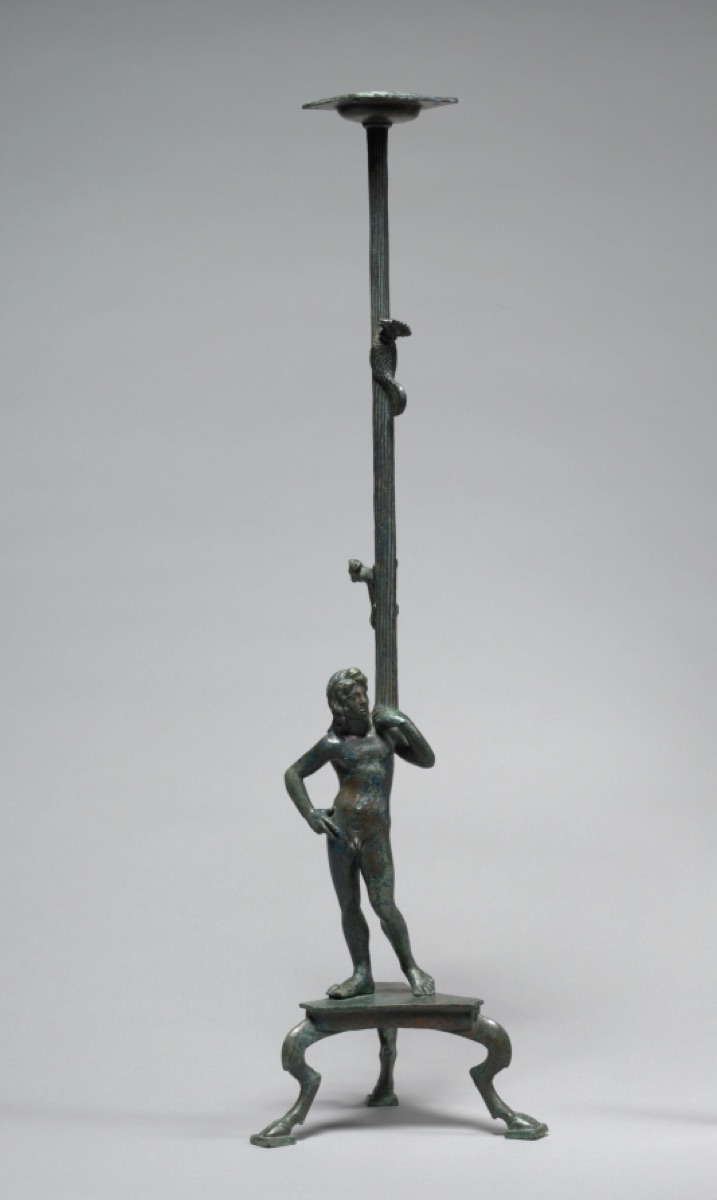
Incense Burner
A bronze stand for burning incense, a figure supporting its shaft below the bowl, typical of the workshops that kept Etruscan ritual bronze-casting alive under growing Roman power.
The Cleveland Museum of Art, John L. Severance Fund, 1952.96
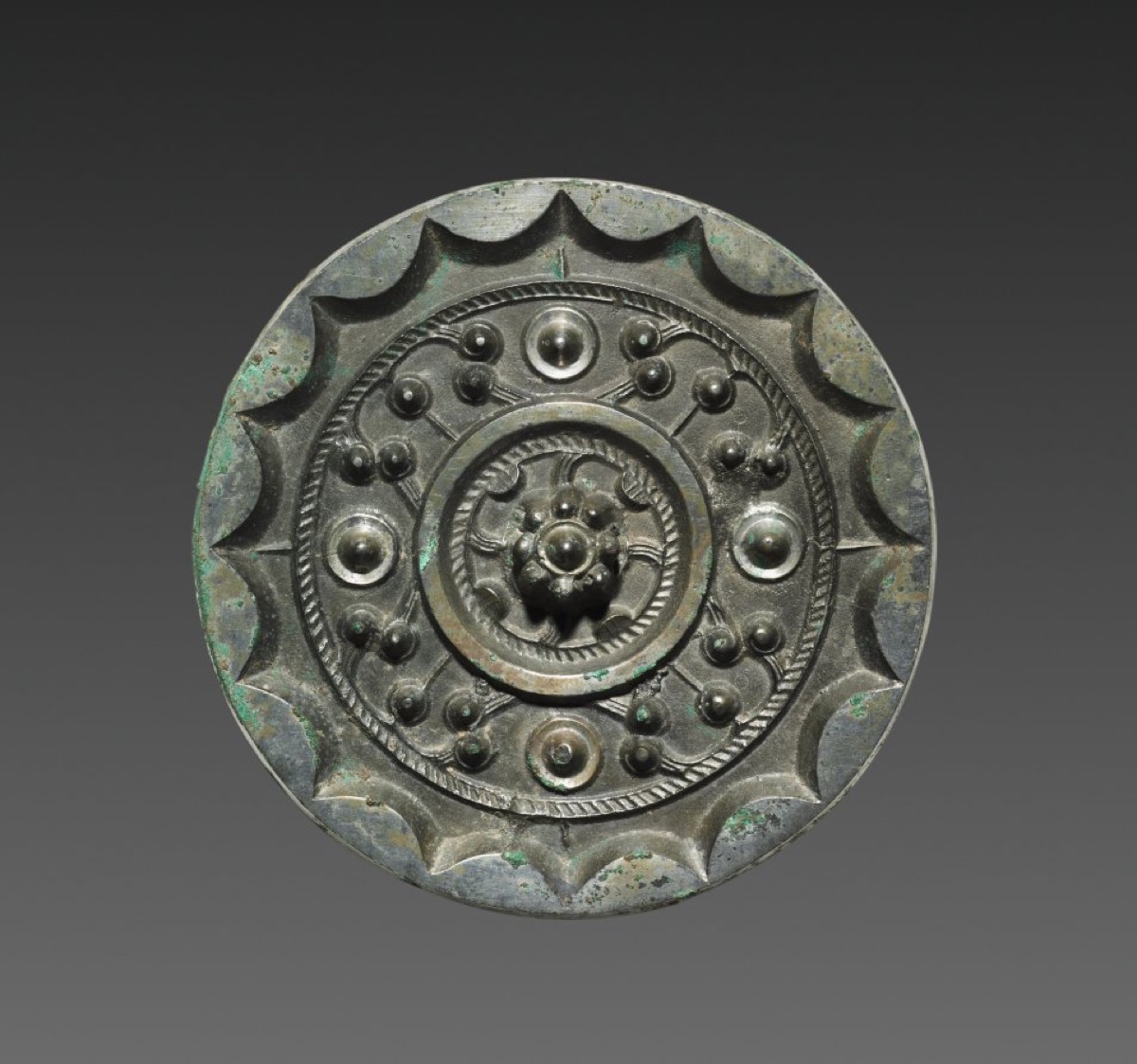
Mirror with Clouds and Nebulae
A cast bronze mirror polished bright on one face and cast with swirling cloud patterns on the back, the everyday luxury of a Han household at the empire's height.
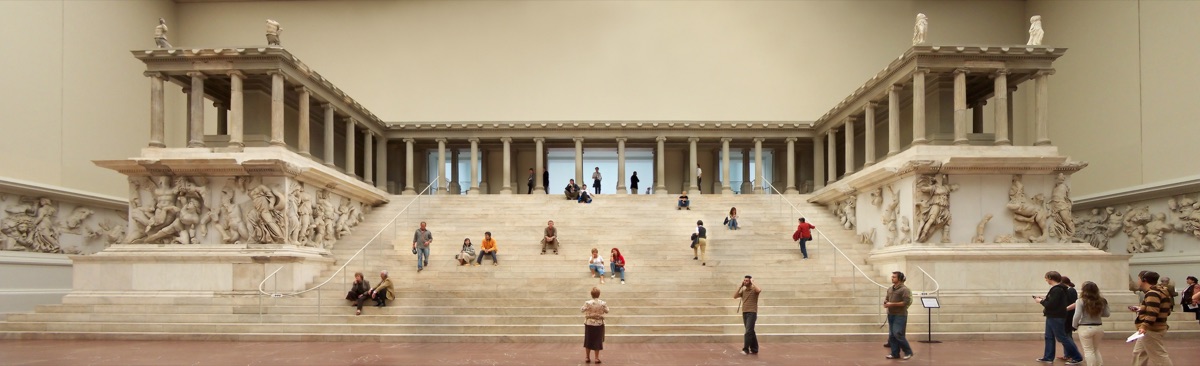
Great Altar of Pergamon
Built under King Eumenes II and wrapped in a frieze of gods battling giants, this monumental altar staged Pergamon's claim to be the new Athens of the Hellenistic east.
Pergamon Museum, Berlin. Photo Jan Mehlich (Lestat), CC BY-SA 3.0
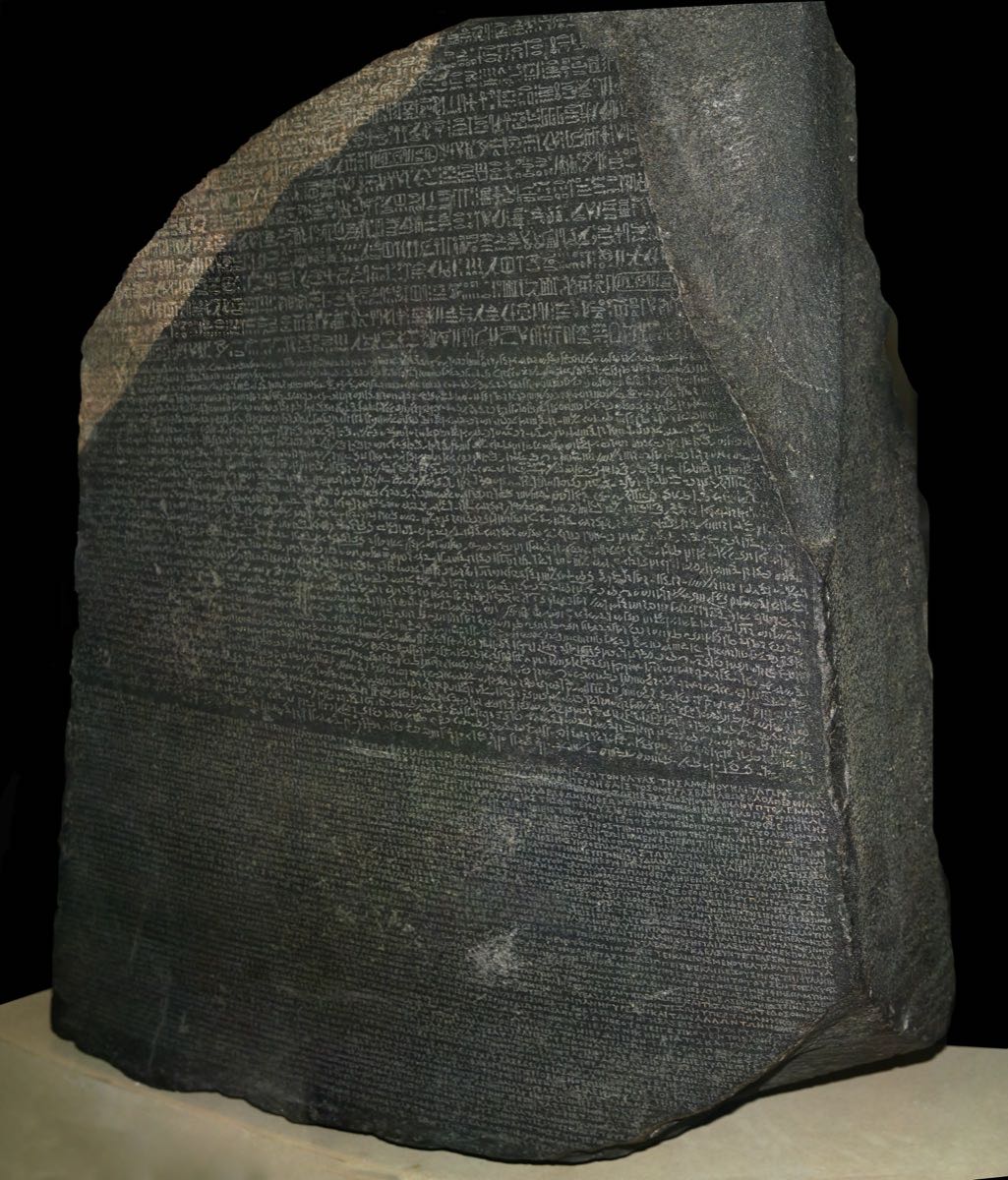
Rosetta Stone
A priestly decree honoring Ptolemy V, cut in hieroglyphic, Demotic, and Greek on the same slab, giving nineteenth-century scholars the parallel text that finally unlocked hieroglyphic writing.
The British Museum, London. Photo Hans Hillewaert, CC BY-SA 4.0
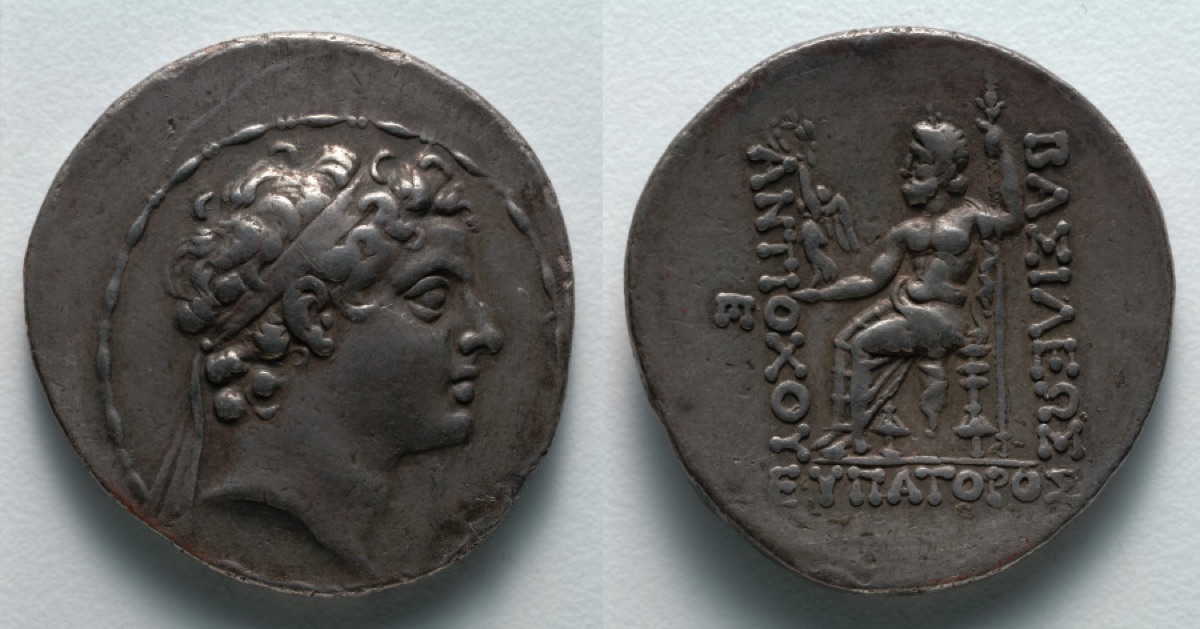
Tetradrachm: Head of Antiochos V (obverse); Zeus (reverse)
A silver coin of the boy-king Antiochos V, struck in Antioch during the last years of Seleukid rule over Judaea and Syria, weeks before Judas Maccabeus rose against his regents.
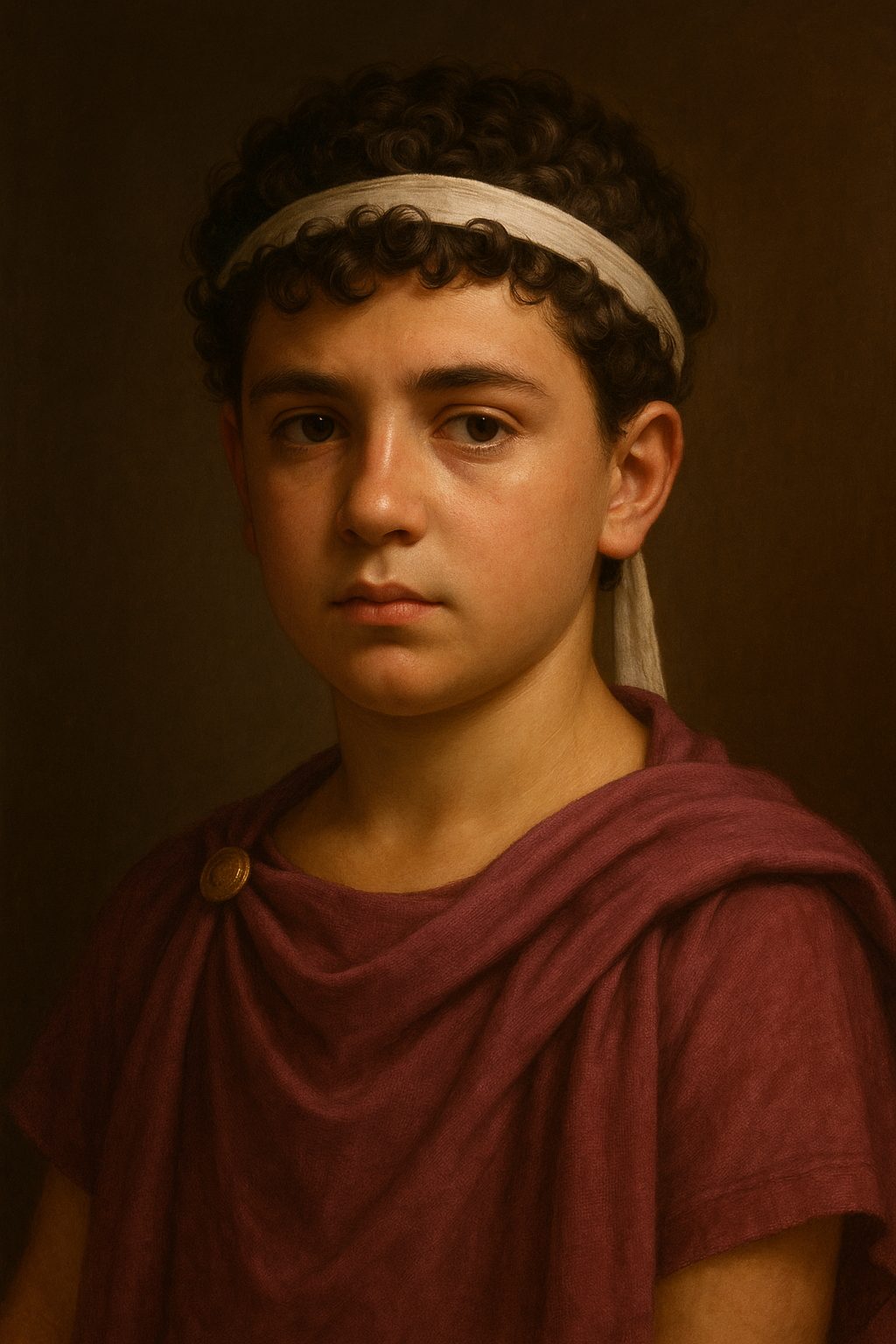
AI reconstruction
Antiochos V Eupator - reconstruction
Antiochos V Eupator, the Seleukid boy-king, drawn into life from his silver coin portrait: a child of about ten with short curly hair, round cheeks and a small chin, wearing the white royal diadem tied in his hair and a purple wool chlamys pinned at the shoulder. He reigned two years under a regent before his cousin had him put to death. The coin die is the only surviving record of his face.
AI reconstruction (2026), based on Tetradrachm: Head of Antiochos V, The Cleveland Museum of Art
New this century
- Papyrus Insinger
The world runs on the interplay of fate and fortune, forces beyond human control, and wisdom lies in temperate conduct that neither battles them uselessly nor blames them for every failure.
- Conics
The ellipse, parabola, and hyperbola are not three unrelated curves but a single family of conic sections, generated by cutting a single double cone at different angles, and their properties can be derived systematically from this unified construction.
- Bhagavad Gita
Right action performed without attachment to its results is the way out of the trap between paralysis and selfish ambition, even when that action is fighting a war against one's own kin.
- Natyashastra
Drama is a 'fifth Veda' accessible to all castes, capable of producing a distinct aesthetic experience in the audience through the disciplined combination of gesture, emotion, music, and stagecraft, and the text lays out the technical rules for producing that effect.
- Yoga Sutras of Patanjali
The mind's habitual fluctuations can be systematically stilled through an eight-limbed discipline of ethical restraint, posture, breath control, and meditative absorption, and this stilling, not belief or ritual, reveals the true, separate nature of consciousness.
- Panchatantra
Animal fables nested inside a frame story teach a prince the practical conduct of rule, making political instruction survivable by putting it in the mouths of jackals.
- Huangdi Neijing
Illness is a disruption of the balanced flow of qi and the interaction of yin and yang and the five phases through the body's channels, so a physician's task is to restore that flow through diet, acupuncture, and regimen rather than to treat isolated symptoms.
- Meroitic Funerary Inscriptions
The standardized Meroitic offering formula asserts that naming the deceased before Isis and Osiris, with their titles and lineage, secures their provisioning and safe passage in the afterlife, a claim legible in its fixed structure even though most of the Meroitic language remains untranslatable.
- Rosetta Stone Decree
A foreign Greek-speaking dynasty can secure its legitimacy in Egyptian eyes only by having Egypt's own priesthood formally declare, in Egypt's own sacred script, that the king has honored the gods and their temples.
- Pseudolus
A clever slave's improvised scheming proves that wit and performance, not birth or wealth, decide who actually controls a household.
- Sirach (Ecclesiasticus)
True wisdom is not a free-floating philosophical ideal but is identical with the Torah given to Israel, so studying the law of Moses and living wisely are, properly understood, the same activity.
- Annales
Rome's history from Aeneas to Ennius's own day deserves the same heroic verse form Homer used for Troy, because Rome's wars and founders are matter enough for epic.
- Andria (The Woman of Andros)
A young man's secret loyalty to a poor foreign woman he loves argues that private affection deserves to outweigh a father's arranged marriage, if he is patient and honest enough to make it work.
- Jubilees
The events of Genesis and early Exodus were always governed by a precise 364-day solar calendar of jubilee cycles, and Israel's true law was revealed to Moses in this expanded, corrected form, not in the shorter account later fixed as scripture.
- Adelphoe (The Brothers)
Two brothers raised under opposite child-rearing methods, one strict and one permissive, force the audience to judge which kind of authority actually produces a decent son, and the play refuses to give an easy answer.
- Community Rule
The true Israel is not the nation as a whole but a small, voluntarily self-segregated community of the elect living in strict purity and shared property while awaiting imminent divine judgment on everyone outside it.
- Histories
Rome's unprecedented rise to control the entire Mediterranean world in under fifty-three years happened through an identifiable, rationally analyzable combination of its mixed constitution and pragmatic statecraft, not through blind fortune.
- Commentary on the Phaenomena of Eudoxus and Aratus
The widely used astronomical poem of Aratus, itself based on the earlier prose of Eudoxus, contains significant errors in its description of the constellations and their risings and settings, which careful comparison against direct observation can correct.
- Chunqiu Fanlu
The Spring and Autumn Annals, read correctly through its coded wording, reveals that Heaven, the ruler, and the natural world are bound together by yin-yang and five-phase resonance, so a ruler's moral conduct directly causes the eclipses, floods, and omens that follow it.
- Huainanzi
The cosmos, the state, and the individual body all run on the same underlying pattern of Dao and qi, so a ruler who understands cosmology, seasonal cycles, and the art of effortless action can govern with the same effortless precision by which the natural world governs itself.
- 2 Maccabees
Faithful martyrdom under persecution is not senseless loss but atoning suffering that God will vindicate through bodily resurrection, and this claim, not political success, is the true meaning of the Maccabean revolt.
- 1 Maccabees
The Hasmonean family earned the right to rule by armed defense of the law against forced Hellenization, so their dynasty's legitimacy rests on zealous action, not on royal or priestly bloodline alone.
- Records of the Grand Historian
Chinese history from the mythical Yellow Emperor to the author's own Han present forms a single continuous moral order legible through the rise and fall of dynasties and the choices of individual men, and a historian's duty is to record it accurately even at ruinous personal cost.
The canon by now
- Pyramid Texts
- Royal Inscriptions of Sargon of Akkad
- The Exaltation of Inanna
- The Curse of Agade
- Coffin Texts
- Admonitions of Ipuwer
- Eloquent Peasant
- Code of Hammurabi
- Old Babylonian Gilgamesh (Pennsylvania and Yale Tablets)
- Inanna's Descent to the Netherworld
- Edwin Smith Surgical Papyrus
- Book of the Dead
- Rigveda
- Baal Cycle
- Ludlul Bel Nemeqi
- Epic of Gilgamesh
- Instruction of Amenemope
- Gathas
- Book of Songs
- Torah
- I Ching (Book of Changes)
- Mahabharata
- Iliad
- Odyssey