Time travel
1st century AD
A Jewish sect writes down its first account of a crucified teacher this century, in the same decades Rome buries a Republic it still calls by its old name and Han China claws its way back from a usurper's collapse.
Mental Worlds: Evidence and Inference
Augustus dies in 14 AD having spent four decades converting Rome's Republic into a hereditary monarchy that still calls itself something else, and the century that follows tests how durable that arrangement actually is. Tiberius, Caligula, Claudius, and Nero exhaust the Julio-Claudian line through a mix of competence, cruelty, and outright derangement, ending in 68 with Nero's suicide and a year of civil war among rival generals before the Flavians restore order. Vespasian and his sons stabilize the succession and, in the process, put down a major Jewish revolt in Judea, destroying the Second Temple in Jerusalem in 70, an event that permanently changes the shape of Jewish religious life by removing the sacrificial cult that had centered it.
That same revolt, and the diaspora communities scattered around the Mediterranean, form the setting in which a new Jewish sect centered on the crucified teacher Jesus writes down its first extended narratives. Mark's gospel, probably composed around the fall of Jerusalem, tells the story through relentless emphasis on Jesus's suffering rather than triumphant miracle; Matthew and Luke follow within roughly a decade, each reworking Mark's material with their own emphases, and John, by the century's final decade, presents a theologically distinct account built around Jesus as divine Word made flesh from creation itself. Paul's letters to scattered congregations, a generation earlier than any of the gospels, are the movement's oldest surviving written texts. Josephus, a Jewish commander who defected to Rome during the revolt, writes the Jewish War and later Jewish Antiquities explaining his people's history and recent catastrophe to a Roman readership, an insider's account written for outsiders.
Han China spends the century's opening decades recovering from Wang Mang's usurpation, a fifteen-year interregnum during which a Confucian reformist seized the throne, renamed the dynasty, and attempted sweeping land and currency reforms that collapsed into rebellion and civil war. Emperor Guangwu restores the Han house in 25 AD, and by the century's later decades the general Ban Chao has reasserted Chinese authority over the Tarim Basin's oasis kingdoms, reopening the corridor toward Central Asia that the interregnum had disrupted. Kushan power, meanwhile, is consolidating in Bactria and northwest India, a new intermediary state that will eventually sit astride the same trade corridor from its own end.
Rome and Han China, by this century, sit at opposite ends of a long-distance commercial network that touches both without making either a direct trading partner of the other; almost everything that crosses the intervening distance passes through several intermediary societies in Central Asia, Parthia, and India along the way. Roman writers know a place called Seres, the silk people, exists somewhere impossibly far east; Han court records preserve a hazy, secondhand account of a wealthy western state. Neither has an embassy, a translated text, or an accurate account of how the other is actually governed; what crosses the intervening distance is silk moving west and glass or coral moving east, carried by intermediaries who may not themselves travel the whole route. It is in this atmosphere of expanding but strictly commercial contact that Pliny the Elder compiles his encyclopedic Naturalis Historia in Rome and Wang Chong writes the skeptical, evidence-testing Lunheng in China, each independently arguing, in his own idiom, against supernatural explanation and for observation as the more reliable guide to how the world actually works.
The political map
Major Polities and Cultural Regions
- Roman Empire Britain to Egypt and Mesopotamia's edge, unified under the Julio-Claudians and Flavians
- Parthian Empire Iran and Mesopotamia, Rome's perennial eastern rival
- Han Empire Restored after Wang Mang's usurpation, reasserting control of the Tarim Basin
- Kushan Empire Bactria and northwest India, newly consolidating on the silk corridor
- Aksum Red Sea trade kingdom, predecessor of Ethiopia's later Christian state
- Kush Nile valley south of Egypt, Meroe still an independent trading kingdom neighboring Roman Egypt
Borders are approximate scholarly reconstructions from historical-basemaps (GPL-3).
State of the domains
Texts and Written Culture
Ovid completes the Metamorphoses and is exiled by Augustus soon after; Seneca writes tragedies and Stoic philosophical letters under Nero, whom he tutors and who eventually orders his death; Petronius satirizes the freedman's table in the Satyricon. In Judea and the diaspora, the earliest narratives of Jesus's life and death are composed, Mark first around 70, then Matthew and Luke-Acts, with John following by century's end, alongside Paul's letters to scattered congregations a generation earlier still. Josephus writes the Jewish War and Jewish Antiquities for a Roman audience. In China, Ban Gu compiles the Han Shu, and Wang Chong writes the skeptical, empiricist Lunheng.
Art
Nero's Domus Aurea experiments with radical interior architecture and illusionistic fresco after Rome's great fire of 64. The Colosseum, begun under Vespasian and completed under Titus, standardizes the amphitheater as an imperial building type. Pompeii and Herculaneum, buried by Vesuvius in 79, preserve wall painting, mosaic, and household art at a level of completeness no other Roman site offers, catastrophe having stopped time there. Han China's decorative arts, lacquerware and jade, continue a mature bureaucratic empire's material culture; Buddhist imagery has not yet entered Chinese visual vocabulary in any surviving form. In the Valley of Mexico, unconnected to any of this, Teotihuacan's first monumental construction gets underway in the course of this century, the start of a growth that will make it one of the largest cities in the Americas within a few centuries.
Medicine
Celsus compiles De Medicina, a comprehensive encyclopedia surveying Greek medical theory and Roman surgical practice for an educated Roman reader with no medical training, an unusually systematic text for its genre. Dioscorides, a military physician under Nero, compiles De Materia Medica, cataloging roughly six hundred plants and their medicinal uses in a pharmacological reference that remains authoritative for over a millennium. In China, the Nanjing, the Classic of Difficult Issues, works through eighty-one problems left open by the Huangdi Neijing, refining pulse diagnosis and acupuncture theory into a systematic counterpart of its own, composed and revised across roughly this century and the next.
Science
Pliny the Elder compiles the Naturalis Historia, an encyclopedic compendium of Roman natural knowledge across geography, zoology, botany, mineralogy, and art, publishing it in 77 and dying two years later while investigating the Vesuvius eruption up close. No astronomical treatise rivaling the following century's Almagest yet exists, though the observational tradition Ptolemy draws on continues at Alexandria uninterrupted. Han China restores its imperial observatory and calendrical bureaucracy after Wang Mang's usurpation and the civil war that ends it in 25 AD. Wang Chong's Lunheng argues against portents and supernatural causation with an unusually skeptical, evidence-weighing method for the period.
Military
Rome conquers Britain from 43 AD under Claudius, suppresses a major Jewish revolt from 66 to 73, destroying the Second Temple in Jerusalem in 70, and consolidates the Rhine and Danube frontier under the Flavians after the civil war of 69, the Year of the Four Emperors. Han China, restored under Emperor Guangwu after Wang Mang's fifteen-year usurpation, resumes campaigns against the Xiongnu and, by the general Ban Chao's efforts late in the century, reasserts authority over the Tarim Basin's oasis kingdoms. Kushan power begins consolidating in Bactria and northwest India, a new player on the same trade corridor.
Technology
Roman concrete and arch construction reach new scale in the Colosseum and in aqueduct systems documented later by Frontinus. Hero of Alexandria describes a steam-powered novelty device, the aeolipile, and various pneumatic and mechanical toys, ingenious but never developed toward practical power generation. Han China's papermaking tradition develops through the century, traditionally credited to the court eunuch Cai Lun just after this century's end, though the technology likely predates him in cruder form. Goods, not technologies or texts, move along the routes connecting Rome, Parthia, Kushan territory, and Han China, silk moving west and glass or coral moving east, each empire knowing the other chiefly as a name attached to a luxury good.
Material world
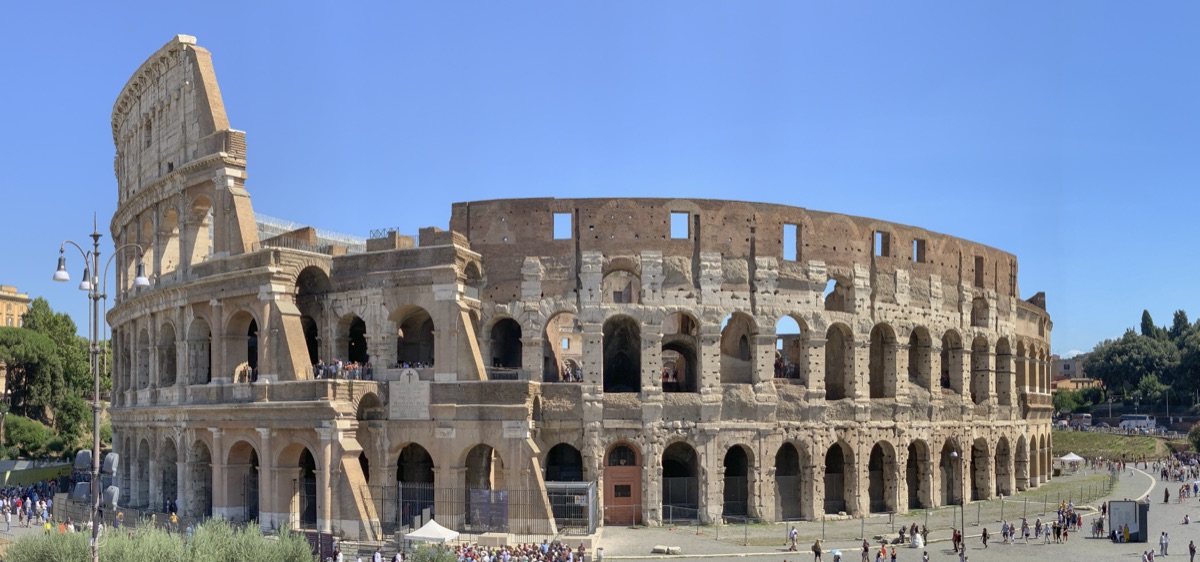
Colosseum
Built by the Flavian emperors on the drained site of Nero's private lake, this amphitheater could seat some fifty thousand people for the games that defined Roman public life.
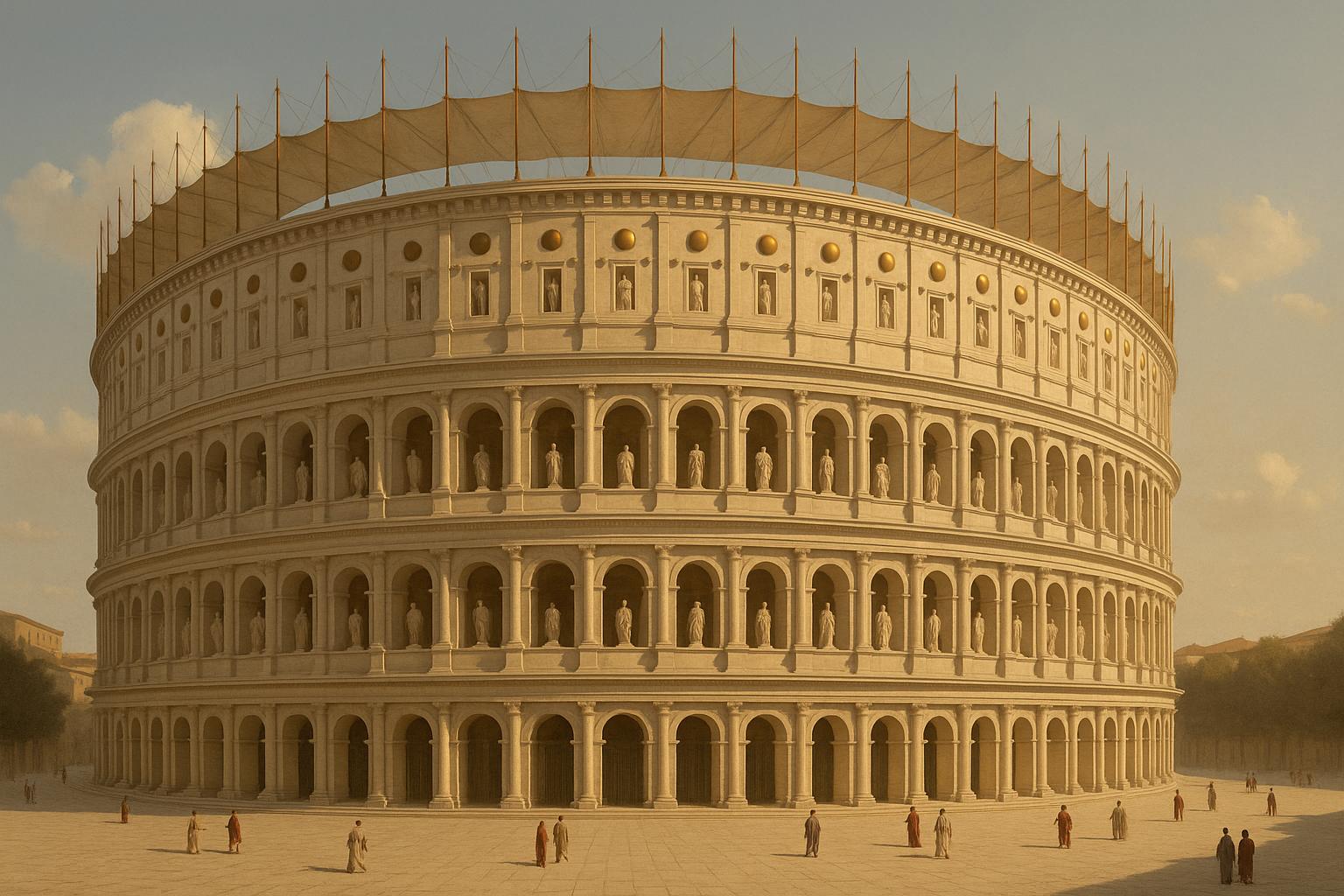
AI reconstruction
Colosseum - reconstruction
The Flavian amphitheater as dedicated under Titus: the travertine outer ring complete through all four storeys, statues in the arcade arches and gilded shields on the attic - details known from Roman coins - and the ring of masts rigged with the velarium awning that shaded spectators. Roughly two thirds of the outer ring later fell in earthquakes and was quarried; the statues' identities are not recorded.
AI reconstruction (2026), based on Colosseum, Rome, photo Nicholas Hartmann via Wikimedia Commons
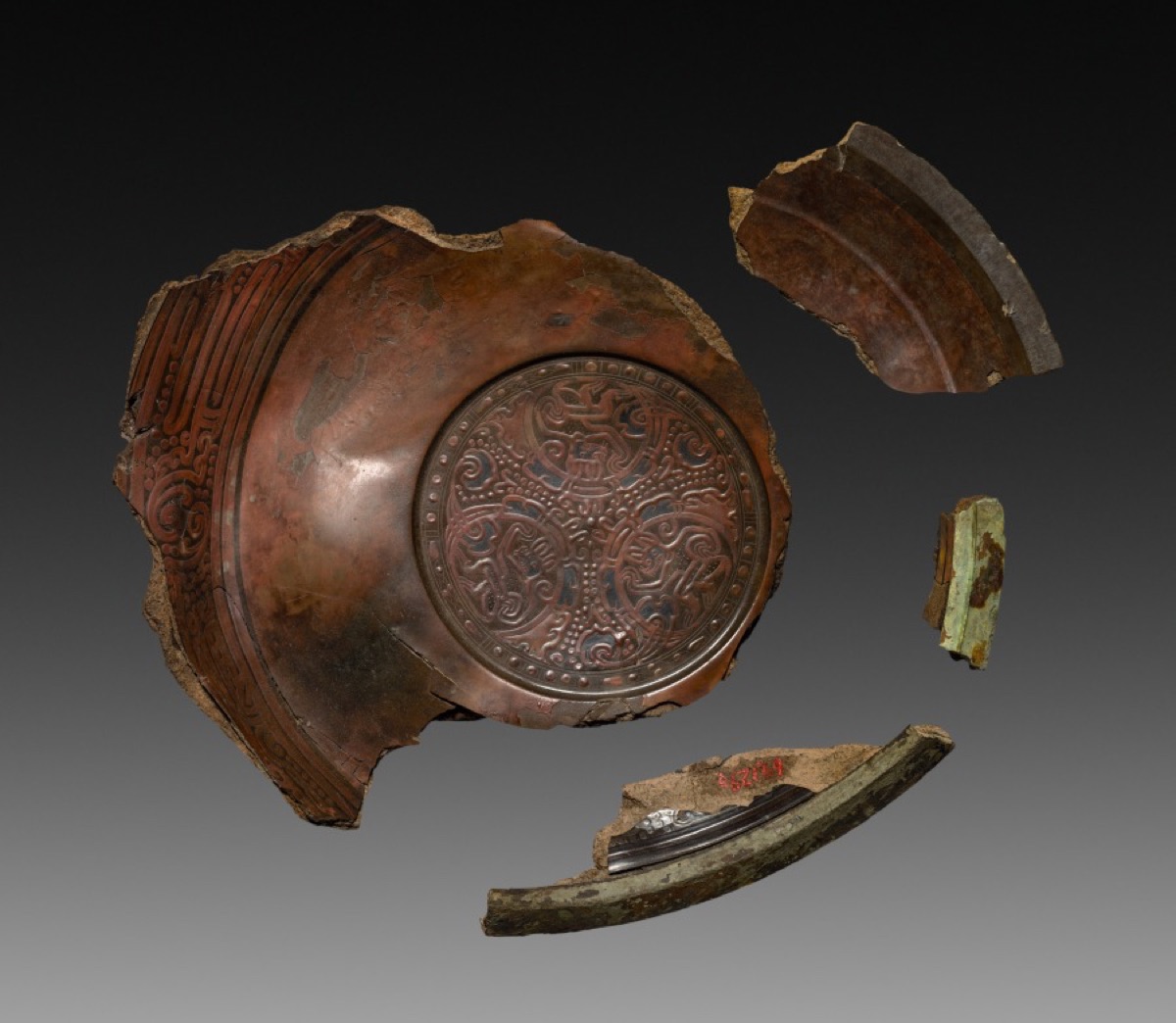
Fragments of a Lacquer Tray
Fragments of a lacquer tray buried in a tomb at the Han commandery of Lolang, on the Korean peninsula, evidence of how far Chinese court luxury goods traveled.
The Cleveland Museum of Art, Edward L. Whittemore Fund, 1969.129
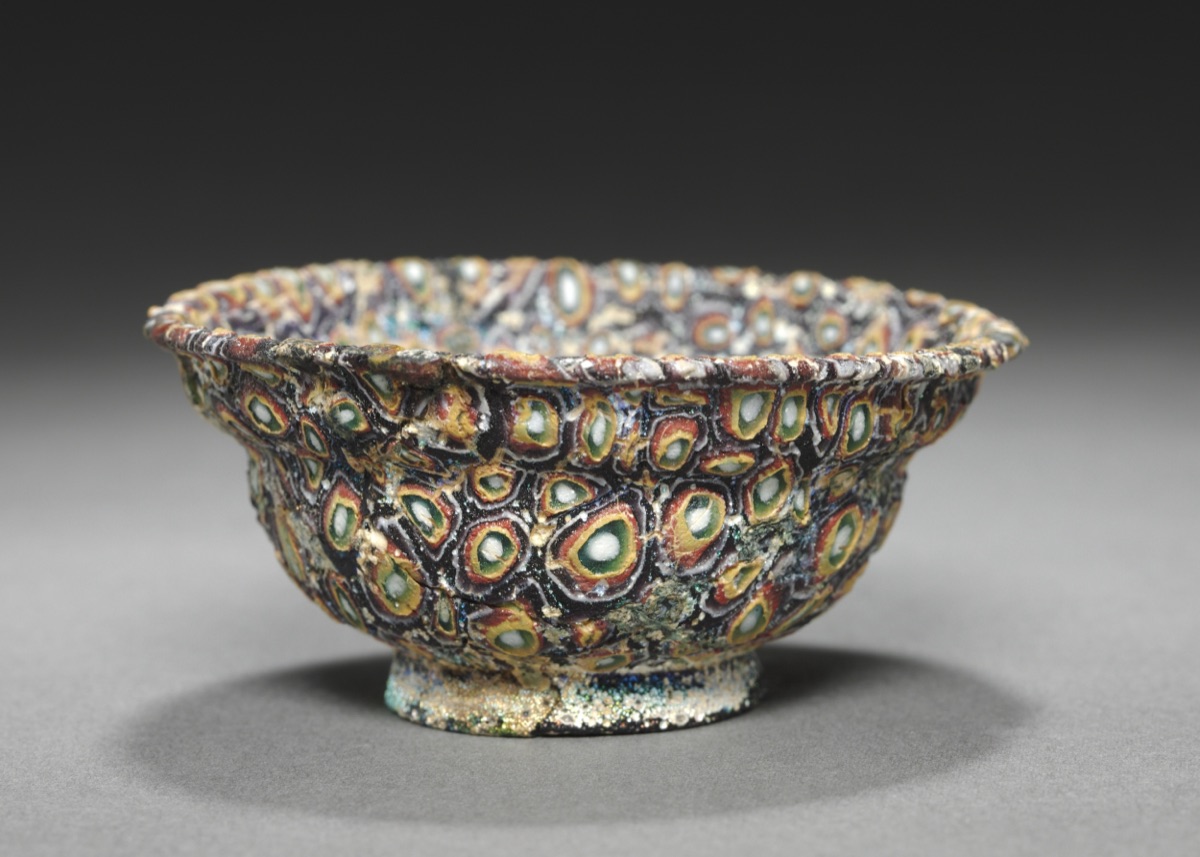
Millefiori Bowl
A bowl fused from hundreds of colored glass canes sliced into flower-like cross-sections, a labor-intensive technique Roman glassworkers mastered and then let fall out of fashion.
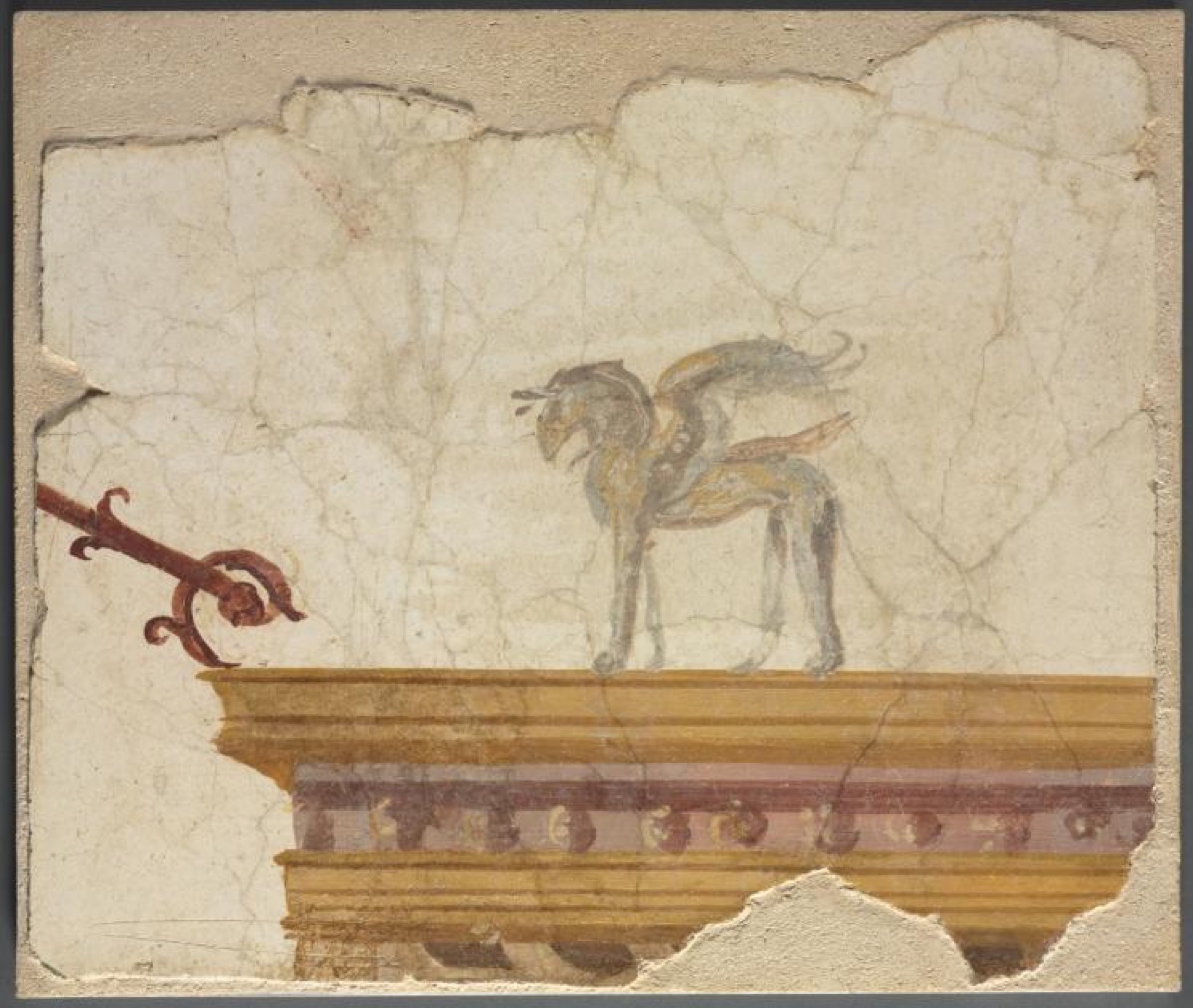
Griffin Atop Entablature
A painted plaster fragment from a Pompeian wall, its griffin perched on an illusionistic ledge in the fashionable Fourth Style buried by Vesuvius in 79 AD.
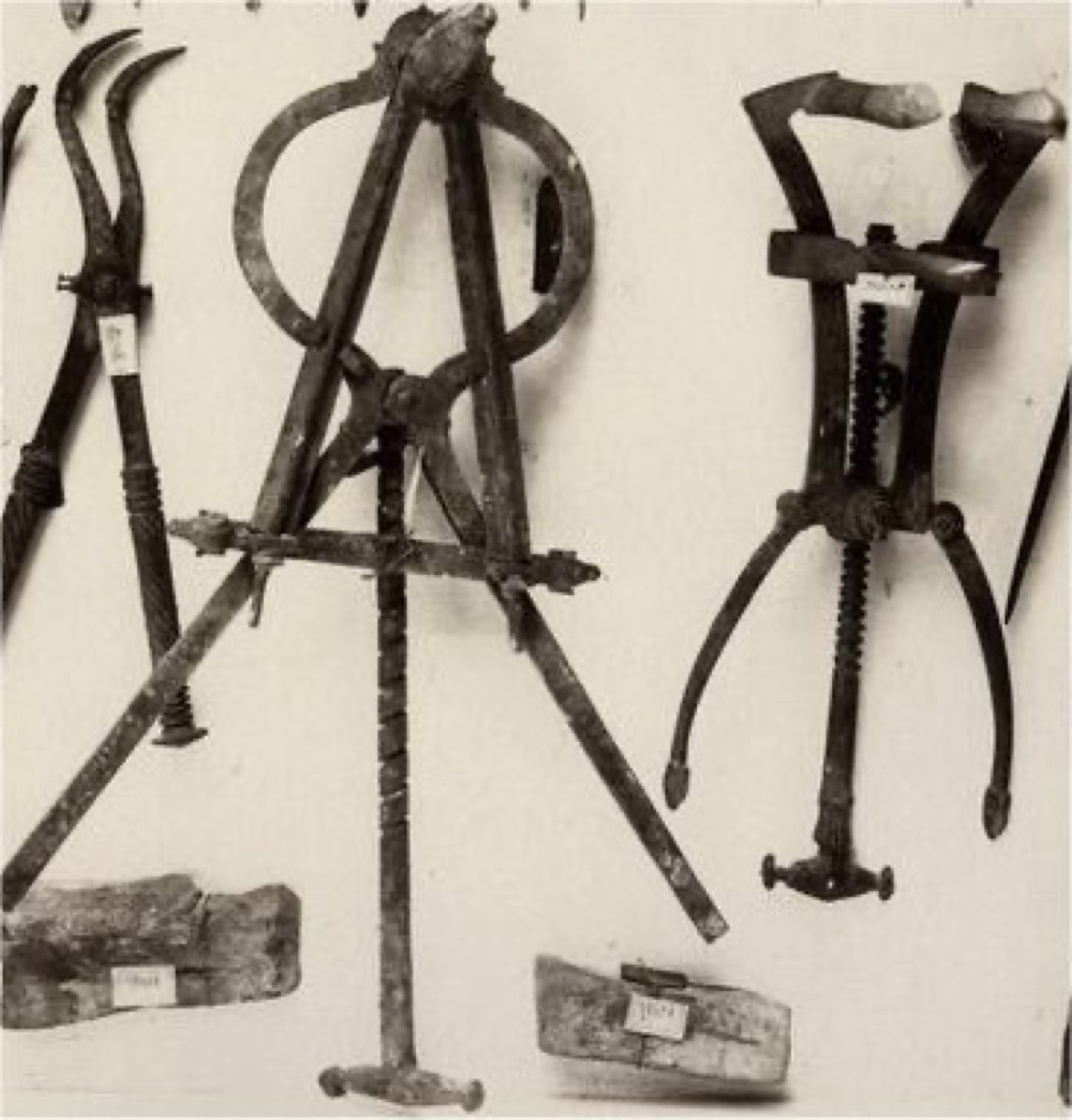
Roman Surgical Instruments Found at Pompeii
Bronze specula, forceps, and probes recovered at Pompeii and sealed by the eruption of Vesuvius, traditionally associated with the so-called House of the Surgeon, among the best-preserved Roman medical kits to survive.
Naples National Archaeological Museum. Historic photo by Giorgio Sommer (1834-1914), public domain
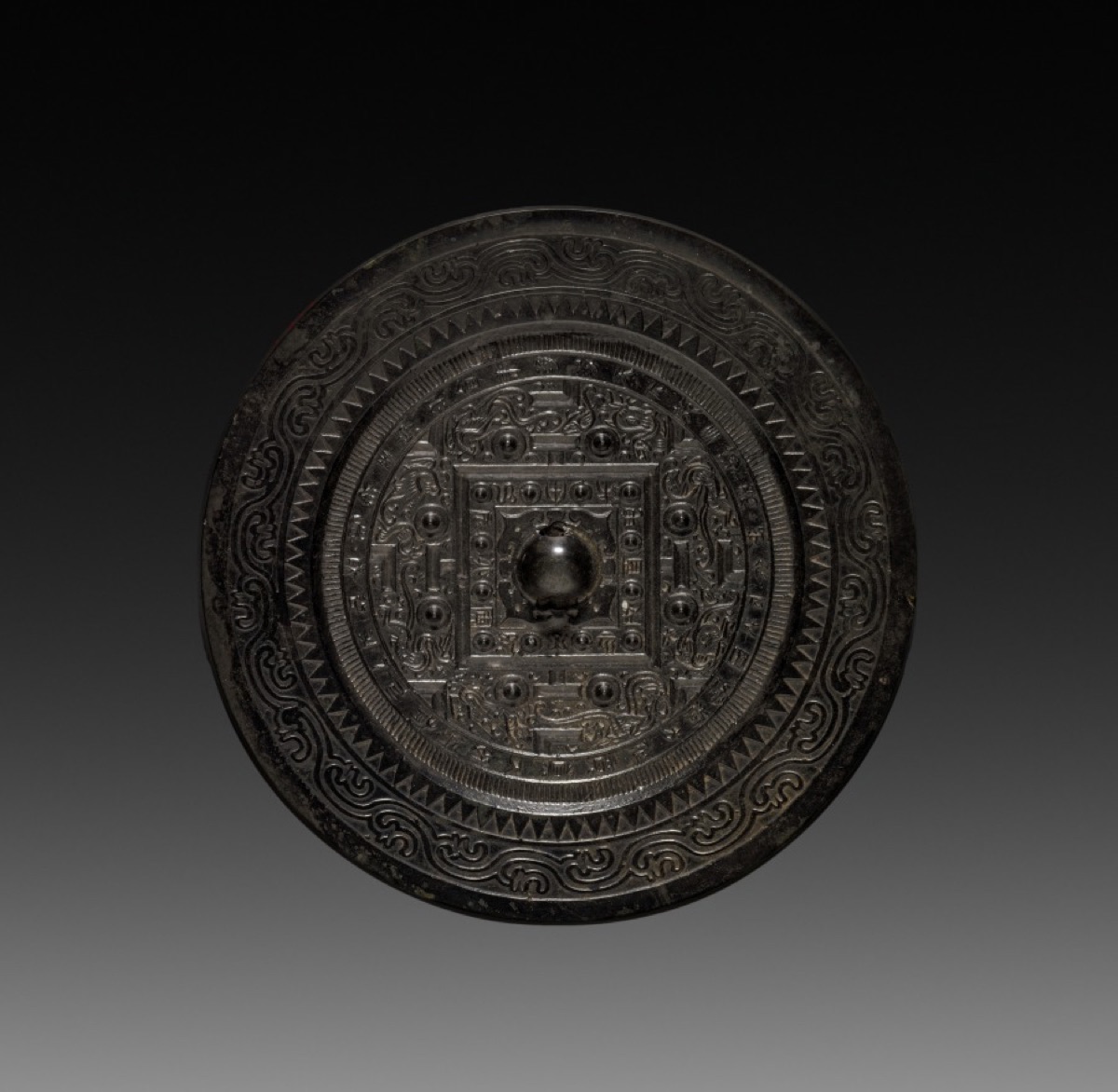
TLV Mirror with Multiple Nipples
A bronze mirror cast with the T, L, and V motifs that map a cosmic diagram of heaven and earth on its back, while its polished face served an ordinary Han household.
The Cleveland Museum of Art, Worcester R. Warner Collection, 1917.953
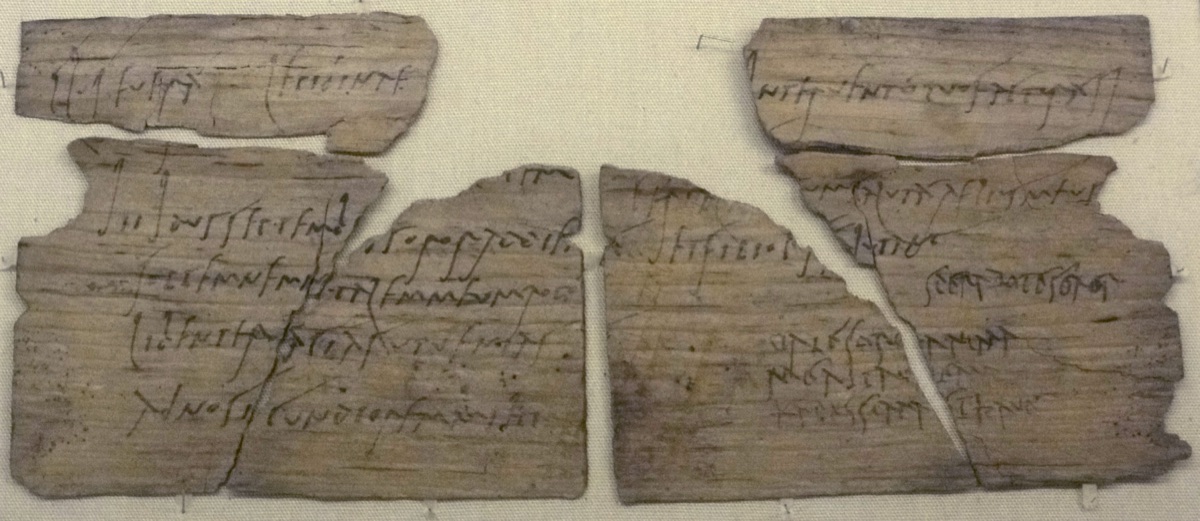
Vindolanda Tablet 291
A thin wooden leaf inked with a birthday party invitation from Claudia Severa to Sulpicia Lepidina at a fort on Rome's northern frontier, the earliest known writing by a woman in Latin Britain.
New this century
- Nabataean Tomb Inscriptions of Hegra
A rock-cut tomb belongs to its named owner and named heirs alone, and the inscription over its door exists to fix that ownership in fixed legal formulas, dated by regnal year and backed by curses and fines against anyone who buries an outsider or sells the tomb without authorization.
- Metamorphoses
Nothing in the world holds a fixed form for long; from the world's creation to Julius Caesar's transformation into a star, all things and even Rome itself are caught in one continuous process of change, and only art can hold that change still enough to be seen.
- Fasti
The Roman religious calendar, its festivals, origin myths, and star-risings, is itself a rich poetic subject, worth the same careful antiquarian and mythological treatment usually reserved for epic material.
- On the Creation of the World
Moses was the first and greatest philosopher, and Genesis, read allegorically through the categories of Platonic and Stoic thought, teaches the same truths about God, the cosmos, and the soul that Greek philosophy reaches only imperfectly on its own.
- De Medicina
Existing Greek medical knowledge, from dietetics through surgery, can and should be organized into a clear, systematic Latin reference, and a well-read layman can produce that reference competently.
- Fabulae (Aesop's Fables in Latin Verse)
The traditional animal fable, retold in polished Latin verse rather than left as prose folklore, can carry pointed social criticism, including criticism of the powerful, under cover of talking wolves and lambs.
- Han Shu
A single unified dynasty, unlike Sima Qian's sweep across many rising and falling states, deserves its own complete history written on its own terms, so the proper unit of Chinese historiography going forward is one dynasty covered exhaustively rather than woven into universal history.
- Medea
Unchecked passion, once a wronged and powerful woman decides to stop restraining it, becomes an unstoppable force that destroys everything in its way, including her own children, and the horror lies in watching her choose this path with full self-awareness at every step.
- De Brevitate Vitae (On the Shortness of Life)
Life is not actually short, as people constantly complain; most people simply waste enormous portions of it on trivial busyness, so that what feels like too little time is really just time badly spent.
- The Undisputed Pauline Epistles
A person is set right with God through faith in Christ's death and resurrection, not through observance of the Jewish law, and this claim entitles Gentiles to full standing in the covenant community without becoming Jews first.
- On the Sublime
Great literature achieves its highest effect not through correctness or ornament but through the sublime, a transporting greatness of thought and expression that seizes a reader's soul and produces astonishment rather than mere persuasion or pleasure.
- Satyricon
The pretensions of newly rich freedmen and the moral chaos of a society obsessed with money and status are best exposed through comic, unsparing, low-life fiction rather than moralizing satire.
- Hebrews
Christ is a superior, final high priest whose single self-sacrifice permanently replaces the repeated animal sacrifices of the Jerusalem Temple, rendering the entire earlier sacrificial system obsolete rather than merely supplemented.
- De Re Rustica
Roman agriculture had declined not because the land itself had grown less fertile but because landowners had abandoned the careful, informed attention farming actually requires, and a comprehensive technical manual can help reverse that neglect.
- Pharsalia (De Bello Civili)
Rome's civil war between Caesar and Pompey destroyed the republic so completely that no divine plan or higher meaning redeems the carnage, and an epic honest about that catastrophe must refuse the gods any role in explaining or excusing it.
- Epistulae Morales ad Lucilium (Moral Letters to Lucilius)
Philosophy is not a subject to study but a discipline to practice daily against fear of death, attachment to wealth, and the pull of public distraction, and a friend's honest letters are as good a vehicle for that daily practice as any formal treatise.
- Satires
Most people are morally and intellectually enslaved by their own vices and confusions without recognizing it, and only rigorous Stoic self-examination, expressed in deliberately dense and difficult verse, can shock a reader into seeing their own condition clearly.
- Gospel of Mark
Jesus can only be understood through his suffering and death, not through triumphant signs, and even his closest followers persistently fail to grasp this until the crucifixion forces the point.
- De Materia Medica
Systematic, firsthand knowledge of plants, minerals, and animal substances, their identification, preparation, and medicinal effect, is more reliable than secondhand herbal lore, and organizing that knowledge methodically makes it useful to practitioners rather than merely descriptive.
- Sutra in Forty-two Chapters
Buddhist practice can be distilled into a short series of plain maxims on desire, impermanence, and the monastic life, presented in language borrowed from Chinese moral vocabulary, that a Chinese reader with no prior Buddhist training can absorb directly.
- Mishnah
The oral law transmitted alongside the written Torah can be organized, argued over case by case, and fixed in a comprehensive written code without ceasing to count as oral tradition, and after the Temple's destruction that codification, not the Temple, becomes the center of Jewish religious life.
- Lunheng
Most of what Han society takes for supernatural, omens, ghosts, and portents interpreted as Heaven's response to human conduct, is explicable by natural cause, and a scholar's job is to weigh every claim, including claims made by the Confucian classics themselves, against evidence rather than authority.
- The Jewish War
The catastrophic Jewish revolt against Rome was caused above all by internal Jewish factionalism and a fanatical minority, not by Roman injustice or by the failure of Judaism itself, a case its author, a former rebel commander turned Roman client, had every personal reason to make.
- Naturalis Historia (Natural History)
Nature in its entirety, from the movements of the stars to the properties of minerals, plants, and animals, can and should be gathered into a single encyclopedic Latin work, because human knowledge is worth compiling comprehensively even where it cannot be fully verified.
- Baihu Tong
Where the transmitted classics disagree on ritual, cosmology, or institutions, an emperor-convened conference of scholars can issue an authoritative, binding resolution, and the correspondences of yin-yang and the five phases provide the underlying logic by which such disputes should be settled.
- Gospel of Matthew
Jesus is the fulfillment and proper interpreter of the law of Moses, not its abolisher, addressed above all to a Jewish-Christian community negotiating its continuing relationship to Torah after the Temple's fall.
- Luke-Acts
The story of Jesus and the story of the early church spreading from Jerusalem to Rome are one continuous narrative of salvation reaching outward from Israel to the whole Gentile world, deliberately written to make that continuity explicit.
- Thebaid
The mutual destruction of Oedipus's warring sons over Thebes shows that fraternal hatred, once set loose by a father's curse, will consume an entire city and both claimants alike, leaving no victor worth calling one.
- Epigrams
The short, pointed epigram, built to land a witty or vicious final line, can capture the texture of daily Roman life, its clients, patrons, social climbers, and petty humiliations, more honestly than any grander literary form.
- Silvae
Occasional poetry, written quickly for specific real events, weddings, deaths, villas, gifts, deserves to be preserved as serious literary art rather than treated as disposable social verse.
- Gospel of John
Jesus is the eternal divine Word made flesh, present with God at creation itself, a claim this gospel makes explicitly and repeatedly in a way none of the other three New Testament gospels does.
- Revelation
Rome is Babylon reborn, a persecuting empire whose apparent power will be shattered in an imminent, cosmically staged final battle, and the faithful who refuse to compromise with it now will reign afterward with Christ.
- Didache
A young Christian community needs a practical manual, not a theological treatise, laying out an ethical "two ways" of life and death alongside concrete instructions for baptism, fasting, the eucharist, and testing traveling prophets.
- Moralia
Philosophy is only valuable insofar as it can be applied to the practical business of living well, managing anger, grief, friendship, marriage, and civic duty, and essays addressing these ordinary concerns directly are as serious a philosophical project as abstract system-building.
- Institutio Oratoria
Training a great orator means training a genuinely good person from childhood onward, because rhetorical skill without moral character produces only an effective liar, and Rome needs orators who are, in Quintilian's famous formula, good men skilled in speaking.
- Jewish Antiquities
The full sweep of Jewish history, from creation to the eve of the revolt against Rome, deserves to stand as a national history equal in dignity to Greek and Roman historiography, told for a Greco-Roman readership largely ignorant of it.
- De Aquaeductu Urbis Romae
Managing Rome's water supply properly requires a precise technical and legal record of every aqueduct's history, capacity, and abuses, and publishing that record openly is itself a check against the corruption that had crept into the system.
- Epistulae (Letters)
Private correspondence, carefully revised and arranged for publication, can present an ideal self-portrait of the cultivated, publicly engaged Roman gentleman, and the record is more valuable for showing how Pliny wanted to be seen than for being unfiltered private communication.
- Germania
A short ethnographic account of the Germanic tribes beyond Rome's border can double as an implicit rebuke of Roman decadence, holding up the Germans' rough, martial simplicity as a mirror to expose how far imperial Rome has drifted from its own ancestral virtues.
- Agricola
It is possible for a genuinely good man to serve honorably under a tyrant without either open resistance or moral surrender, as Tacitus's own father-in-law Agricola did governing Britain under Domitian, and preserving the memory of such careful integrity matters as much as celebrating open defiance.
- Parallel Lives
Character revealed in small anecdotes and private choices teaches history's moral lessons more reliably than the recitation of battles and political events, and pairing a comparable Greek and Roman life makes each easier to judge.
- Satires
Rome under the emperors has become intolerable to live in honestly, corrupt patrons, dangerous streets, social climbers everywhere, and only furious, exaggerated satire, indignation itself, can do justice to how bad it has gotten.
- Buddhacarita
Recasting the Buddha's life in the high literary register of Sanskrit court poetry, the text argues his renunciation of a princely life was not a rejection of worldly excellence but its deliberate, reasoned transcendence.
- Diamond Sutra
Even the Buddhist teaching itself, and the very concepts of self, being, and dharma used to convey it, must be seen as empty of fixed identity, since clinging to any concept, however sacred, is still clinging.
- Shuowen Jiezi
Every Chinese character can be broken down into a small set of structural components and pictographic, ideographic, or phonetic principles, so understanding a word's true meaning requires first understanding the logic of how its written form was built.
- Nineteen Old Poems
Ordinary human losses, a friend's departure, a wife left waiting, the felt shortness of life against unmarked time, need no mythological or political frame to carry philosophical weight; plain five-syllable lines about missing someone are argument enough that life is brief and should be lived with that fact in view.
- Teotihuacan Urbanism and Sign System
Among the largest cities of the pre-Hispanic Americas, it planned its more than twenty square kilometers on a rigid grid anchored to the Avenue of the Dead, housed most of its population in walled multi-family apartment compounds decorated with elaborate mural programs of state ritual and cosmology, and recorded names, places, and dates in a partially understood sign system whose underlying language remains unidentified and whose very name for itself is unknown.
The canon by now
- Pyramid Texts
- Royal Inscriptions of Sargon of Akkad
- The Exaltation of Inanna
- The Curse of Agade
- Coffin Texts
- Admonitions of Ipuwer
- Eloquent Peasant
- Code of Hammurabi
- Old Babylonian Gilgamesh (Pennsylvania and Yale Tablets)
- Inanna's Descent to the Netherworld
- Edwin Smith Surgical Papyrus
- Book of the Dead
- Rigveda
- Baal Cycle
- Ludlul Bel Nemeqi
- Epic of Gilgamesh
- Instruction of Amenemope
- Gathas
- Book of Songs
- Torah
- I Ching (Book of Changes)
- Mahabharata
- Iliad
- Odyssey