Time travel
6th century BC
Persia assembles the largest empire yet built while a handful of Ionian thinkers develop a distinctive form of explicit cosmological argument in Greek prose, against a wider Near Eastern backdrop already rich in mathematical and astronomical tradition.
Mental Worlds: Evidence and Inference
This is the century a small number of Greek-speaking thinkers on the Ionian coast begin pressing a question in a distinctive way: not which god is responsible for the world's order, but what the world is physically made of and what holds it together. The question itself is not unheard of, since Babylonian astronomy and Egyptian measurement had long pursued regularities in nature; what is new within the Greek tradition is the habit of arguing the answer out in prose and disagreeing with named predecessors by name. Thales's answer, that everything reduces to water, sounds naive stated baldly, but the form of the question is the real innovation; his student Anaximander goes further, positing an undefined, boundless principle behind all things and arguing, from a kind of symmetry, that the earth needs no pillar or turtle to support it because it simply rests in balanced equilibrium at the center of everything. Pythagoras, working in the Greek colonies of southern Italy rather than Ionia, takes a different route to a similarly radical claim, that number and ratio underlie reality more fundamentally than any material substance does. None of these men would recognize the label later history gives them, natural philosophers, but each is developing a distinctive Ionian and Italian form of explicit cosmological argument in Greek prose, seeking material and structural explanations for the world's regularities without recourse to divine intention, an approach that took shape within a wider eastern Mediterranean and Near Eastern environment already rich in mathematical, astronomical, and cosmological tradition.
Persia supplies this century's dominant political fact. Cyrus's conquest of Media, Lydia, and Babylon within a single reign, followed swiftly by Cambyses's conquest of Egypt, assembles an empire larger than anything the Near East has produced, one that will eventually reach from the Aegean's edge to the Indus valley. Cyrus's own account of taking Babylon, inscribed on the cylinder that bears his name, presents the conquest as liberation, restoring displaced gods and deported peoples to their cities, a piece of calculated propaganda aimed at a Babylonian audience; it names Mesopotamian sanctuaries and peoples such as Ashur, Akkad, and Eshnunna, and says nothing about Judah.
Judah's own experience of the century is catastrophe followed by an ambiguous restoration. Nebuchadnezzar II destroys Jerusalem in 587 or 586 BC and deports its political and priestly elite to Babylon, a rupture severe enough that it produces, among the exiles, both Ezekiel's visionary prophecy and a substantial reworking of Judah's own history into what becomes a second edition of the Deuteronomistic narrative, an attempt to explain catastrophe as covenant consequence rather than divine abandonment. That the Judean exiles were also permitted to return, after 539 BC, is known only from Judean texts written later, Ezra and Chronicles, not from the cylinder itself, though it fits the general policy of restoration the cylinder advertises. The community that rebuilds Jerusalem's temple by 516 BC is not simply resuming what existed before; it is a religious tradition reshaped by exile into something more textually centered and more insistent on its god's uniqueness than it had been before Babylon destroyed the first temple.
Three other lives, unfolding far from Ionia, Persia, and Judah and entirely unconnected to any of it, deserve honest mention and equally honest caution. In the state of Lu, a man later ages call Confucius is born in 551 BC. On the traditional long chronology, both the future Buddha and the Jain teacher Mahavira are born in the Ganges valley during these same decades, though the dates for each are genuinely contested among modern scholars, with some placing both figures a century or more later than tradition holds. What can be said without qualification is this: none of what any of these three teaches is written down in this century, or for a long while afterward. Confucius's sayings will not become the Analects until his disciples and their disciples compile them, generations later; the Buddha's and Mahavira's teachings survive this century only as living, oral instruction passed among small circles of followers who have not yet organized themselves into the institutions later ages will recognize as Buddhism and Jainism. A person alive in Lu or Magadha in this century could have heard these men speak. No one anywhere could yet have read a word either said.
The political map
Major Polities and Cultural Regions
- Neo-Babylonian Empire Destroys Jerusalem in 587/586 BC, reaches its peak under Nebuchadnezzar II, then falls to Cyrus of Persia in 539 BC
- Achaemenid Persia Rises from a Median vassal to the largest empire yet assembled, conquering Media, Lydia, Babylon, and Egypt within two generations
- Egypt Native Saite dynasty until Persian conquest in 525 BC ends independent rule
- Greek city-states Sparta developing its military order, Athens moving from Solon's reforms toward Cleisthenes's democracy by the century's end
- Kingdom of Judah Destroyed as a state in 587/586 BC; its exiled elite return under Persian sponsorship after 538 BC
- Magadha Emerging Gangetic kingdom, the setting, by tradition, for the early lives of the Buddha and Mahavira
- Kingdom of Kush Continues at Napata, increasingly oriented toward its own Nubian and, later, Meroitic identity after losing Egypt
Borders are approximate scholarly reconstructions from historical-basemaps (GPL-3). Nearest available basemap anchor year: 500 BC.
State of the domains
Texts and Written Culture
Ionian and Italian Greek thinkers develop a distinctive form of explicit cosmological argument in Greek prose, seeking material and structural explanations for the world: Thales proposes water as the underlying substance, Anaximander proposes an undefined boundless principle and reasons about the earth's shape without needing a god's support, and Pythagoras founds a community treating number as the key to reality. Their approach is innovative, but it takes shape within a wider eastern Mediterranean and Near Eastern environment already rich in mathematical, astronomical, medical, and cosmological traditions. In Judah, Ezekiel prophesies among the Babylonian exiles, and a second, exilic edition of the Deuteronomistic History reworks Judah's history within a covenant framework. In China, Confucius is born in Lu in 551 BC; nothing he teaches will be written down in his own lifetime. In Magadha, on the traditional long chronology, the future Buddha and the Jain teacher Mahavira are also born, though their dates are contested.
Art
Achaemenid Persian art, still forming under Cyrus and Cambyses, draws on Elamite, Babylonian, and Median craft traditions toward a royal style reaching full expression only in the following century's Persepolis. Babylonian art under Nebuchadnezzar II peaks in the glazed brick Ishtar Gate before Babylon falls to Cyrus in 539 BC. Greek sculpture develops the kouros and kore forms, freestanding figures indebted to Egyptian proportion but increasingly interested in anatomical observation. Egyptian art under the Saite dynasty continues its archaizing program until Persian conquest ends native rule in 525 BC. Far to the southwest, in the Oaxaca Valley of Mexico, Zapotec carvers at San Jose Mogote incise one of Mesoamerica's earliest known glyphs, a sacrificed captive's calendrical name, into a stone corridor floor, a development unfolding in complete isolation from any of the scripts developing elsewhere this century.
Medicine
The earliest surviving layer of what becomes the Sushruta Samhita, a surgical tradition attributed to Sushruta, falls in this century, though the compilation that survives is a much later redaction and the text's actual origin remains heavily contested; nothing like a finished treatise exists yet, only the start of a tradition compiled centuries afterward. Babylonian exorcistic medicine continues its long-established practice through the empire's final decades and into Persian rule. In Greece, medical thought remains folk and ritual, with no evidence yet of the systematic, naturalistic approach the following century's Hippocratic school will develop.
Science
Thales's prediction of a solar eclipse, whether by genuine astronomical reasoning or later legend, becomes the symbolic starting point later Greek tradition uses for natural philosophy as distinct from myth. Anaximander proposes that the earth needs no support because it rests in balanced equilibrium at the center of things, an argument from symmetry rather than divine will, and reportedly produces one of the first attempts at a map of the known world. Babylonian astronomers continue systematic observation that Persian administration, after conquering Babylon in 539 BC, will inherit and eventually fund at even larger scale. Pythagorean number theory, still closer to religious doctrine than mathematics, nonetheless treats numerical relationship as reality's deepest layer.
Military
Nebuchadnezzar II destroys Jerusalem in 587 or 586 BC after a rebellion, deporting much of Judah's elite to Babylon, an event Judean tradition treats as catastrophe requiring theological explanation ever after. Cyrus of Persia conquers Media, then Lydia, then Babylon in 539 BC, assembling within a single reign the largest empire the Near East has yet seen; his successor Cambyses adds Egypt in 525 BC. Darius I, after a succession crisis, consolidates the empire into a satrapy system administered from Susa, with Persepolis begun late in the century as a ceremonial seat, and records his version of events at Behistun. Sparta develops its military order, while Athens moves from Solon's reforms toward Cleisthenes's democracy by the century's end.
Technology
Achaemenid Persia begins building the administrative infrastructure, royal roads, relay postal systems, and standardized coinage adapted from Lydian precedent, that will let a single empire govern from the Aegean to the Indus. Babylonian engineering under Nebuchadnezzar II includes major fortification and canal work at Babylon itself before the city falls to Cyrus. Greek city-states field hoplite phalanx warfare, heavy infantry fighting in close formation most scholarship traces to the previous century, though its precise origins remain disputed, and that will define Greek land warfare for the next two centuries. Ironworking and coinage, the latter recently invented in Lydia, both spread rapidly across the Mediterranean and Near East this century, coinage in particular reshaping how trade and taxation function.
Material world
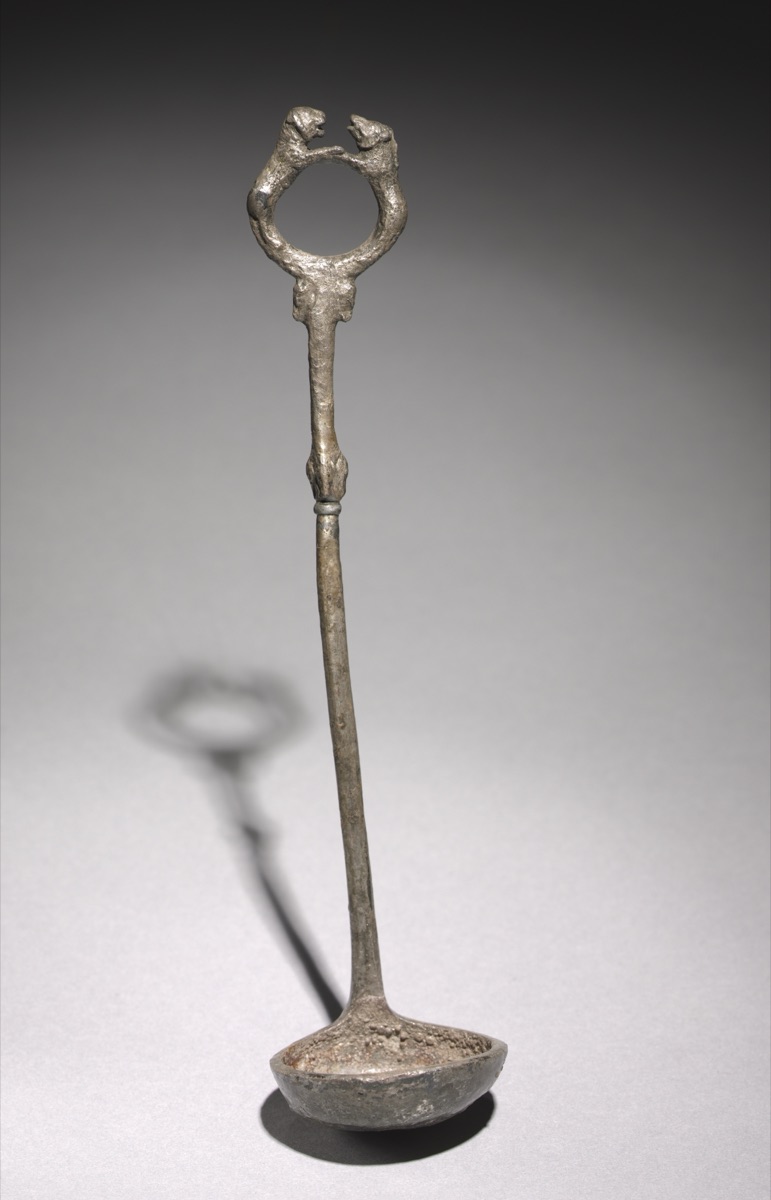
Ladle
A silver ladle from the newly conquered western provinces of the Achaemenid empire, founded by Cyrus the Great in the mid-6th century BC.
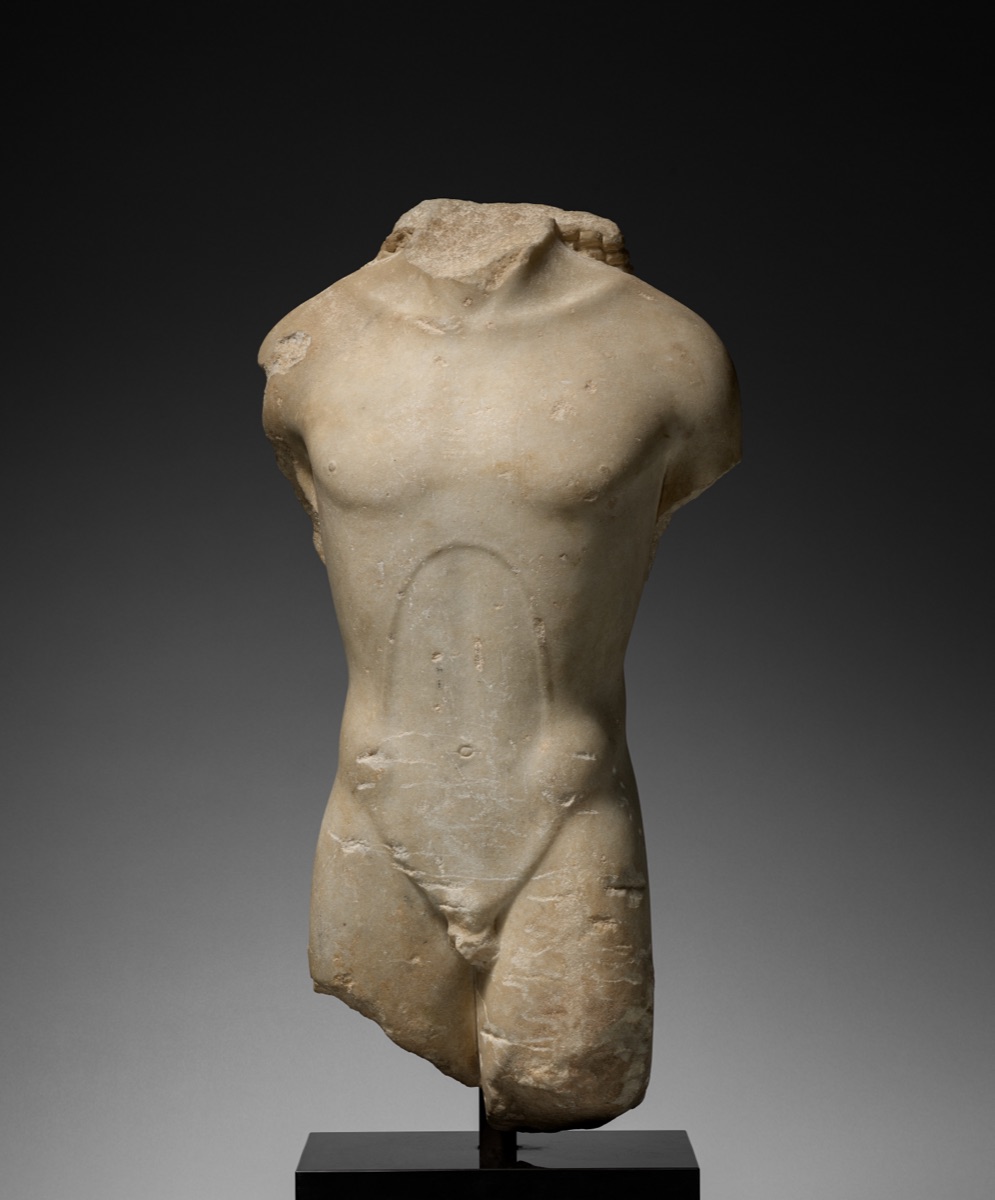
Torso of a Kouros
The torso of a marble kouros, the standing nude youth type Archaic Greek sculptors carved by the hundreds for graves and sanctuaries.
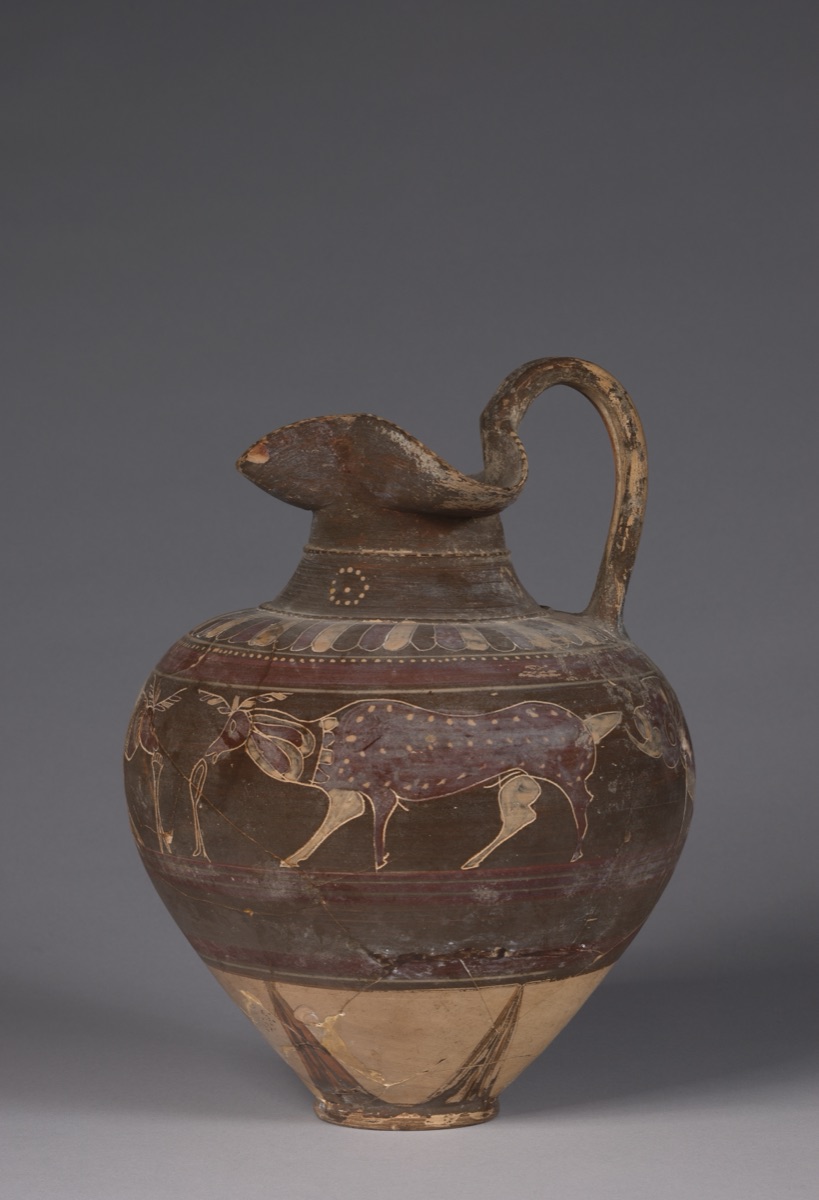
Polychrome Oinochoe: Deer and Lions
A wine jug painted in the Corinthian-derived style Etruscan workshops made their own, evidence of how far Greek pottery fashion traveled.
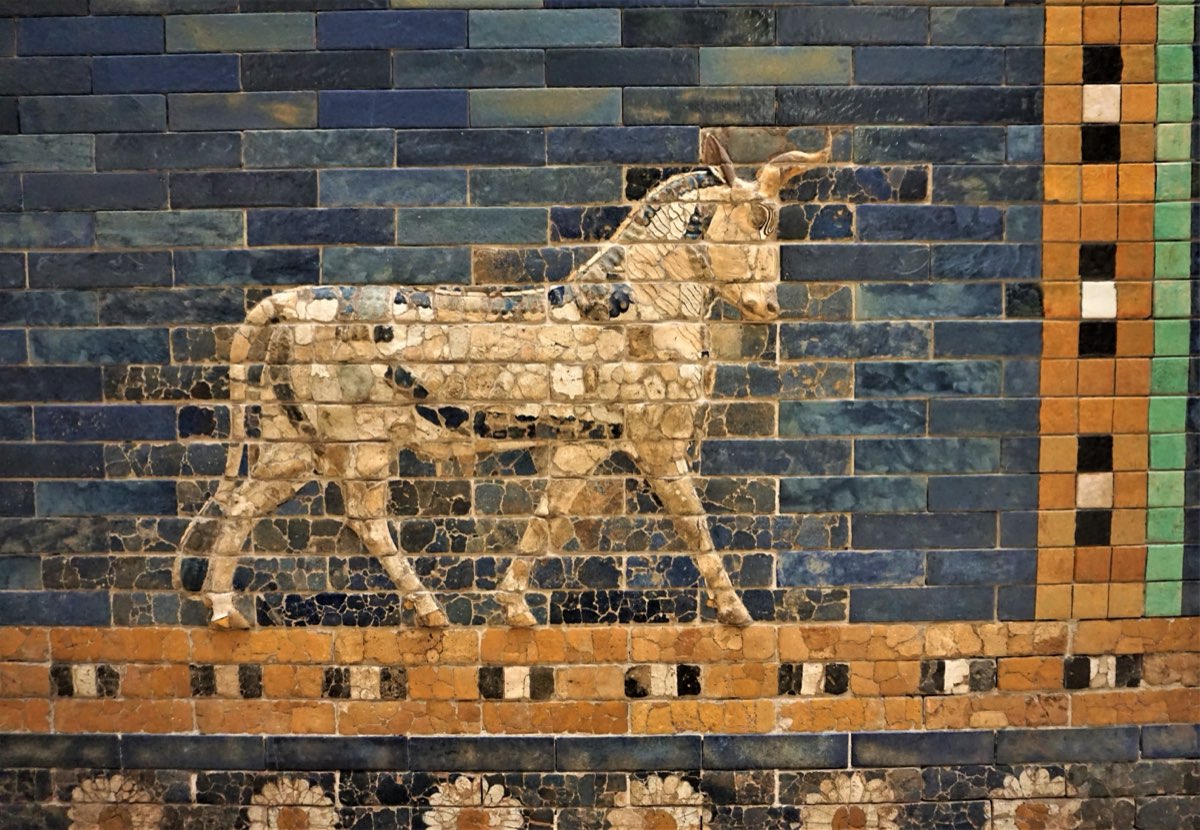
Striding Bull Relief, Ishtar Gate
A molded and glazed-brick aurochs from the facade Nebuchadnezzar II built as Babylon's ceremonial entrance, reassembled in Berlin's Pergamon Museum.
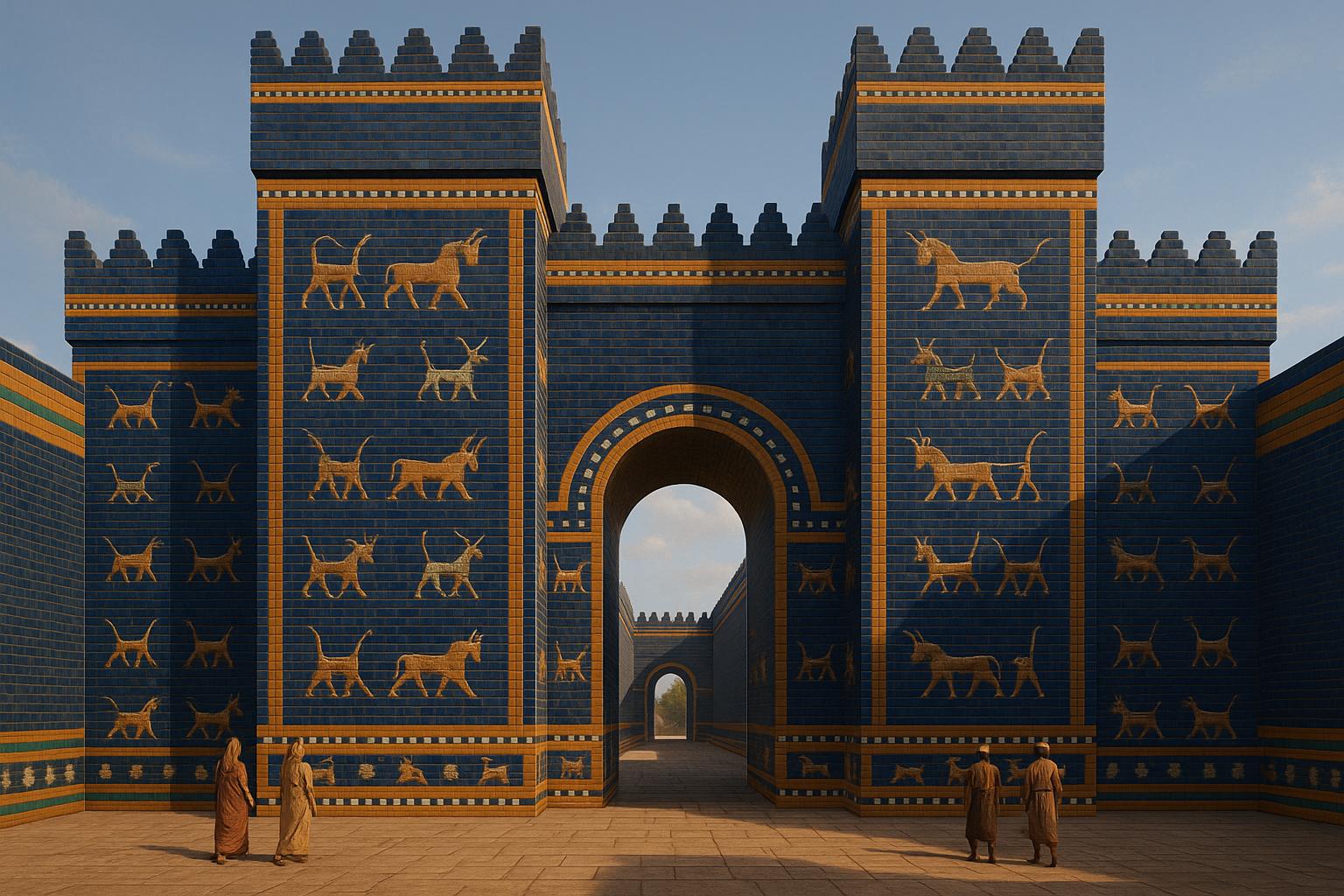
AI reconstruction
Ishtar Gate of Babylon - reconstruction
Nebuchadnezzar II's ceremonial gate as dedicated: the double-towered gateway and processional walls sheathed in deep blue glazed brick, ordered rows of molded aurochs and mushhushshu dragons, ochre borders and stepped crenellations, the glaze still glossy. The reconstruction is grounded in the excavated bricks themselves - thousands survive, including the museum's striding bull - and in the gate rebuilt from them in Berlin.
AI reconstruction (2026), based on Striding Bull Relief, Ishtar Gate, Pergamon Museum, Berlin
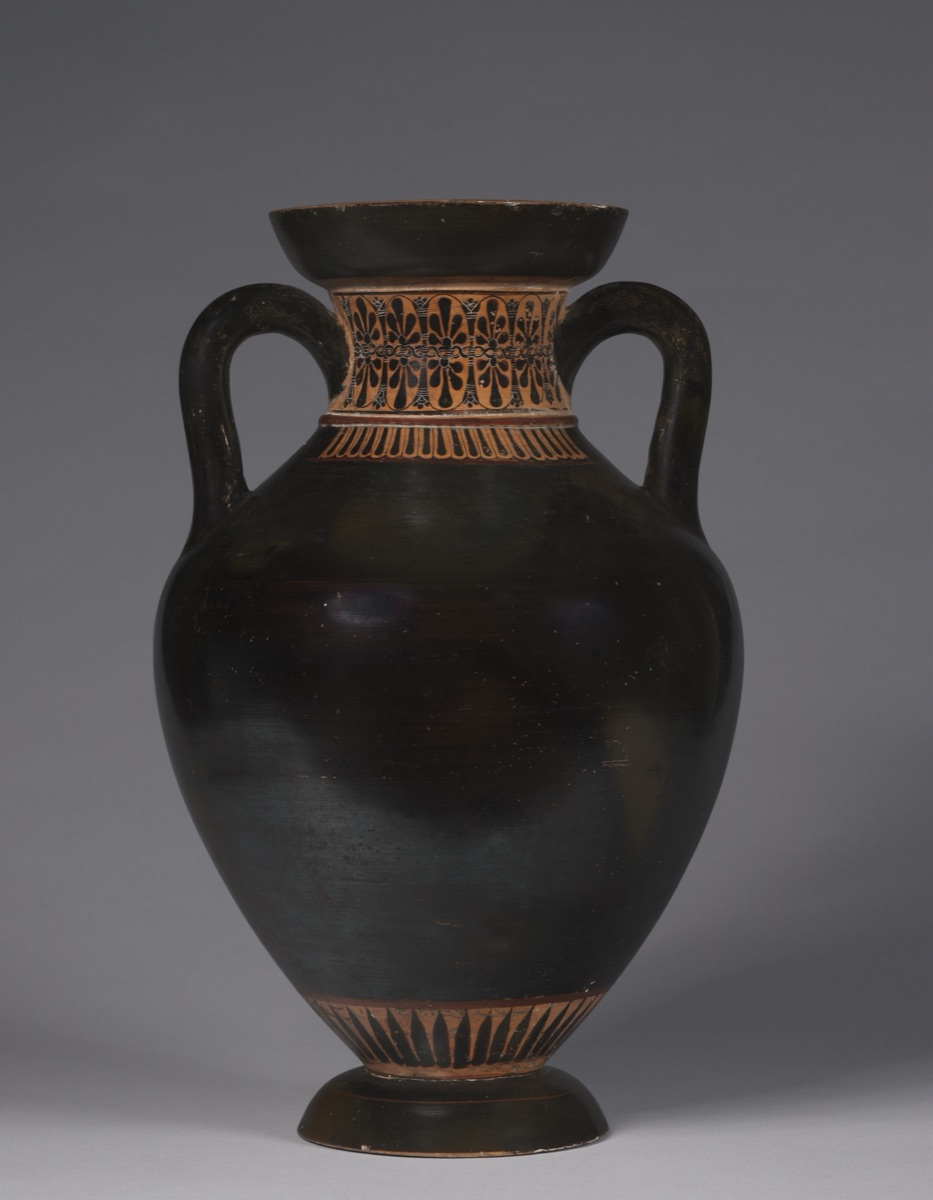
Black-Figure Neck-Amphora of Panathenaic Shape
A black-figure storage amphora in the shape awarded to victors at the Panathenaic Games, Athens's civic festival for Athena.
New this century
- Job
The doctrine that suffering proves guilt is false, and the honest response to unearned suffering is not a better theory of justice but a direct, unmediated encounter with a God who owes no explanation.
- Fragments
Desire is a physical, almost violent force that overtakes the body and mind regardless of a person's will, and lyric poetry sung to a small circle is the right instrument for confessing it.
- Isha Upanishad
True renunciation is not abandoning the world but acting within it while claiming no personal ownership over its fruits, since everything already belongs to the Lord who pervades it.
- Sushruta Samhita
Surgery is a legitimate and teachable branch of medicine, and the text lays out procedures, instruments, and training methods, including practicing incisions on vegetables and dead animals, precise enough to be followed rather than merely described.
- San Jose Mogote Monument 3 ("Danzante")
A carved stone slab laid as a corridor doorstep at San Jose Mogote in the Etla Valley of Oaxaca depicts a sacrificed, prone captive with his heart removed and, carved between his feet, a calendrical day-name glyph commonly read '1 Earthquake' or '1 Motion': among the earliest attested Zapotec writing and, by some readings, among the earliest writing anywhere in Mesoamerica, conventionally dated c. 600 BC (Marcus 1992), though Cahn and Winter argue Monument 3 may instead have been reset later and be broadly contemporaneous with the Monte Alban Danzantes, as late as 200 BC or after, so its placement in the Late Rosario phase is a live dispute among specialists rather than a settled fact.
- Ezekiel
God's presence is not tied to the Jerusalem Temple but travels into exile with the people, so the deportation is neither abandonment nor defeat but a relocation of divine judgment and, eventually, of restoration.
- Enthronement Stela of Aspelta
Kushite kingship passes not simply by birth order but by the army and court's formal nomination of royal candidates, ratified when Amun's oracle at Gebel Barkal selects the true king from among them.
- Doctrines and Testimonia
Water is the single underlying material principle from which everything else in the natural world is generated, part of a distinctive Ionian turn toward seeking material and structural explanations for the world in Greek prose.
- Fragments
The origin of all things cannot be any one ordinary substance like water, since that substance would already need explaining, but must be an indefinite, boundless principle (the apeiron) from which opposites separate out and to which they eventually return.
- Elegies
A world where a corrupt, upstart class has displaced the old aristocratic order can only be endured, not fixed, and a father's bitter, hard-won wisdom about loyalty, class, and survival deserves to be passed down intact to a beloved young protege as a kind of poetic inheritance.
- Fragments
The gods that different peoples worship look and act suspiciously like the peoples who worship them, which suggests that human beings have invented their gods in their own image rather than received true knowledge of the divine.
- The Cyrus Cylinder
Composed by Babylonian scribes for a foreign conqueror, the cylinder argues that Cyrus's takeover of Babylon was not conquest at all but restoration, the god Marduk himself choosing a righteous outsider to replace an impious native king.
- Doctrines and Testimonia
Air, through the processes of rarefaction and condensation, is the single material principle that becomes fire when thinned and becomes wind, cloud, water, and earth in turn as it is progressively compressed.
- Pythagorean Fragments and Doctrines
Number and mathematical proportion are the true underlying structure of reality, including the harmony of music and the movements of the heavens, and the soul is immortal and subject to transmigration through successive bodies.
- Sarcophagus Inscription of Eshmunazar II
Eshmunazar II's tomb inscription asserts that his premature death cut short a reign of temple-building piety rewarded by the Persian Great King with the rich Sharon Plain territories of Dor and Joppa, and it threatens total ruin on anyone who violates the tomb.
- Behistun Inscription
Darius I turns a violent and contested seizure of the Persian throne into proof of divine right, carving his suppression of nine rebel kings in three imperial languages onto a cliff face where no rival could erase, forge, or ignore it.
- Persepolis Fortification Archive
The Persepolis Fortification tablets collectively attest that the Achaemenid state provisioned and mobilized labor across the imperial heartland through an exhaustive, centrally audited rationing system administered in Elamite rather than the king's own Old Persian.
The canon by now
- Pyramid Texts
- Royal Inscriptions of Sargon of Akkad
- The Exaltation of Inanna
- The Curse of Agade
- Coffin Texts
- Admonitions of Ipuwer
- Eloquent Peasant
- Code of Hammurabi
- Old Babylonian Gilgamesh (Pennsylvania and Yale Tablets)
- Inanna's Descent to the Netherworld
- Edwin Smith Surgical Papyrus
- Book of the Dead
- Rigveda
- Baal Cycle
- Ludlul Bel Nemeqi
- Epic of Gilgamesh
- Instruction of Amenemope
- Gathas
- Book of Songs
- Torah
- I Ching (Book of Changes)
- Mahabharata
- Iliad
- Odyssey