Time travel
4th century BC
Plato and Aristotle give Greek philosophy a shared vocabulary just as Alexander destroys the empire that had framed the previous two centuries.
Mental Worlds: Evidence and Inference
This century closes the axial explosion with two Athenian philosophers who spend their careers systematizing, in strikingly different ways, the two previous centuries' scattered arguments, and with a Macedonian king who ends, by force, the political order that had made much of that argument possible. Plato, writing dialogues that stage his teacher Socrates in conversation rather than laying out doctrine directly, works across the century's first half toward increasingly ambitious claims: that justice is a structure of the soul before it is a structure of the city, that mathematical and moral knowledge are of a piece, and that the visible world is a shadow of a more real, unchanging order of Forms. His student Aristotle rejects the Forms as Plato conceives them and, after founding his own school at the Lyceum in 335 BC, spends the century's final years producing an entire library of treatises on logic, physics, biology, ethics, politics, poetry, and the soul, an attempt not to found a religion or a mystery cult but to organize the whole of existing knowledge into coherent, teachable disciplines. Between them, Plato and Aristotle do not so much end Greek philosophy's argument as give it, for the first time, a shared vocabulary later centuries in Latin, Arabic, and eventually every literate tradition touched by either will keep arguing inside.
That argument continues to happen because Athens, though militarily and politically diminished after its defeat in the previous century's Peloponnesian War, remains wealthy and stable enough to support philosophical schools as ongoing institutions rather than individual careers. What ends that stability, decisively, is Macedon. Philip II builds an army and a treasury capable of unifying Greece by force at Chaeronea in 338 BC, and his son Alexander, coming to power after Philip's assassination two years later, spends the following decade destroying the Achaemenid Persian empire outright, defeating Darius III, burning Persepolis, and pushing as far as the Indus before his own exhausted army finally refuses to continue. Alexander dies in Babylon in 323 BC, not yet thirty-three, and the empire he built fragments almost immediately among his generals, but the political map it leaves behind, Greek-ruled kingdoms scattered from Egypt to the edge of India, will shape the following centuries far more than any single battle he won.
Elsewhere, comparably significant transformations proceed with no awareness of Athens or Macedon whatsoever. In China, Shang Yang's Legalist reforms remake the state of Qin around strict law, agricultural output, and military merit rather than aristocratic privilege, an institutional experiment that looks, in this century, like just one contender among many Warring States; only in retrospect, more than a century later, will it become clear that Qin's reforms are what eventually let it conquer and unify the rest. In India, Chandragupta Maurya founds an empire that, within a generation, absorbs the very satrapies Alexander's invasion had briefly planted in the northwest, an ironic inheritance in which the aggressive edge of one civilization's conquest becomes the founding opportunity for another's. Mencius and Zhuangzi, meanwhile, develop rival, mutually unimpressed extensions of Confucian and proto-Daoist thought, Panini formalizes Sanskrit grammar with a precision no ancient language had received before, and the Deuteronomistic tradition's heirs, along with a returned Judean community organizing itself under men remembered as Ezra and Nehemiah, keep building the textual and institutional framework Second Temple Judaism will carry forward.
None of these developments needed Alexander's conquest to matter. But it is Alexander's conquest, more than any philosopher's argument, that determines which of these worlds will spend the following centuries in direct contact with each other, and which will not.
The political map
Major Polities and Cultural Regions
- Empire of Alexander By 323 BC stretches from Greece and Egypt to the Indus, the largest single empire yet assembled, before fragmenting at his death
- Achaemenid Persia Conquered by Alexander between 334 and 330 BC, ending roughly two centuries of Achaemenid rule
- Macedon Unifies Greece under Philip II by 338 BC, the base from which Alexander's conquests are launched
- Qin and the Warring States China's fractured Warring States system, with Qin beginning the Legalist reforms that will eventually unify the country
- Mauryan Empire Founded by Chandragupta Maurya around 321 BC, rapidly expanding across northern India
- Carthaginian Empire Dominant naval and trading power in the western Mediterranean, still independent of Rome
- Roman Republic Expanding within Italy, fighting the Samnite Wars from 343 BC, still a regional rather than Mediterranean power
Borders are approximate scholarly reconstructions from historical-basemaps (GPL-3).
State of the domains
Texts and Written Culture
Plato's dialogues, from the Apology to the Republic and Timaeus, develop Socratic method into systematic accounts of justice and the soul; his student Aristotle, after founding the Lyceum in 335 BC, produces treatises on ethics, politics, logic, and biology. Demosthenes warns Athens, unsuccessfully, against Macedon. Menander's comedies, beginning late in the century, replace political satire with domestic plots. In China, Mencius develops Confucian ethics around innate human goodness while Zhuangzi's Inner Chapters push Daoist thought toward radical skepticism; the Daodejing, despite its legendary attribution to an earlier Laozi, is compiled in current form only now. In India, Panini's Ashtadhyayi gives Sanskrit a precise grammar, and the Sutta Nipata gathers the Pali Canon's oldest strata of verses attributed to the Buddha.
Art
Greek sculpture under Praxiteles and Lysippus moves from the previous century's severe idealism toward more sensuous, expressive forms, while Macedonian royal tombs at Vergina, including one likely belonging to Philip II, display gold work and painting reflecting the kingdom's new resources. Alexander's conquests, in the century's final years, carry Greek artistic conventions as far as Bactria and the edge of India, planting the seeds of what the following century calls Hellenistic style; the hybrid Gandharan style further east, often mistakenly traced to this moment, is actually a Kushan-era phenomenon centuries later, outside this era's span. Persepolis, the Achaemenid ceremonial capital, is burned by Alexander's forces in 330 BC, an act later sources variously explain as calculated symbolism or drunken accident. Far south, the Chavin interaction sphere spreads its ceremonial iconography across the central Andes, the Janabarriu ceramic style marking a shared religious horizon among communities still without writing of any kind.
Medicine
The Hippocratic school's later, more aphoristic works, including the Aphorisms and the physician's oath later ages treat as the tradition's ethical charter, though its own date is debated, along with On the Sacred Disease's argument that epilepsy has natural rather than divine causes, belong to this century's opening decades, capping the naturalistic medical program the school built over the previous century. No comparably systematic medical literature survives from India or China this century, though both traditions almost certainly continue developing distinct diagnostic and therapeutic practices that surface in later, better-documented texts. Aristotle's biological writings, while not medical in intent, contribute detailed anatomical observation later medical writers will draw on.
Science
Aristotle's History of Animals catalogs and classifies animal life with a systematic thoroughness no earlier natural history attempts, while his Physics develops a theory of motion, causation, and change intended to supersede the Presocratics' competing accounts with a single coherent framework. Panini's grammar of Sanskrit, though a work of language rather than nature, applies a comparably rigorous formal analysis, describing the language's rules with an economy and precision modern linguists still study. Babylonian astronomers continue refining mathematical methods for predicting planetary and lunar positions, groundwork the following centuries' Hellenistic astronomy will inherit. No comparable systematic natural philosophy is attested in China this century, where philosophical energy concentrates more on ethics and statecraft than on nature.
Military
Philip II unifies Greece under Macedonian hegemony by defeating the allied city-states at Chaeronea in 338 BC, and his son Alexander, after Philip's assassination in 336 BC, conquers the entire Achaemenid Persian empire within a decade, defeating Darius III, burning Persepolis in 330 BC, and pushing as far as the Indus before his own army refuses to go further. Alexander dies in 323 BC, and his conquests fragment among his generals almost immediately. In China, Shang Yang's Legalist reforms in Qin, beginning in the 350s BC, restructure the state around strict law, military merit, and agricultural productivity. In India, Chandragupta Maurya founds the Mauryan dynasty around 321 BC, absorbing the Greek satrapies Alexander had left behind in the northwest.
Technology
Macedonian military technology under Philip and Alexander combines a longer-piked phalanx formation with sophisticated siege engineering, demonstrated most dramatically at the siege of Tyre in 332 BC, where Alexander builds a causeway out to the island city under constant bombardment. Qin's Legalist reforms include early standardization of administrative measures and law across the state, a bureaucratic technology of governance that will later scale to unified China. Aristotle's systematic classification of living things and Panini's formal grammar both represent, in their different domains, a new technology of organizing knowledge itself, imposing explicit rule and category on material earlier scholarship had handled more informally.
Material world
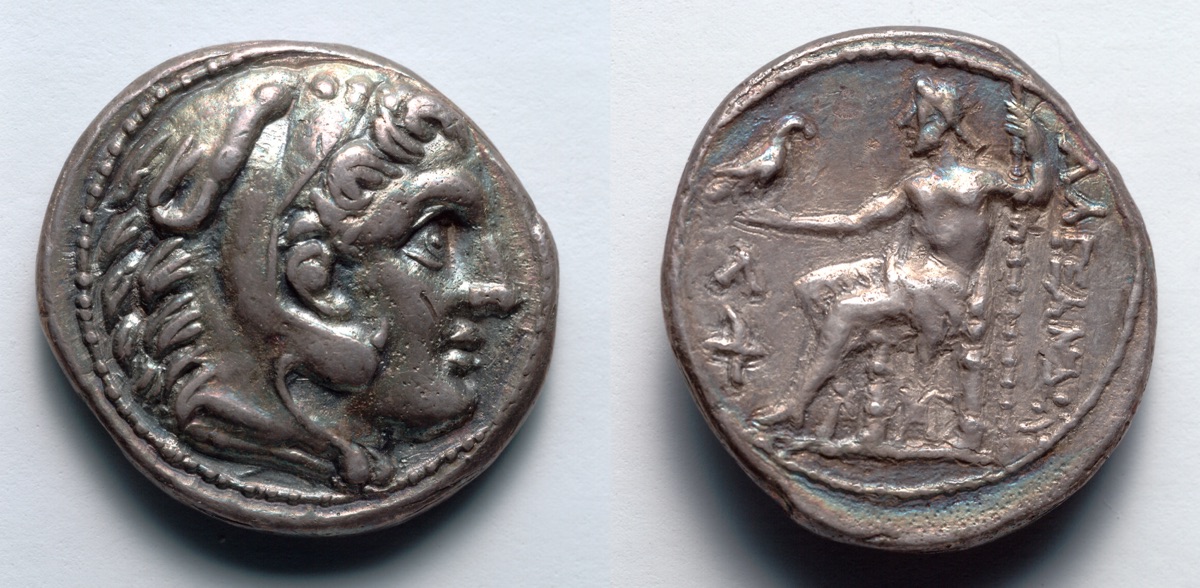
Tetradrachm: Head of Young Herakles / Zeus
A silver tetradrachm struck under Alexander the Great, a coin type reissued across his conquests from Macedon to Babylon.
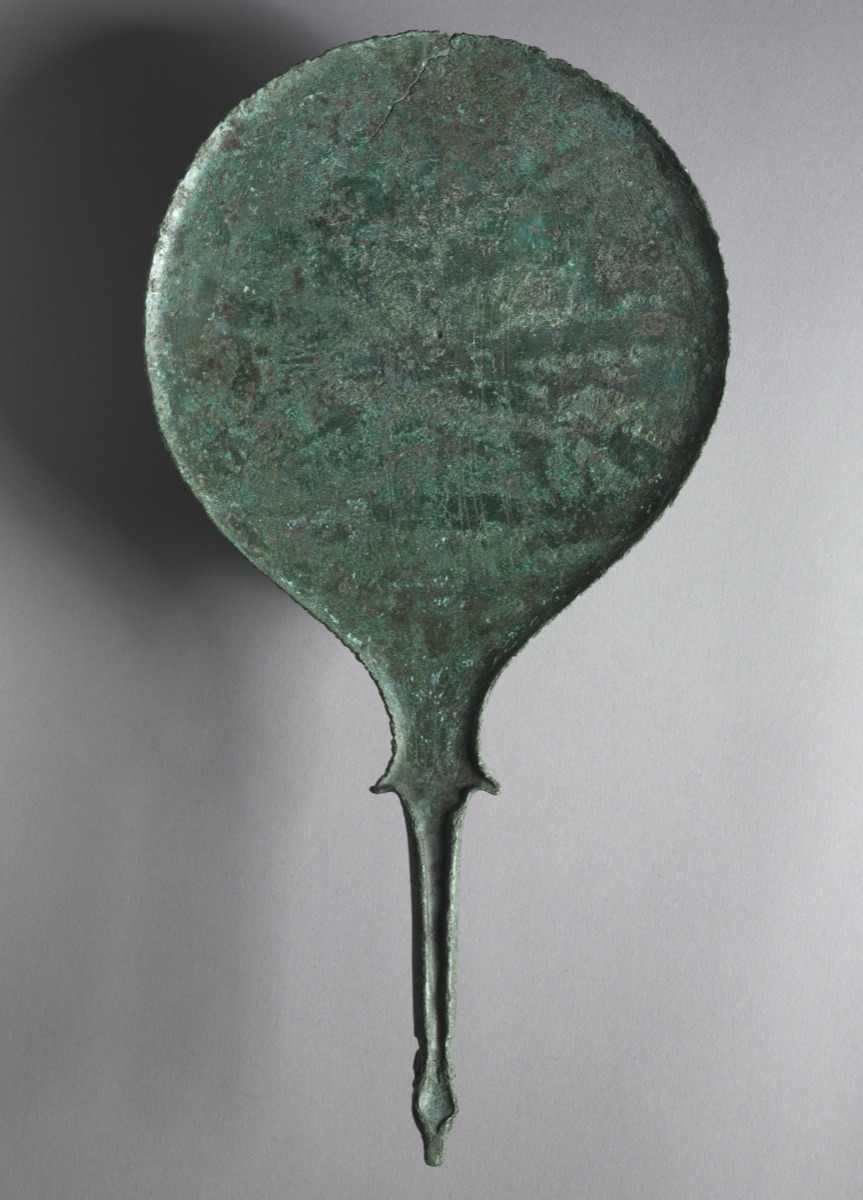
Mirror with Engraved Scene: Two Female Figures
A bronze hand mirror engraved on its back, a form of everyday luxury goods Etruscan workshops produced for centuries.
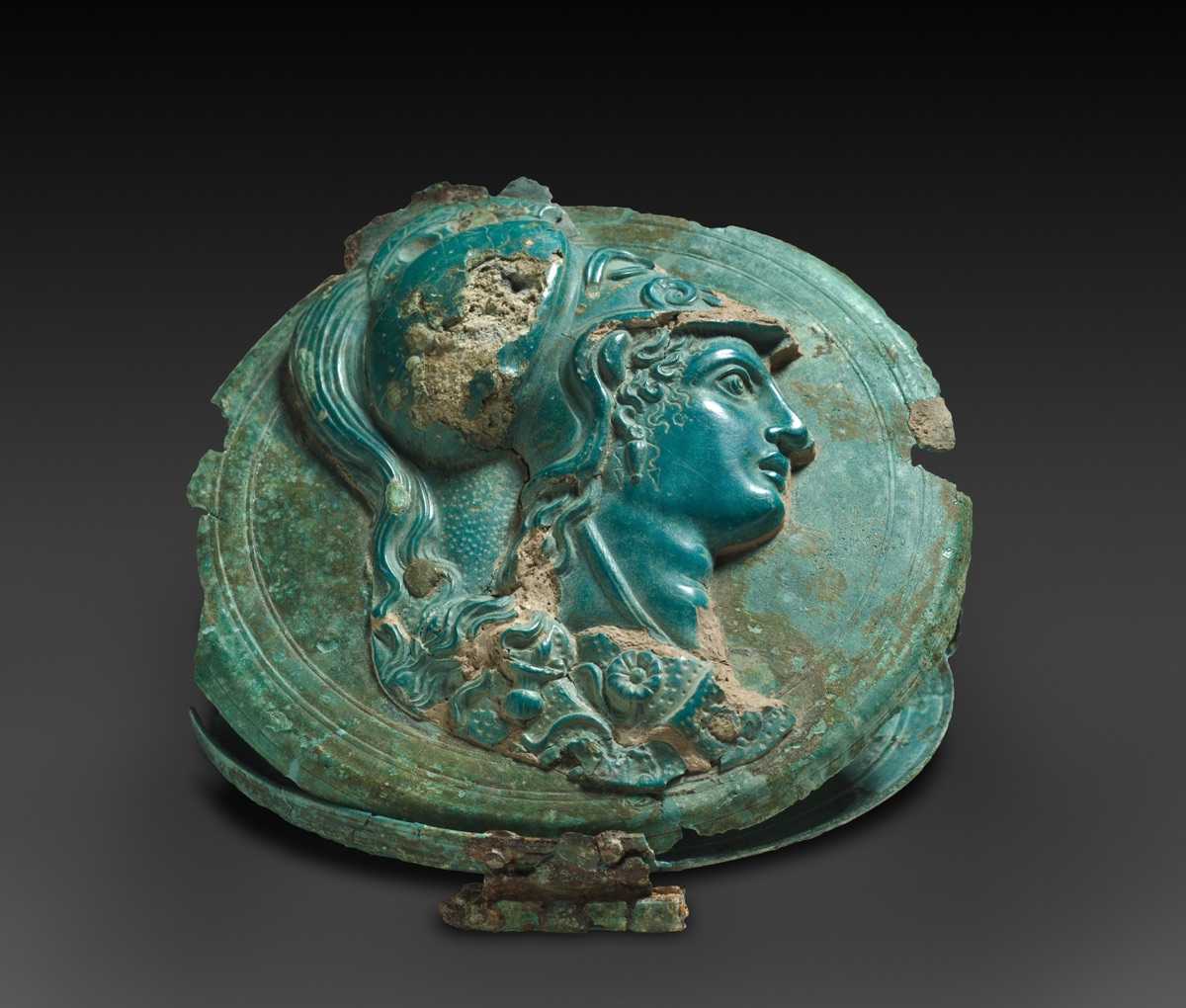
Box Mirror with Head of Athena
A bronze box mirror with a relief head of Athena on its lid, a luxury toilet article from the generation after Alexander's death.
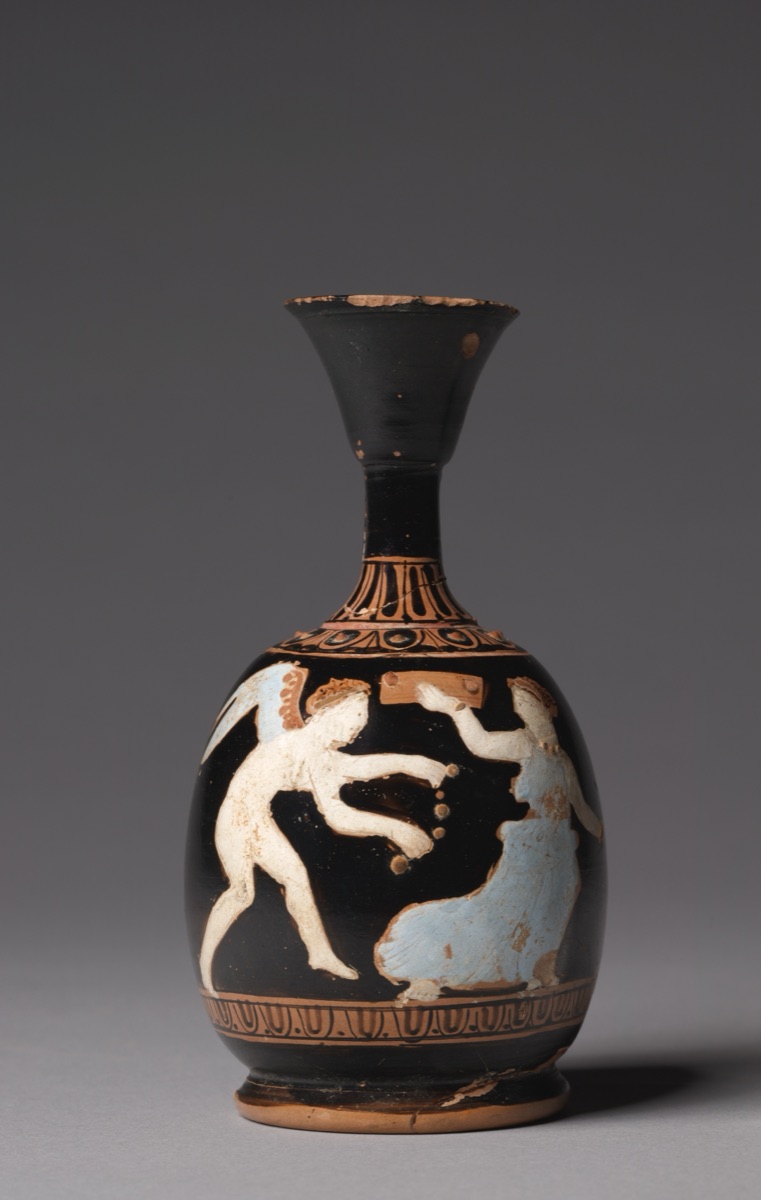
Red-Figure Squat Lekythos: Eros and Woman
A squat oil flask painted in red-figure with Eros attending a woman, a late phase of Athenian fine pottery before the style declined.
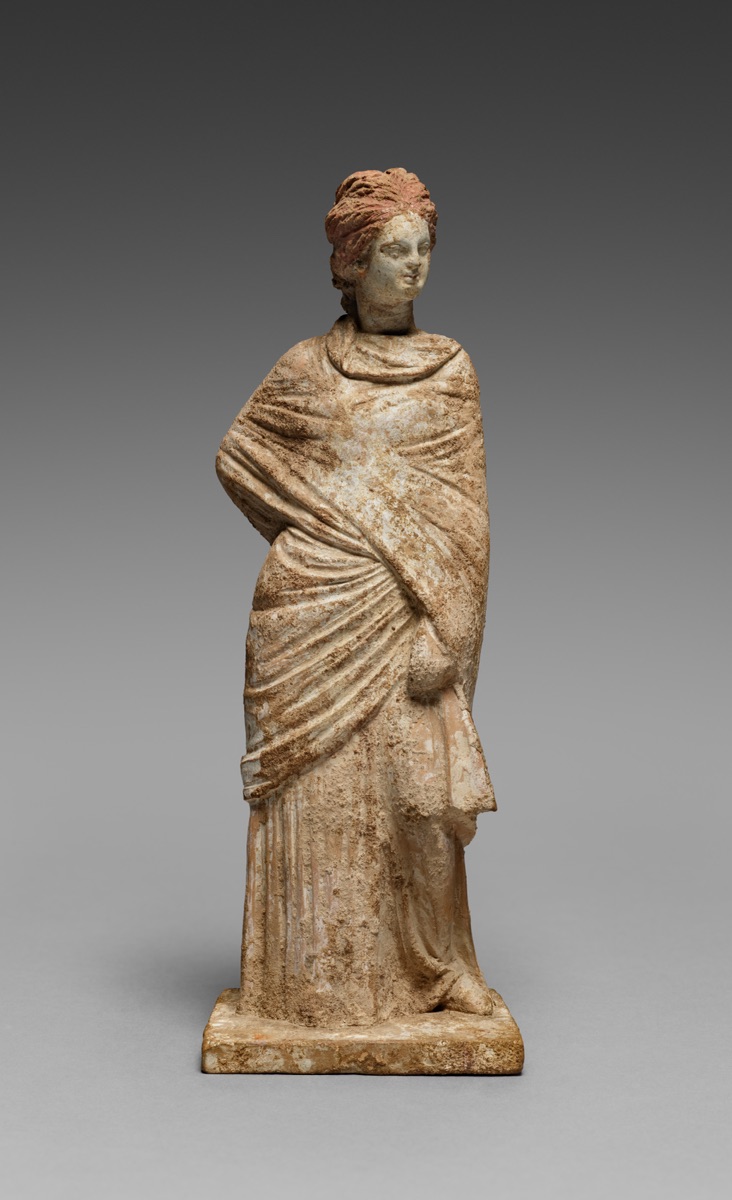
Female Figurine
A painted terracotta Tanagra figurine, the mass-produced genre statuettes of draped women that became fashionable across the Hellenistic world.
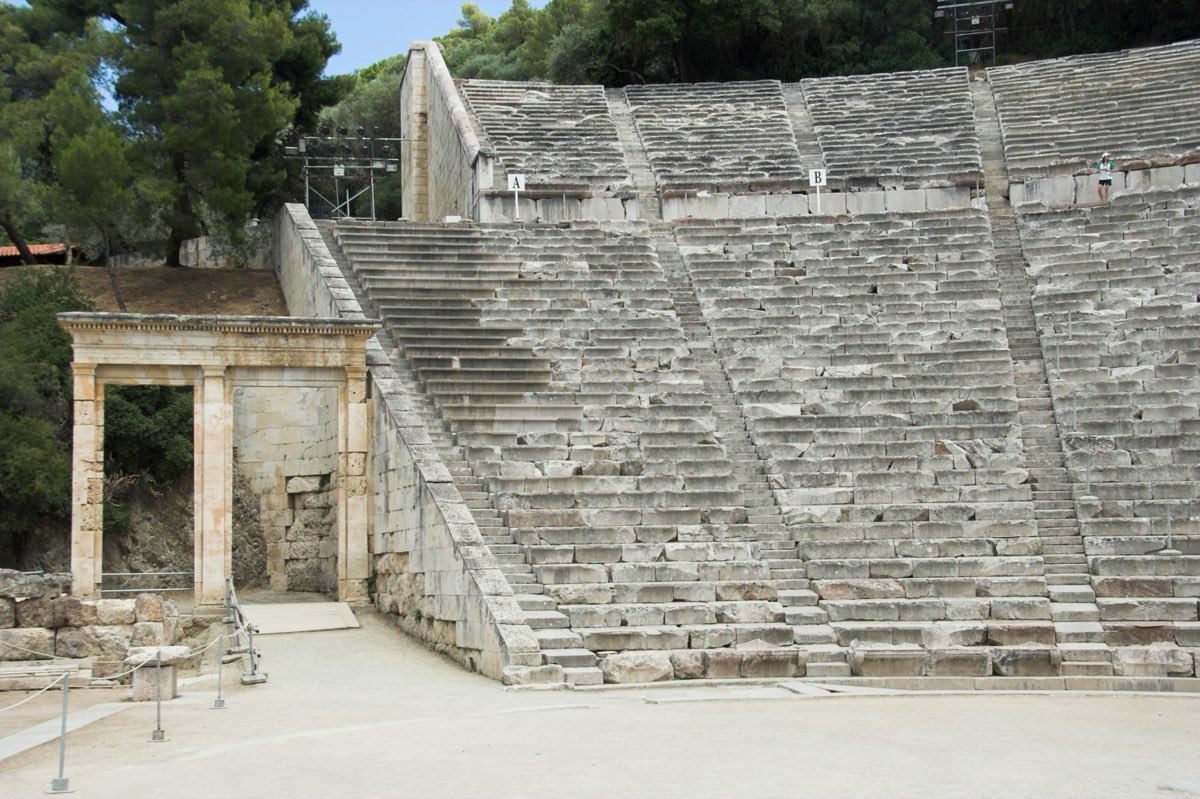
Theatre of Epidaurus
The best-preserved theatre of the ancient Greek world, built into a hillside at the sanctuary of Asclepius for its celebrated acoustics.
New this century
- Ezra-Nehemiah
A rebuilt Temple is not enough to restore a people; only public re-acceptance of the written law of Moses, read aloud and enforced, completes the return from exile.
- On the Murder of Eratosthenes
Athenian law explicitly permits a husband to kill a man he catches committing adultery with his wife inside his own home, and a defendant can win acquittal by showing the killing was exactly this lawful, righteously motivated act rather than a premeditated murder disguised as one.
- Ashtadhyayi
Sanskrit's entire grammar can be generated from a small set of roughly 4,000 algebraic-style rules ordered so that more specific rules override general ones, making the language describable as a closed formal system rather than a list of usage examples.
- Sutta Nipata
Clinging to views, possessions, and even religious identity itself is what keeps a person bound, and the sage lets go of all of it, including the wish to be seen as wise.
- Daodejing
The way that can be described is not the eternal way, and the wisest rulers govern, and live, by acting so little that things unfold on their own.
- Zuo Zhuan
The Spring and Autumn Annals' bare entries only make sense once expanded into full narrative, complete with speeches, motives, and consequences, because moral judgment in history requires seeing not just what happened but why people acted as they did.
- Huangdi Sijing
Legitimate rule follows the impersonal, unchanging patterns of Dao and law already built into the cosmos, so a wise ruler governs by aligning administration with those patterns, fusing Daoist non-action with Legalist law, rather than choosing one philosophy over the other.
- Orphic Gold Tablets
The dead soul faces a dangerous crossroads in the underworld and must recite the correct words, that it is a child of Earth and starry Heaven, to the guardians of a sacred spring in order to drink and join the company of other blessed initiates rather than the ordinary dead.
- Iberian Inscriptions
A pre-Roman population of eastern and southern Iberia recorded coinage, personal names, and lead-plaque texts, likely commercial or legal in nature, in scripts that can be read letter by letter but whose underlying, non-Indo-European language still resists translation.
- Apology
An examined life lived in pursuit of truth is worth more than an unexamined one bought with survival, and Socrates would rather be condemned to death than stop questioning his fellow citizens.
- Meno
Virtue cannot simply be taught by professional teachers the way a craft is taught, since no reliable teachers of virtue exist, which suggests that if virtue can be acquired at all, it comes through recollecting knowledge the soul already possesses or through some form of divine gift.
- Phaedo
The soul is immortal and akin to the unchanging Forms it can know through reason, so death, properly understood by a philosopher who has spent life detaching from bodily concerns, is not to be feared but welcomed as liberation.
- Symposium
Erotic desire, properly understood and pursued, is not merely appetite for a beautiful body but the soul's ladder toward contemplating Beauty itself, the highest object philosophy can pursue.
- Panegyricus
The fractious Greek city-states should set aside their endless wars against each other and unite instead under joint Athenian and Spartan leadership for a common war against Persia, since only such unity can restore Greek prosperity and end the cycle of ruinous internal conflict.
- Republic
A just city and a just soul share the same structure, and justice is finally shown to be worth choosing for its own sake, whether or not it is ever rewarded.
- Memorabilia
Socrates was a pious, morally serious teacher of practical virtue rather than the impious corrupter of youth his accusers claimed, and recalling his ordinary conversations on courage, friendship, and self-control is the best available defense of his character.
- Anabasis
Ten thousand Greek mercenaries stranded deep in hostile Persian territory after their employer's death can fight and negotiate their way home through disciplined, consultative leadership, proving that well-organized citizen-soldiers could out-march and outfight forces many times their number.
- Phaedrus
Written speech is a lesser, more rigid substitute for living dialogue, since a text cannot answer questions, defend itself, or adapt to its particular listener, and true rhetoric must be grounded in knowledge of the soul rather than mere technique.
- Hellenica
Greek history did not stop when Thucydides's account broke off in 411 BC, and continuing it through Sparta's rise, overreach, and the unsettled balance of power that followed shows how quickly a hegemony won by war can be lost again.
- Timaeus
The visible universe is not eternal but was fashioned by a benevolent divine craftsman, using mathematical proportion and the four elements, as the best possible copy of an eternal, unchanging model, making the cosmos itself a work of reasoned, purposeful design.
- Chronicles
Israel's history is best told again from the beginning, with its embarrassments trimmed and its Temple worship foregrounded, because a restored Second Temple community needs a usable past more than a complete one.
- Rhetoric
Persuasion works through three distinct means, the speaker's own credibility, the emotional state aroused in the audience, and the logical argument of the speech itself, and rhetoric, properly understood, is not a morally suspect trick but a legitimate counterpart to logic for reasoning about matters where certainty is unavailable.
- Zhuangzi
Every fixed standard of right and usefulness is a perspective mistaken for the whole, so the freest life is the one that stops arguing over which perspective is correct and instead moves with the transformations of things.
- Book of Lord Shang
A strong state requires citizens who farm and fight and nothing else, achieved by uniform harsh law applied without regard to rank, by weakening the nobility, and by keeping the people poor and ignorant enough that they have no ambition beyond what the state assigns them.
- Sun Bin's Art of War
Victory goes to the commander who manipulates the enemy's expectations and terrain, deliberately feigning weakness, luring an opponent into overextension, and striking where he assumes safety, so that battle is decided before the armies actually collide.
- Guanzi
Effective statecraft requires managing the material foundations of the state, granaries, currency, and the balance of trade, as carefully as it requires managing ritual and law, because a hungry or impoverished population cannot be governed by moral appeal alone.
- Shanhaijing
The world beyond the settled Chinese heartland is populated by strange mountains, seas, peoples, and beasts each with its own fixed place and properties, and cataloguing them geographically, however fantastical they read to a modern eye, is a legitimate way of mapping and making sense of the unknown.
- Xanthos Trilingual
The decree asserts, in three languages before three audiences, that the citizens of Xanthos and their governing council have permanently bound themselves to fund a new civic cult, financed by a tax levied whenever a slave is freed.
- Nicomachean Ethics
The good life is not a feeling but an activity, the practice of virtue as a mean between extremes, sustained over a whole life and aimed at flourishing rather than pleasure.
- Poetics
Tragedy works on an audience through a structured plot that arouses pity and fear only to purge them, and the best plots turn on a single reversal of fortune driven by a character's own error rather than by wickedness or chance.
- Politics
The city-state exists by nature to enable the good life, not merely survival, and the best constitution is not a single ideal form but whatever mixed arrangement of rule best fits a given population's actual character and circumstances.
- Metaphysics
There must be a science studying being simply as being, distinct from all the specialized sciences that study only a particular kind of being, and the deepest such inquiry culminates in an eternal, unmoved first cause that all things ultimately depend on.
- Physics
Natural change and motion can only be understood through the four causes, material, formal, efficient, and final, and nature itself is best explained as things acting for the sake of an end rather than merely by mechanical necessity.
- On the Soul
The soul is not a separate substance trapped in the body but the form and actuality of a naturally organized living body, so asking whether soul and body are one is as misguided as asking whether wax and its shape are one.
- On the Crown
A lifetime spent urging Athens to resist Philip of Macedon's expansion, even though that resistance ultimately ended in military defeat, was the right and honorable policy, and the political rival now attacking that record for having failed is a lesser man measured by any standard beyond hindsight.
- Mencius
Human nature is intrinsically good, since every person is born with the seeds of compassion, shame, deference, and moral discernment, so government succeeds by cultivating what people already have in them rather than imposing order from outside.
- Gongsun Longzi
A name and the thing it names are not the same, so 'a white horse' is logically not identical to 'a horse,' and taking that distinction seriously exposes how loosely ordinary language, and the political claims built on it, actually track reality.
- Dyskolos
A misanthropic old man's stubborn isolation from his neighbors and even his own family can be broken down by a young man's persistent courtship of his daughter and by chance misfortune forcing him to accept help, showing that ordinary social bonds, not heroic action, resolve the real conflicts of everyday life.
The canon by now
- Pyramid Texts
- Royal Inscriptions of Sargon of Akkad
- The Exaltation of Inanna
- The Curse of Agade
- Coffin Texts
- Admonitions of Ipuwer
- Eloquent Peasant
- Code of Hammurabi
- Old Babylonian Gilgamesh (Pennsylvania and Yale Tablets)
- Inanna's Descent to the Netherworld
- Edwin Smith Surgical Papyrus
- Book of the Dead
- Rigveda
- Baal Cycle
- Ludlul Bel Nemeqi
- Epic of Gilgamesh
- Instruction of Amenemope
- Gathas
- Book of Songs
- Torah
- I Ching (Book of Changes)
- Mahabharata
- Iliad
- Odyssey