Time travel
23rd century BC
Sargon's daughter Enheduanna, installed as high priestess at Ur, becomes among the earliest authors in world literature known to sign her own name, while Naram-Sin expands Akkad's empire and Egyptian officials push trade expeditions deep into Nubia.
Mental Worlds: Evidence and Inference
A priestess serving at Ur's temple of Nanna this century occupies a position no woman in the written record has quite held before: Enheduanna, daughter of Sargon, installed by her father's political design to bind Akkad's new empire to Sumer's oldest religious center, composes hymns and, in a gesture without earlier known precedent, signs them with her own name. In the Exaltation of Inanna, she casts her own political crisis, exile from her temple office during an uprising, as a direct plea to the goddess Inanna, fusing intimate personal distress with cosmic praise in a single voice. What made this new was not the poetry's skill alone but the naming: a real, or at least claimed, individual author standing behind a text, rather than the anonymous tradition and formulaic voice that had defined Mesopotamian literature since the Instructions of Shuruppak three centuries earlier. Whether every surviving line is truly hers, since every manuscript is an Old Babylonian copy roughly six centuries later, is a live scholarly question, but the century itself is the one in which authorship, as an idea, first becomes something a Mesopotamian text can claim.
Her father's empire, meanwhile, is tested and, under her nephew Naram-Sin, expanded further. Naram-Sin crushes a coordinated revolt of Akkadian cities and campaigns against the Lullubi people of the Zagros mountains, then takes the extraordinary step of declaring himself a god within his own lifetime, his name written with the divine determinative reserved elsewhere only for deities. A subject of the empire encountering the Victory Stele commemorating this campaign, the king shown towering over his own soldiers in a god's horned crown, was being asked to accept a claim about political authority that went beyond anything Sargon himself had asserted: not merely universal kingship, but actual divinity, ratified, according to one inscription, by the grateful petition of Akkad's own citizens.
In Egypt, authority took a very different, more outward-looking form this century. The official Harkhuf, serving under Pepi I and the child-king Pepi II, leads repeated trading and diplomatic expeditions deep into Nubia, returning once with a dancing pygmy whose arrival so delighted the young king that Pepi's own excited letter to Harkhuf, quoted in Harkhuf's tomb inscription, survives as one of the most personally vivid pieces of writing from Old Kingdom Egypt. Alongside him, the official Weni narrates his own rise through royal favor, including command of an army against Asiatic nomads, establishing the tomb autobiography as a durable Egyptian literary form. Where Akkad extended its authority through conquest and self-deification, Egypt this century extended its reach through trade, diplomacy, and the accumulation of exotic goods and knowledge from beyond its borders, two very different models of how a literate person's world could expand, one by force, one by expedition.
Far to the east, cities along the Indus now rival Sumer and Egypt in scale and civic planning, their inhabitants living within one of the century's three great urban civilizations, entirely unaware of Enheduanna's hymns, Naram-Sin's claimed divinity, or Harkhuf's pygmy, exactly as those civilizations remained unaware of them.
The political map
Major Polities and Cultural Regions
- Akkad (under Naram-Sin) Mesopotamian empire at its territorial peak, suppressing internal revolt and campaigning into the Zagros mountains.
- Egypt (Sixth Dynasty) United Nile kingdom under Pepi I and Pepi II, pushing trade and diplomatic expeditions south into Nubia.
- Susa and Elam Southwestern Iranian center under continued Akkadian influence and periodic conflict.
- Indus valley civilization (mature urban phase) Cities including Mohenjo-daro and Harappa flourishing along the Indus; script still undeciphered.
Borders are approximate scholarly reconstructions from historical-basemaps (GPL-3). Nearest available basemap anchor year: 2000 BC.
State of the domains
Texts and Written Culture
Enheduanna, high priestess of Nanna at Ur and daughter of Sargon, is credited with the Exaltation of Inanna and the Temple Hymns, closing both with her own name, the earliest personal authorial claim to survive in world literature, though every copy is an Old Babylonian school text six centuries later and scholars remain divided on what the attribution means. In Egypt, the Pyramid Texts spread from Unas's tomb to those of his Sixth Dynasty successors Teti and Pepi I, while the official Weni's tomb autobiography and Harkhuf's account of his Nubian expeditions, bringing back a dancing pygmy for the young king Pepi II, mark a second, more personal Egyptian genre taking shape alongside them.
Art
Naram-Sin's Victory Stele, showing the king larger than his soldiers, wearing the horned crown reserved for gods, and trampling defeated Lullubi enemies underfoot, marks Akkadian royal art's boldest departure yet from Sumerian convention, a single narrative composition rather than registers of repeated small figures. Akkadian cylinder seals continue favoring dynamic combat scenes between heroes and monsters. In Egypt, Sixth Dynasty tomb reliefs, including scenes from Harkhuf's own tomb depicting his Nubian expeditions, and continued high-quality relief carving at Abydos and Saqqara maintain Old Kingdom artistic standards even as royal pyramid-building slows from its Fourth Dynasty peak.
Medicine
No medical treatise survives from this century in either civilization. Enheduanna's own hymns describe emotional and physical distress in vivid figurative language, exile, humiliation, bodily suffering, but as devotional poetry rather than clinical description, and no medical theory underlies it. Skeletal evidence from Akkadian and Egyptian burials continues to show healed injuries consistent with warfare, including trauma likely from Naram-Sin's campaigns against the Lullubi, without any accompanying written diagnosis or treatment. The first Egyptian medical papyri are still some five centuries off, and Mesopotamia's earliest surviving prescriptions nearer than that.
Science
Harkhuf's inscribed account of his Nubian expeditions for Pepi II includes practical geographic knowledge of trade routes south along the Nile and into Nubia, evidence of accumulating, if unsystematized, information about regions beyond Egypt's own borders. In Mesopotamia, Akkadian administration continues to depend on standardized weights, measures, and the year-name system for coordinating a multi-city empire. Enheduanna's hymns to Inanna and to forty-two temples across Sumer and Akkad function partly as a literary survey of the empire's cult geography, an early instance of a comprehensive religious catalogue rather than a natural-scientific one.
Military
Naram-Sin, Sargon's grandson, suppresses the Great Revolt, a coordinated uprising of Akkadian cities threatening to unravel the empire, and follows it with a campaign against the Lullubi in the Zagros mountains, commemorated on his Victory Stele; his claim, without known Mesopotamian precedent, to be god of Akkad, written into his own name with the divine determinative, rests explicitly on this military success. In Egypt, Weni's autobiography records his command of an army raised against Asiatic nomads in the Sinai and southern Levant under Pepi I, one of the more detailed Egyptian military accounts to survive from the Old Kingdom, alongside Harkhuf's diplomatically framed but militarily backed Nubian expeditions.
Technology
Akkadian administration under Naram-Sin continues refining bureaucratic tools inherited from Sargon, standardized inscriptions, year names, and a network of provincial governors managing conquered Sumerian cities. In Egypt, Harkhuf's expeditions imply developed donkey-caravan logistics capable of multi-month journeys into Nubia and back, alongside continued Nile boat transport for moving goods and expedition members between the border regions and the royal court. Bronze weaponry, evident in the equipment shown on Naram-Sin's Victory Stele, continues to spread through the Akkadian military, gradually displacing the copper weapons standard in earlier Early Dynastic Mesopotamian warfare.
Material world
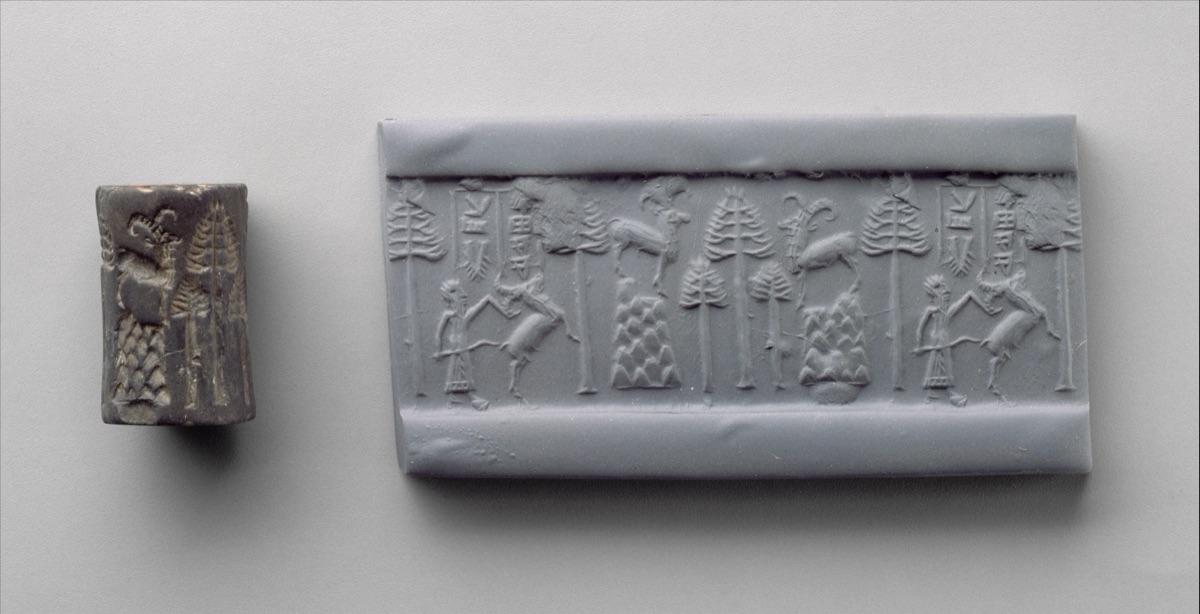
Cylinder Seal with a Hunting Scene
An Akkadian-period cylinder seal cut with a hunting scene, the naturalistic figural style that set Akkadian glyptic art apart from its Sumerian predecessors.
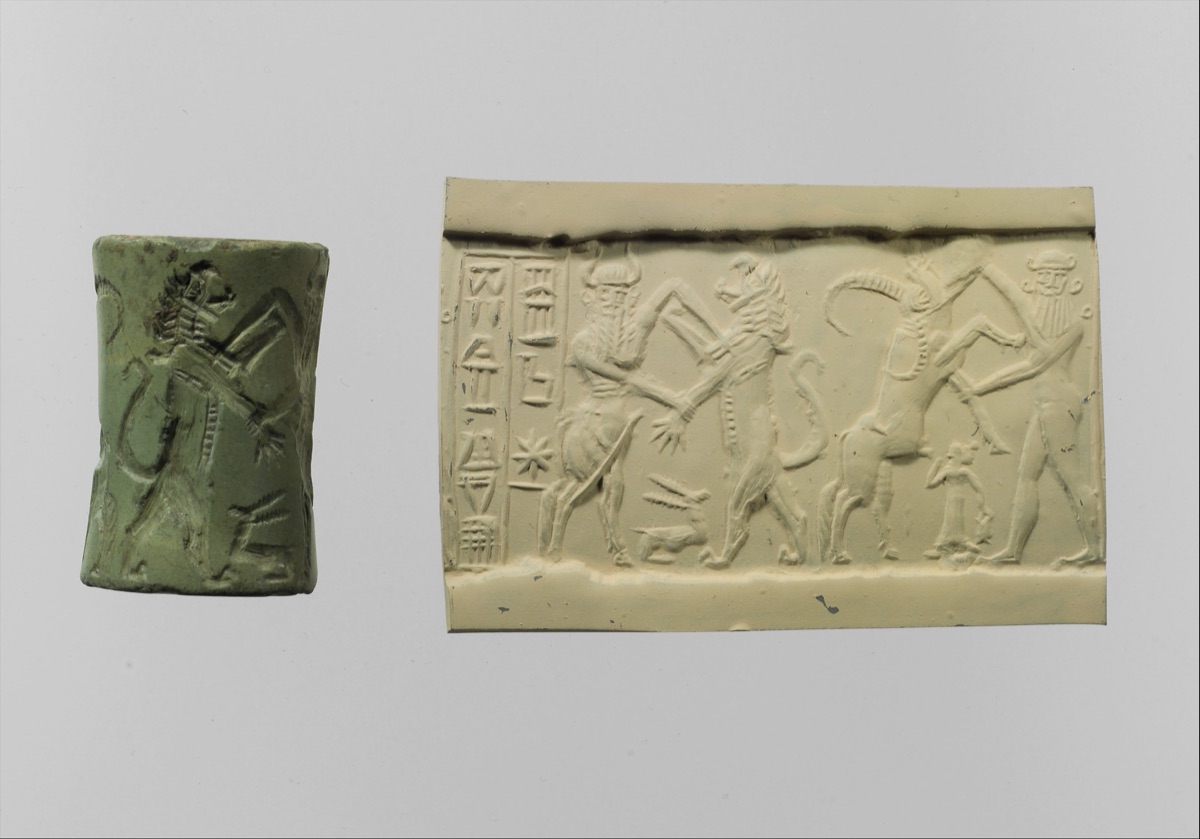
Inscribed Cylinder Seal
An Akkadian cylinder seal combining an inscription naming its owner with a contest scene of a bull-man battling a lion and a hero battling a water buffalo, the combat imagery that defined Akkadian seal-cutting.
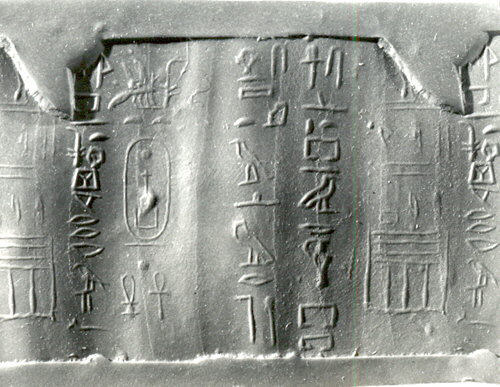
Cylinder Seal (Old Kingdom Egypt)
An Egyptian cylinder seal from the late Old Kingdom, a Mesopotamian administrative technology adopted and adapted along the Nile.
New this century
- The Exaltation of Inanna
Among the earliest works in world literature known to close with its author's own name, it turns personal exile and political crisis into praise of a goddess who holds order and violence in the same hand.
- The Temple Hymns
A single collection of hymns to forty-two temples across Sumer and Akkad, closing with a claimed author's own name, argues that a unified authorship can bind a whole kingdom's scattered holy places into a single literary map.
- Autobiography of Weni
A career is a text: personal advancement can be narrated as an unbroken sequence of royal favor, turning autobiography into a record of loyal service rather than private reflection.
- Royal Inscriptions of Naram-Sin
A king who crushed a coordinated rebellion of every major city he inherited argues that his victory proves more than political survival, it proves his own divinity, and he has himself written into official titulary as a god.
- The Bassetki Inscription
The citizens of Akkad, not the king himself, are recorded as the ones who petitioned to build Naram-Sin a temple, arguing that his claim to divinity was ratified from below as popular acclamation rather than imposed from above.