Time travel
34th century BC
At Uruk, institutional administrators press reed styluses into wet clay to track grain, beer, and livestock, using an emerging writing system that records commodities, labour, offices and allocations rather than sentences.
Mental Worlds: Evidence and Inference
A thinking person alive this century, if literate at all, is almost certainly an institutional administrator at Uruk, and what that person knows how to do is count, not compose. The tablets pressed out of wet clay this century record barley rations, beer allocations, and herds of sheep and goats, tallied against the names of offices rather than people; many come from the monumental temple precinct, though the exact institutional structure behind them remains debated among specialists. The tablets do not yet preserve continuous narrative or ordinary sentences. They combine quantities, commodities, offices, names, and administrative relationships in a notation whose linguistic content remains limited and difficult to reconstruct. Many tablets come from monumental precincts and clearly reflect institutional administration, though the exact organisations behind them and how far they formed a unified temple economy remain debated. The mind behind the stylus is keeping accounts rather than expressing an inner life, and if that mind has private thoughts, an opinion about a king, a fear of the flood season, a joke, none of it is written down, because writing does not yet do that. It exists to make an institution's holdings visible and auditable.
Almost at the same moment, on the higher of the two dates argued for the Abydos find, some nine hundred miles southwest, someone at Abydos in Egypt is doing something recognizably similar with bone and ivory. Small tags, incised with combinations of signs and pierced for attachment, are tied to jars of oil and bolts of linen buried with an early ruler. Whether this Egyptian practice grew from contact with Mesopotamia or sprang up on its own, historians still argue; what is not in dispute is that it, too, is inventory, not narrative. Mesopotamian and Egyptian recording systems emerge within roughly the same broad period, and whether the Egyptian development was entirely independent or partly stimulated by interregional contact remains debated. Both, independently or not, arrive at the same idea: that a mark on a durable surface can stand in for a spoken claim about ownership, and that this is worth doing when the claim is valuable enough to need remembering after the person who made it has left the room.
Everywhere else, the century is unwritten but not unpeopled. Farming villages of the early Indus valley, not yet cities, are already growing wheat and barley in the Punjab. Elam's lowland communities around Susa trade obsidian, copper, and textiles with Uruk's merchants without yet writing any of it down themselves. Across the rest of the inhabited world, in the Aegean, along the Nile beyond its delta, in the river valleys of China, societies farm, build, bury their dead with grave goods, and think whatever people think, but leave nothing legible to a later reader. This is not because they lack minds worth knowing. It is because writing, where it exists at all, has not yet been asked to carry anything but a number and a name.
What a person of this century could know, then, was almost entirely local and almost entirely oral: the boundaries of a family's fields, the genealogy of a lineage recited at a funeral, the songs sung at a temple festival, the practical craft of irrigation and pottery passed from a parent's hands to a child's. None of it traveled far, and almost none of it lasted. The single durable exception, grain counted at Uruk, oil counted at Abydos, is the century's real news: that a mark can outlive the moment it was made in. Nobody yet suspects what else that mark will eventually be made to do.
The political map
Major Polities and Cultural Regions
- Uruk Dominant temple-city of southern Mesopotamia and, very likely, one of the largest presently known settlements in the world this century.
- Susa (proto-Elamite sphere) Rival lowland center in southwestern Iran, in trade contact with Uruk but not yet producing legible texts of its own.
- Naqada Egypt Competing chiefdoms of Upper Egypt (Naqada, Hierakonpolis, Abydos) moving toward unification, still generations from a single king.
- Indus valley farming communities Early Harappan settlements such as Ravi-phase Harappa in the Punjab; farming villages, no cities and no script yet.
Borders are approximate scholarly reconstructions from historical-basemaps (GPL-3). Nearest available basemap anchor year: 3000 BC.
State of the domains
Texts and Written Culture
Among the earliest securely attested writing traditions currently known, all of this century's surviving writing is administrative. At Uruk's Eanna temple precinct, officials press reed styluses into wet clay to record grain deliveries, beer rations, and herds of livestock, combining numerical notation with pictographic signs for objects, professions, and place names. Ivory and bone tags carrying similar tallying marks appear around the same time, on the higher of two proposed dates, in a royal tomb at Abydos in Egypt, suggesting proto-writing emerges independently, or through contact, in two river valleys at once. Neither tradition names a person in a sentence or tells a story. Whatever songs or genealogies exist this century survive only in memory, unrecoverable to any later reader.
Art
Uruk's temple precinct is the century's largest building project anywhere, raised on packed-earth platforms that anticipate the ziggurat form Mesopotamian temples will keep for millennia. Cylinder seals, small carved stone cylinders rolled across wet clay to leave a repeating pictorial band, come into wide use, marking ownership of sealed goods with files of animals, ritual processions, and geometric motifs rather than writing. Figural sculpture is rare and small; most imagery is glyptic, cut into seals and stone vessels, or worked in low relief using cone mosaic in cream, red, and black pressed into mudbrick facades. In Egypt, painted pottery and carved ivory knife handles show the same shift toward organized, repeated pictorial scenes.
Medicine
No medical writing from this period has yet been identified. Healing practices must therefore be reconstructed indirectly, from human remains, tools, plant evidence and later traditions. The proto-cuneiform tablets record livestock and grain, never illness or the body. Skeletal remains from Uruk-period cemeteries show the ordinary wear of hard agricultural labor and occasional healed fractures, evidence that injuries were survived and presumably treated, but the treatment itself left no trace. Whatever healing knowledge existed, herbal remedies, midwifery, bone-setting, splinting, was oral craft, passed hand to hand and mouth to ear, and not judged worth the labor of impressing into clay meant for counting sheep. Healing practice in this period must therefore be reconstructed indirectly, from remains, tools, and later tradition, rather than from any surviving written source.
Science
No scientific text exists, and the century's real intellectual achievement is classification rather than explanation. Uruk's accountants already use two overlapping numerical systems, one sexagesimal for counting most goods, another metrological for grain and land, that will underlie Mesopotamian mathematics and astronomy for the next three thousand years. Lunar observation almost certainly already structures ritual timekeeping, since tracking the moon's cycle is close to universal among early farming societies, but no surviving record fixes how Uruk itself reckoned months this early. The same instinct toward counting and labeling appears in Egypt's earliest ivory tags, which record quantities of oil and linen delivered to a tomb.
Military
No text describes warfare this century, and the archaeological evidence for organized combat is thin next to what follows. Uruk's own defensive wall belongs to a later legendary tradition and is not yet built. What is attested is scale and density: Uruk itself is likely already one of the largest presently known settlements in the world, its growth built on craft specialization and a food surplus that will eventually be able to support armed retainers. Weapons recovered from this period are simple copper and stone tools doubling as arms, mace-heads and daggers, rather than the mass-produced bronze weaponry and siege architecture that mark the wars Sumerian city-states will fight two or three centuries later.
Technology
The potter's wheel is in use at Uruk, and beside it the mass-produced bevel-rim bowls, hand-pressed in crude moulds by the thousand rather than thrown, standardize the daily ration itself. Copper and arsenical-copper tools are common, though true tin bronze remains centuries away. Wheeled transport is not yet firmly attested in Mesopotamia; the earliest clear Mesopotamian evidence for carts belongs to the next two centuries, though roughly contemporary wheel evidence already exists further west in Europe. Irrigation canals off the Euphrates sustain Uruk's barley and date-palm agriculture, the surplus paying for temple building and one of the earliest sizable urban populations presently known. In Egypt, copper tools and faience glazing appear alongside the same ivory-carving skill visible in the Abydos tags.
Material world
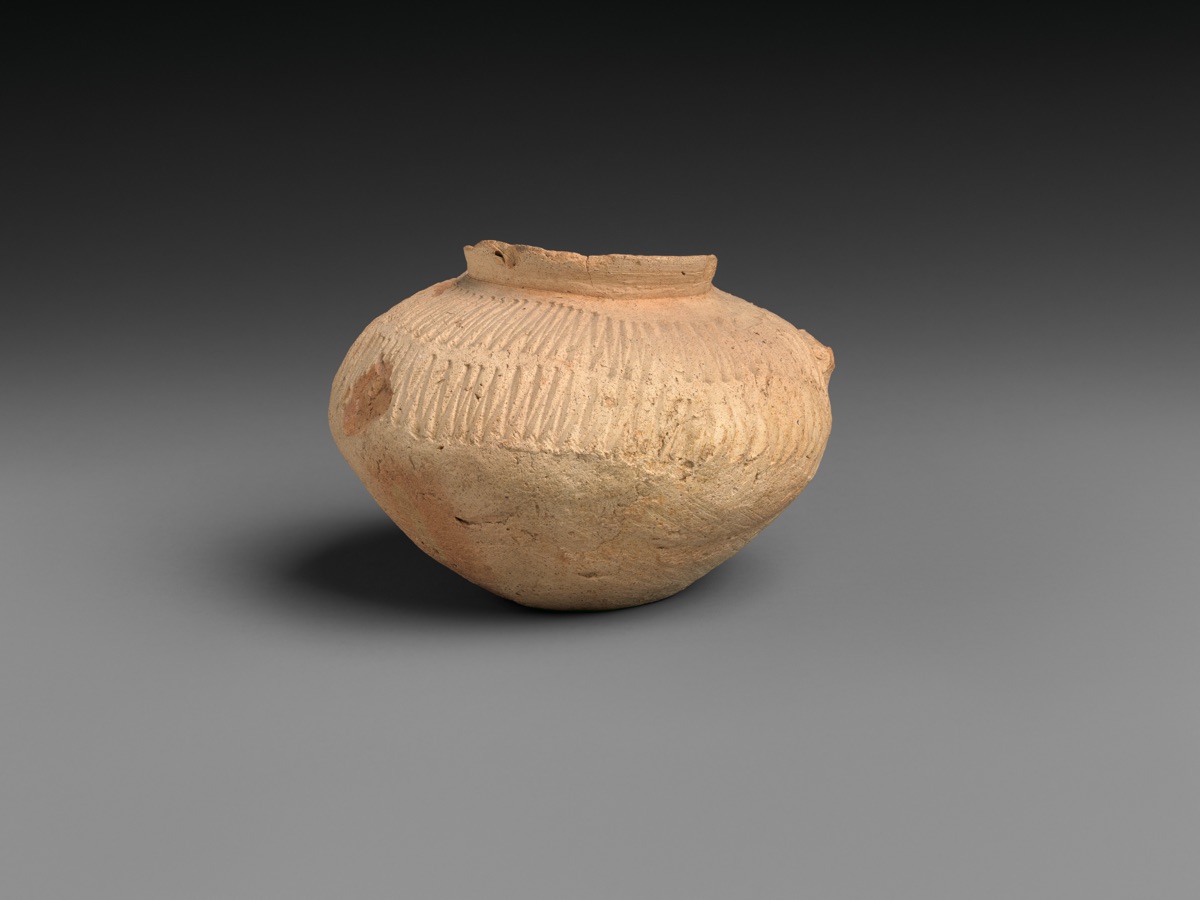
Jar with Impressed Decoration
A Middle Uruk ceramic jar with a band of impressed decoration, from the same southern Mesopotamian tradition that would soon produce writing.
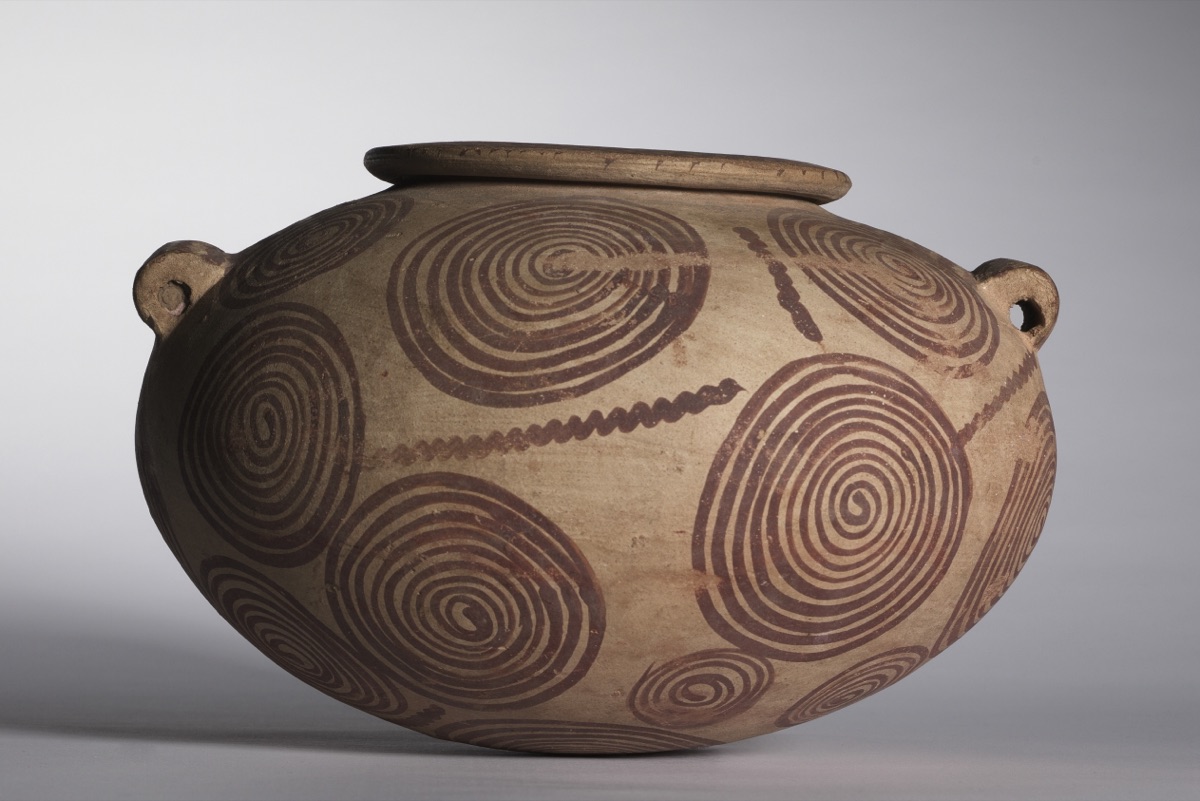
Squat Jar with Lug Handles
A hand-built marl-clay jar from Naqada II Egypt, painted with red spirals imitating the more costly vessels its owners could not afford in hard stone.
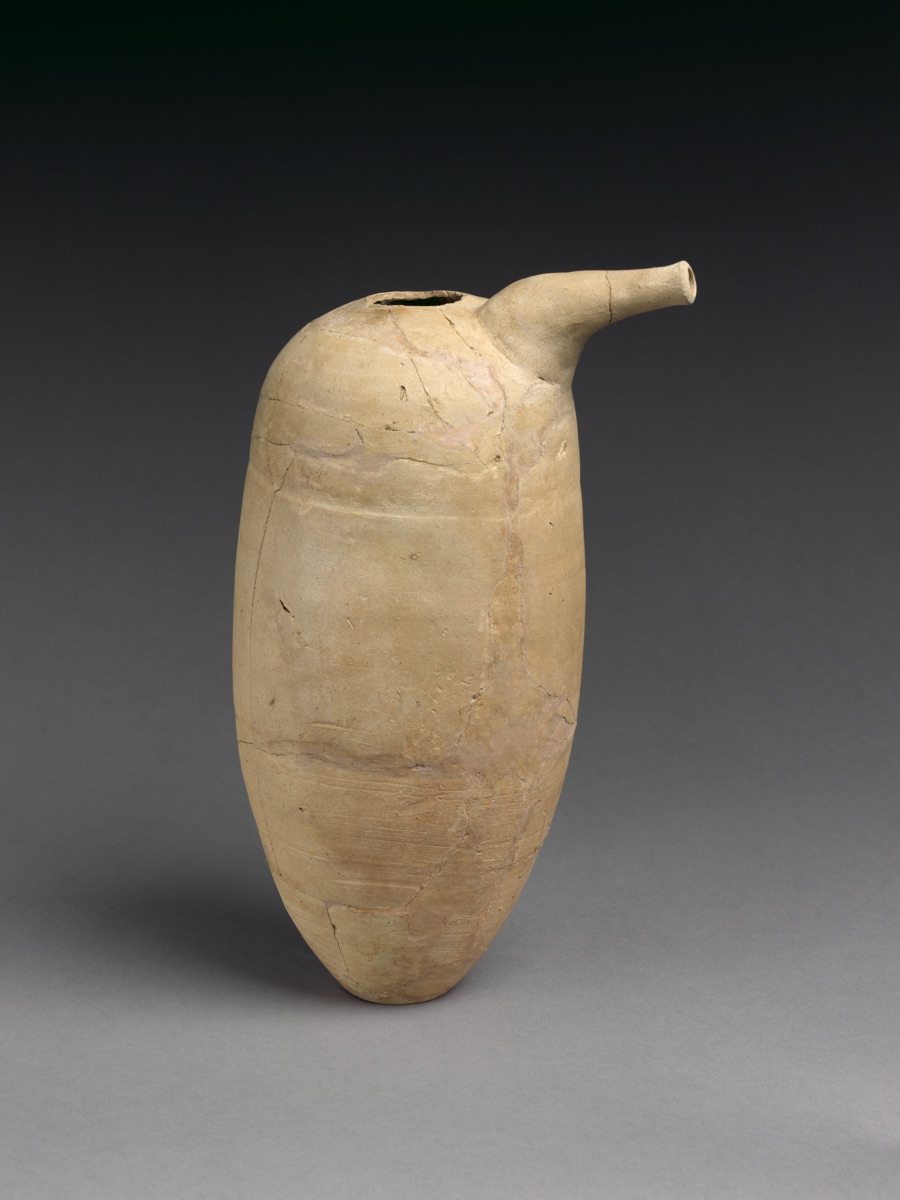
Spouted Jar
A wheel-finished spouted jar from Uruk-period Mesopotamia, evidence of the pouring vessels that supported the era's expanding temple and household economies.
New this century
The canon by now
No tier-one work in the corpus predates this century.