Time travel
26th century BC
At Abu Salabikh and Shuruppak, Sumerian scribes copy among the earliest surviving literary compositions known, proverbs and a temple hymn, while Egypt's Fourth Dynasty rushes from Sneferu's experiments in pyramid form to Khufu and Khafre's Great Pyramid and Sphinx at Giza, and Ur's elite are buried alongside subsidiary burials interpreted as sacrificed retainers of their own.
Mental Worlds: Evidence and Inference
A trainee scribe at Abu Salabikh this century copies out a text unlike anything a predecessor eight centuries earlier could have produced: not a tally of grain or a list of professions, but proverbs, a father's advice to his son on how to speak, farm, and treat a neighbor, framed as the counsel of a legendary sage named Shuruppak to his son Ziusudra. Alongside it, that same scribe likely also copies the Kesh Temple Hymn, eight sections that each close on the same refrain, praising the sanctity of the temple at Kesh through disciplined repetition rather than narrative variety, a hymn that will still be copied at scribal centers such as Nippur many centuries later. Neither text tells a story with a beginning, middle, and end, and neither names a living individual as its author; but both mark something genuinely new for Mesopotamian writing so far attested, a use of writing to preserve wisdom and praise meant to be recited and remembered, not only counted and stored. For what is, on current evidence, among the earliest times, a literate Mesopotamian's inner formation, the values instilled by moral instruction, the cadence of communal worship, has a written trace.
At Ur, meanwhile, a member of the city's elite dies and is buried with a splendor that borders on the theatrical: gold headdresses, a lyre inlaid with a bearded bull's head in gold and lapis lazuli, and rows of attendants whose subsidiary burials have been interpreted as accompanying their lord or lady into the grave, though the precise circumstances and extent of any killing remain debated, a practice recalling Egypt's own earlier retainer burials at Abydos, though the two traditions developed independently. A person attending such a funeral at Ur would have witnessed both extraordinary wealth and a display of mortality bound together as a single statement about status surviving death. The inlaid Standard of Ur found in one such tomb shows the same society's other face, war carts trampling enemies on one side, a triumphant banquet on the other, offering a rare visual, if unnamed and undated within the tomb itself, account of how Sumerian warfare and its celebration actually looked.
In Egypt, a mason working on Sneferu's pyramids this century experiences something closer to engineering drama than most people of this era ever would: partway through building what is now called the Bent Pyramid, its angle is visibly changed, evidence, still standing today, that the original steep design risked structural failure and had to be corrected in real time. No text explains this decision, but the building itself is an argument, proof that Egyptian builders were capable of recognizing and solving a serious engineering problem under construction rather than simply following a fixed, unquestioned plan. Within this same century, Sneferu's son Khufu applies that hard-won knowledge at a wholly different scale at Giza, and a laborer housed in the settlement at the pyramid's foot spends years of life moving and setting the roughly two million blocks that make it, for the rest of this record's span and long after, the largest building on earth; Khufu's son Khafre follows with his own pyramid and, by long tradition though not certain proof, the Great Sphinx carved in his likeness.
Across the Indus system, cities are now forming in a genuinely new way, dense, planned settlements at sites that will soon include Mohenjo-daro and Harappa, though no script yet accompanies this urbanization in any form modern scholars can point to this early. What connects a Sumerian scribe reciting proverbs, an Egyptian builder correcting a pyramid's angle, and an early Indus city-dweller laying out a planned street is not a shared body of knowledge but a shared moment: each, in a different register, is discovering that accumulated practice, whether verbal, architectural, or urban, can be refined, corrected, and passed forward with an intentionality that goes beyond mere survival.
The political map
Major Polities and Cultural Regions
- Egypt (Fourth Dynasty, Sneferu through Khafre) United Nile kingdom spanning Sneferu's perfected pyramid form to Khufu and Khafre's Great Pyramid and Sphinx at Giza.
- Ur and the Early Dynastic Mesopotamian city-states Ur's royal cemetery attests exceptional wealth; Uruk, Kish, Lagash, and Umma remain independently governed rivals.
- Susa and the Iranian lowlands Regional center in southwestern Iran, now well past its earlier proto-Elamite script tradition.
- Indus valley civilization (early urban phase) First cities forming along the Indus and its tributaries; still no deciphered script.
Borders are approximate scholarly reconstructions from historical-basemaps (GPL-3). Nearest available basemap anchor year: 3000 BC.
State of the domains
Texts and Written Culture
This century produces some of the earliest surviving literary texts presently known anywhere: the Instructions of Shuruppak, proverbs and moral counsel framed as a father's advice to his son, and the Kesh Temple Hymn, eight sections each closing on the same refrain in praise of the temple of the birth goddess Nintud at Kesh, both known from early tablets found at the separate site of Abu Salabikh. Neither is a story in the modern sense; both are formulaic, meant for memorization within scribal training, but both go beyond pure accounting to preserve wisdom and praise meant to be recited, not merely counted. It is the moment Mesopotamian writing first does something recognizably literary, alongside the administrative accounting it has done for eight centuries already.
Art
The Royal Cemetery of Ur, in use by this period, contains lavishly furnished tombs, including gold and lapis lazuli jewelry, the inlaid Standard of Ur depicting war and peace in shell and mosaic, and elaborate lyres, accompanied by rows of subsidiary burials interpreted as sacrificed retainers, evidence of court display comparable in scale to Egypt's own earlier retainer burials, though as at Abydos the precise circumstances of death remain debated. In Egypt, King Sneferu's Bent and Red Pyramids at Dahshur mark the transition from stepped to true smooth-sided pyramid form, and within the same century his son Khufu completes the Great Pyramid at Giza, roughly 146 meters tall, followed by Khafre's slightly smaller pyramid and the Great Sphinx, traditionally identified with Khafre's own face on a lion's body.
Medicine
Medicine this century remains what it has been for eight centuries already: unwritten. The Royal Cemetery of Ur's subsidiary burials, interpreted as sacrificed retainers, along with skeletal evidence from ordinary burials in both Egypt and Mesopotamia, continue to show healed injuries and the physical costs of hard labor, but no written source in either region explains treatment, diagnosis, or cause. Egyptian medical writing remains roughly eight centuries away, and the first Mesopotamian prescriptions a few centuries nearer still; whatever practical healing skill existed at Ur's court or Sneferu's building sites was oral craft, unrecorded and now unrecoverable in detail.
Science
The Bent Pyramid's mid-construction change of angle is Sneferu's clearest piece of applied engineering evidence, a correction to probable structural risk visible in the finished monument itself; his son Khufu's later Great Pyramid at Giza goes further still, its sides oriented close to true cardinal directions with a precision implying careful astronomical observation, though no contemporary text explains the method behind either achievement. In Mesopotamia, the Instructions of Shuruppak and Kesh Temple Hymn, while literary rather than scientific, both depend on and demonstrate an increasingly confident scribal command of language and memorized structure, evidence of a maturing intellectual technology even without natural-philosophical content.
Military
The Standard of Ur, a wooden box inlaid with shell, lapis lazuli, and red limestone found in the Royal Cemetery, depicts on one face a Sumerian army of infantry and battle wagons defeating and trampling enemies, and on the other a celebratory banquet, offering the clearest surviving visual account of Early Dynastic Sumerian warfare and its aftermath. It shows four-wheeled war carts drawn by donkeys, spearmen in cloaks, and bound captives, though it identifies no specific battle or enemy by name. In Egypt, Sneferu's reign includes recorded campaigns against Nubia and Libya in later Egyptian tradition, but under his successors Khufu and Khafre, Old Kingdom military activity is comparatively undocumented, resources visibly concentrated on pyramid construction instead.
Technology
Sneferu's engineers solve the structural problems of true pyramid construction within his own reign at Dahshur, correcting the Bent Pyramid's angle and completing the fully smooth-sided Red Pyramid; his son Khufu then applies that solved technology at far greater scale at Giza, moving, dressing, and setting an estimated 2.3 million stone blocks through a logistics system of quarrying, sledge transport, and organized worker housing unmatched anywhere in the world this century. In Mesopotamia, bronze tools and weapons continue spreading, and the technology on display in the Royal Cemetery of Ur, gold granulation, lapis lazuli inlay, sophisticated lyre construction, shows craft specialization at a genuinely high level, supported by long-distance trade reaching as far as Afghanistan for lapis lazuli.
Material world
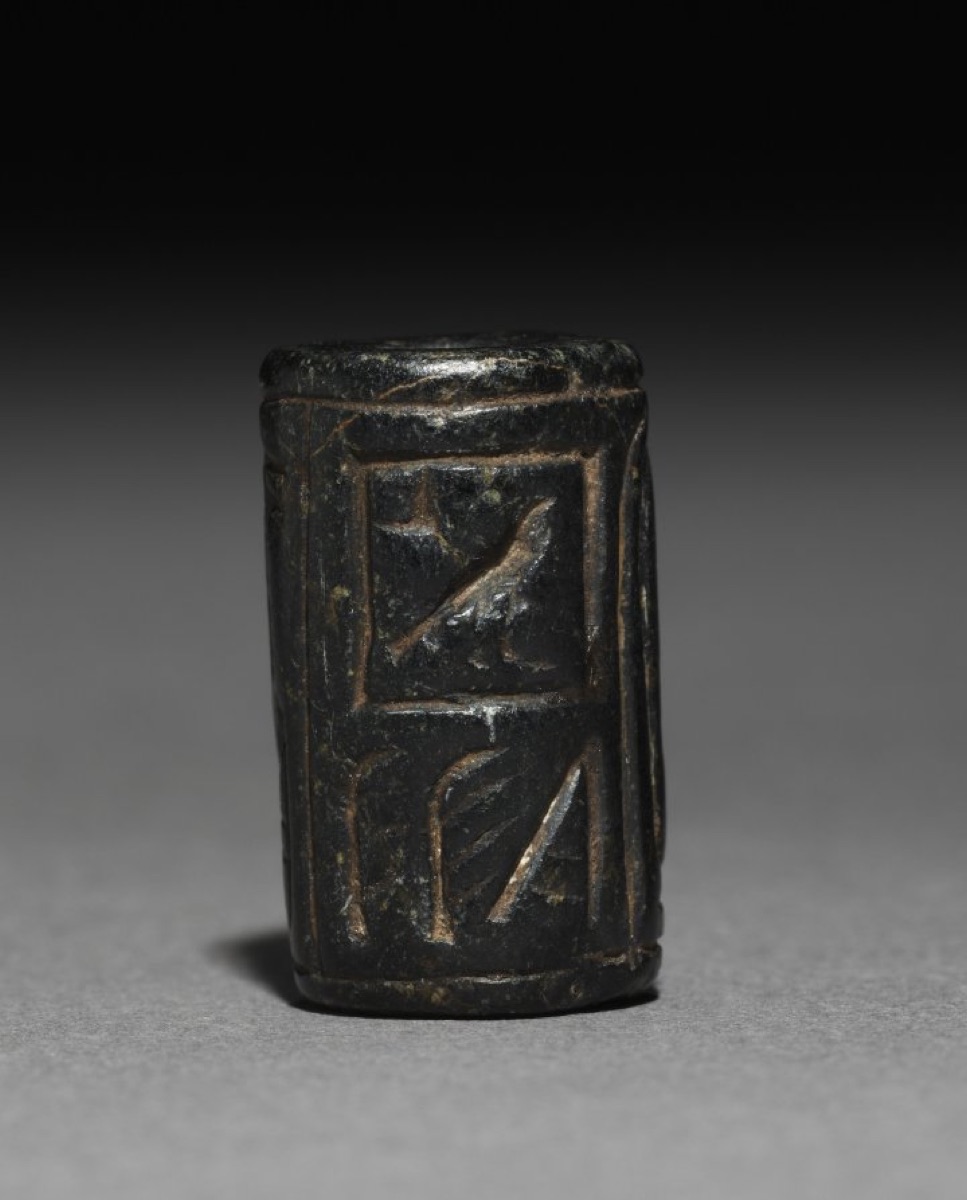
Cylinder Seal of Mycerinus (Menkaure)
A cylinder seal inscribed with the throne name of Menkaure, builder of the third and smallest Giza pyramid, used to authenticate royal goods and documents.
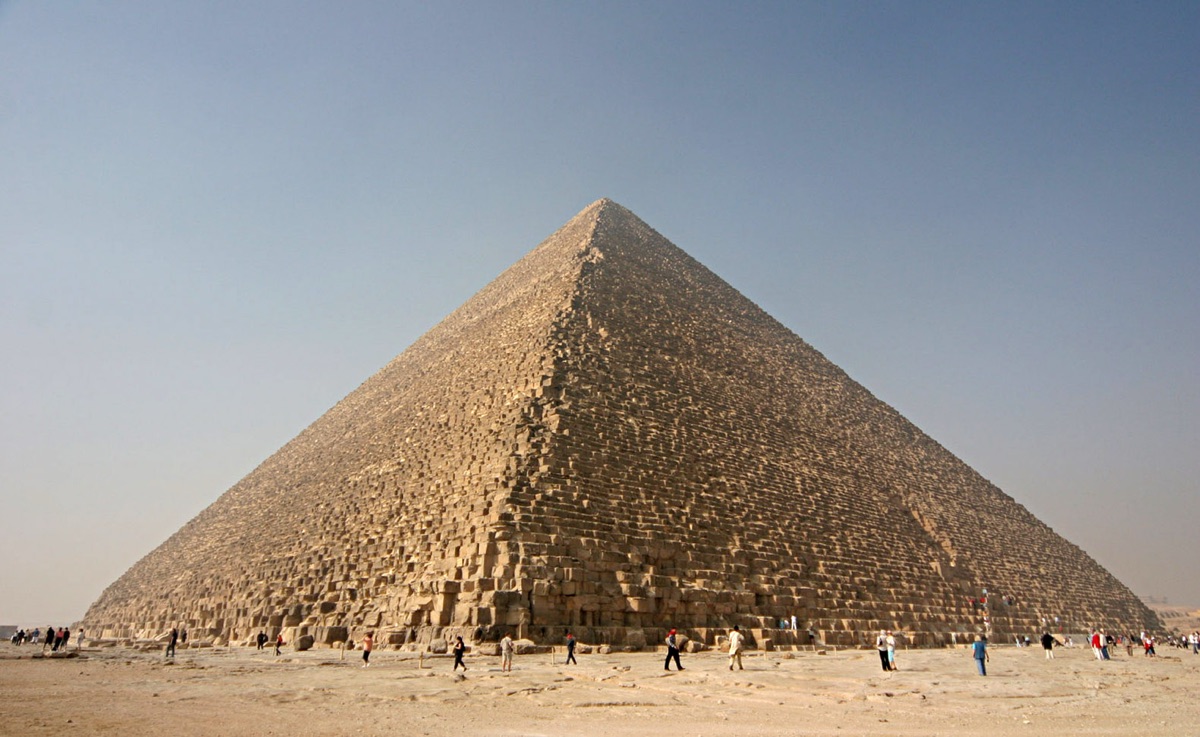
Great Pyramid of Khufu
The tomb of Khufu at Giza, the tallest structure on Earth for roughly 3,800 years and still the most precisely engineered of the pyramids.
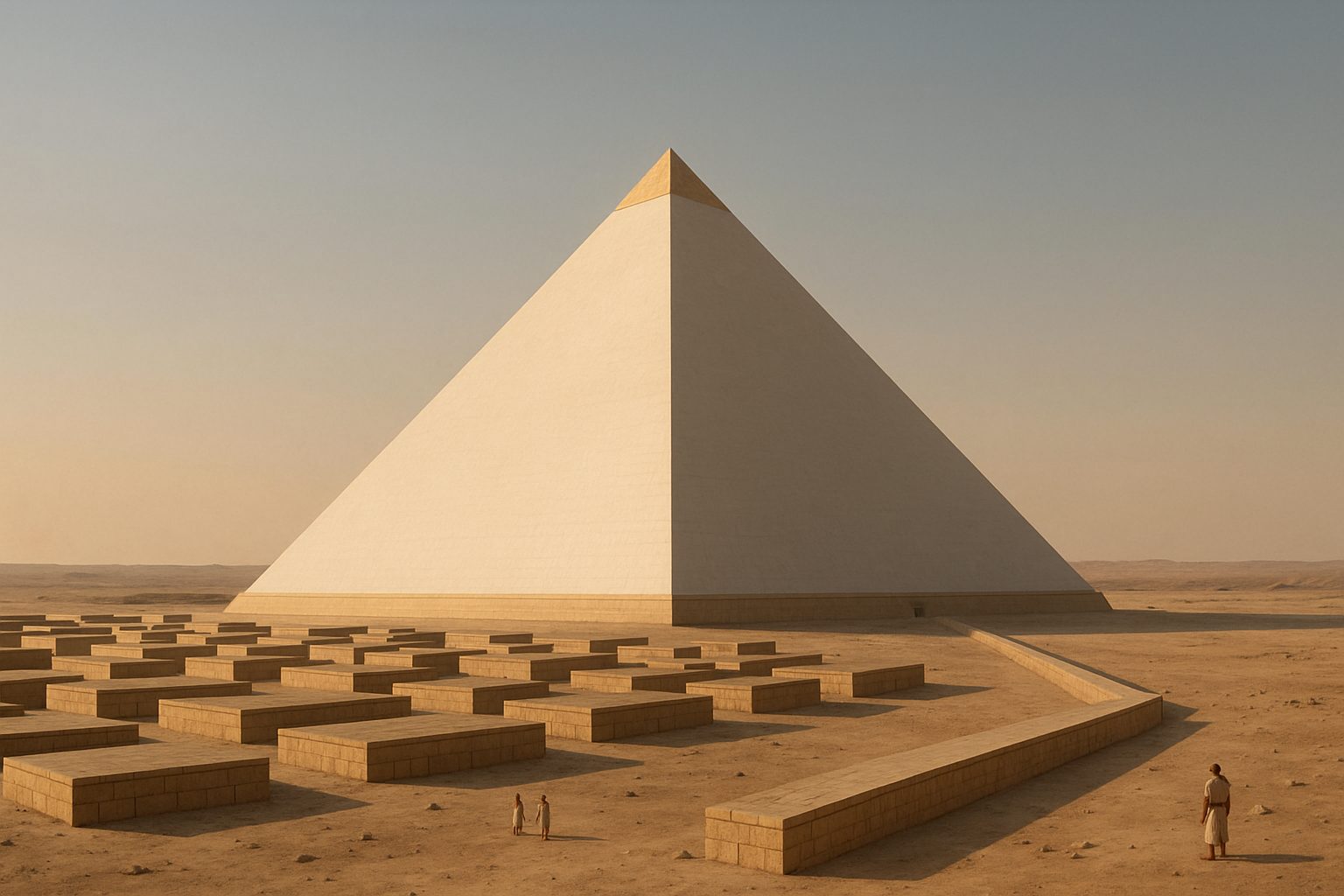
AI reconstruction
Great Pyramid of Khufu - reconstruction
Khufu's pyramid at Giza as completed: the whole monument cased in polished white Tura limestone, faces smooth and unbroken, a gilded capstone at the tip, with rows of flat-roofed mastaba tombs and the covered causeway at its feet and no other great pyramid yet on the plateau. The white casing survives only in traces today; the gilding of the capstone is plausible but not proven.
AI reconstruction (2026), based on Great Pyramid of Khufu, photo Nina Aldin Thune via Wikimedia Commons
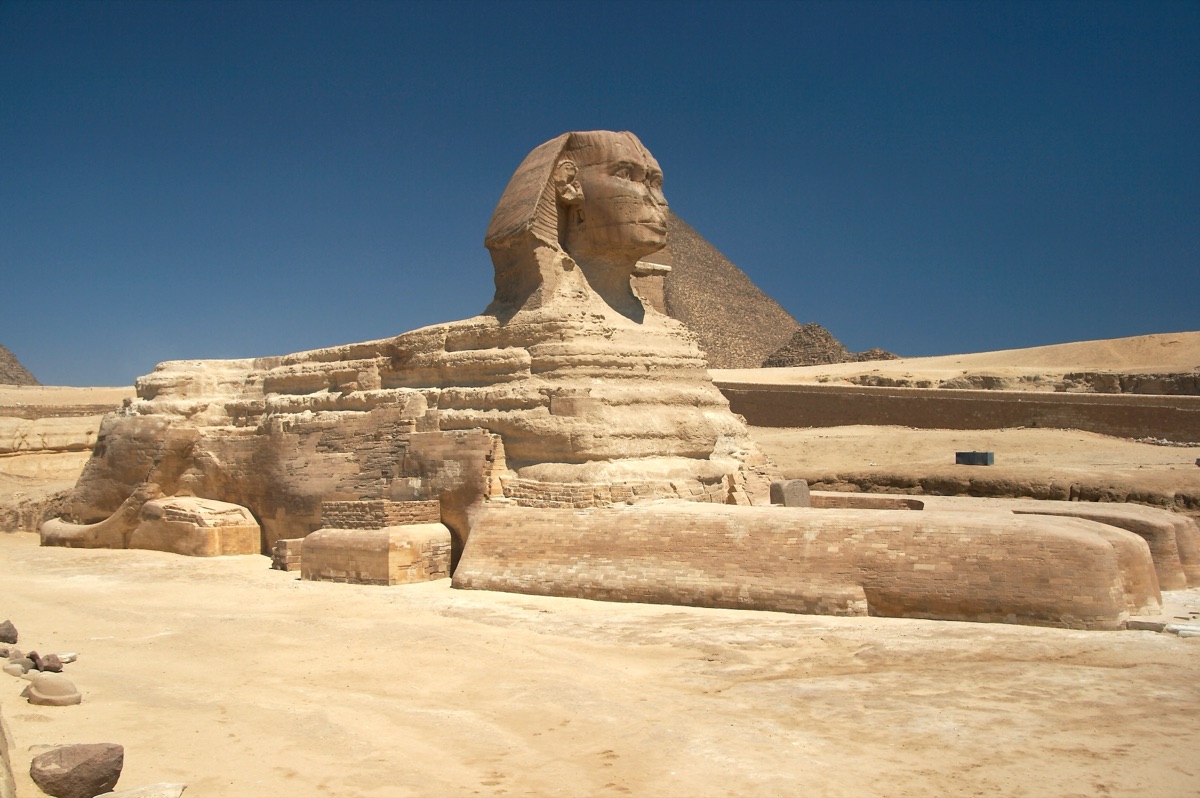
Great Sphinx of Giza
A single limestone outcrop carved into a recumbent lion with a royal human head, conventionally dated to Khafre's reign and standing guard over his pyramid causeway.
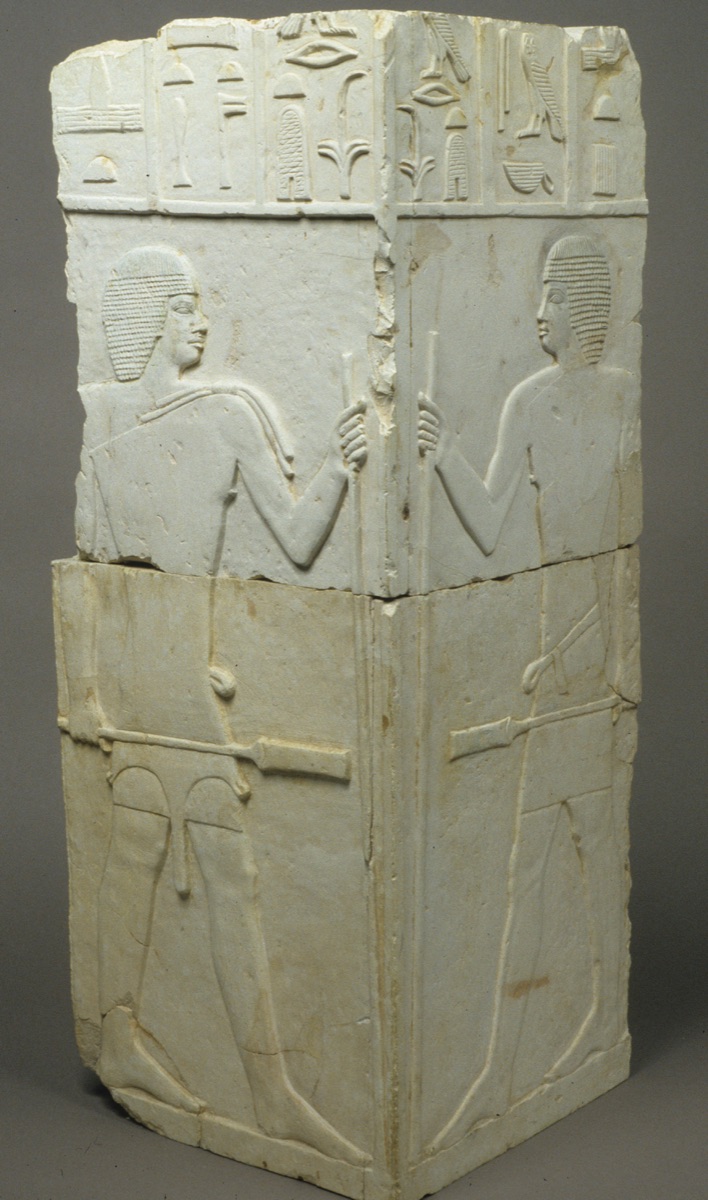
Corner of a Niche from the Tomb of Akhtihotep
Painted limestone from a Saqqara tomb niche, decoration of the kind that lined the private mastabas built in the shadow of the Giza pyramids.
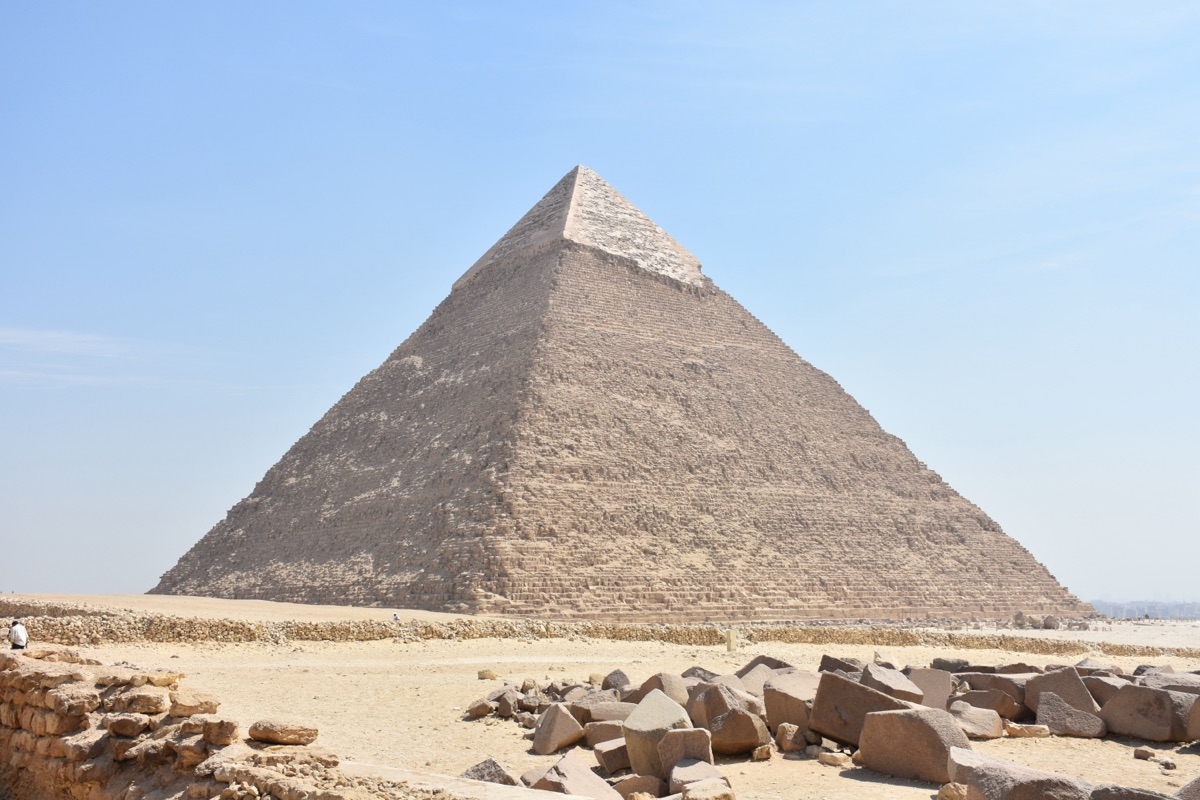
Pyramid of Khafre
Khafre's pyramid at Giza, slightly smaller than his father Khufu's but built on higher ground so it appears taller, still crowned with its original limestone casing near the top.
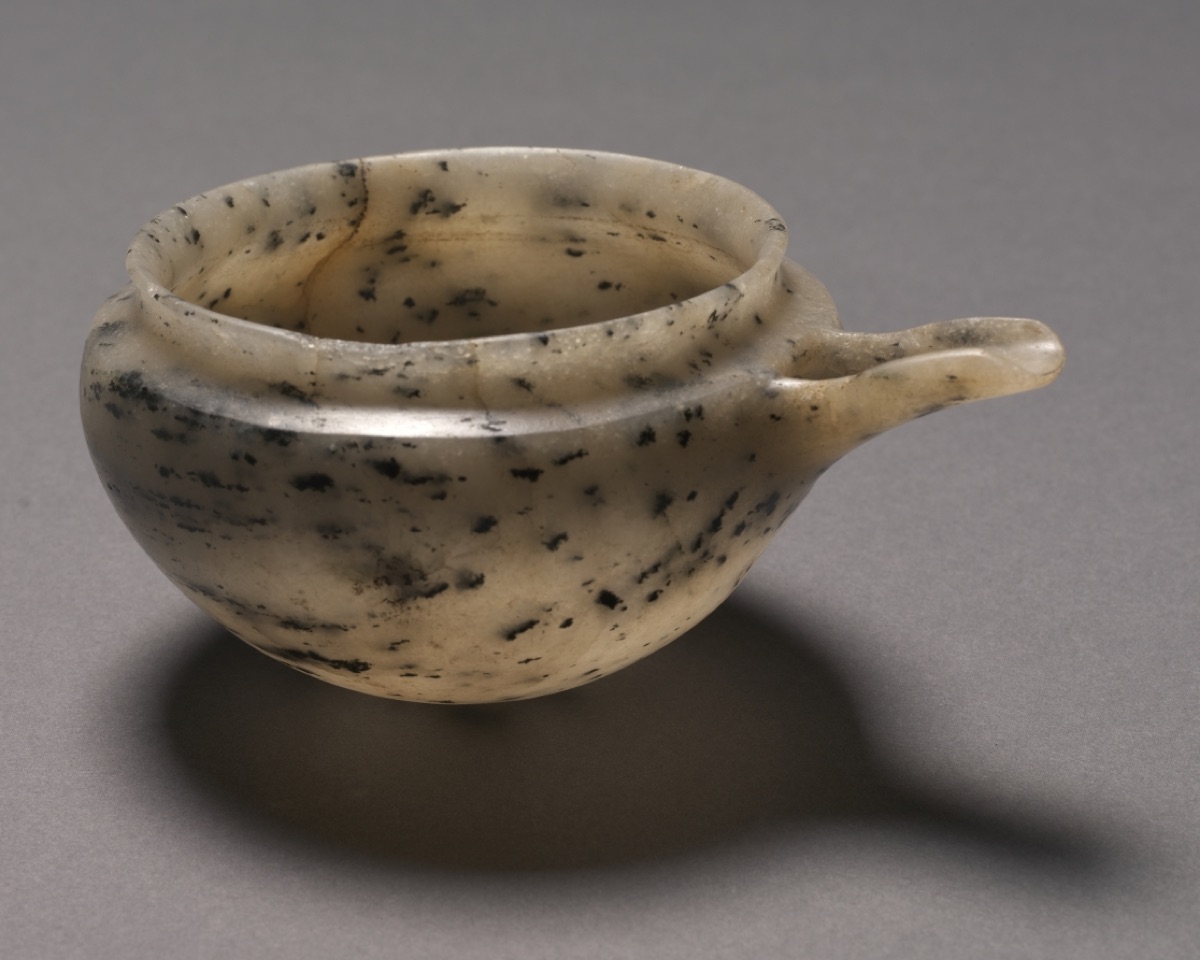
Spouted Bowl
A spouted bowl carved from mottled anorthosite gneiss, Fourth Dynasty stoneworking skill applied to an everyday household form.
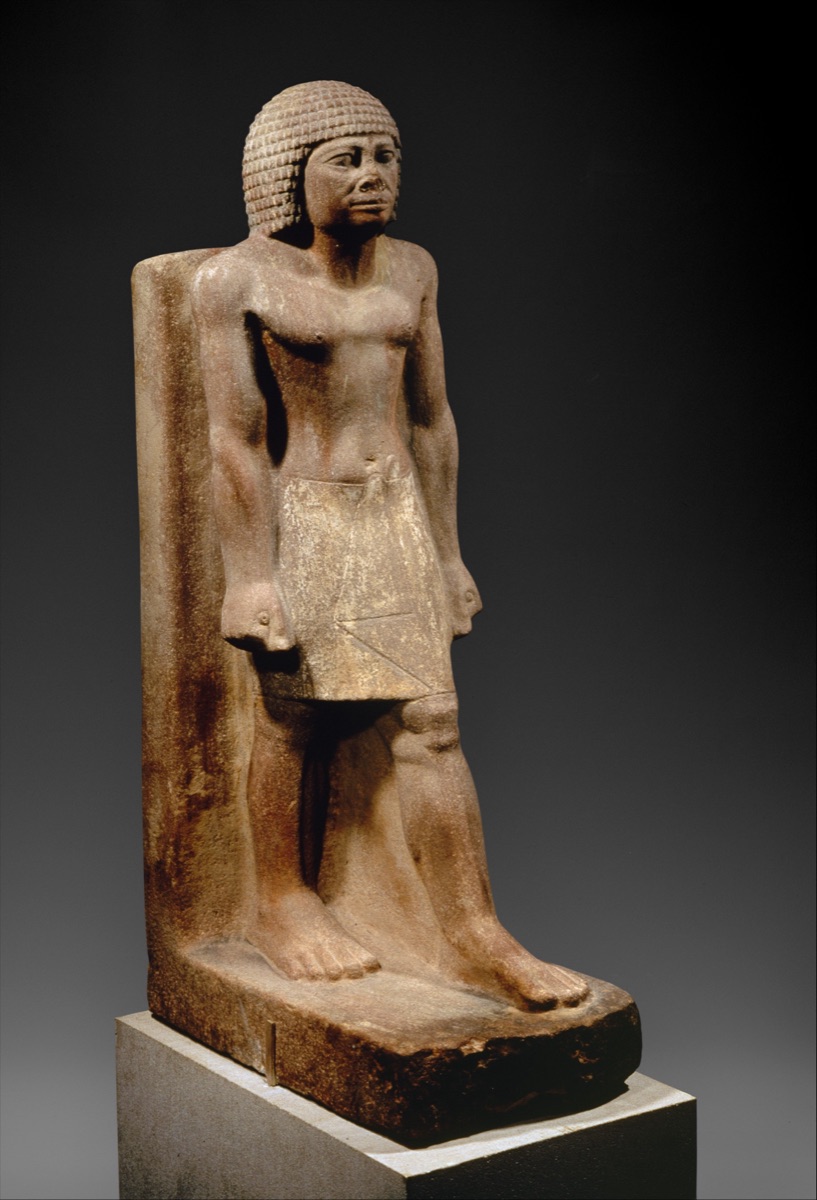
Striding Figure
A quartzite striding figure in the formal Old Kingdom sculptural pose, hard stone carved with the same precision tools used on the Giza monuments.
New this century
- Instructions of Shuruppak
Practical wisdom passed from father to son, on farming, speech, and neighbors, survives as one of the earliest known works of wisdom or instructional literature.
- The Kesh Temple Hymn
A temple's holiness is proven by praising it in eight nearly identical stanzas that repeat with only the smallest variation, arguing that sacred order shows itself through disciplined repetition.
- Indus Seals and Script
A standardized sign system appears on seals, tablets, and pottery across the urban Indus world, and while scholars can describe its patterns of use in detail, no accepted decipherment establishes what language, if any single language, it records.
The canon by now
No tier-one work in the corpus predates this century.