Time travel
12th century BC
The Bronze Age palace world burns: Hittite kings, Mycenaean wanaktes, and the city of Ugarit go dark within two generations, while Egypt survives as a shrunken kingdom and Assyria and Babylon absorb the shock.
Mental Worlds: Evidence and Inference
A person literate in this century inherits a world of interconnected courts: Egyptian pharaohs correspond with Hittite kings as equals, Ugarit's harbor moves grain and tin between Cyprus, the Levant, and the Aegean, and Mycenaean wanaktes employ scribes trained in a syllabic script borrowed for palace bookkeeping. Within two or three generations, most of that world stops existing. The precise cause is still argued: drought, systems collapse in overextended palace economies, the raiders and migrants later Egyptian texts call the Sea Peoples, earthquake, internal revolt, some combination of all of it. What is not argued is the result. The Hittite capital at Hattusa is abandoned. Ugarit, whose royal archive was still receiving letters describing enemy ships on the horizon when its tablets were baked hard in the fire that destroyed the city, goes silent. The Mycenaean palaces burn one after another, and with them goes Linear B, the only script the Aegean world possesses; Greek will not be written again for roughly four hundred years.
Egypt survives, but visibly diminished. Ramesses III turns back an invasion by land and by river battle, an episode his mortuary temple at Medinet Habu commemorates in unusually literal detail, as though the state needed to insist on the win. The empire in Canaan and Nubia that earlier New Kingdom pharaohs had projected largely dissolves within the following decades; Egypt turns inward. Assyria enters this century already paying for the previous one's overreach: Tukulti-Ninurta I's conquest of Babylon by force, commemorated in an epic poem composed in his own court's honor, had ended in his assassination around 1207 BC, and Assyrian power now contracts rather than builds on what he took. Babylon's Kassite dynasty, which had ruled with unusual stability for over three centuries, is finally toppled by Elam around 1155 BC, roughly this century's midpoint rather than its end. Nowhere is there a clean break; everywhere there is contraction.
For the scribes who remain employed, in the temple and palace corners that do survive, the work continues with striking continuity. Babylonian editors at this time are fixing the standard version of the Epic of Gilgamesh, the version that later Assyrian libraries will copy for another six hundred years, and canonizing centuries of celestial omen watching into what becomes Enuma Anu Enlil. Egyptian scribal schools keep copying wisdom instruction and love poetry as if the state around them were not shrinking. In India, reciters continue compiling the hymn collections that will become the Atharvaveda, Samaveda, and Yajurveda, entirely by ear, no writing system yet involved. In China, Shang diviners at Anyang keep cracking bones and inscribing the answers, a state cult of divination untouched by anything happening two thousand miles west. The collapse is a Mediterranean and Near Eastern event; it does not touch the Yellow River valley or the Ganges plain at all.
What a literate person could know in this century, then, depends entirely on where they sat. In Hattusa or Ugarit in the century's final years, they could know that letters were no longer coming and preparations were failing. In Babylon or Egypt, diminished but intact, they could know a slower, managed decline, cushioned by scribal institutions old enough to outlast a single dynasty's troubles. In the Aegean, within a generation, no one could know how to read at all.
The political map
Major Polities and Cultural Regions
- Egypt New Kingdom under Ramesses III and his successors, repelling the Sea Peoples but losing its Levantine and Nubian reach
- Hittite Empire Central Anatolia and north Syria, collapsing by the century's final decades under invasion and famine
- Assyria Middle Assyrian kingdom on the upper Tigris, still absorbing Tukulti-Ninurta I's earlier conquest of Babylon and his assassination, and contracting through this century
- Babylonia Kassite dynasty in southern Mesopotamia, sacked by Elam around 1155 BC, near this century's midpoint
- Mycenaean Greece Aegean palace centers at Mycenae, Pylos, and Tiryns, burned and abandoned; the world that follows is not literate
Borders are approximate scholarly reconstructions from historical-basemaps (GPL-3). Nearest available basemap anchor year: 1000 BC.
State of the domains
Texts and Written Culture
Babylonian scribes fix the Epic of Gilgamesh into the standard version later copies preserve, and compile the omen astronomy of Enuma Anu Enlil from centuries of sky watching. In Egypt, the Instruction of Amenemope and folktales like the Tale of Two Brothers keep a scribal tradition alive as the state contracts, and Papyrus Harris I itemizes, in the dead Ramesses III's voice, what a shrinking state pours into its temples. In Assyria, Tiglath-Pileser I's annals open with boasts of Mediterranean campaigns, a revival that will not survive him. Vedic reciters in India compile the Atharvaveda, Samaveda, and Yajurveda; the Gathas attributed to Zoroaster may belong here too. At Ugarit, the world's oldest alphabetic library is destroyed mid-century and not rebuilt.
Art
At Medinet Habu, Ramesses III's mortuary temple carves the Sea Peoples' defeat in a battle relief as detailed as any Egyptian art had produced, a boast made as the New Kingdom's reach was already narrowing. Mycenaean palace fresco and fine pottery workshops go silent as the palaces themselves burn. In China, Late Shang bronze casters at Anyang continue producing ritual vessels of a technical sophistication unmatched elsewhere, cast in sectioned piece molds for ancestor sacrifice. Babylonian and Assyrian glyptic art, small cylinder seals cut with mythological scenes, persists through the disruption with little apparent break in workshop tradition.
Medicine
Egyptian medicine continues along established lines: the Berlin medical papyrus, compiled in this range, mixes empirical wound treatment and pharmacology with incantation against disease conceived as hostile spirit action, a blend unchanged for centuries. No comparable medical compilation survives from Mesopotamia, the Aegean, India, or China for this exact window, though Babylonian diagnostic and healing practice is well attested both earlier and later and almost certainly continues through the disruption; the gap is in the surviving record, not necessarily the practice. Nothing suggests any break with the divinatory model of illness that dominates the Near East.
Science
Babylonian scholars continue compiling Enuma Anu Enlil, a canon of celestial omens built from generations of watching Venus, the moon, and planets for what their movements portend for the king, laying observational groundwork later astronomy will inherit. Egyptian scribes keep star clock and calendar traditions running despite the state's contraction. In China, Shang diviners inscribe oracle bones with cracks read for answers on harvest, war, and weather, an empirical seeming practice embedded entirely in divination. Nothing yet resembling a search for impersonal causes exists anywhere; the sky and the world are read for the intentions of gods and ancestors.
Military
Chariot-based palace armies that dominated the previous two centuries prove unable to stop the mixed invaders and raiders modern scholars call the Sea Peoples; the Hittite army and state collapse entirely and Ugarit's garrison cannot save the city. Ramesses III repels a Sea Peoples invasion of Egypt by land and river battle around mid-century, commemorated at Medinet Habu, but the victory slows Egypt's retreat from the Levant. Assyria absorbs Tukulti-Ninurta I's conquest of Babylon a generation earlier and the palace assassination that ended his reign around 1207 BC; Assyrian power contracts through this century rather than building on it. Iron weapons remain rare next to bronze; the collapse is political and logistical, not new weapons defeating old ones.
Technology
Iron working exists but remains a minor, expensive craft next to bronze throughout this century; the shift to iron as the dominant metal is a consequence of the collapse, not its cause, as tin and copper trade networks break down under the disruption. Egyptian and Mesopotamian irrigation, granary, and canal systems, built over centuries, keep surviving states fed even as long distance trade contracts sharply. Alphabetic cuneiform at Ugarit represents the technological peak of Near Eastern writing, a script of thirty signs able to record any word in the local Semitic language, extinguished with the city before its full potential is felt elsewhere.
Material world
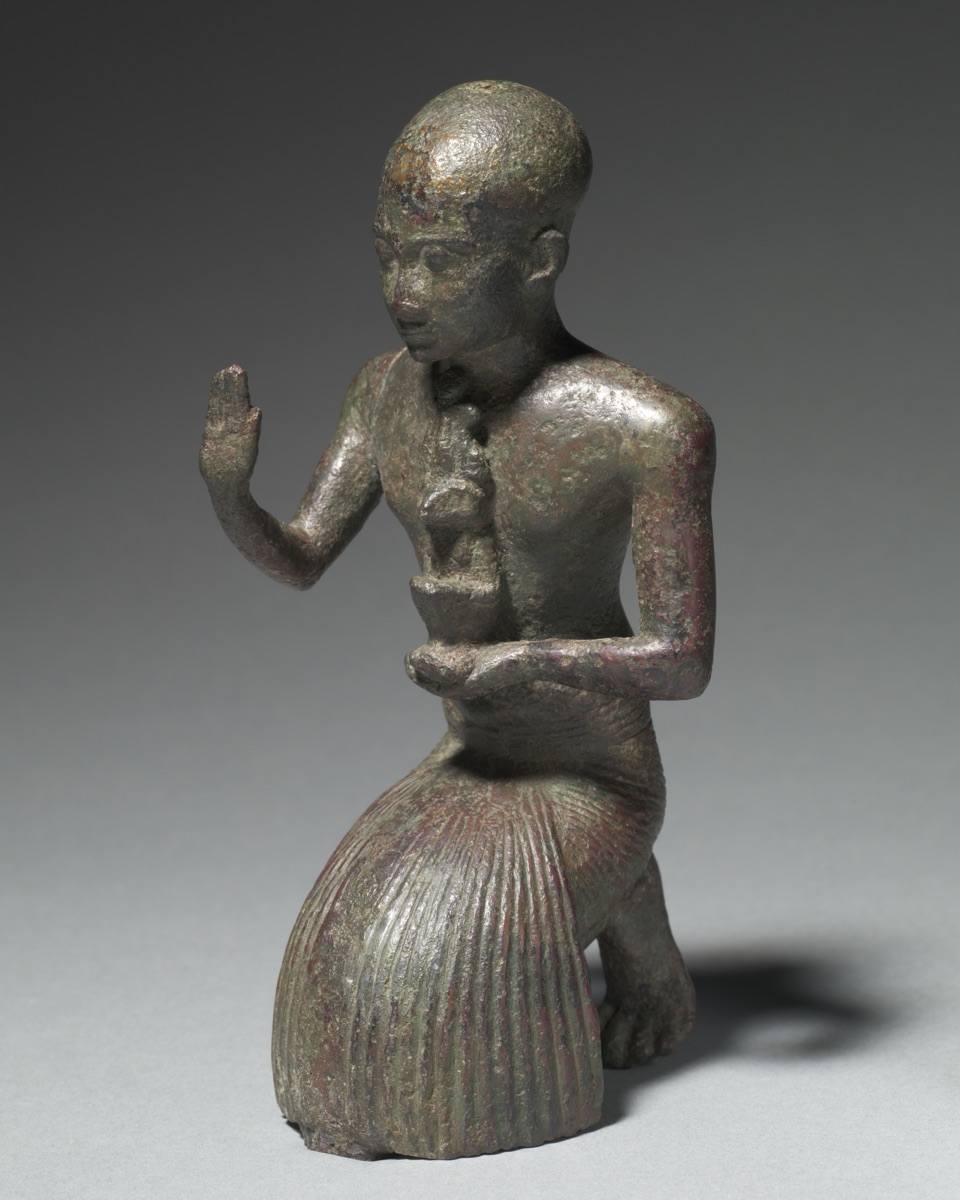
Statuette of a Kneeling Priest
A bronze statuette, likely for temple use, from the reign of the Ramesside kings, made as Egypt absorbed the shocks of the Sea Peoples' invasions.
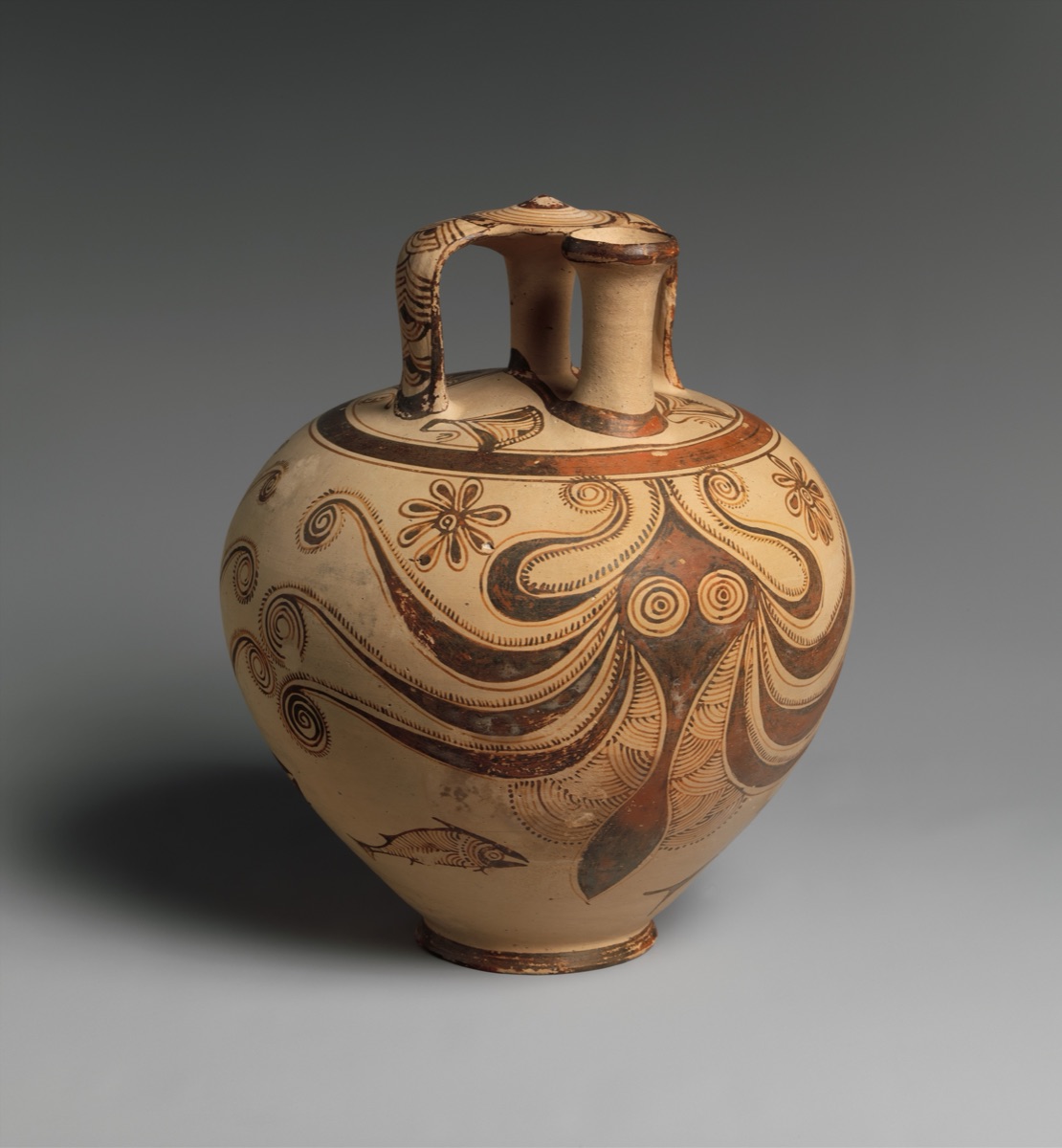
Stirrup Jar with Octopus
A terracotta stirrup jar painted with an octopus, made as Mycenaean palace culture collapsed and its potters kept working regardless.
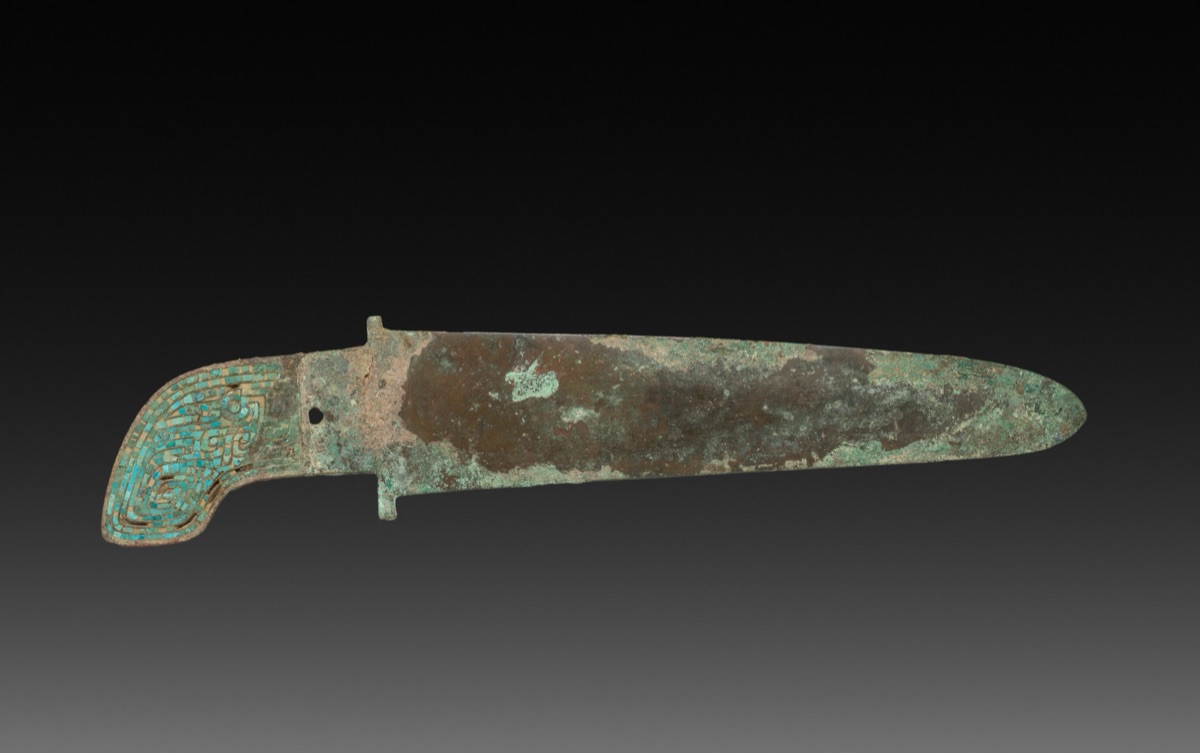
Ge (Dagger-Axe)
A bronze ge blade with turquoise-inlaid haft, the hafted dagger-axe that armed Shang chariot warriors and Bronze Age China's infantry alike.
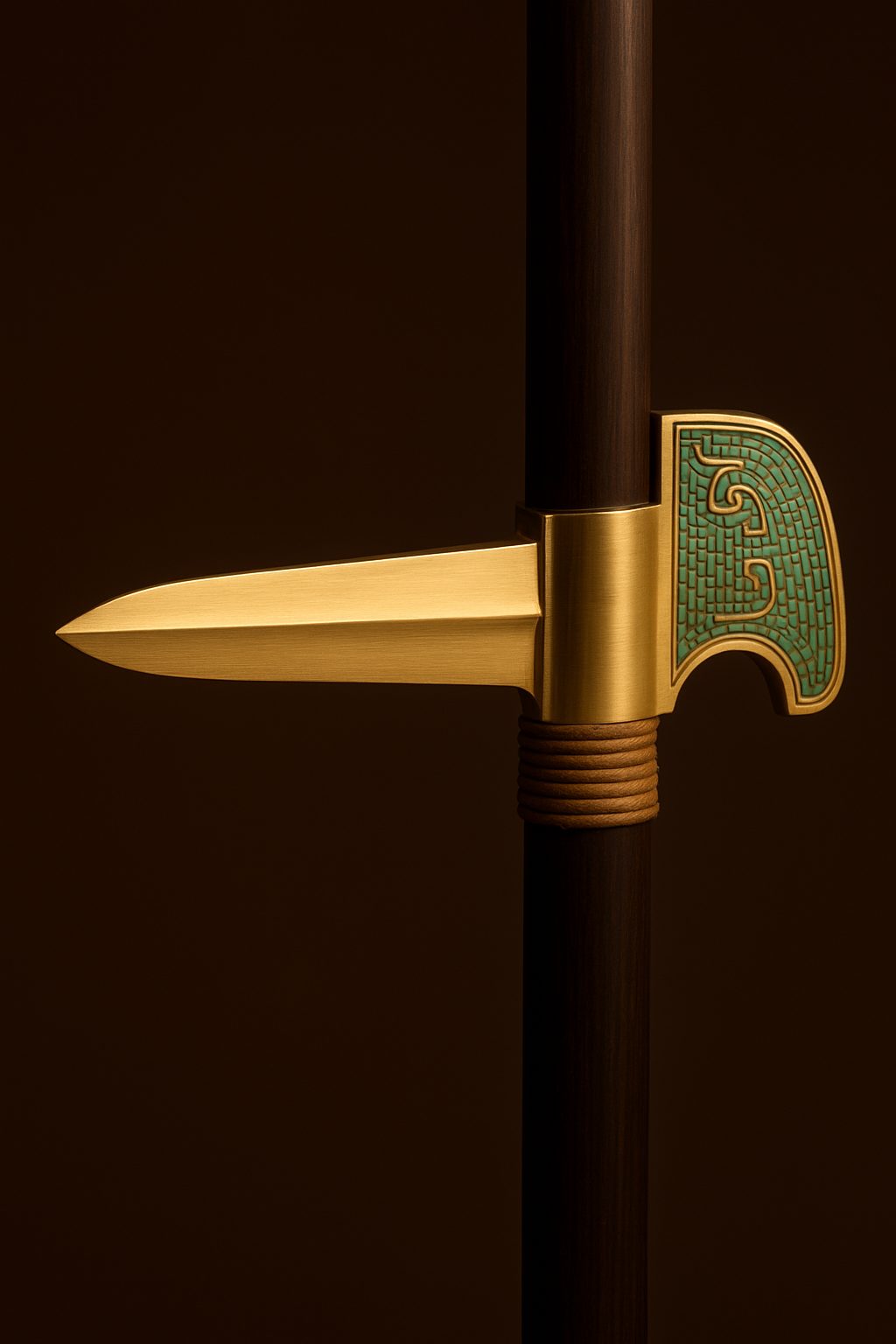
AI reconstruction
Shang bronze ge dagger-axe - reconstruction
A Shang dynasty ge dagger-axe restored and hafted for use: the blade of freshly polished tin-bronze fixed sideways at a right angle near the top of a tall lacquered wooden shaft, bound with cord, its butt plate inlaid with a mosaic of small turquoise tesserae. The blade and inlaid butt survive in the museum; the shaft and lashing follow the standard reconstruction of how Shang chariot fighters carried the weapon.
AI reconstruction (2026), based on Ge (Dagger-Axe), The Cleveland Museum of Art
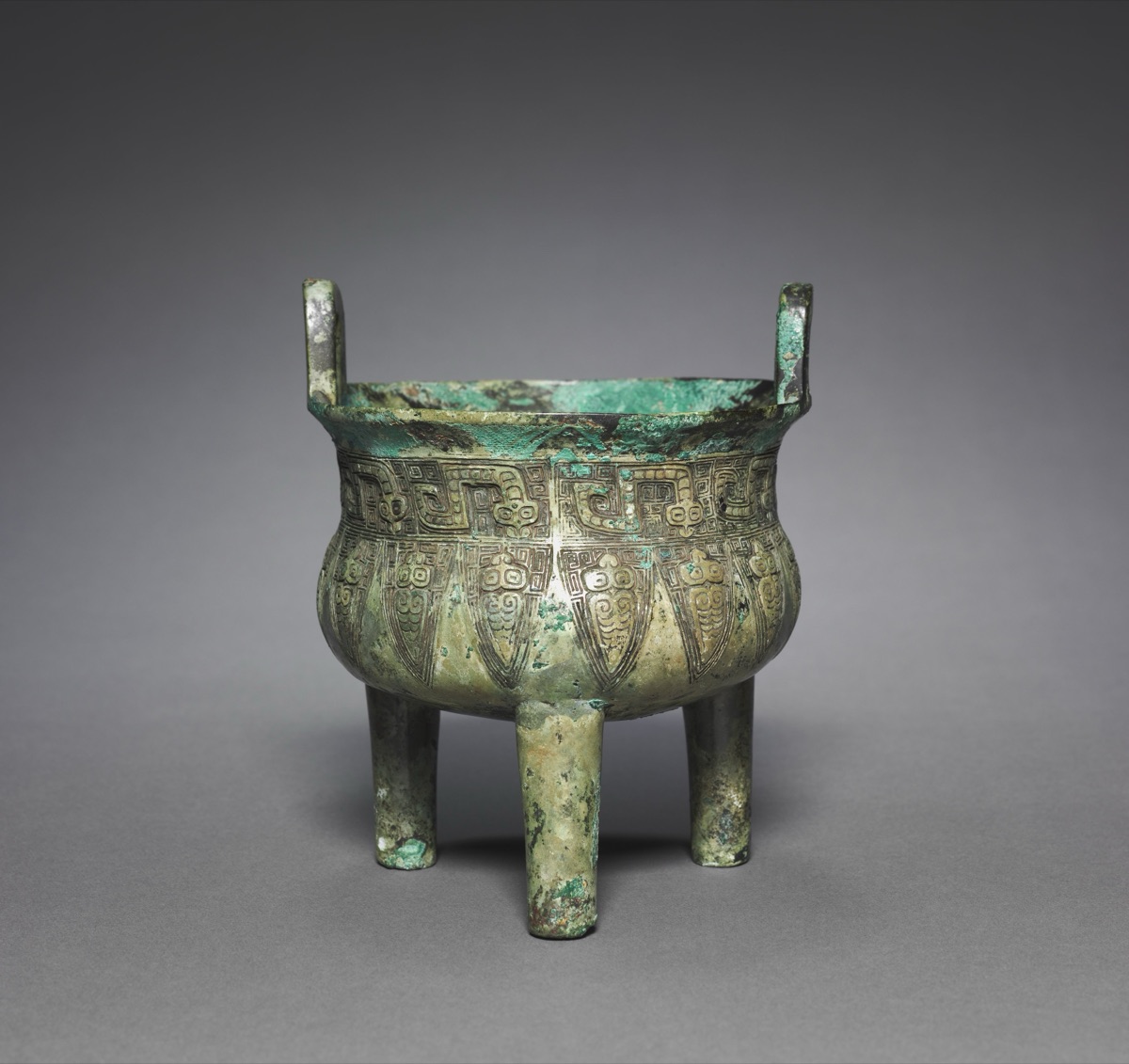
Tripod Cauldron (Ding)
A cast bronze ding, the vessel type used in Shang ancestor-worship feasts and later fixed as a symbol of royal legitimacy.
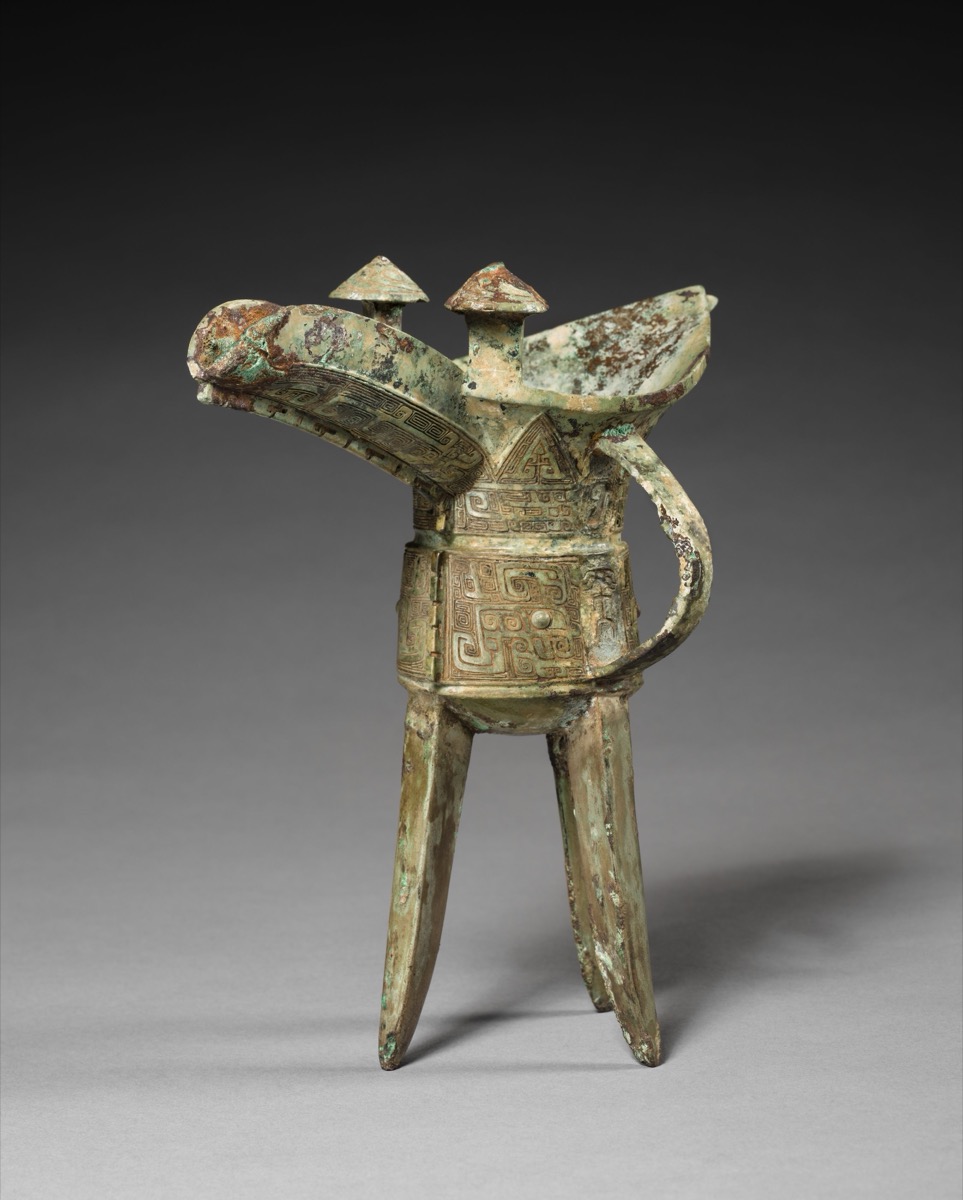
Wine Cups (Jue)
One of a pair of bronze jue cups, the ritual vessel type Shang kings used to pour wine libations to royal ancestors and the high god Shangdi.
New this century
- Epic of Gilgamesh
Even a king who storms heaven must make peace with death; immortality lies in works and walls, not in escaping the grave.
- Instruction of Amenemope
Contentment achieved by patient self-restraint before the gods, not the pursuit of wealth by any means, is the truest form of wisdom, because fortune belongs to the gods to grant or withhold.
- Love Songs of Papyrus Chester Beatty I
Desire between social equals, voiced by a woman as freely as by a man, is worth preserving in writing on its own terms, without moral frame or divine sanction.
- Tale of the Doomed Prince
A fate pronounced at birth, that a prince will die by crocodile, snake, or dog, can be delayed by flight and vigilance but perhaps never fully escaped.
- Gathas
A single wise god, Ahura Mazda, opposes a spirit of falsehood, and every person must choose sides through the moral triad of good thoughts, good words, and good deeds.
- Samaveda
The power of the Vedic hymns lies as much in their correct melodic performance as in their words, turning the Rigveda's verses into chant technology for the Soma sacrifice.
- Yajurveda
Sacrifice only works when the officiating priest's spoken formula and physical action correspond exactly, and the entire ritual calendar has to be organized around securing that correspondence.
- Atharvaveda
Words spoken as charms and spells can heal disease, win love, curse enemies, and secure a household, extending Vedic religion from public sacrifice into everyday domestic and magical life.
- Tale of Two Brothers
Betrayal within a family can be answered with supernatural transformation rather than simple revenge, carrying the wronged brother through death and rebirth to eventual kingship.
- Contendings of Horus and Seth
The rightful succession of a god-king can be decided only through a farcical, decades-long tribunal of the gods, in which cleverness and spite matter as much as legitimate claim.
- Papyrus Harris I
A king's reign can be justified retrospectively as a record of unbroken piety, measured in the sheer volume of land, goods, and personnel donated to the temples of Egypt.
The canon by now
- Pyramid Texts
- Royal Inscriptions of Sargon of Akkad
- The Exaltation of Inanna
- The Curse of Agade
- Coffin Texts
- Admonitions of Ipuwer
- Eloquent Peasant
- Code of Hammurabi
- Old Babylonian Gilgamesh (Pennsylvania and Yale Tablets)
- Inanna's Descent to the Netherworld
- Edwin Smith Surgical Papyrus
- Book of the Dead
- Rigveda
- Baal Cycle
- Ludlul Bel Nemeqi