Time travel
15th century BC
Thutmose III builds Egypt's largest empire yet from Nubia to the Euphrates while Rigveda's hymns begin to be composed and memorized, unwritten, on the far side of the world.
Mental Worlds: Evidence and Inference
No previous Egyptian scribe had as much to read about his own king's deeds as one attached to Thutmose III's court does this century. The Annals, carved at Karnak, record campaign after campaign into the Levant in careful, almost bureaucratic detail, down to lists of captured chariots and tribute, an approach to military narrative closer to a ledger than an epic but no less proud for it. If he served under Hatshepsut a generation earlier, he might instead know the Deir el-Bahri reliefs commemorating her expedition to Punt, a trading voyage down the Red Sea coast rendered in vivid narrative scenes of exotic goods, incense trees, and a foreign ruler's court. If his duties run toward mortuary religion, he has access to something genuinely new: the Amduat, a detailed hour-by-hour account of the sun god's nightly journey through the underworld, painted now on royal tomb walls in the Valley of the Kings rather than inscribed for wider circulation, restricted, in effect, to the king and those who prepare his tomb.
He would know almost nothing of a development unfolding thousands of miles to the east, in the Punjab region of the Indian subcontinent, where Sanskrit-speaking communities are beginning to compose what will become the Rigveda. These hymns exist only in memory and voice; nothing is written, and nothing will be written for well over a thousand years, yet the transmission technique already forming around them, precise meter, formulaic repetition, and eventually recitation methods built for near-perfect fidelity, is itself a formidable intellectual achievement, arguably more exacting in its demands than anything scribal writing requires. No Egyptian, Mesopotamian, or Anatolian scribe of this century has any way of knowing this is happening, and no one composing those hymns has any way of knowing Thutmose III's Annals exist.
Closer to Egypt, a Mitannian scribe in north Syria serves a kingdom just beginning to matter on the international stage, contesting the Levantine corridor with Egypt in a rivalry too evenly matched for either side to win decisively. He would leave behind little text that survives to the present, his kingdom's literary legacy overshadowed by the diplomatic archive it will generate a century later at Amarna, still well in the future from where he stands. A Kassite scribe in Babylon, meanwhile, inherits the old Mesopotamian scholarly and mathematical tradition largely intact, sexagesimal calculation, omen literature, court hymnody, without adding a major new landmark text this century; these are consolidating decades for a dynasty still settling into rule after the disruption a century back.
A Hittite scribe in Anatolia serves a kingdom turned inward, its earlier dramatic reach into Mesopotamia not repeated, weakened by the succession troubles that have dogged it since the previous century. He has the Telipinu Proclamation, a royal edict trying to fix orderly succession after generations of court violence, evidence that Hittite kingship is still working out the basic mechanics of stable transfer of power.
What connects these separate worlds is trade and, increasingly, diplomacy rather than shared text: Minoan pottery and fresco style reach Egyptian and Levantine courts, tin and copper move along routes no single scribe fully maps, and Egyptian and Mitannian armies fight each other regularly enough that both sides have functional, if crude, knowledge of the other's language and customs. The exception, invisible to everyone involved, is the handful of Sanskrit-speaking families in the Punjab already reciting the verses that will outlast every one of this century's monuments.
The political map
Major Polities and Cultural Regions
- New Kingdom Egypt Under Thutmose III, the widest Egyptian empire yet, from Nubia to the Euphrates
- Mitanni Hurrian kingdom in north Syria, Egypt's chief rival for the Levant
- Kassite Babylon Consolidating dynasty controlling southern Mesopotamia
- Hittite kingdom Central Anatolian power in a comparatively weak, inward-focused period
- Minoan Crete Palace civilization at Knossos, its influence reaching Egyptian and Levantine courts; Mycenaean Greek control of the palace itself looms late in the century
Borders are approximate scholarly reconstructions from historical-basemaps (GPL-3).
State of the domains
Texts and Written Culture
The Amduat, a detailed guide to the sun god's nocturnal journey through the underworld's twelve hours, appears now as a new genre of royal funerary text painted on the walls of Valley of the Kings tombs rather than written on papyrus for wider circulation. The Litany of Re similarly catalogues the sun god's many forms. Thutmose III's Annals, inscribed at Karnak, record his campaigns, including the Battle of Megiddo, in the fullest surviving Egyptian military narrative to date. Far to the east, in the Punjab, the Rigveda's earliest hymns begin to be composed orally in early Sanskrit, transmitted by memory alone.
Art
Hatshepsut's mortuary temple at Deir el-Bahri, with its terraced colonnades and Punt-expedition reliefs, ranks among the New Kingdom's great architectural achievements. Minoan wall painting at Knossos turns to marine and naturalistic subjects, the dolphin fresco among them, while LM IB potters develop the Marine Style proper on octopus and nautilus vases; the great miniature ship frieze belongs to Akrotiri on Thera. By the century's later decades Knossos adds the processional and bull-leaping scenes for which the palace is best known, its influence reaching Egyptian and Levantine courts through trade. Kassite Babylon's art remains modest and derivative of earlier Mesopotamian conventions during these consolidating decades, without a distinctive new style yet emerging.
Medicine
No major new medical compendium distinguishes itself this century, though Egyptian physicians continue practicing the case-based surgical method and herbal-magical treatment established in the previous century's Edwin Smith and Ebers papyri. The Hearst Medical Papyrus, likely compiled around now, adds further remedies to the existing corpus without significant methodological advance. Mesopotamian medicine under the Kassites remains bound to omen and incantation, treating illness as a message to be interpreted rather than a mechanism to be corrected, a divide between Egyptian clinical case-method and Mesopotamian divinatory diagnosis that will persist for centuries.
Science
Egyptian administration under an expanding New Kingdom bureaucracy refines land-measurement and tax-accounting mathematics without producing a major new theoretical text this century. Systematic Mesopotamian astronomy remains omen-based rather than predictive under Kassite rule, though the observational habits that will eventually produce sophisticated ephemerides are already centuries deep. In the Punjab, Rigvedic composers develop an extraordinarily precise oral transmission technique, using meter, formula, and eventually recitation methods designed to preserve sound with near-perfect fidelity, a different kind of intellectual achievement from written mathematics but no less rigorous in its own domain.
Military
Thutmose III wins the Battle of Megiddo, the first of seventeen campaigns into the Levant, building an Egyptian empire that stretches from the fourth cataract of the Nile to the Euphrates, the widest reach Egyptian arms will ever achieve. Chariotry is now the decisive arm across every major Near Eastern army, Egyptian, Mitannian, and Hittite alike. Mitanni, a Hurrian kingdom in north Syria, emerges as Egypt's chief rival for control of the Levantine corridor, fighting a long, inconclusive contest that will eventually end in treaty rather than conquest. Kassite Babylon remains comparatively quiet militarily during these decades of consolidation.
Technology
Egyptian engineers under Hatshepsut mount a major seaborne trading expedition to Punt, reflected in Deir el-Bahri's relief carvings, requiring ship construction capable of Red Sea voyages. Chariot manufacture across the Near East continues to refine wheel and axle design for speed and durability in battle. Irrigation and canal technology in both Egypt and Kassite Babylon remain essentially continuous with earlier practice. Bronze metallurgy is fully mature; iron remains rare and largely ornamental. Monumental construction at Karnak and Deir el-Bahri demonstrates advanced quarrying, transport, and engineering logistics at a scale rivaling the Old Kingdom pyramids.
Material world
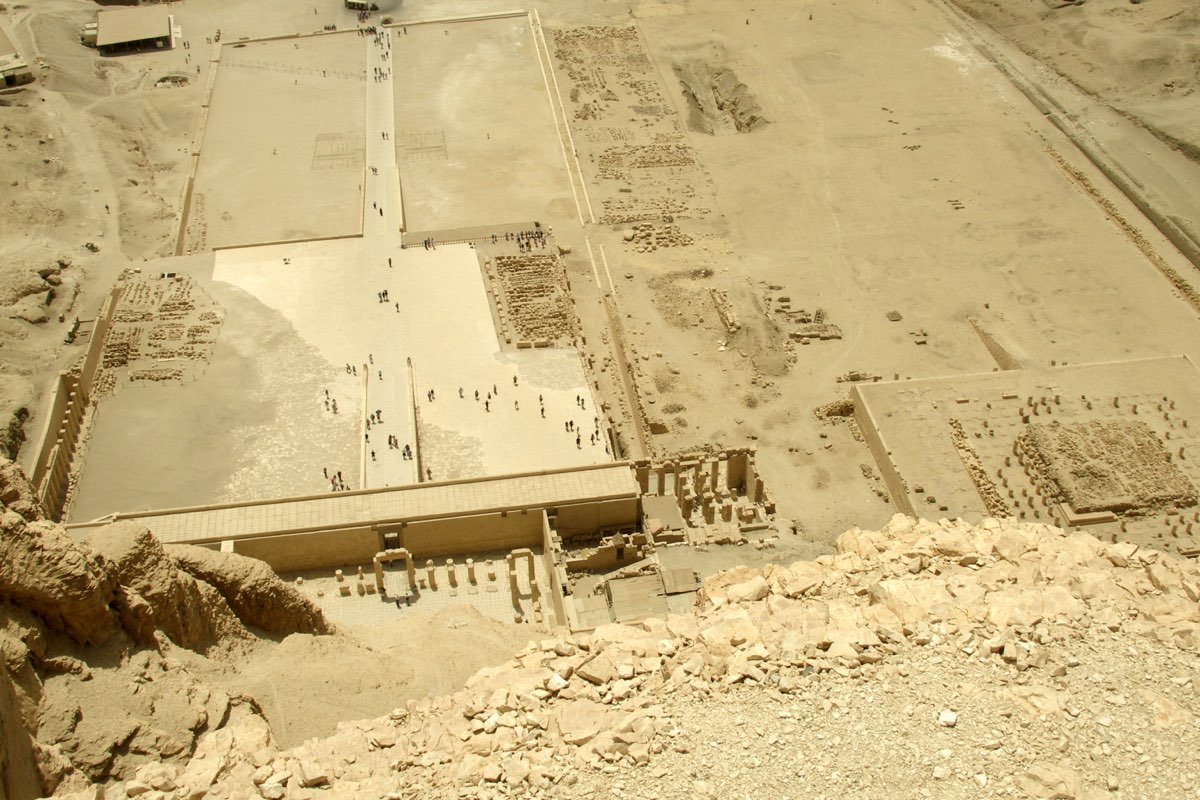
Mortuary Temple of Hatshepsut, Deir el-Bahari
Three colonnaded terraces cut into the cliffs at Deir el-Bahari, built as the funerary temple of Egypt's longest-reigning female pharaoh.
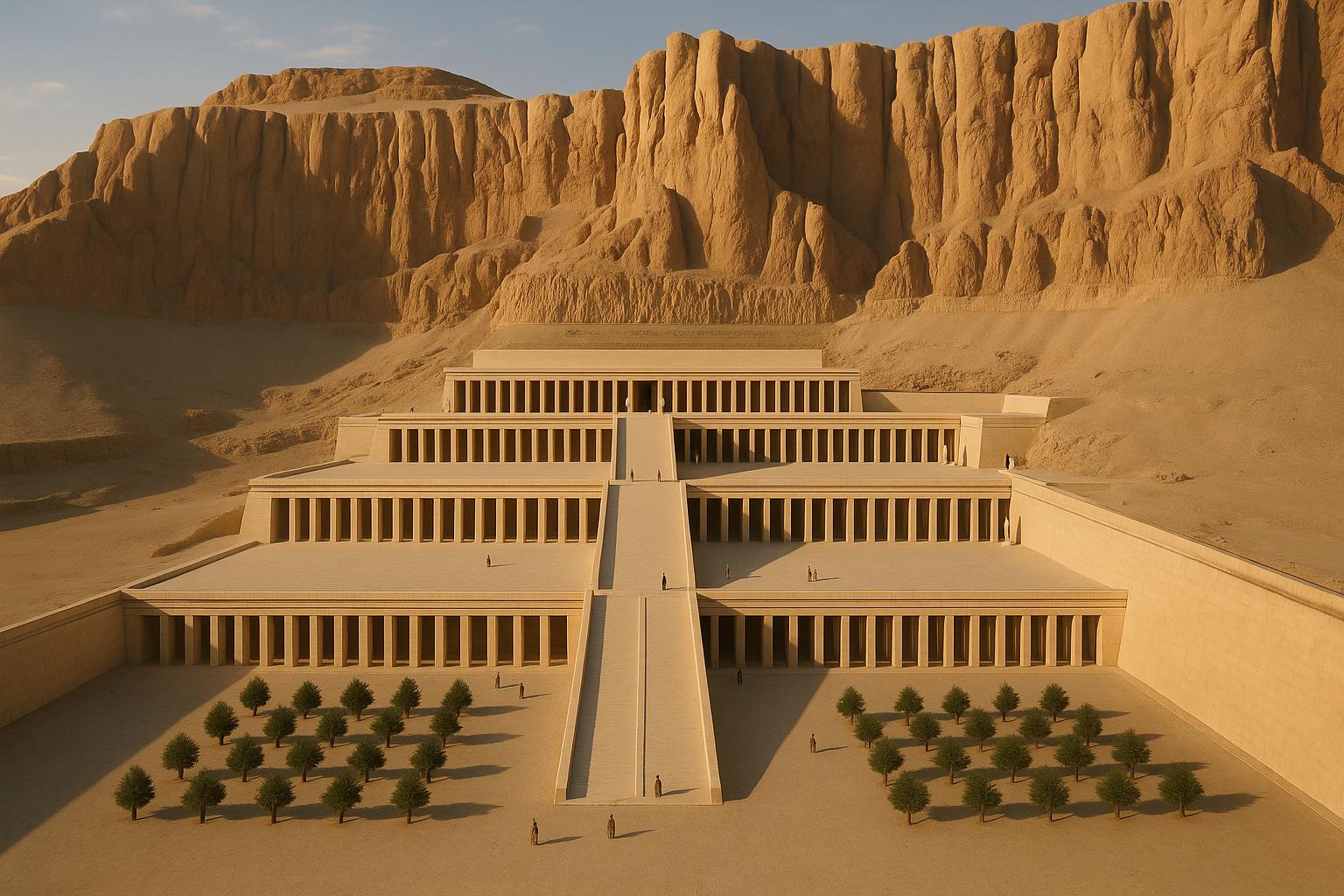
AI reconstruction
Temple of Hatshepsut at Deir el-Bahari - reconstruction
Hatshepsut's funerary temple as it looked in use: broad colonnaded terraces of bright limestone stepped against the cliff, linked by long axial ramps, the forecourt planted with rows of imported myrrh trees - a planting the temple's own reliefs record from the Punt expedition. The colonnades survive restored today; the gardens, statues in place, and unweathered stone are the reconstruction.
AI reconstruction (2026), based on Mortuary Temple of Hatshepsut, photo Vyacheslav Argenberg via Wikimedia Commons
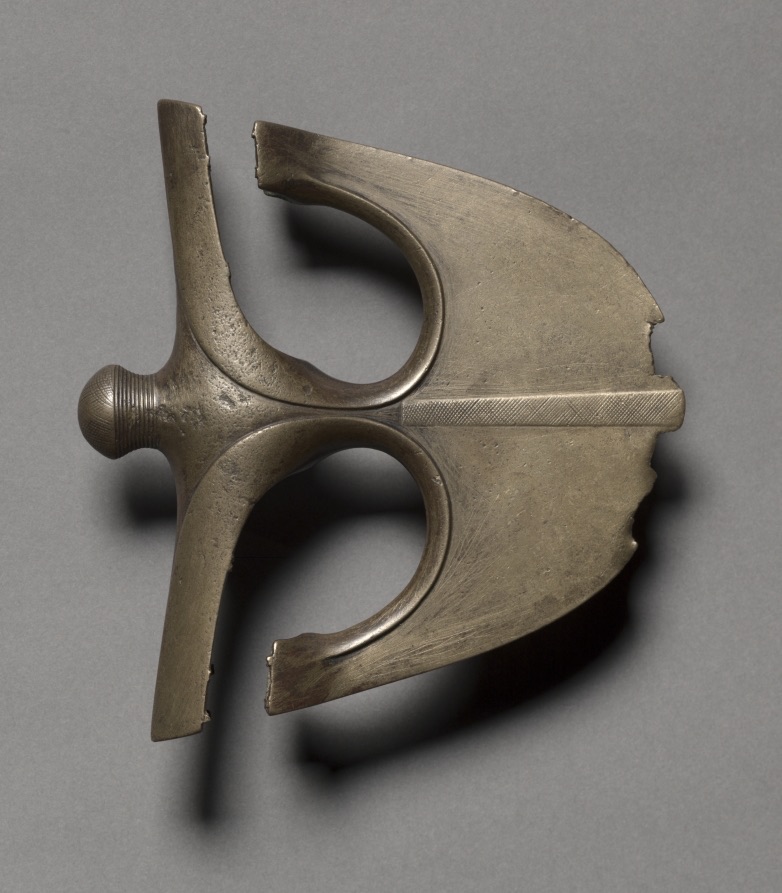
Duck-Billed Axe Head
A bronze axe head hafted by lashing through its epsilon-shaped cutouts rather than a socket, in the flared duck-billed profile common in the Middle Kingdom and Second Intermediate Period, a form New Kingdom armies were phasing out in favor of narrower socketed axes.
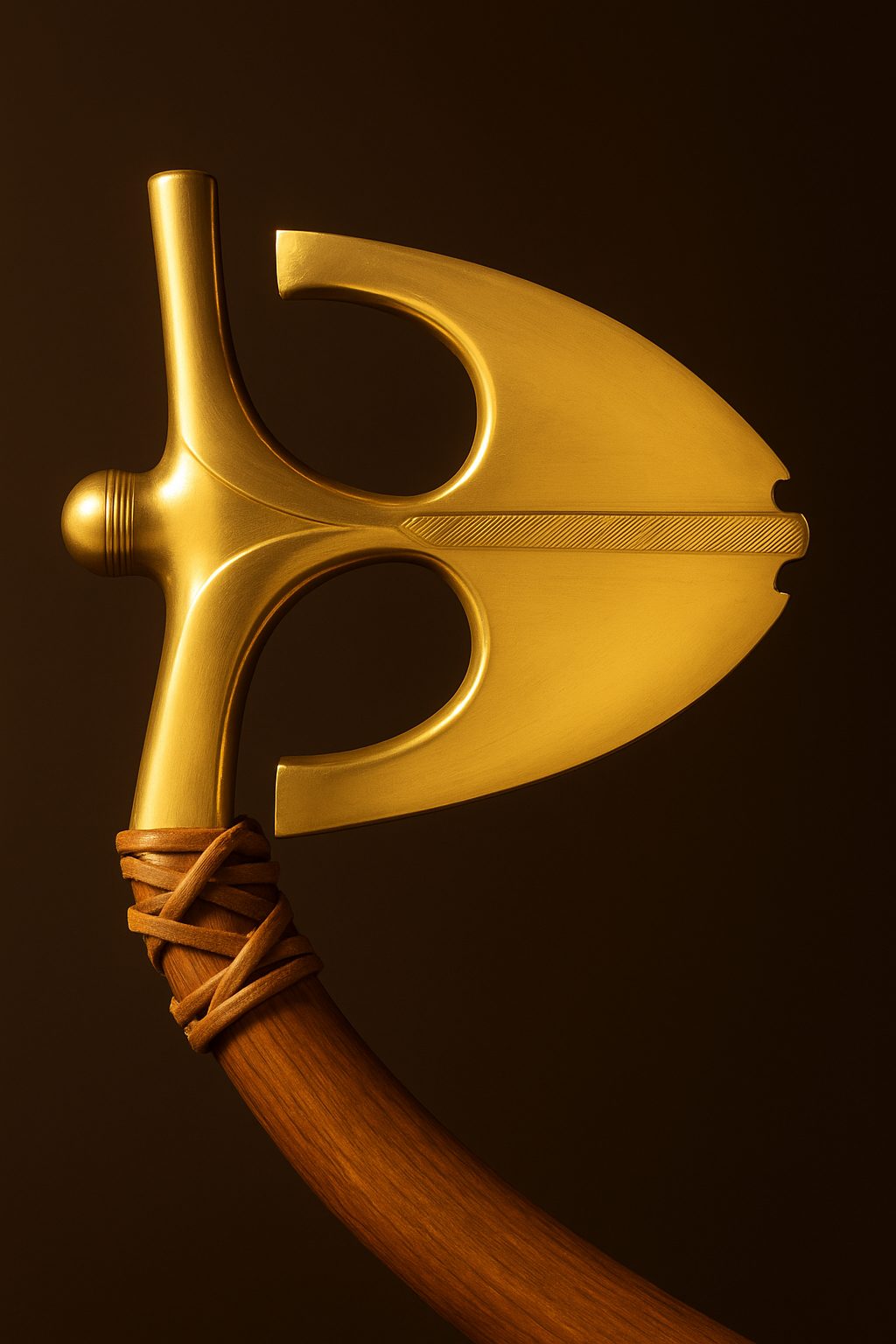
AI reconstruction
Duck-billed axe - reconstruction
The duck-billed axe restored as a complete weapon: the flared crescent head with its two epsilon-shaped openings freshly cast and polished, lashed with rawhide thongs through those openings onto a curved wooden haft. The museum's head survives alone with broken tangs; haft and lashing here follow the standard reconstruction of the type, a form already old-fashioned when New Kingdom armies turned to socketed axes.
AI reconstruction (2026), based on Duck-Billed Axe Head, The Cleveland Museum of Art
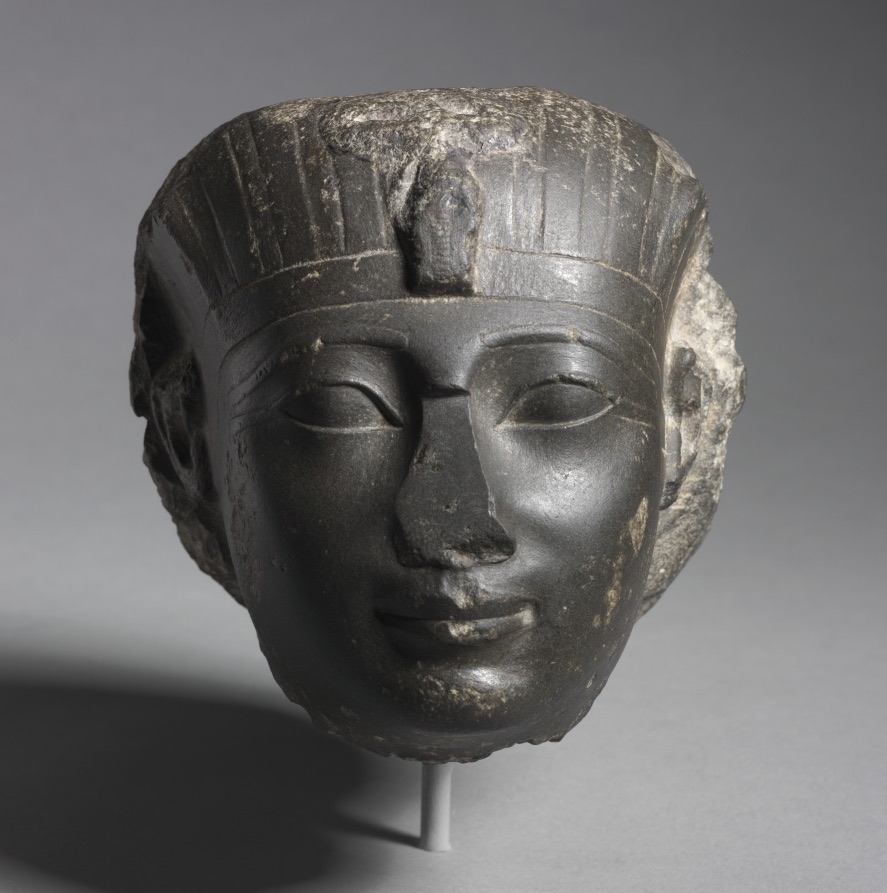
Head of Queen Hatshepsut (?)
A graywacke royal head thought to portray Hatshepsut, one of only a handful of ancient Egyptian rulers who reigned as king rather than queen consort.
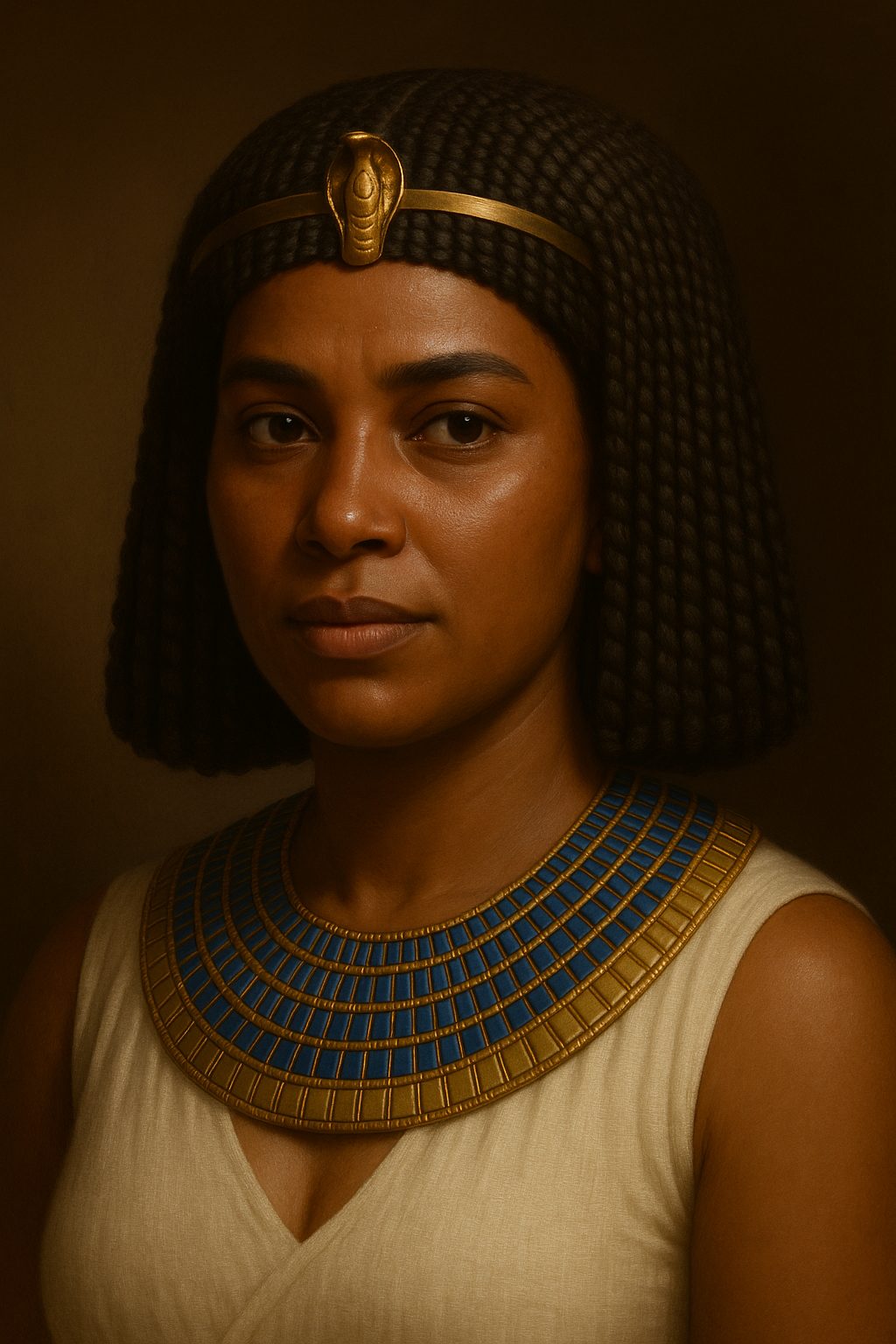
AI reconstruction
Hatshepsut - reconstruction
Hatshepsut, the woman who ruled Egypt as king, imagined from a graywacke royal head thought to portray her: softly rounded cheeks, wide almond eyes and a faint composed smile, here with a plaited wig, gold uraeus diadem, broad bead collar and white linen dress. The attribution of the source head is probable rather than certain, and her official statues mix her features with royal convention.
AI reconstruction (2026), based on Head of Queen Hatshepsut (?), The Cleveland Museum of Art
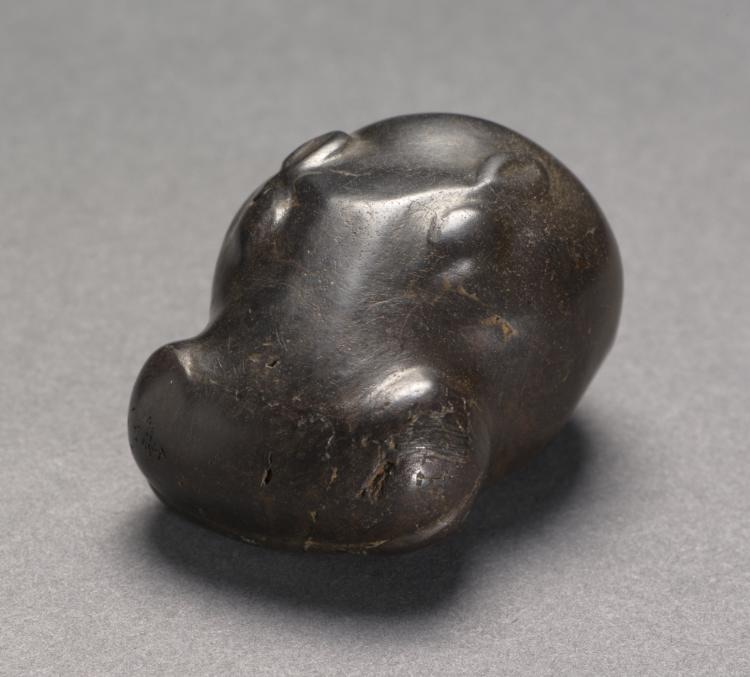
Weight in the Form of a Hippopotamus Head
A small hematite weight shaped as a hippopotamus head, part of the balance-scale system Egyptian markets and treasuries used to measure gold, silver, and grain by mass.
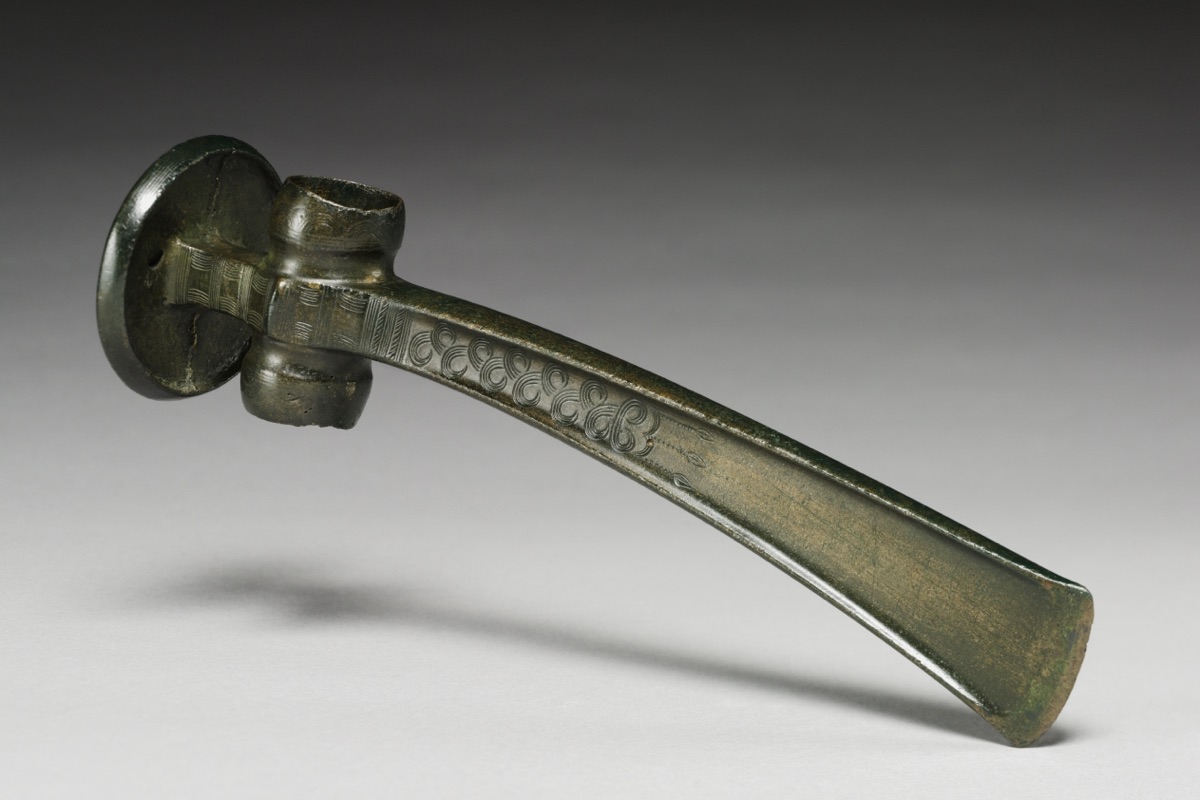
Battle Axe
A solid-cast bronze battle axe from Bronze Age Hungary, evidence that the shift from stone to metal weaponry reached well beyond the Near East and the Aegean.
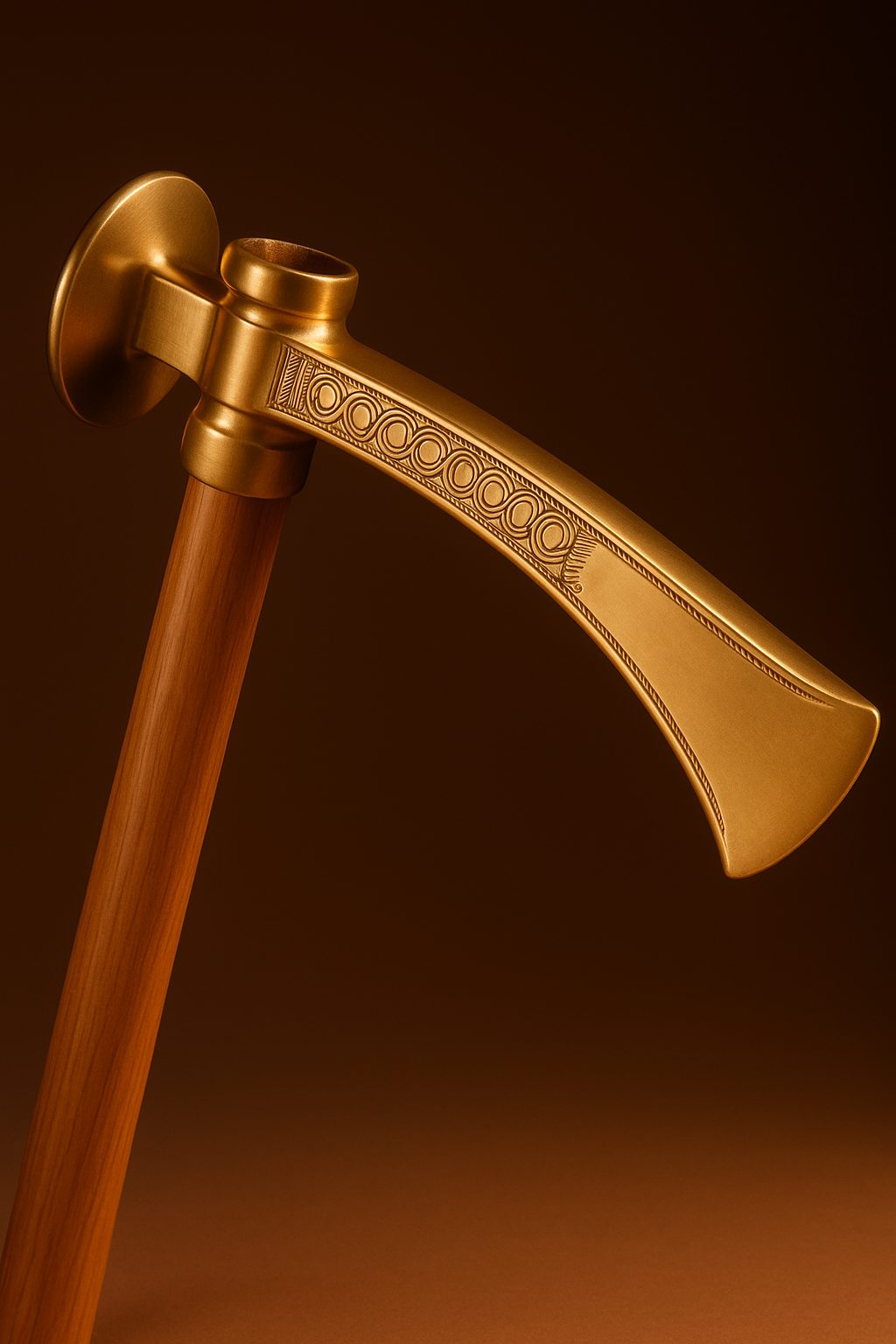
AI reconstruction
Bronze Age battle axe from Hungary - reconstruction
A disc-butted battle axe from Bronze Age Hungary restored to new condition: the freshly cast bronze with the warm sheen of new metal, the flat disc butt, the long curved flaring blade, and the crisp incised running-spiral ornament that covers the body, fitted through its socket onto a straight wooden haft. The original survives with a dark green patina; the wooden haft is a plausible mounting, not a surviving part.
AI reconstruction (2026), based on Battle Axe (Hungary), The Cleveland Museum of Art
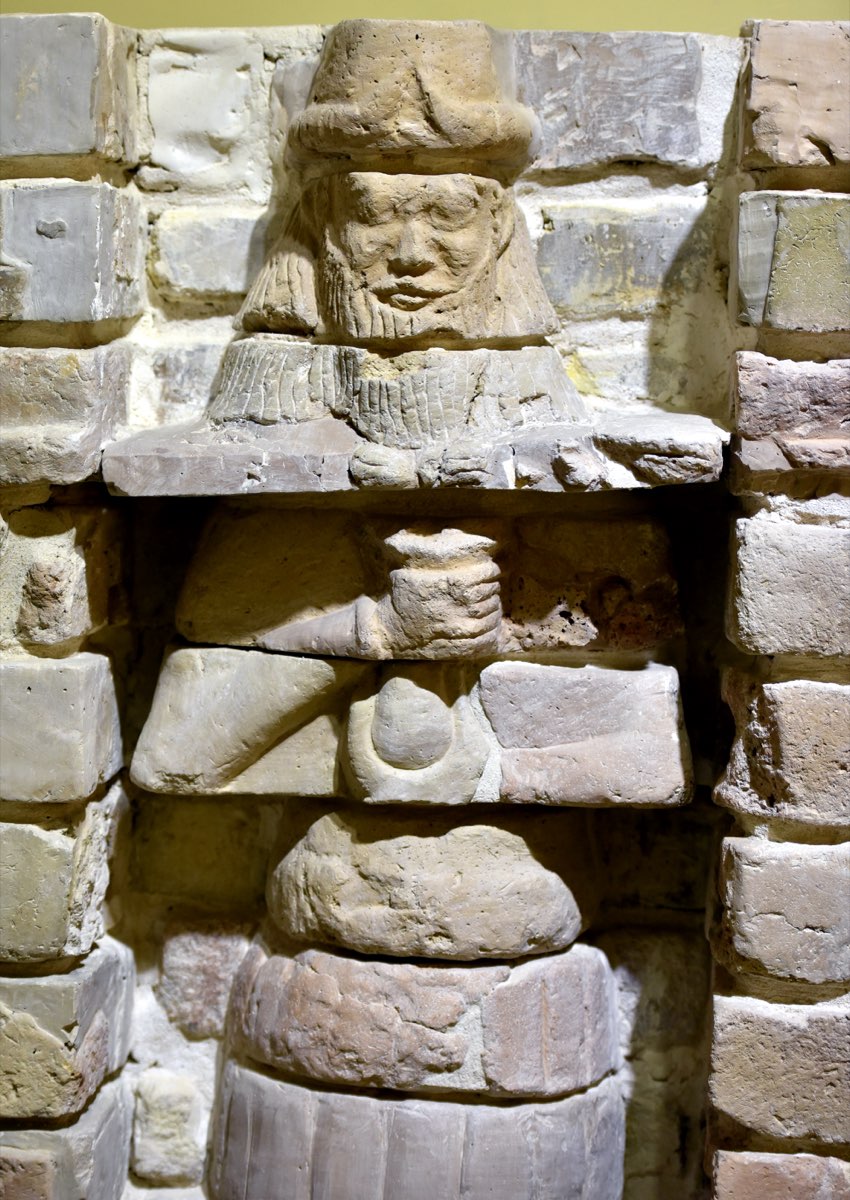
Facade Relief, Temple of Inanna, Uruk
A molded mudbrick relief of a deity pouring life-giving water, from the facade the Kassite king Karaindash added to the Inanna temple at Uruk.
Photo: Osama Shukir Muhammed Amin FRCP(Glasg) / Wikimedia Commons, Iraq Museum
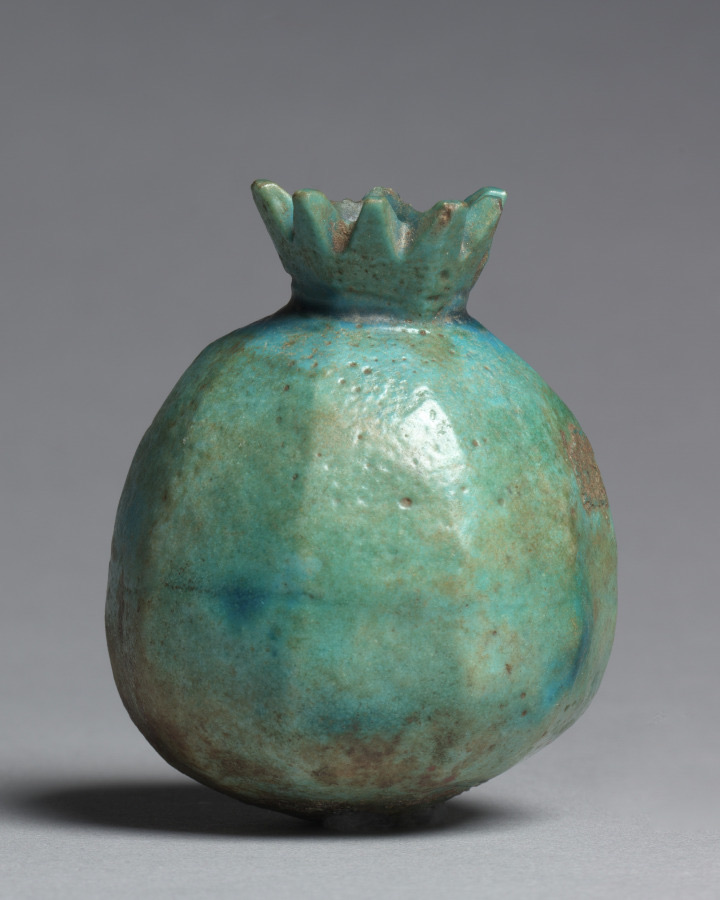
Pomegranate Vase
A blue faience vessel molded in the shape of a pomegranate, a fruit newly fashionable in New Kingdom Egypt after contact with the Levant.
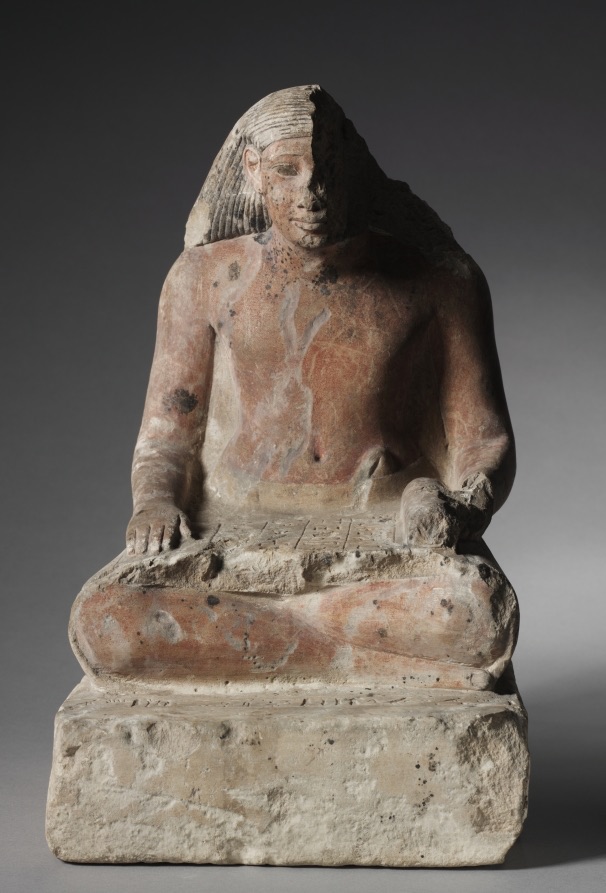
Seated Scribe of Medthu
A limestone statue of a scribe seated cross-legged with a papyrus roll on his lap, the standard pose for depicting the literate officials who ran the New Kingdom bureaucracy.
New this century
- The Descent of Ishtar to the Netherworld
A shorter, harder-edged Akkadian retelling argues that Ishtar's absence from the world of the living has a direct physical cost, no beast will mount another, no man will impregnate a woman, until the queen of heaven is released.
- Adapa and the South Wind
A wise priest who breaks the South Wind's wing is offered immortality by the sky-god Anu and, on the false advice of his own patron god Ea, refuses it, arguing that even perfect wisdom is no guarantee against being deceived by the god who is supposed to protect you.
- Proclamation of Telipinu
A cycle of royal assassinations can only be stopped by fixing succession in law, so the king who survived the purges binds every future heir to a written order of inheritance and a court that judges royal killers instead of letting blood feuds decide.
- Rigveda
The cosmos runs on a hidden order, rta, that gods and rituals alike must serve, and the correct hymn, precisely spoken, is the tool that keeps that order intact.
- Amduat
The sun god's nightly passage through twelve hours of the underworld is a precise itinerary that only the properly equipped dead, and no other, can follow to rebirth at dawn.
- Litany of Re
The sun god exists simultaneously in seventy-five distinct forms, and a dead king who can name and merge with all of them secures the most complete possible union with the sun's power.