Time travel
8th century BC
Alphabetic writing, already old on the Levantine coast, reaches Greek hands and produces Homer within decades of Isaiah and Amos preaching in Judah and Israel, while Assyria conquers the northern Hebrew kingdom outright and Kushite pharaohs rule Egypt from the south.
Mental Worlds: Evidence and Inference
Three things happen in the eastern Mediterranean and Levant this century that later ages will treat as beginnings, and not one of the people involved has any idea the others are happening. In Ionia, a poet or a poetic tradition later Greeks simply call Homer composes the Iliad, drawing on an oral epic tradition centuries old but now, for the first time, fixed with the help of an alphabet Greek communities have adapted from Phoenician traders within roughly the past hundred years. In Israel and Judah, a sequence of individuals, a shepherd from Tekoa named Amos, a prophet of the northern kingdom named Hosea, and a Jerusalem figure named Isaiah, deliver oracles that treat the Assyrian empire's advance as divine judgment rather than mere geopolitics, oracles that will eventually be gathered into what becomes Hebrew scripture. And by tradition, in 776 BC, communities across the fragmented Greek world begin gathering every four years at Olympia for an athletic festival substantial enough to become, eventually, the basis for a shared Greek calendar.
None of these three developments knows about either of the others. Isaiah has never heard of Homer; the poet of the Iliad has no concept of the Assyrian empire currently reorganizing the eastern end of the Mediterranean world Greek traders are just beginning to reach. What connects them, if anything does, is not contact but a shared underlying condition: enough political fragmentation, in both the Aegean and the Levant, that no single palace or temple controls the production of meaning, and just enough literacy, newly available through an alphabet simple enough to be learned outside a scribal caste, that individual voices, a poet, a shepherd-turned-prophet, can be preserved rather than absorbed into anonymous court tradition.
Assyria supplies the century's grimmer throughline. Tiglath-Pileser III's reorganization of the empire into directly ruled provinces, and his practice of mass deporting conquered populations to break local resistance, culminates under Sargon II in the conquest and dissolution of the northern kingdom of Israel in 722 BC. Its population is scattered into Assyrian territory and largely disappears from the historical record, an early and thorough demonstration of what imperial policy can do to a small state caught between larger powers. Judah survives, reduced to a nervous Assyrian vassal, which is precisely the political condition Isaiah's oracles are responding to: a small kingdom watching its northern sibling erased and wondering whether faithfulness or diplomacy offers better odds of avoiding the same fate.
Further south, the direction of conquest inverts. Piye of Kush moves north out of Nubia and defeats a fragmented coalition of Delta rulers, uniting Egypt under a Kushite dynasty that presents itself, in its own inscriptions, not as a foreign occupier but as a restorer of proper Egyptian religious order, building temples and claiming continuity with the very civilization it has just conquered.
A literate person anywhere in this world, in Ionia, in Jerusalem, in Nineveh, or in Napata, could know their own immediate political and literary situation in unusual detail. What none of them could know, and what only the accident of a shared documentary record lets later readers see, is that they were all, in their very different registers, participating in the same rough moment: alphabetic literacy loosening writing's grip from a narrow scribal class, right as an aggressive new empire was demonstrating exactly what happened to those who lost.
The political map
Major Polities and Cultural Regions
- Neo-Assyrian Empire Reorganized under Tiglath-Pileser III into a directly administered provincial empire; conquers Israel outright under Sargon II in 722 BC
- Kingdom of Kush Conquers Egypt under Piye, ruling as the Twenty-Fifth Dynasty from Napata
- Egypt Reunified under Kushite rule after a century of Delta fragmentation
- Kingdom of Judah Southern Hebrew kingdom, an Assyrian vassal after Israel's fall, home to Isaiah and Micah
- Kingdom of Israel Northern Hebrew kingdom, conquered and dissolved by Assyria in 722 BC
- Greek city-states Aegean poleis newly literate in an adapted Phoenician alphabet, home to Homer and the first Olympiad
- Phoenician city-states Levantine trade cities whose alphabet is now spreading across the Mediterranean
Borders are approximate scholarly reconstructions from historical-basemaps (GPL-3). Nearest available basemap anchor year: 700 BC.
State of the domains
Texts and Written Culture
In Ionia, a poet tradition later ages call Homer composes the Iliad, the first work of Greek alphabetic epic to reach a fixed form; Greek writing, adapted from a Phoenician model within roughly the past century, is still new enough that literacy remains rare. In Israel and Judah, four prophets active across these decades, Amos, Hosea, Isaiah, and Micah, deliver the earliest oracles later gathered into scripture, warning of Assyrian conquest before it happens and, in Isaiah's case, after Samaria has fallen. In Assyria, Tiglath-Pileser III's annals and the first Neo-Assyrian state letters document an empire now administering conquered territory directly. In Kush, Piye's victory stela narrates his conquest of Egypt in a pious king's voice.
Art
Greek pottery painting develops the Geometric style's late, most elaborate phase, dense meander and figure ornament on large funerary vessels, just as the alphabet these communities are adopting appears as graffiti on pots and dedications. Assyrian palace relief reaches new scale under Sargon II's new capital at Dur-Sharrukin, continuing Ashurnasirpal II's tradition of narrative battle and deportation scenes. Kushite pharaohs, now ruling Egypt as the Twenty-Fifth Dynasty, commission traditional Egyptian temple art and pyramid building at Napata, archaizing to claim continuity with Egypt's old order. Phoenician ivory and metalwork continues circulating as luxury trade goods across this entire zone. Equally isolated, Chavin de Huantar in the Peruvian highlands is a ceremonial center whose carved stone galleries and feline imagery anchor a tradition that will spread across the central Andes in the centuries ahead; the Andes, this far, remain without writing of any kind.
Medicine
No dedicated medical compilation survives from this century in any tradition. Mesopotamian exorcist physicians continue applying the diagnostic framework systematized generations earlier; Egyptian temple medicine likely continues under Kushite rule with little apparent disruption, since the new dynasty deliberately preserves existing religious and administrative institutions rather than replacing them. Nothing in the surviving Greek material from this century suggests any medical practice distinct from folk remedy and ritual; the analytical medical tradition later associated with Greece remains centuries away, and no comparable evidence for a distinct approach survives from India or China in this same window either.
Science
Babylonian celestial omen compilation continues, and Assyrian eponym lists extend the chronology later scholars use to reconstruct this period with precision. The Greek world adopting the alphabet has, as yet, produced nothing resembling natural inquiry; that belongs to the coming two centuries. In India, the earliest Sulba Sutras set out precise geometric rules for constructing ritual fire altars, practical geometry embedded in sacrificial religion rather than pursued for its own sake, but genuine mathematics nonetheless. Egyptian and Kushite astronomical knowledge continues along established lines. The century's most consequential development for later science is not scientific at all: the alphabet, efficient enough that within a few centuries it makes possible a far wider circle of readers than the scripts it supplements.
Military
Tiglath-Pileser III reorganizes the Assyrian empire around standing provincial administration and mass deportation of conquered populations, a policy his successors continue; Sargon II completes the conquest of the northern Hebrew kingdom of Israel, whose capital Samaria falls in 722 BC, and the kingdom disappears as an independent state. In Egypt, Kushite king Piye conquers the fragmented Nile valley from the south, defeating a coalition of Delta rulers and reunifying Egypt under a Nubian dynasty, an inversion of the usual direction of conquest. The first Olympic Games, held by tradition in 776 BC, formalize a pan-Hellenic competition backed by a sacred truce guaranteeing safe passage to competitors, though the truce does not suspend the endemic warfare between Greek city-states themselves.
Technology
Assyrian engineers under Sargon II build canals and a new capital city, Dur-Sharrukin, at remarkable speed, reflecting an imperial administration now capable of large coordinated construction projects. Iron tools and weapons are fully standard equipment across the Near East, the Aegean, and increasingly the wider Mediterranean world the Phoenicians trade into. The Greek adoption of the Phoenician alphabet, adding vowel signs the Semitic original lacks, is this century's most consequential development for the future, even though almost no one alive to make the adaptation could have known it would eventually be adapted again for Latin, Cyrillic, and most alphabets in use three thousand years later.
Material world
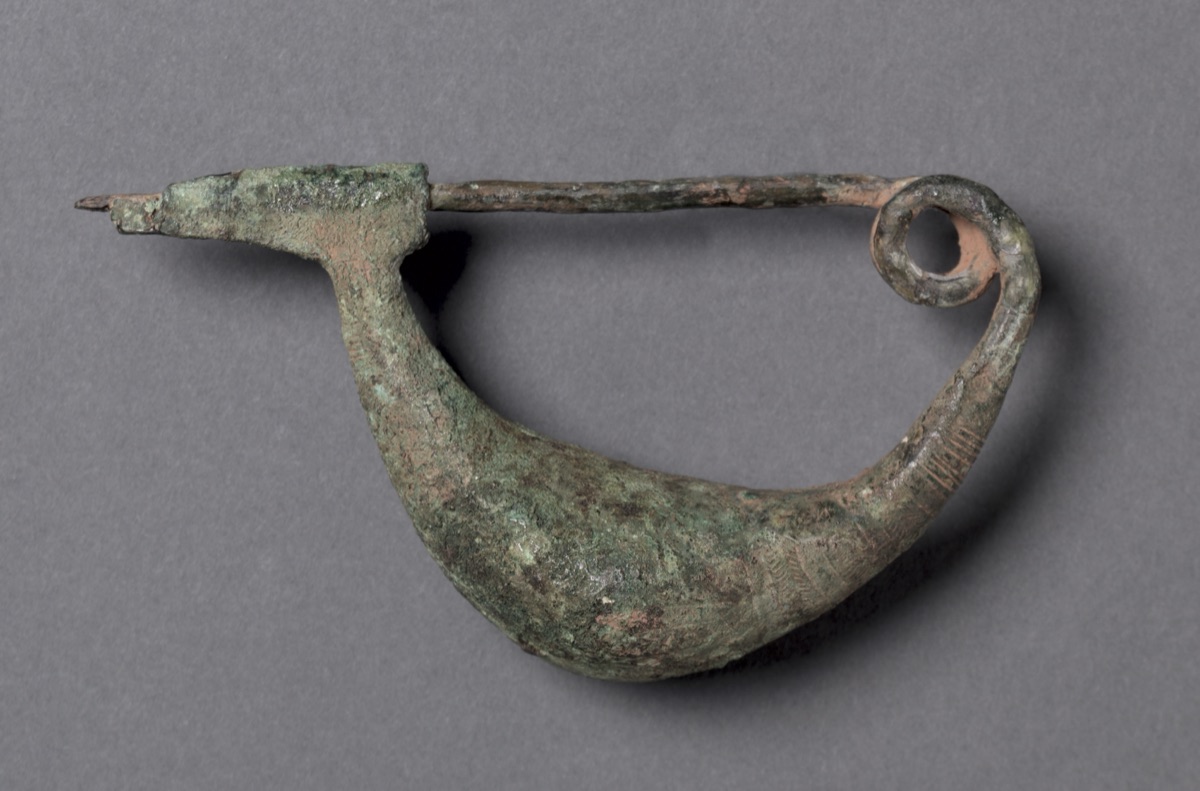
Boat-Shaped Fibula
A boat-shaped bronze fibula, a larger and more ornate version of the dress-fastening clasp worn across early Iron Age Etruria.
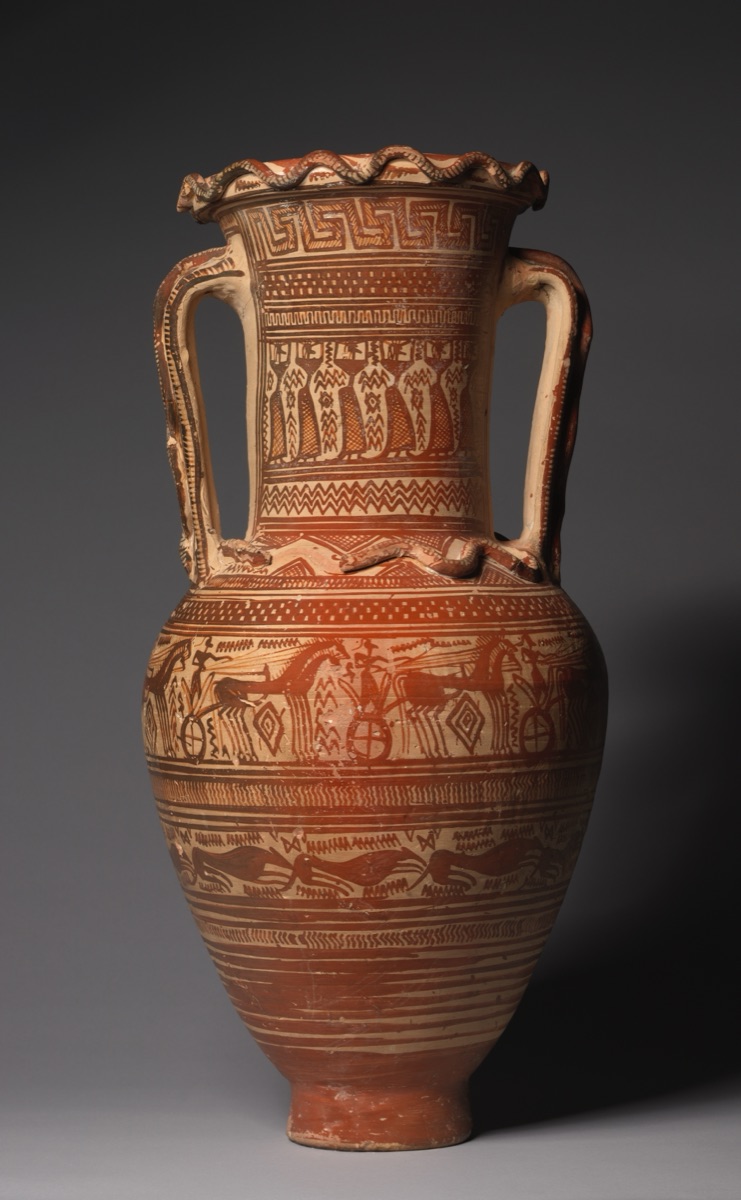
Geometric Neck-Handled Amphora: Prothesis
A Late Geometric funerary amphora painted with mourners and chariots around a laid-out corpse, marking an aristocratic grave in Homer's Athens.
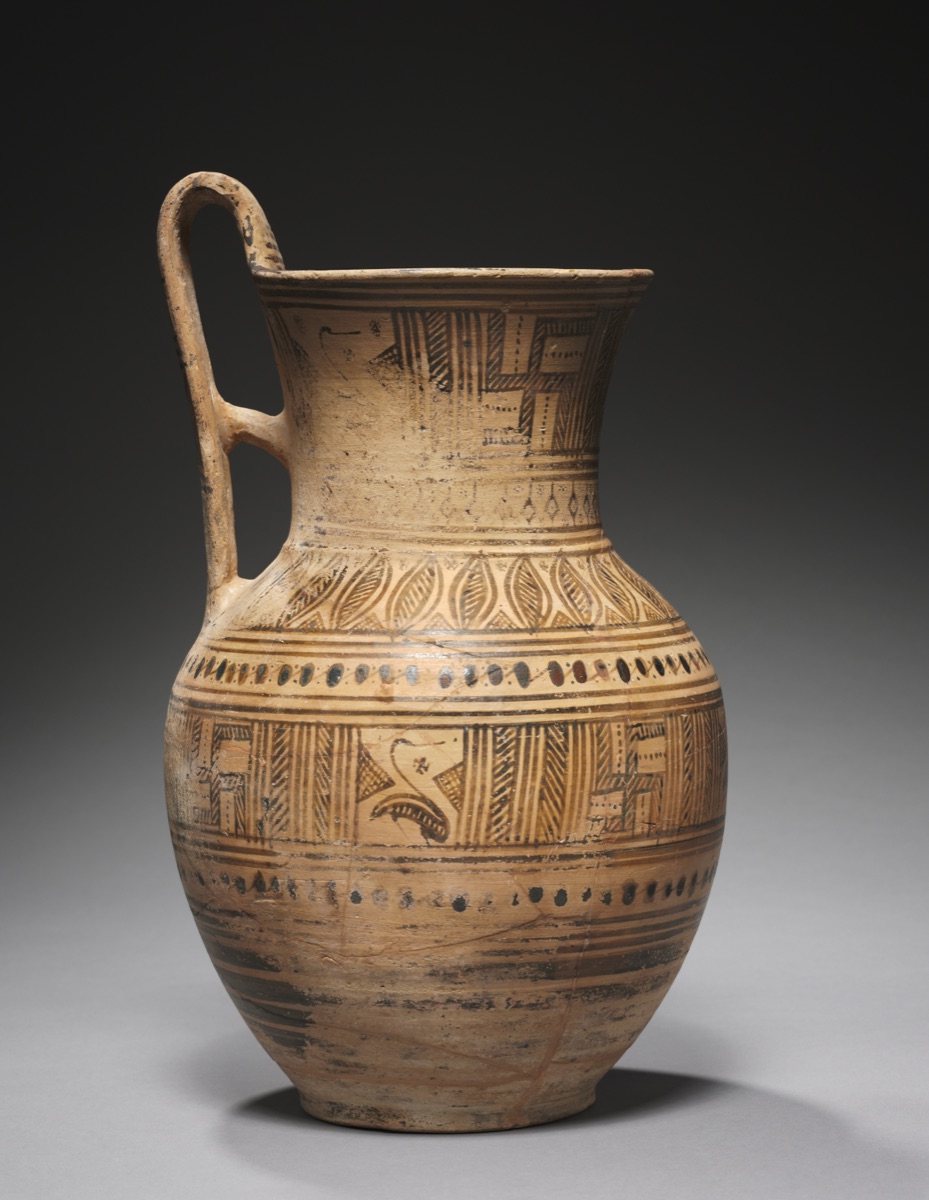
Geometric Pitcher: Swans
A pitcher painted with alternating panels of swans and swastikas in the Geometric style that dominated Athenian pottery before figural black-figure painting emerged.
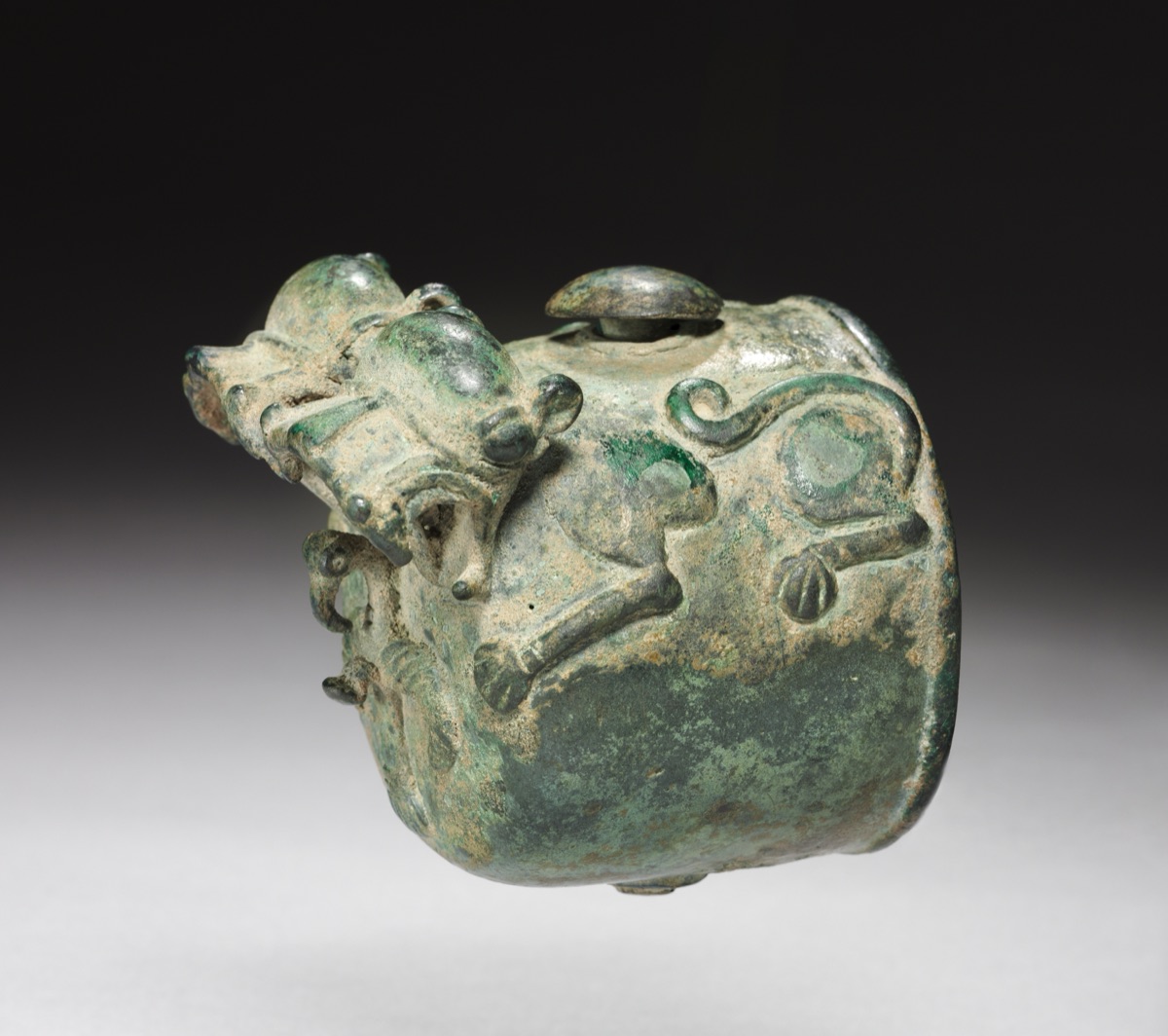
Axel Shaft Cup
A cast bronze fitting from the Luristan bronze tradition, whose animal-headed horse gear and vessels circulated across the Iranian plateau.
New this century
- Shatapatha Brahmana
Every element of the elaborate Vedic sacrifice, down to the individual bricks of the fire altar, encodes a cosmological truth, so that performing the ritual correctly is itself an act of understanding the structure of the universe.
- Aitareya Brahmana
The sacrificial and social order rests on divine intervention rescuing individuals from its own cruelest logic, a claim the text makes through the story of a boy nearly sacrificed by his own father even as it lays out how the order must otherwise be performed.
- Mahabharata
The pursuit of dharma amid conflicting duties destroys even the most righteous family, arguing that no single rule of right conduct survives contact with the tangle of kinship, ambition, and fate, leaving only the difficult work of judgment case by case.
- Sulba Sutras
The geometry required to construct fire altars of specified shape and exactly equal area, a requirement of correct Vedic sacrifice, can be worked out through precise rules of construction, arriving at a statement equivalent to the Pythagorean theorem and a close decimal approximation of the square root of two centuries before either is attested in Greek sources.
- South Arabian Inscriptions
South Arabian rulers and private dedicators recorded their building projects, wars, legal grants, and offerings to their gods in a distinct monumental script, leaving a written record of the incense-trade kingdoms independent of both Mesopotamian cuneiform and the Phoenician-derived alphabets to their north.
- The Babylonian Chronicle Series
A sequence of terse, year-by-year chronicles argues that history is best recorded without royal boasting or divine editorializing at all, listing kings' actions, battles, and deaths in a flat, ostensibly neutral register descended from the older king-list genre.
- The Twelve (Minor Prophets)
Twelve short, historically scattered prophetic voices were deliberately gathered into a single scroll because read together, across four centuries, they make one sustained argument about covenant, judgment, and the promised Day of the Lord.
- Iliad
Mortal glory is purchased with mortal loss; the wrath of one man reveals the price of honor in a world the gods toy with.
- Babylonian Astronomical Diaries
Nightly, unbroken astronomical recordkeeping sustained for over six centuries argues that pattern recognition alone, without any theory of why the heavens move as they do, is enough to make prediction reliable, the foundation of the mathematical astronomy that followed.
- Isaiah
Judgment on a faithless nation and comfort for an exiled one come from the same book because a prophetic voice outlives the prophet, reinterpreted for a catastrophe he did not live to see.
- Great Triumphal Stela of Piye
Piye's conquest of Egypt is presented not as foreign invasion but as Amun's chosen and ritually pure Kushite king restoring divine order over corrupt northern rulers who no longer deserved to rule in the god's name.
- Karatepe Bilingual Inscription (Azatiwada Inscription)
Azatiwada, a Luwian-speaking vassal ruler in Cilicia, proclaims in parallel Phoenician and Hieroglyphic Luwian texts that he founded the fortress of Azatiwataya and secured peace and abundance for his kingdom, cursing any successor who erases his name.
- Sargon II's Letter to the God Ashur
Reporting his eighth campaign against Urartu not to a human official but to the state god Ashur himself, Sargon II argues that even a royal military report is properly addressed as an act of religious accountability rather than mere record-keeping.
The canon by now
- Pyramid Texts
- Royal Inscriptions of Sargon of Akkad
- The Exaltation of Inanna
- The Curse of Agade
- Coffin Texts
- Admonitions of Ipuwer
- Eloquent Peasant
- Code of Hammurabi
- Old Babylonian Gilgamesh (Pennsylvania and Yale Tablets)
- Inanna's Descent to the Netherworld
- Edwin Smith Surgical Papyrus
- Book of the Dead
- Rigveda
- Baal Cycle
- Ludlul Bel Nemeqi
- Epic of Gilgamesh
- Instruction of Amenemope
- Gathas
- Book of Songs
- Torah
- I Ching (Book of Changes)