Time travel
21st century BC
Ur-Nammu and Shulgi rebuild Sumer into the Ur III state and, for the first time, Mesopotamian scribes write a retrospective history explaining why Akkad fell, even as Egypt's civil war ends in reunification under Mentuhotep II.
Mental Worlds: Evidence and Inference
A Sumerian subject of Ur-Nammu, and later of his son Shulgi, lives inside a state visibly rebuilding itself after the previous century's disorder, and the rebuilding is not only political but literary. Ur-Nammu's law code opens by crediting his justice to the gods Nanna and Utu, then lists roughly forty provisions favoring monetary compensation over the physical retaliation later associated with Hammurabi's stricter code, evidence of a ruler advertising fairness as the foundation of legitimate kingship. Shulgi goes further, commissioning more than twenty hymns claiming for himself scribal mastery, superhuman athletic feats, and descent from the goddess Ninsun, distributed through the empire's scribal schools so that every trainee scribe absorbed the king's claimed virtues as part of ordinary literacy training. A person educated in an Ur III scribal school this century learned to read and write inside a curriculum that was, quite explicitly, also a curriculum in royal ideology.
What is genuinely new this century, though, is not royal self-praise, which Mesopotamia has produced for generations, but retrospective explanation. Scribes under this same dynasty compile the Sumerian King List, presenting every dynasty back to a mythical age before the flood as a single unbroken chain of legitimate kingship, and compose the Curse of Agade, which explains Akkad's recent, still living-memory collapse not as bad luck or military failure but as divine punishment for Naram-Sin's sacrilege against Enlil's temple at Nippur. This matters because the previous century's own subjects, watching Akkad disintegrate under Gutian pressure, had no such explanation available to them; they experienced only disruption. A person alive now, by contrast, inherits a story, a moral and theological account that makes the chaos their parents or grandparents lived through retroactively meaningful. History, as a genre that assigns cause and blame to the past rather than merely dating it, effectively begins in Mesopotamian literature this century.
In Egypt, a comparable turn toward reflection appears in the Instruction of Merikare, in which a king counsels his son toward justice, generosity, and caution against provoking future rebellion, while also stating, in one of the earliest such claims anywhere, that a god created humanity for its own sake and judges each person individually after death. This is philosophy in a genuine, if practical, register: a claim about divine justice and human accountability offered as guidance for how to rule and how to die. Meanwhile the Coffin Texts, now spreading among provincial officials rather than kings alone, extend to a wider class of the wealthy the very spells the Pyramid Texts had reserved for a pharaoh three centuries earlier at Unas's tomb, the same basic promise that death can be navigated with the right words and the right knowledge, now available to whoever can pay a scribe.
By this century's final years, both of the era's great river civilizations have pulled themselves back from fragmentation into unified, confident states: Ur-Nammu and Shulgi's Sumer in the north, Mentuhotep II's reunified Egypt in the south. It closes, fittingly, an arc that began fourteen centuries earlier with a temple accountant at Uruk pressing a reed stylus into wet clay to count sheep. Writing has traveled in that span from pure tally to law, hymn, personal signature, political counsel, and now retrospective history; a thinking person at the end of this century could read a text that explained not just what happened, but why, and could, for the first time in the story this record tells, ask that same question of the deeper past and expect an answer.
The political map
Major Polities and Cultural Regions
- Ur (Ur III empire, under Ur-Nammu and Shulgi) Reunifies and governs Sumer and Akkad after Akkad's collapse; the era's dominant Mesopotamian power.
- Egypt (Herakleopolitan and Theban rival kingdoms, reunified by Mentuhotep II) Divided between northern and southern dynasties for most of the century; reunited under Thebes by its final years.
- Susa and Elam Southwestern Iranian power, intermittently in conflict with Ur III forces over border territory.
- Indus valley civilization (mature urban phase) Cities including Mohenjo-daro and Harappa remain populous and planned; script still undeciphered.
Borders are approximate scholarly reconstructions from historical-basemaps (GPL-3). Nearest available basemap anchor year: 2000 BC.
State of the domains
Texts and Written Culture
Ur-Nammu's law code, the world's oldest surviving, favors monetary compensation over physical retaliation and credits the king's justice to the gods Nanna and Utu. His son Shulgi commissions over twenty self-praising hymns claiming scribal mastery, athletic superhumanity, and descent from the goddess Ninsun, distributed through the scribal school system as living propaganda. Compilers under the same Ur III dynasty produce the Sumerian King List, folding every dynasty into one unbroken chain of kingship, and the Curse of Agade, which explains Akkad's recent collapse as divine punishment for Naram-Sin's sacrilege against Nippur's temple. In Egypt, the Instruction of Merikare counsels a king toward justice and states that a god judges each person individually after death.
Art
Ur-Nammu builds the Great Ziggurat of Ur, a massive stepped temple platform in mudbrick faced with baked brick, the most ambitious Mesopotamian religious building of the era and the clearest surviving statement of Ur III royal piety. In Egypt, provincial coffins begin to be painted inside with the spells later called the Coffin Texts, extending to wealthy regional officials the same royal privilege the Pyramid Texts, carved into kings' burial chambers beginning with Unas three centuries earlier, had once reserved for a pharaoh alone. Sumerian cylinder seals of the period favor formal presentation scenes, a worshipper led by a minor deity before an enthroned god or king.
Medicine
No medical text is preserved in the corpus of extant literature this century, though this is, not coincidentally, the era that produces what specialists usually call the oldest surviving medical text anywhere: a modest Sumerian tablet from Nippur listing roughly a dozen salves and poultices by ingredient and preparation, with no accompanying theory of why they work. Shulgi's hymns boast of his own physical superiority, running great distances, mastering weapons and music, but as royal propaganda rather than medical claim. Skeletal evidence from Mesopotamian and Egyptian burials of this period continues to show healed trauma consistent with both hard labor and warfare. Egypt's own first surviving medical papyri remain several centuries off.
Science
Shulgi's administrative reforms standardize weights, measures, and a calendar across the Ur III state, and the era's bureaucracy generates tens of thousands of surviving accounting tablets, among the densest documentary records from any government of comparable size before modern times. This is organizational rather than explanatory science; no text asks why a measure should take a given value, only that it must be fixed and obeyed uniformly across the empire. In Egypt, no comparable centralized standardization is attested this century, consistent with the kingdom's political fragmentation for most of its length; local administrative practice under the rival Herakleopolitan and Theban courts survives only in fragments.
Military
Ur-Nammu, who founded the Ur III state at the very end of the previous century breaking away from Utu-hegal's Uruk, spends this century reasserting order across a Mesopotamia the later Curse of Agade tradition remembers as devastated; his son Shulgi consolidates control with a more standing military establishment and expanded frontier garrisons. In Egypt, the civil war between the Herakleopolitan kings of the north and the rising Theban dynasty of the south, simmering for decades, is finally decided in this century's final years when Mentuhotep II of Thebes defeats his rivals and reunifies the kingdom, ending the First Intermediate Period. Neither Mesopotamian nor Egyptian sources narrate either conflict in the tactical detail later warfare accounts will offer.
Technology
Ur-Nammu's ziggurat and Shulgi's network of roads and way-stations, letting royal messengers cross the empire on a fixed schedule with guaranteed provisions, represent the Ur III state's major infrastructural achievements, built on continued canal maintenance sustaining southern Mesopotamia's irrigation agriculture. Standardized baked brick, stamped with royal names, becomes common in monumental construction. In Egypt, coffin workshops serving provincial officials produce increasingly elaborate painted interiors for the Coffin Texts, and Nile boat transport continues to underpin whatever unified administration survives the kingdom's fragmentation until reunification at the century's end.
Material world
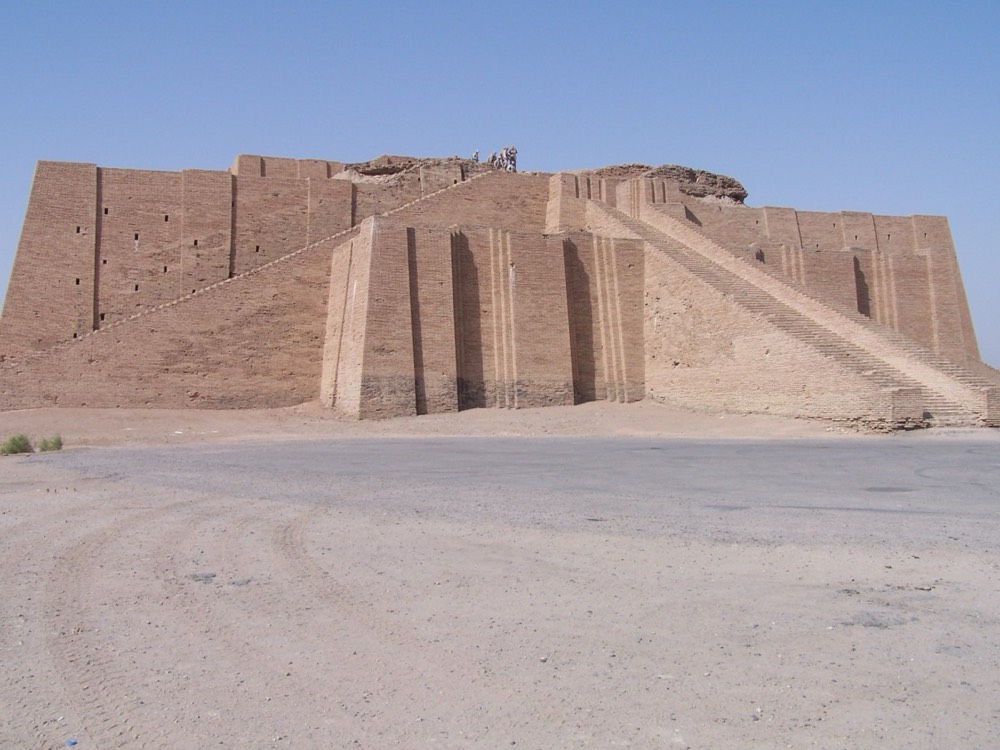
Great Ziggurat of Ur
A stepped mudbrick temple platform built by Ur-Nammu to honor the moon god Nanna, the best preserved of Mesopotamia's great ziggurats.
Photo: Cherie A. Thurlby, US Department of Defense, via Wikimedia Commons
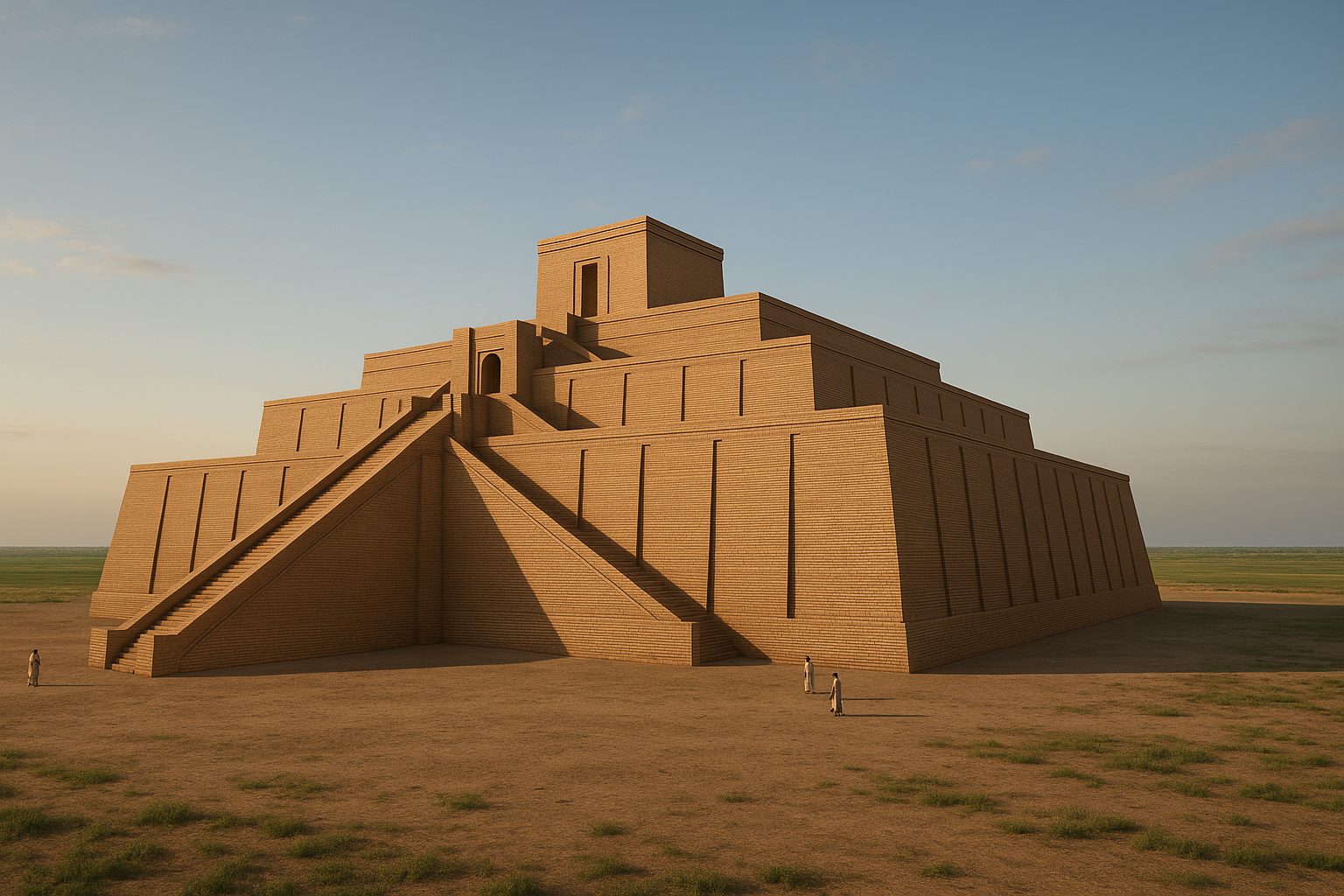
AI reconstruction
Great Ziggurat of Ur - reconstruction
Ur-Nammu's ziggurat as completed: the huge buttressed base terrace of baked brick, two smaller stages above it, and a small shrine of the moon god Nanna at the summit, reached by three converging staircases meeting at a gate-tower. The base and stairs survive and were partly rebuilt in antiquity and in the 1980s; the upper stages and shrine follow the standard excavation-based reconstruction and are inference.
AI reconstruction (2026), based on Great Ziggurat of Ur, photo Cherie A. Thurlby, US Department of Defense, via Wikimedia Commons
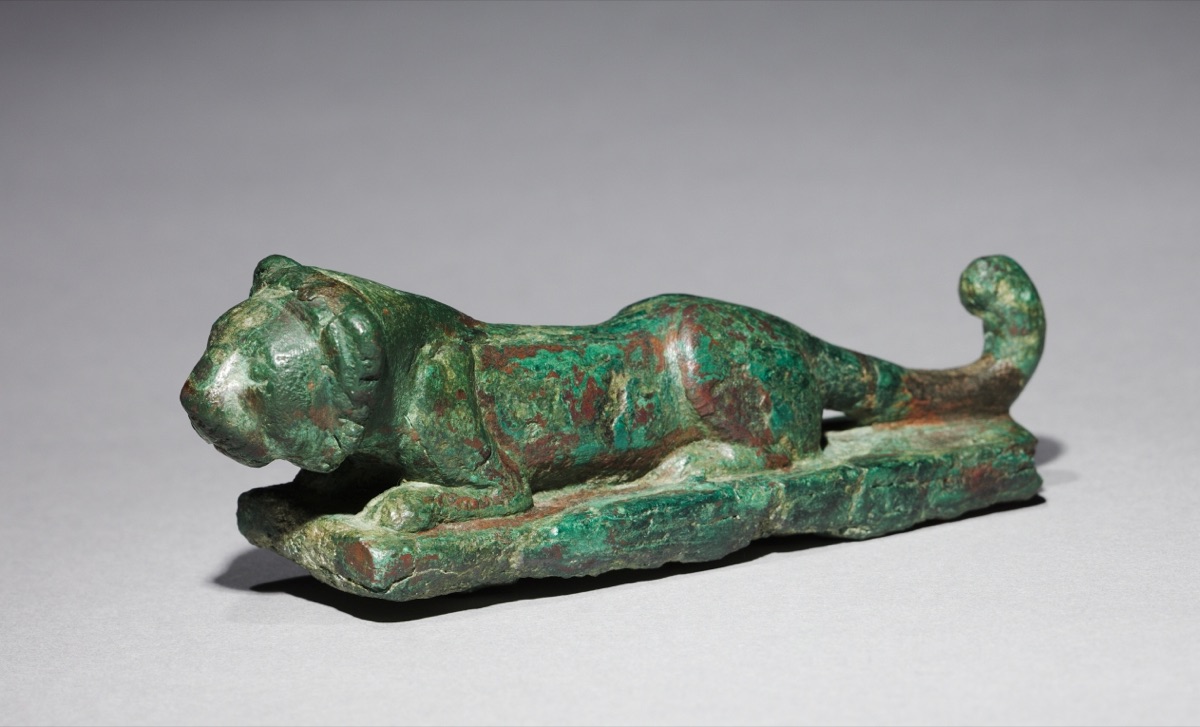
Lioness
A small lost-wax cast copper-alloy lioness from the Neo-Sumerian revival, the animal-form votive tradition continuing under Ur's Third Dynasty kings.
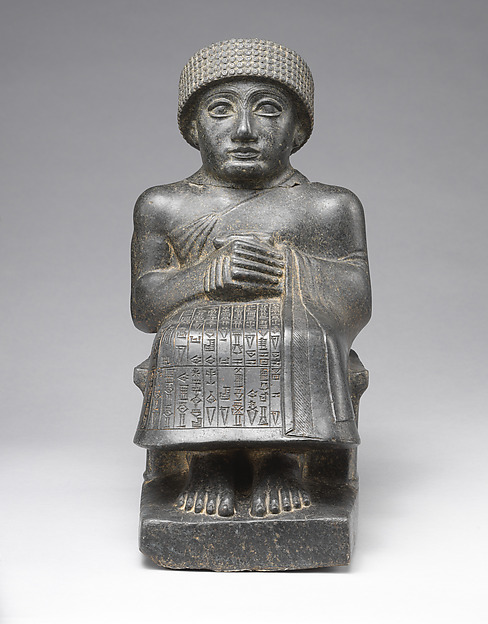
Seated Statue of Gudea
Another diorite portrait of Gudea of Lagash, the imported hard stone itself a display of the trade networks his temple-building projects commanded.
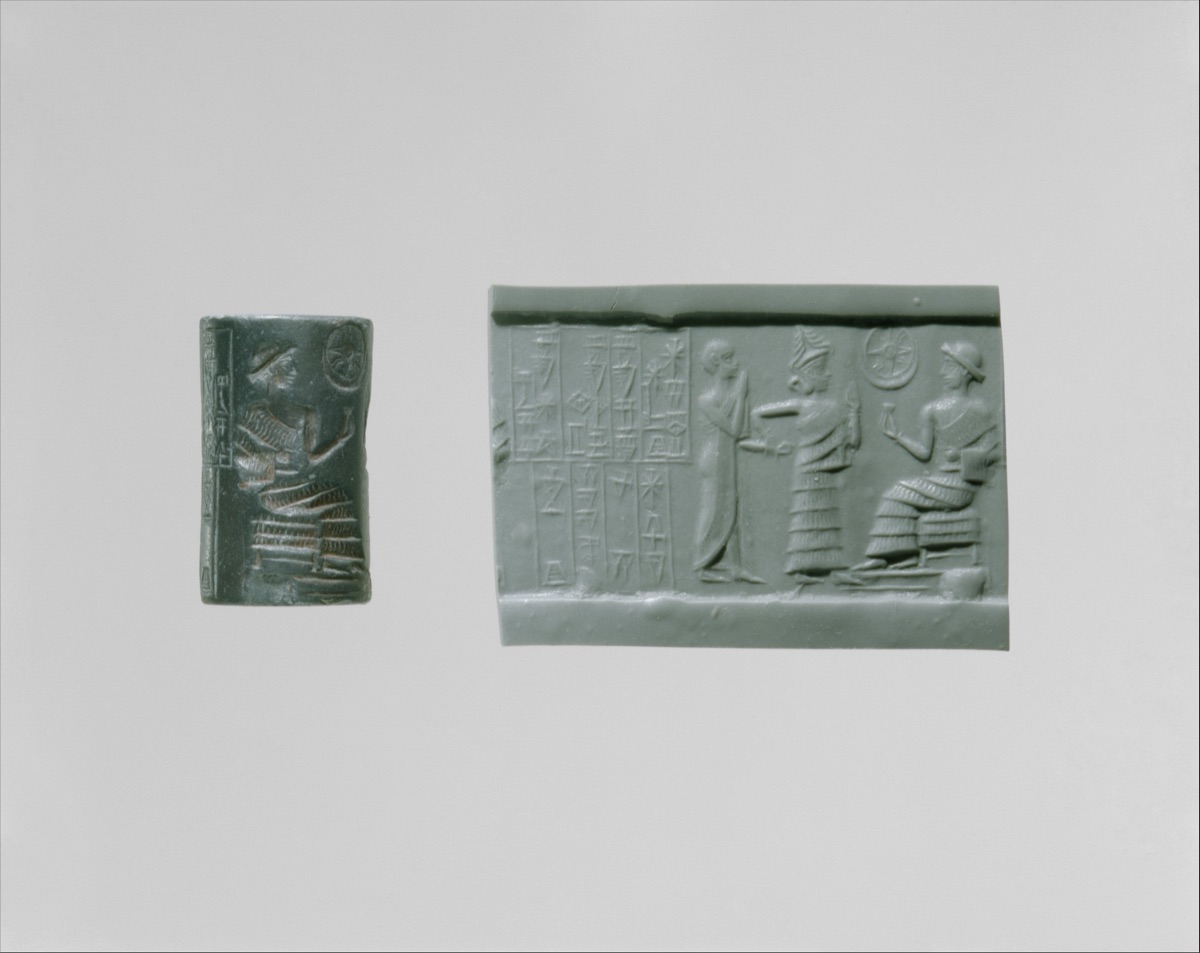
Cylinder Seal with a Goddess
A Ur III cylinder seal showing a worshipper led by an interceding goddess before a seated figure, the standardized presentation scene typical of the dynasty's bureaucratic seals.
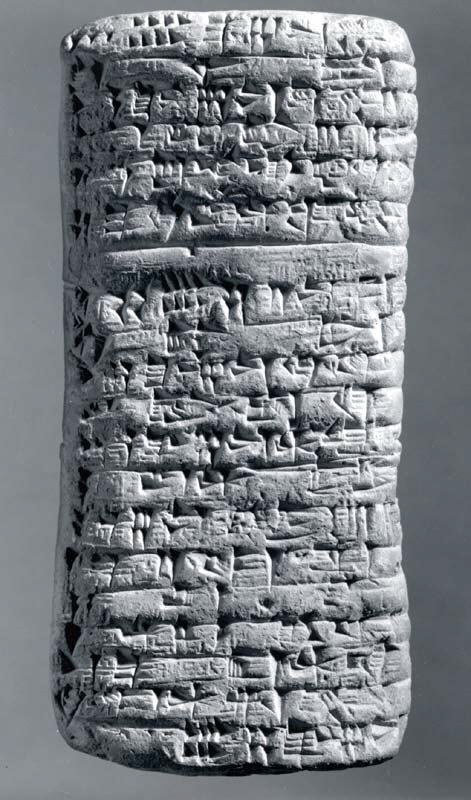
Tablet Recording a Barley Account
A cuneiform tablet from Ur III's dense state bureaucracy, recording barley accounts with the meticulous record-keeping the dynasty was known for.
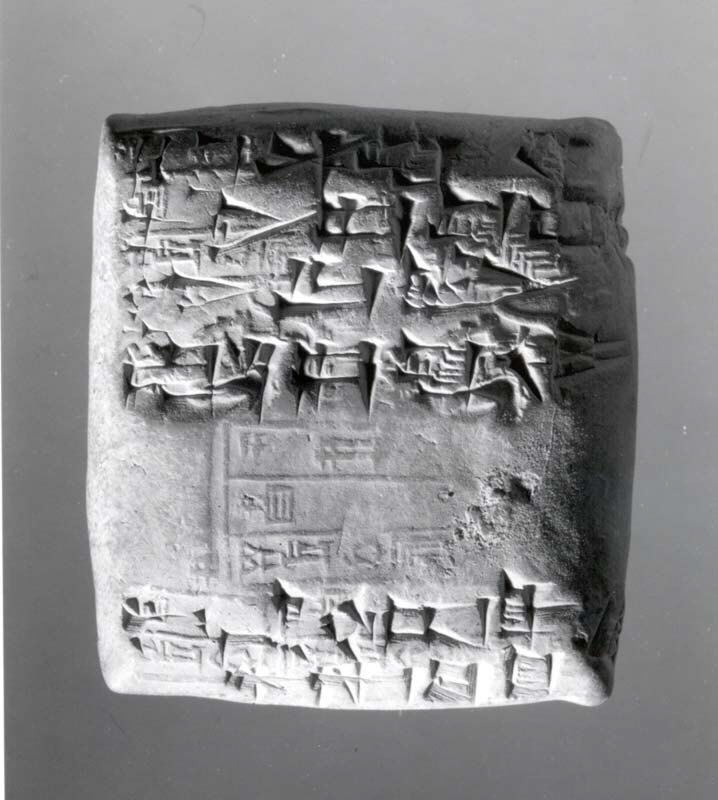
Tablet Recording Irrigation Labor
A cuneiform tablet tracking labor assigned to irrigation work, evidence of the centralized corvee labor that kept Ur III's canal system running.
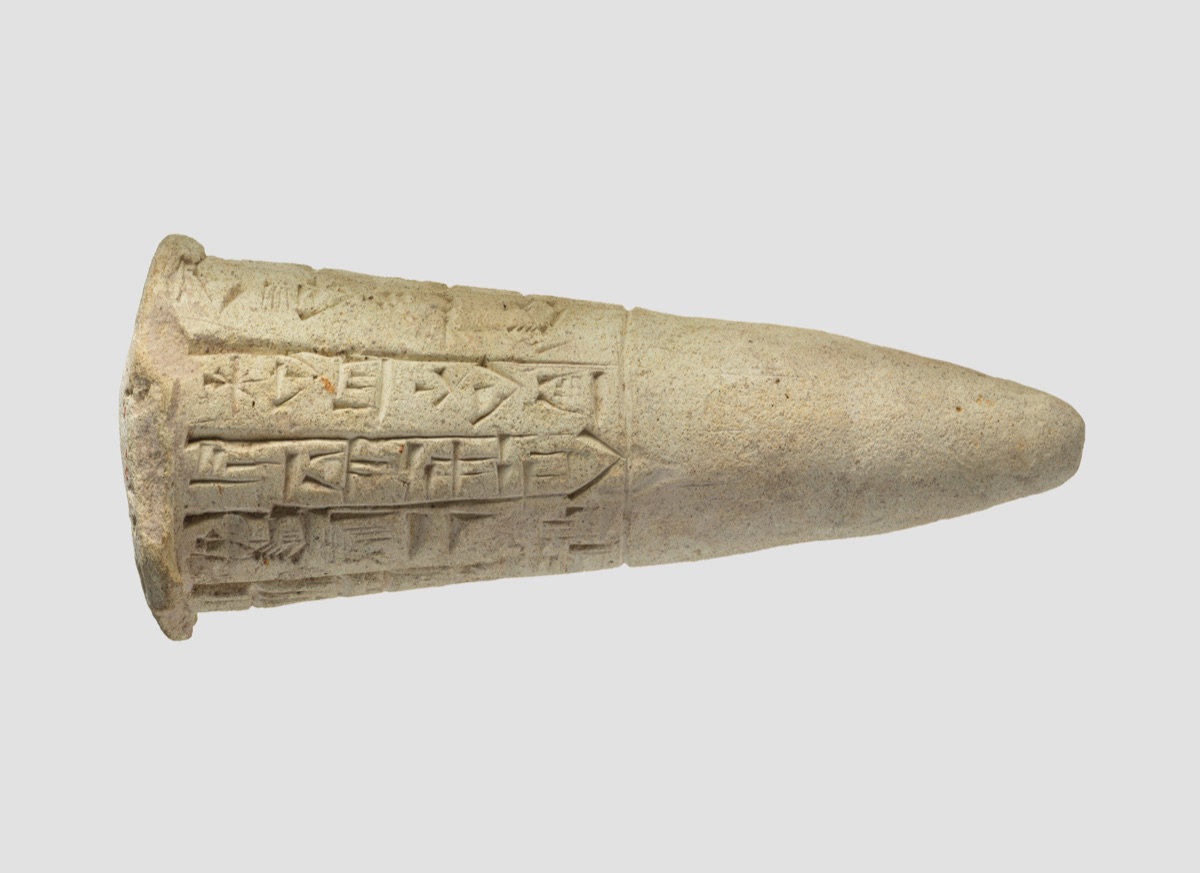
Votive Cone of Gudea
A clay cone inscribed to commemorate Gudea's rebuilding of the Eninnu temple of Ningirsu, driven into the temple's brickwork as a dedicatory record.
New this century
- Sumerian King List
Kingship itself, not any single dynasty, is presented as descending from heaven and moving from city to city, turning political propaganda into one continuous timeline.
- The Curse of Agade
A city can fall not because its king was too weak but because he was too strong, and the gods who once ate at his table will just as readily starve it into ruin.
- Code of Ur-Nammu
Among the earliest surviving law codes, it argues that a king's legitimacy rests on measurable fairness, standardized weights, protected widows and orphans, and monetary compensation for injury rather than physical retaliation.
- Coffin Texts
The afterlife once guaranteed only by royal spells can be claimed by any provincial official wealthy enough to be buried with them, because the same magic that raised a king can raise a nomarch.
- Instruction of Merikare
A king's legitimacy rests on justice, generosity, and calculated self-presentation, not on conquest alone, because the ruled must be persuaded as much as the enemy defeated.
- The Royal Hymns of Shulgi
A king secures his rule not only through armies and canals but by commissioning dozens of hymns that claim for him scribal learning, athletic superhumanity, and divine sonship all at once.